


Robert Jenrick begins his case for the biggest welfare cuts in a generation with a young man he met in Newark. He is 23, lives in his childhood bedroom and suffers from anxiety. He had been working, was signed off sick and eventually received a letter telling him he no longer needed to look for another job. Money began arriving. According to Jenrick, nobody from the state telephoned him again.

The Telegraph@Telegraph“This is not generosity. It is suicidal empathy.” Robert Jenrick articulates that Britain’s welfare system is failing young people, and sets out Reform’s plans for a major overhaul in that department 🔽 telegraph.co.uk/news/2026/08/1…
His mental health became worse. When Jenrick asked whether he had been happier while working, the young man admitted that he had. There is a perfectly reasonable criticism of the welfare system contained in that story. Somebody struggling with their mental health should not simply receive a payment and then disappear from view. If that is what happened, the state failed him.
Jenrick, though, wants the anecdote to do considerably more work. “Work – structure, purpose, the company of others – is precisely what recovery from anxiety requires,” he writes. From one young man whose circumstances we barely know, he arrives at a general theory of illness, employment and welfare.
We do not know what job this man had. We do not know whether the job contributed to his anxiety, what treatment he received, what his employer did to support him or whether there was a realistic route back into the workplace. We do not even know whether he would have been able to return to the same kind of employment. Jenrick supplies none of this because, for his argument, it is unnecessary. The problem is that the young man stopped working and the solution is that he starts again.
Suicidal empathy
This assumption runs through Reform’s new welfare proposals. It also runs through Kemi Badenoch’s attack on Labour in the Telegraph. Both begin with something real. Spending on health and disability benefits has risen sharply. More people are claiming support, including younger people, and there are legitimate questions about whether the existing system is helping people who might be able to return to work.
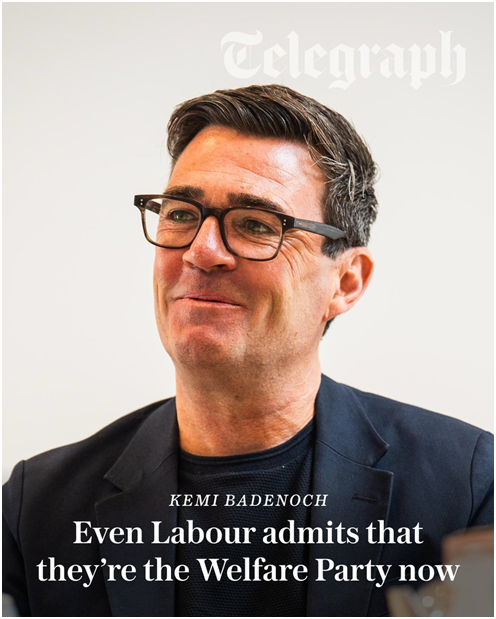
The Telegraph@Telegraph‘Burnham must know that reducing the benefits bill isn’t what Labour MPs got into politics to do. If he wants to do something about welfare, he will need Conservative votes.’ Read leader of the Conservative Party, Kemi Badenoch’s, full piece below ⤵️ telegraph.co.uk/news/2026/08/1…
There is no point pretending otherwise. A welfare system which signs somebody off indefinitely, offers little treatment and makes almost no attempt to reconnect them with work where that is possible is not doing its job. Nor should the left be frightened of asking why health-related claims have increased so much, or whether parts of the present system have become dysfunctional.
The difficulty begins when Jenrick turns that problem into something else. Rising sickness becomes evidence that welfare is itself producing sickness. Employment then becomes the route back to health, and cutting benefits can be presented not as removing support but as an act of compassion.
Jenrick calls the existing arrangement “suicidal empathy”. It is worth stopping over those words because they are not simply an unusually aggressive way of saying that welfare policy has gone wrong. “Suicidal empathy” is also the organising idea of Gad Saad’s recent book Suicidal Empathy: Dying to Be Kind. Saad says he had begun publicly developing the phrase in 2024 and was pleased by the speed with which it subsequently spread. We cannot know from Jenrick’s use of two words whether he has read Saad. Though he probably has. What matters is how closely the argument itself fits.
Saad’s idea is that empathy, ordinarily considered a virtue, can become socially destructive when it overrides harder judgments. He applies this to immigration, criminal justice and culture, but he also applies it explicitly to redistribution and the welfare state. Socialism, welfare and what he calls the “nanny state” all appear as examples of compassion losing contact with reality. In his chapter on welfare, Saad connects support for social programmes with insufficient belief in personal agency and describes progressive politics as being shaped by an “infantile ethos of empathy”
A cut becomes as ‘sign of concern’
”.This is almost exactly the move Jenrick makes with the young man in Newark. Giving him money looks compassionate but has, in Jenrick’s telling, made his life worse. The properly compassionate action therefore becomes the apparently harsher one. Reduce his dependence on benefits and push him towards employment. Compassion has not merely failed. Too much compassion has become the cause of the failure.
Once you accept that premise, the politics of welfare changes quite dramatically. The person proposing a cut no longer has to admit that something painful is being done in pursuit of lower spending. The cut itself becomes evidence of concern. The politician willing to remove support can present himself as the person who cares enough to do what sentimental politicians will not.
Badenoch reaches much the same destination through more openly moral language. Britain’s welfare bill represents a “devastating waste of human potential”, she says, before describing workers watching their money going “straight into the pockets of those who could and should work”. Then comes the image she wants the reader to remember: those who rise early for work becoming resentful of people “whose curtains stay drawn and cars never leave the driveway”.
It is an old argument. The worker gets up. The claimant stays in bed. One contributes while the other consumes, and somewhere between the bedroom curtains and the stationary car the distinction between illness and idleness quietly disappears. Saad does something similar when he repeatedly contrasts those paying what he calls their “hard-earned money” with those benefiting from redistribution. The language differs, but the moral sorting is familiar.
Whose inactivity?
What strikes me is how selective this concern about inactivity always is. Nobody looks at somebody living from a portfolio of investments and asks whether their curtains were still closed at ten in the morning. A landlord collecting rent from six properties can spend Tuesday playing golf without becoming evidence of Britain’s collapsing work ethic. Somebody living from inherited wealth is rarely described as a tragic waste of human potential. Idleness becomes politically dangerous when poor people practise it. If you possess enough capital, not working is freedom. If you possess very little, it becomes dependency.
That takes us beyond the argument over whether Reform can really save £50 billion a year. There is a view of human beings sitting underneath these proposals in which paid employment is not simply the means by which most people obtain an income. It is the mechanism through which we acquire legitimacy. Work gives us structure and purpose. It joins us to society. If we are outside employment, something has gone wrong which public policy should attempt to correct.
There is enough truth in that to make the argument attractive. Good work can matter enormously. A decent job can offer companionship, routine and the satisfaction of doing something useful. Losing work when you want to work can be devastating, and anyone interested in human flourishing should want people who are able to work to have access to decent employment.
But paid employment has no monopoly on structure or usefulness. Somebody caring for an elderly parent is doing something socially necessary. So is somebody raising children or supporting a disabled partner. People volunteer, study, make things and hold communities together. Much of the work necessary for society to function is unpaid and therefore disappears from the economic measures politicians routinely use to tell us who is contributing.
Work does not always provide structure
There are also plenty of jobs which provide very little of what Jenrick promises. Unpredictable hours do not provide much structure. A warehouse where every movement is monitored may provide wages without dignity. A badly managed workplace can produce anxiety rather than cure it, while insecure work can make planning a life almost impossible. When Jenrick writes that work provides structure, purpose and company, the obvious questions are what work, under what conditions and for whom. Those questions disappear because “work” is being used as an abstraction, stripped of wages, hours, management, insecurity and power.
There is another sleight of hand in his argument. Personal Independence Payment is repeatedly pulled into a discussion about people being out of work, even though PIP is not an unemployment benefit. It exists to help meet some of the additional costs associated with disability and long-term illness, and people can receive it while working.
A disabled person who needs additional transport, specialist equipment or assistance does not stop having those costs because they obtain a job. In some cases, the support may make employment easier to sustain. Yet Jenrick moves from the unemployed young man with anxiety to abolishing PIP as though the anecdote has established the case for doing so.
It has not. It tells us that one young man became ill, left his job and became more isolated. That should make us want to know what happened to him. Instead, his life is compressed into an argument about welfare dependency.
Cutting benefits no solution
Under Reform’s proposals, Jenrick writes, “he would not be on benefits”. That is offered as an outcome in itself, when what we actually need to know is whether he would be better. Perhaps he would be. Reform’s proposed Return to Work Cover might keep somebody connected to an employer who has a financial reason to help them return. Better treatment might be available and rehabilitation might begin much earlier. Those possibilities deserve serious consideration.
But being removed from a benefit is not the same as recovering. Somebody can disappear from a claimant count because they found secure work. They can also disappear because eligibility tightened, because they were pushed towards another form of support or because relatives ended up carrying them financially. They might simply become poorer. The administrative result is the same. One fewer claimant. The human result can be entirely different.
That is why Jenrick’s use of the Netherlands needs more scrutiny than it receives in his piece. He points to a large fall in disability benefit applications after employers were given greater responsibility for long-term sickness. What matters is not merely that fewer people claimed disability benefits but what subsequently happened to them. Did they move into sustainable work, did they shift into another part of the welfare system or did the costs simply move elsewhere? A welfare system cannot be judged simply by how efficiently it makes claimants disappear.
The same problem runs through Badenoch’s talk of “incentives”. People who “could and should work”, she says, should not be receiving handouts. Once again the barrier to employment is imagined principally as a problem of motivation, encouraged by a welfare state which has made life outside work too easy.
Deindustrialisation and austerity iskey not motivation
Look at what has vanished from the story. Britain has experienced decades of deindustrialisation. Secure jobs with occupational benefits disappeared from many communities and were replaced by lower-paid service work, agency labour and much weaker protections. NHS waiting lists matter. Access to mental health treatment matters. Housing costs matter. The quality of work matters as well. None of this means individuals have no responsibility for their lives. It does mean that a serious account of rising sickness and economic inactivity has to look at more than the benefit payment arriving at the end of the process.
Jenrick briefly mentions growing up amid the “dislocation and deindustrialisation of the Black Country”. It is an interesting choice of words because deindustrialisation appears in his story only as an explanation for why a safety net matters. It never becomes part of his explanation for why large numbers of people may now struggle to remain connected to work. The factory closes, the secure job disappears, public services are hollowed out and housing becomes more expensive. Work becomes less secure. Eventually politics finds somebody sitting at home and asks why he has failed to make himself economically useful.
There is a still more difficult question which neither Jenrick nor Badenoch really addresses. Some people will never be able to undertake conventional paid employment. Others may be able to work intermittently, or for only a few hours. Some conditions fluctuate and some bodies simply deteriorate. A welfare state worthy of the name cannot treat those people as failed workers awaiting repair. Their claim to dignity cannot depend upon how close they are to returning to the labour market.
That is why Badenoch’s phrase “waste of human potential” bothers me. Potential for what? Earning a wage? Paying tax? Increasing output? Human beings cannot be reduced to unused productive capacity waiting to be returned to circulation. There is useful work that never receives a wage, and there are useful lives that will never fit comfortably inside the labour market.
There is a welfare debate to be had. Reform is right about that much. The rise in health-related claims is real and simply insisting that every existing arrangement must be defended will leave the argument to people such as Jenrick and Badenoch. A system which abandons people to years of illness with little treatment and no meaningful contact is hardly something the left should feel obliged to preserve.
Turning reality upside down
But “suicidal empathy” tells us something about the direction in which that debate is moving. Saad’s argument is that compassion itself can become pathological, particularly when it expresses itself through redistribution and welfare. Jenrick takes us very close to the same place. Welfare has not merely become too expensive or badly administered. By protecting people from the consequences of being outside employment, it is said to have damaged the very people it intended to help.
That is a much larger claim than anything contained in Reform’s £50 billion headline. It turns the welfare state from a protection against misfortune into one of the causes of it. Once that argument takes hold, taking money away can be called compassion and leaving it in place becomes cruelty. I can almost hear Margaret Thatcher uttering that very line.
Jenrick gives us “suicidal empathy”. Badenoch gives us the closed curtains and the car that never moves. Both invite the person going to work to look at somebody who is not and ask why they should have to support them. What they never really ask is why paid employment has become the principal test of whether somebody is making proper use of their life.
Work can matter enormously. It can give people things they genuinely need and, where people want to return to it, the state should do far more to make that possible. But a wage is not a certificate of human worth, and somebody does not become useless when they stop earning one.
As I point out on the original blog this article comes from, the 5 x use of “Britain” is inaccurately used here to give an impression that the UK state has a single “welfare” system that is solely controlled by the UK government at Westminster.
In fact there are important differences in social security and other state benefit systems across the 4 legal jurisdictions of the UK state – England, Cymru-Wales, Scotland and the north of Ireland – and important political differences in the decisions made by the political parties that lead each of these legislatures and governments, particularly between Scotland and England.
There are very few benefits that are exclusive only to all three parts of “Britain” and it is factually wrong to use it as a catch-all to describe that actual extent.
I appreciate the term is often used in quotes from Westminster politicians, but revolutionary ecosocialists shouldn’t just reiterate the narratives of the state mainstream but should challenge them when appropriate.
I also think the creeping use of the US version of the term “welfare” should be refuted. The UK state’s post-1945 implementation of the “welfare state” was a very much wider and integrating political framework, incorporating eg health and education services, housing, clean streets, wellbeing in the workplace and many other public services and regulation. The term “welfare” and particularly “welfare bill” is often used today by right wing politicians in its US sense and to mean state Social Security Benefits and contributions to state pensions – a very much narrower neo-liberal use of the term.