

The CGTP trade union confederation made its first assessment of the strike. ‘The government is completely out of touch with the reality of the country,’ says CGTP leader. Tiago Oliveira.
More than three million workers from north to south of the country joined Thursday’s general strike. An assessment was presented in the early afternoon by the secretary-general of the GGTP, who also responded to Minister Leitão Amaro, who minutes earlier had given a press conference to say that he considered the strike ‘“unimpressive”.
” The government does not understand the response that workers are giving today, it does not want to understand the reasons that are bringing workers to the struggle today,‘ said the CGTP leader, accusing the right wing PSD/CDS government of ’trying to diminish the impact of the general strike, it has its own political agenda. Workers will certainly fight against it, as they are doing today in this general strike.”
With regard to the strike figures, Tiago Oliveira highlighted the strong support of workers in the private sector which is paralysed and operating at minimum capacity. In the public sector and local administration, support ranges from 80% to 100%. In the summary survey presented by Tiago Oliveira to journalists, he reported that fish markets were closed from north to south, the ports of Lisbon, Aveiro and others were shut down, canteens and cafeterias closed, a number of companies in the beverage, food, ceramics, textile, distribution and automotive sectors had participation rates above 80%, as did the social sector and transport, with Faro airport closed and strong support elsewhere.
The National Federation of Public and Social Service Workers’ Unions stated that this ‘was the largest strike in recent years’, with participation levels above 95% in the main sectors of public administration. The conclusion is that the government’s labour package ‘can only have one destination – the dustbin!’, they conclude.
The secretary-general of the UGT also told Rádio Renascença at the end of the morning that participation in the strike could exceed 80%. “I believe this strike will have more impact than in 2013, based on the data we have. People are better informed about the situation and have joined the strike. It is an important day to give a firm response,” said Mário Mourão, not ruling out the possibility of calling a second general strike against this labour package.
Jose Manuel Pureza, the national coordinator of the radical Left Bloc took part in the general strike demonstration in Lisbon, which brought together thousands of people and marched through the streets from Rossio to São Bento.
He reacted to the words of Minister Leitão Amaro, who had said that the strike was ‘ unimpressive’, countering that the Government ‘ridicules itself by talking about weak support for the general strike’.
For José Manuel Pureza, ‘the government is entrenched in a position’ that translates into ‘aggression and mere ideological prejudice’. And if it persists in this position, ‘it is up to those who want to organise themselves to have a decent life to continue to organise themselves to defeat the government’.
‘It is important that today is like this so that tomorrow and the days that follow will be strong,’ continued the Bloco coordinator, also calling for ‘unity to be maintained going forward because that is the only way to defeat the government.’
11 December 2025, taken from Bloco Esquerda web site (translation, editing by Dave Kellaway)
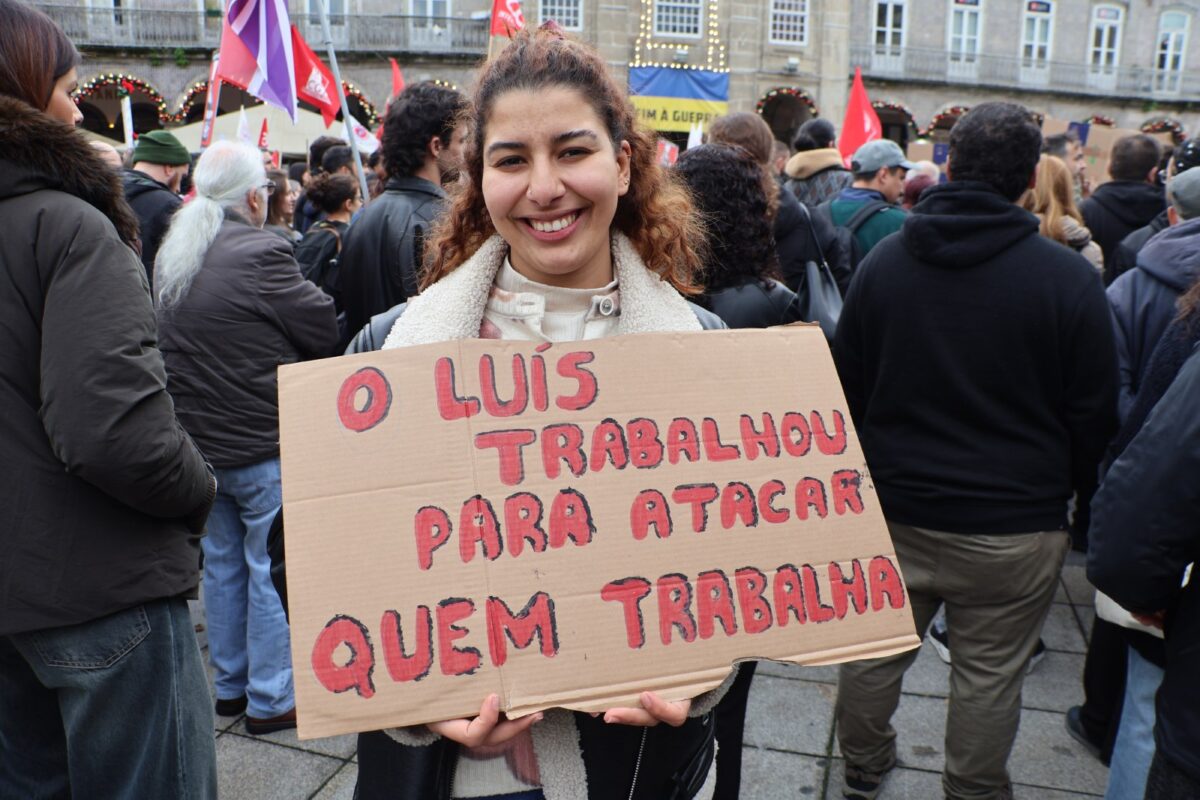
Extracts from an article by A Toupeira Vermelha (Red Mole) in International Viewpoint provide us with a detailed background to the general strike:
The “Draft labour-law reform bill” (the so-called labour package) is a set of more than one hundred regressive amendments to the Portuguese Labour Code presented by the Government of the Social Democratic Party (PSD) and the CDS – People’s Party (CDS-PP) with the support of the Liberal Initiative (IL) and CHEGA, the far-right party.
No rhetoric of “modernity” or the “digital economy” can conceal the true plan. The attacks on labour rights are clear and undeniable. Proposals to extend working hours, normalise precariousness, facilitate dismissals, and attack time for social reproduction (rest, holidays, health, parenting, leisure) unequivocally aim to shift the balance of power in favour of employers. But to achieve this aim, it is also necessary to restrain workers’ organisation, as well as the tools of struggle they mobilise. Thus, the package introduces various measures designed to weaken workers’ collective strength, undermining collective rights, the framework and security of collective agreements, and the very right to strike.
The measure that seeks to broaden the interpretation of minimum service obligations during a strike is a clear attack on the most important instrument of workers’ struggle. The proposal to expand minimum services to more sectors is practically a way of abolishing the right to strike. With this labour package, the strike – the tool that gives force to the fight for dignified and full employment – takes on an appearance of a right, but without material strength.
Normalising precariousness: the return of lives on hold
Several proposals deepen and broaden precariousness, particularly affecting people working on digital platforms.The package also seeks to extend the duration of fixed-term and uncertain-term contracts and to multiply “atypical” arrangements (intermittent work, temporary work, etc.), thus making it harder to obtain a stable employment relationship. These measures aim to ensure a more “efficient” management of labour from the employer’s perspective and to restore the employment contract as a permanent disciplining mechanism..
The way in which this labour package brings back coercive instruments over work is closely linked to measures aimed at hindering workers’ self-organisation. By facilitating dismissals, the measures foreseen in the labour package encourage forced competition among workers, distorting existing forms of solidarity. With the PSD–CDS labour package, it becomes easier for employers to get rid of workers and replace them with outsourcing and impoverished subcontracting. By removing restrictions on hiring external companies after collective dismissals and limiting the possibilities of effective reinstatement after unlawful dismissal, capital is handed tools and legitimacy to exploit labour without restraint.
Eight hours’ labour, eight hours’ recreation, eight hours’ rest
Another attack targets the working time, which is central to workers’ lives and has long been an arena of historic struggle. With the new labour package, we are faced with proposals that aim to extend working hours, directly attacking reproductive time and political participation. Stretching the working week to nearly fifty hours, concentrated in peaks of work when it suits the company, pushes workers into a regime where rest, family life, and health are subordinated to the volatility of business and markets. Furthermore, proposals to reduce overtime pay or to generalise flexible working-time banks empty the very concept of supplementary work. “
It is therefore no surprise that the package also targets rest time. Holidays and pay are undermined, encouraging the commodification of time for social reproduction. Holiday time becomes treated as a privilege rather than a right – a right won by the workers’ movement after 1974 (as a result of the Carnation revolution when fascism was overthrown)
Defend the family do not destroy the time needed to build it
There is also a glaring contradiction in this labour package. A Government that presented itself as “family-friendly”, heir to Pedro Passos Coelho’s discourse on birth-related rights, now promotes attacks on parenting and on work-life balance. They claim to want higher birth rates, yet in practice they make parenting more expensive by increasing, through various reforms, the emotional, physical, and organisational costs of having children. They claim to support work-life balance, yet they reinforce flexible scheduling mechanisms used primarily to serve employers’ interests. They claim to value motherhood and fatherhood, yet they have used these rights as bargaining chips in negotiations.
It is therefore important to expose this contradiction, which also serves as a strategy for the Government in managing negotiations. By putting extremely aggressive proposals on the table, the Government and capitalists know that these will become the focus of negotiations and are prepared to withdraw them to present the final result as a “balanced compromise”, tying workers’ struggle to the negotiating table. But even if many of these measures fall, the essential remains: more working time under capitalist control, widespread precariousness, hollowed-out strike rights, greater expiry of collective bargaining agreement – all meaning less time and availability for personal, family and political life..
The possibility of exchanging holidays for money is, in reality, a response to structurally low wages: those who cannot make ends meet are pushed into giving up rest to fill the gaps. If wages were sufficient, there would be no need to trade rest for income. Through contractual means, the Government is cutting wages outright. If wages are insufficient, it is not because workers have “too much holiday”: it is because employers accumulate more.
The PSD/CDS labour package, besides being a profound attack on wages, time, stability, and workers’ rights, is also a moment of defining the future of work: either we accept that the future is decided in negotiations controlled by the bosses, or we enforce a bottom-up “no”, with collective capacity and organised strength to stop these attacks
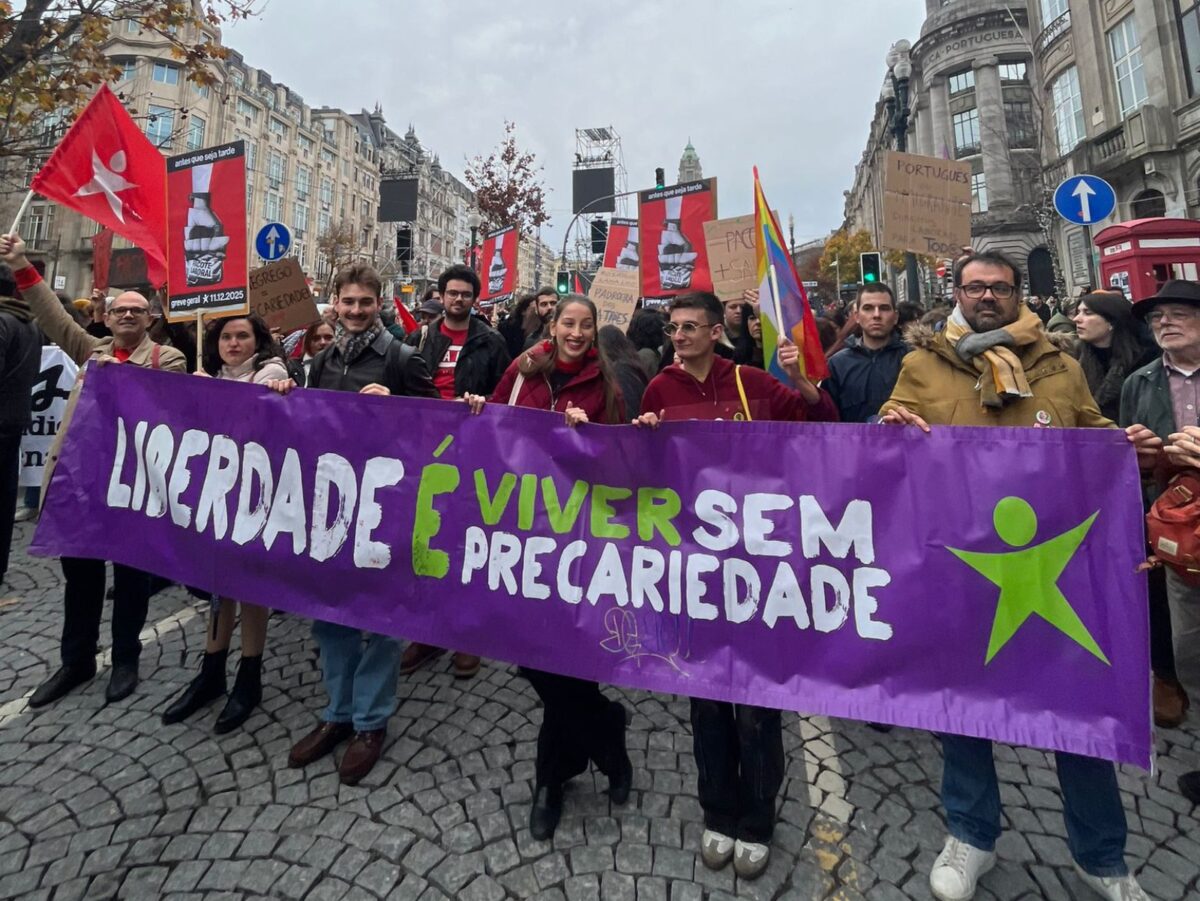
Photos from Bloco website