


On 21 March 2026, the Minister for Women and Equalities presented the updated code of practice prepared by the Equality and Human Rights Commission (EHRC). The code provides guidelines for how service providers and associations must act to comply with the Equality Act 2010, and includes guidance on how to comply with the UK Supreme Court ruling in For Women Scotland v The Scottish Ministers last year on the protected characteristics of sex and gender reassignment. Parliament has 40 days to assess the code, which will be implemented if it is not rejected by that deadline. The code has received ministerial approval and has been supported by Andy Burnham, who is hoping to replace Keir Starmer as Prime Minister. Associated updates to employers are seen in data collection guidelines.
The new code defines ‘sex’ as ‘biological sex’ or the sex of a person at birth, and clarifies that a gender recognition certificate (GRC) does not change a person’s biological sex. The Equality Act includes gender reassignment as one of the protected characteristics under law; the code recognises that many of the guidelines would negatively impact trans people, but states that these would be legitimate exceptions to the requirements of the Equality Act. It lays down procedures for gender inspections that are inherently demeaning and discriminatory. And of course all of this further reinforces discrimination against and erasure of intersex people objecting to the way they have been mutilated to fit the gender binary.
Hierarchy
The code claims to use inclusive language by using the adjective ‘trans’ when referring to trans people, but in defining ‘man’ and ‘woman’ as being based on sex (assigned) at birth, it treats trans women and men as separate categories of gender. This creates a distinct hierarchy between trans people, where cis people are treated as the default and trans people as the other, effectively discriminating on the basis of gender reassignment.
In referring to cis people as simply ‘men’ and ‘women’, and trans people as ‘trans men’ and ‘trans women’, a hierarchical distinction is created between those who are covered by the category of gender reassignment and those who are not. This is in stark contrast to other protected categories, where for example, the code refers ‘non-disabled’ people as the comparators for disabled people, ‘white’ people as comparators for racial discrimination, and ‘heterosexual’ people as comparators for lesbian/gay/bisexual people.
The guidelines of the code are often internally inconsistent, making enforcement a nightmare for both service providers and users. The disproportionately harmful impacts of the code on trans people are treated as irrelevant, effectively creating a hostile environment for trans people. Trans people are effectively treated as a ‘third gender’, implicitly using self-defeating notions of ‘separate but equal’ to justify this discrimination. If/when implemented, the code will likely make it impossibly difficult for trans and non-binary people to exist in public spaces. It will make it an offence for trans folks to use any single-sex facilities entirely, whether those of our assigned sex at birth or our actual sex. And it flags that where no single-sex facilities are provided – such as where all toilets are trans inclusive – a cis-gendered person would be able to bring a discrimination claim.
International attacks
This is not a unique occurrence specific to the UK and US. Similar legislative restrictions against trans and non-binary people have been used to limit queer people’s right to public life and dignity in other countries as well. Javier Milei’s administration in Argentina introduced policies to prohibit access to gender-affirming care to under 18s, while Venezuela has blocked trans citizens from legally changing gender markers on national identity documents. In Peru and Panama laws have been weaponised by state authorities to target, harass and detain trans people. In Colombia, abuse of trans people persists due to lack of enforcement of laws to prevent this.
In India, the Modi government passed the Transgender Persons Act earlier this year overriding the right to self-identification that was established by the judiciary in 2014; trans people will now need their identities approved by officials instead. Similar attempts to target trans people with criminalisation appeared in Türkiye. Leaving trans and non-binary people in a state of administrative limbo is a tactic in a wider global strategy to reduce civil rights and eradicate those who do not conform to the heteronormative standards of gender.
Examples
To take a few examples from the EHRC code:
On competitive sports, §13.73 the code states that trans people should be excluded in single-sex sports of the sex they identify with, making absolutely no exemptions or allowances for changes to physiology and performance that hormone therapy may bring. This basically dismisses all existing scientific data on the matter. [1]
Ironically, it leaves no room for factual data that contradicts this, exposing the lie of gender criticals’ claim to care about either free speech or actual science. §13.82 acknowledges that this may limit trans people participation in sports, but says that this would not be unlawful; it suggests that mixed-sex categories should be considered but does not mandate this despite mandating the exclusion of trans people from such activities. Of course, this does not even scratch the surface of what radical and revolutionary (but nonetheless fair) inclusion in sport could actually look like, whether these be open categories, mixed leagues, and the development of all gender/ability sports.
On the provision of sex-segregated services, in addition to codifying discrimination, the code repeatedly pathologises, targets and stereotypes trans people. The provision of sex-segregated services is conditional on it being based on sex assigned at birth, whether this be toilets, changing rooms, classes, or support services. §13.116 of the code states that in providing single-sex facilities, the provider must consider whether the service is provided due to “male violence against women”, but completely ignores that trans people are disproportionately targets of such violence compared to cis people,[2] including disproportionate violence faced by trans women vis-à-vis cis women.[3] Yet the code in §13.131 suggests that services that are open to cis and trans women would be discriminatory against cis and trans men (of course the code never once uses the term ‘cis’, instead using the phrase “men and trans men”) despite the allowance for single-sex spaces for cis women on account of violence that they experience less than trans women. The code states that appropriate mixed-sex facilities ought to be made available, but by default, particularly on toilets, these are likely to simply be existing (and often inadequate) accessible toilets for disabled people. The code even suggests this as a solution in §13.124, requiring service providers to monitor impact on trans and disabled people.
The code treats trans women as impacted by harassment based on perceived sex (§8.28), but refuses to extend this to discriminatory service provision, and goes on in §13.146 to use the “perceived” sex of trans men to exclude them from single-sex spaces of both their sex assigned at birth and their actual sex. The distress and discomfort of cis people around trans people is given disproportionate allowance through the exclusion of trans people where the discomfort (and actual risk of violence and harm to) trans people is completely ignored.
The code explicitly suggests asking for personal data, such as one’s sex (assigned at birth) to ensure that the correct facilities are being accessed. It contradicts itself by simultaneously suggesting that it is not possible to be sure of sex by appearance alone, and that concern about the sex of a person may be evidenced by appearance, behaviour, or even simply concerns raised by other users. Users may legitimately be banned for failing to provide confirmation of sex. It then once again goes on to contradict itself by stating that there is no official record in the UK that can reliably confirm or deny a person’s sex at birth. Effectively, this forces trans people to both seek to pass, and live entirely in stealth to be able to safely access public services. This is both not accessible to all trans people, and is additionally made even less so by the government’s blanket ban on puberty blockers for trans children. Additionally, it makes it very dangerous for trans and non-binary people (including those who pass) to openly claim to be trans/non-binary, risking being blocked from accessing services and facilities, harassment, and intrusions on privacy for doing so.
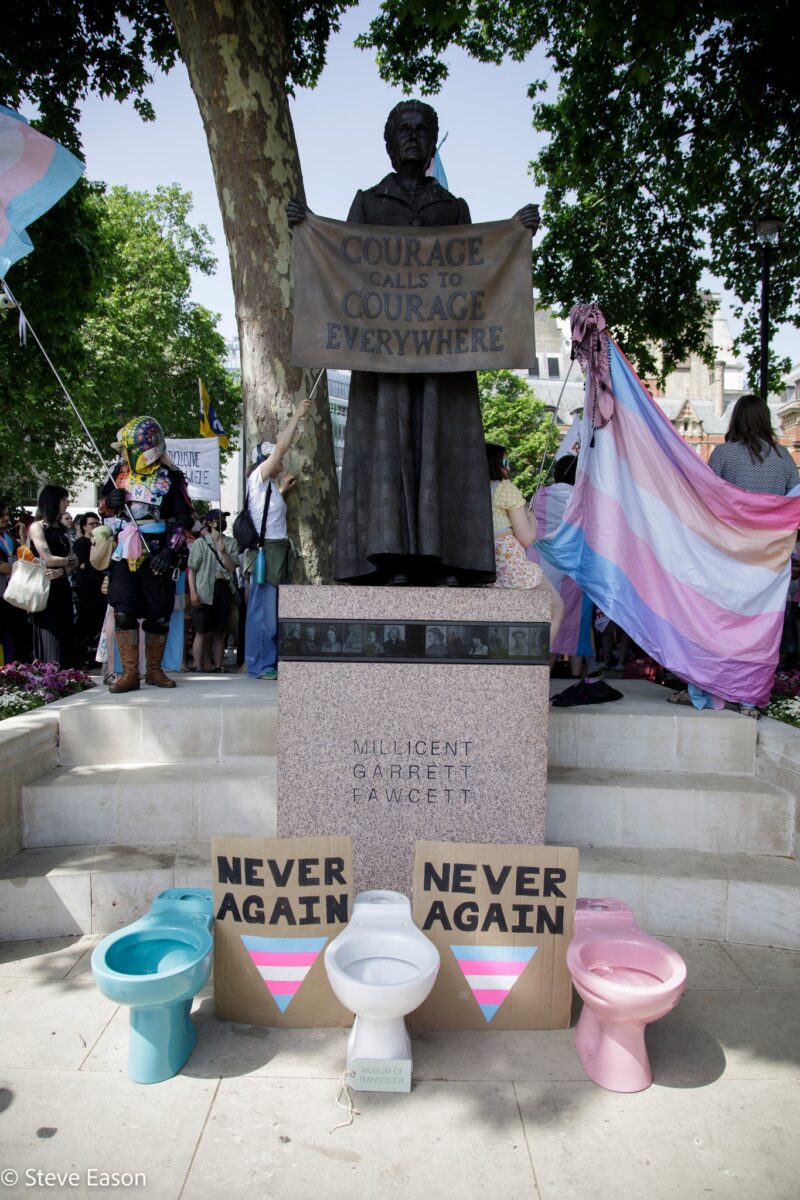
The new EHRC code states that it “does not relate to the employment practices of businesses, charities or voluntary bodies.” This is because employment rights are governed separately, by the Equality Act’s employment provisions and the Health and Safety (Workplace) Regulations 1992.
However, the Supreme Court ruling on the meaning of sex applies across the legislation including the employment provisions. Further, the High Court confirmed in Good Law Project v EHRC that workplace facilities must be operated on a biological sex basis to comply with the Health and Safety Regulations.
Employers have additionally been given updated instructions for data collection on gender statistics, once again with internal contradictions. It recognises that it is a criminal offence to disclose a person’s pre-GRC gender, but this will implicitly be done when employers prohibit trans people from using same-sex facilities. Employees should be invited to update their records, while employers are recommended not to ask for documentation to confirm this. As a side note: cis people will also be impacted by the implementation and enforcement of the code; they might begin to learn that there is simply no way to conclusively ‘prove’ one’s sex to those who do not believe it. This is particularly true of those cis people who are not perceived as conforming to the gender binary.
In effect, the code will have the impact of making it impossible for trans people to be safely in public, be subject to mandated invasive, humiliating and harassing inquiries at every turn.
Malicious compliance
The contradictory nature of the code allows for some forms of malicious compliance by users and service providers. This is not to say that the code can stand (it absolutely should not, nor should the UK Supreme Court decision), but that we may be able to fight it in additional ways if/when implemented. The goal of malicious compliance is to mitigate the harmful impact as much as possible, while sabotaging the implicit goals of transphobes to force trans people out of public spaces. This is particularly relevant to cis people and service providers seeking to support trans liberation.
To start with, cis folks could regularly and ubiquitously make reports to service providers about inadequate mixed-sex facilities, especially when the only available one is also the only accessible toilet, even if you do not actually use/need to use them. Report discomfort at being potentially monitored in single-sex spaces (really, it should make everyone uncomfortable that others may be monitoring one to identify one’s sex/genitals/whatever currently passes for sex in the mind of a transphobe). The goal in this case may be to force providers to convert all public facilities into gender neutral ones that would still be compliant with the requirements of the code.
Service providers are required to monitor impact; use this as much as possible to both claim discomfort at using the sex-segregated facility and to report the woeful lack of accessible spaces for disabled people. Actively seek out and only use services that offer only (or at least enough) mixed-sex/gender neutral facilities; but make sure to indicate to services that do not do so that this is the reason you are avoiding them to actually have an impact. In addition to negative feedback to those primarily providing sex-segregated facilities, actively provide positive feedback to those providing predominantly gender-neutral services, so that they can demonstrate that this is effective in their monitoring.
Ask to update your HR records with your employers, and where possible, use the option to “prefer not to say” what your sex/gender is (this is usually an option in hiring forms, although this may not remain true with the code in effect). Find ways to make compliance with the code either impossible, difficult, and perhaps antithetical to the goals of the transphobes behind it.
Service providers could convert single-sex services and facilities to mixed-sex ones; actively make the effort to prevent, monitor and enforce consequences on all and any forms of harassment, whether to cis or trans people, in the use of these facilities. Actively monitor complaints (perhaps even passively solicit such as feedback) to report back to the government at every available opportunity on the implementation of the code; highlight the ridiculousness of the provisions, their inconsistencies, and impossibility of enforcement.
For service providers who currently have single-sex bathrooms, one suggestion is to follow what many trans-inclusive venues already do: make them gender-neutral facilities with signs to show what kind of facilities are available in each space instead of the gender (eg. “seated toilet cubicles”, “seated toilet cubicles and urinals”, “urinals”, or simply images representing these). This means that anyone can use whichever bathroom they prefer based on actual functionality, but the facility is not sex segregated, while the service provider is additionally spared having to overhaul the entire facility.
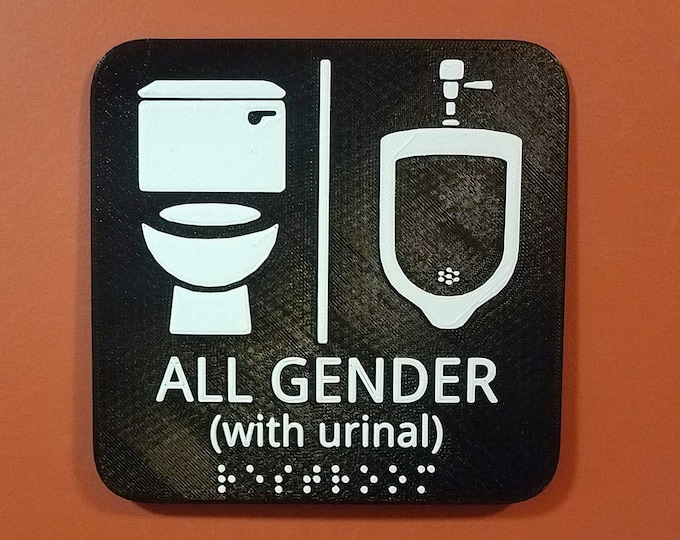
It will actually be better for all of us to move towards harm prevention, support and accountability instead of segregation as a response to lack of safety that oppressed people of all stripes face. In the end, nothing justifies the treatment of trans people as a segregated category.
Taking action
The Good Law Project is currently appealing the EHRC guidelines and have asked for support funding this, in addition to appealing the Supreme Court decision informing it. These will ultimately be the only legal routes of challenging the code. They have also launched a campaign facilitating writing to MPs to protest the code of practice, with the hope of raising objections to the guidelines before the 40-day deadline. TransActual has a whole host of actions that one can take to support positive change for trans people in the UK. They also have a page on trans people’s rights (under review due to the code at the time of publishing this post).
University and College Union (UCU) have issued a strong statement of criticism of the guidelines. Kate Osborne MP and Nadia Whittome MP have also expressed their solidarity.
Protests have already taken place in Manchester and London in the short time since the guidelines were released. ACR took a leading role in organising the London protest which attracted over 200 people in under 12 hours. Trans people were the core of the uplifting London event and the amount of trade union support involved at such short notice on a bank holiday weekend was also impressive. So too was the fact that chants and speeches against attacks on migrants coming from both the current government and from forces to their right were just as popular as those for trans fight backs. Unite the struggles felt like more than a slogan on Saturday: it was a concrete strategy.
More local events in response to these pernicious guidelines will undoubtedly take place in the weeks ahead – as will the highlighting if this issue within already organised events from trade union conferences to pride and trans pride events. Keep a look out and do what you can to support them.
The fight for trans liberation is a global one. Similar restrictive legislation in other countries demonstrates interconnected efforts to restrict the civil rights of trans people that appears to be working. We must take action now to organise ourselves and fight back in our unions, organisations and communities. We must be careful to not put our faith in institutions like the EHRC or Parliament, change must be built from below. Cis allies in particular must actively protect trans and non-binary people, both because our rights are actively being demolished and because we will not be the last group to be targetted. There can be no socialism without trans liberation. When our rights are under attack, we fight back.
Sofia Mendes Sieczkowska, Bruna Caruso Mazzolani, Danilo Reis Coimbra, et al., “Body Composition and Physical Fitness in Transgender versus Cisgender Individuals: A Systematic Review with Meta-Analysis,” Systematic Review, _British Journal of Sports Medicine_ 60, no. 3 (2026): 198–210, https://doi.org/10.1136/bjsports-2025-110239.↩︎
Jacob Evje, Sam Fluit, and Tilmann von Soest, “Transgender People Experience More Discrimination and Violence than Cisgender Lesbian, Gay, or Bisexual People: A Multilevel Analysis across 30 European Countries,” _International Journal of Transgender Health_ 27, no. 2 (2026): 736–50, https://doi.org/10.1080/26895269.2024.2440856.↩︎
Andrew R. Flores, Ilan H. Meyer, Lynn Langton, and Jody L. Herman, “Gender Identity Disparities in Criminal Victimization: National Crime Victimization Survey, 2017–2018,” _American Journal of Public Health_ 111, no. 4 (2021): 726–29, https://doi.org/10.2105/AJPH.2020.306099.↩︎