

Ben Glover in his article, Manchester needs steel, not just Services, in the New Statesman raises some important points about Burnham’s proposals to ‘re-industrialise’ Britain. He is right about one thing, the language Labour uses has changed.
Britain needs to make more things. Almost everyone now agrees on that. Then the real argument begins: what should be built, who should own it, and what kind of economy do we want to create.
Twenty years ago, a piece like his would have been written in the dialect of New Labour. There would have been innovation clusters, creative industries, global cities and highly skilled workers moving easily across borders. This was the knowledge economy. Britain’s future lay in services. Manufacturing belonged to the past, an embarrasing past. The mills, mines and shipyards would be allowed to survive, but as heritage sites, local museums or backdrops for television dramas about communities that no longer existed.
A change in the language
With Burnham’s arrival, the language has changed. Production has returned. So have ten-year plans, national resilience, domestic industry and economic security. Trade unions are calling for reindustrialisation. The Spectator and the Telegraph are already warning of a return to the 1970s. The Treasury is attacked for being too London-centred and too attached to abstract measures of efficiency. The word “industrial” is respectable again, perhaps even fashionable. New Labour is dead. The Labour of planning, production and beer-and-sandwiches politics is back.
This is a real shift. Even its defenders on the Labour right are finding it harder to argue that the old model still works. Glover’s piece, “Burnham’s New Politics of Production”, is part of that change. He presents Andy Burnham as the first Labour leader in decades willing to break openly with the idea that Britain should be a services superpower sustained by a small number of rich cities. The country, in this account, was pulled apart by deindustrialisation. Regional inequality deepened. Places stripped of secure work became fertile ground for the BNP, UKIP, Reform UK and now Restore Britain. Burnham’s promise to reindustrialise Britain is offered as an answer to both economic decay and political disaffection.
There is plenty here that is right. Britain does need to produce more. It cannot remain dependent on imported energy, imported machinery, imported components and foreign-owned infrastructure while imagining itself to be economically sovereign. An economy built around finance, property and low-paid services has not delivered prosperity to the majority of the country. Nor has it provided the security required in a period of war, climate breakdown and renewed competition between states.
But saying Britain should manufacture more is now the easy part. The argument has travelled well beyond the Labour left.
So manufacture what exactly?
Cars? Steel? Semiconductors? Pharmaceuticals? Wind turbines? Batteries? Missiles? Drones? Consumer electronics? Heat pumps? Locomotives? Aircraft? The components that Britain currently imports and would struggle to obtain during a geopolitical crisis?
Choices are necessary
Glover gives us a direction, but not yet a set of clea rchoices.
And these are not interchangeable choices. Each requires different skills, supply chains, energy demands, capital costs and timescales. Reindustrialisation talked about at the level of finished products, cars, steel, semiconductors, skips past the layer underneath them: the tools that make the tools, the skills that take a generation to build and disappear within one. Some industries produce large numbers of skilled jobs like his. Others are highly automated and produce very few. Some can be distributed across the country. Others gather around universities, ports or existing industrial clusters. Some might reduce Britain’s dependence on imports. Others would merely assemble foreign components before the finished goods were sold under a British badge.
Without choices, reindustrialisation becomes another word like Johnson’s levelling up. It sounds serious because it gestures towards a real problem. It remains a slogan because nobody has agreed what it requires.
There is a deeper omission in Glover’s argument. He writes at length about production but says very little about ownership. This matters.
A factory is not simply a collection of machinery and workers. It is also a set of property relations. Someone owns the land, the patents, the equipment and the final product. Someone decides whether profits are reinvested or extracted. Someone decides whether the plant remains open when market conditions change. Someone has the power to relocate production, cut wages or demand subsidies from the government.
End free bungs to capitalist corporations
If Britain attracts foreign-owned factories whose profits flow elsewhere, has the economic model fundamentally changed? There may be more jobs, and those jobs may be valuable. But the strategic decisions still remain outside the country. The state carries the cost of training workers, building roads and providing energy infrastructure. The company retains the right to leave.
We have seen versions of this before. Samsung received public assistance for its Wynyard plant before shifting production to Slovakia. Motorola took nearly £17 million for Bathgate and then closed the factory with the loss of more than 3,000 jobs. Siemens received £18 million for its semiconductor plant on Tyneside before shutting it down. LG was offered a public support package worth about £247 million for its Newport complex, only for one factory never to begin production and the other to close in stages.
Some of the direct grants were later clawed back. But the wider costs were not. The state had prepared the land, supported the infrastructure, trained the workers and carried the economic risk. The companies still retained the final right to close, relocate or abandon production.
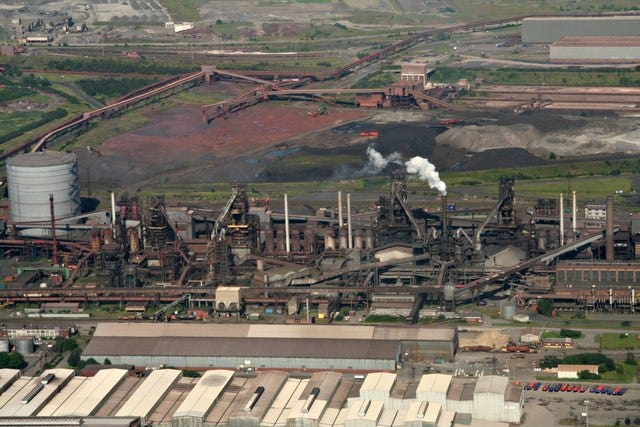
This has long been one of Labour’s blind spots. The party talks about investment, jobs and growth, but becomes evasive when asked who should own productive assets. Public ownership is treated as a special case requiring elaborate justification, as the government’s handling of British Steel under Jingye showed. Private ownership remained the default even after the private owner had failed.
Public control and ownership needed
A serious industrial strategy would have to ask whether the state should take equity stakes in companies it subsidises. It would have to consider public ownership in energy, transport and strategically important manufacturing. It would have to confront the role of pension funds, private equity and overseas investors. It would need institutions capable of holding assets for the long term rather than distributing public money and hoping for the best. That is the difference between industrial policy and corporate welfare.
Glover is too ready to accept a particular account of why people dislike Labour. He writes that many voters see the party as taking money from those who “play by the rules” and handing it to those who do not. It is Farage’s “alarm clock Britain” argument, now increasingly common on parts of the Labour right, which includes Blue Labour. It reduces the political crisis to resentment over welfare and taxation.
There are voters who think this way, and plenty of them. The right and a compliant press have spent decades giving that resentment a target, directing anger about low wages and failing services towards benefit claimants. Look at social media on any day of the week and you will find people attacking those on welfare because they choose to vape or, God forbid, own a television.
But hostility towards Labour cannot be reduced to the belief that benefits are too generous. People are angry about falling living standards, expensive housing, insecure work, broken public services and the sense that politics can belong to people with more money than they have. Immigration is part of that anger, as are distrust, cultural change and resentment towards institutions that appear distant or contemptuous. These feelings overlap. They do not form a single clean explanation.
No trade off between redistribution and industrial support
The danger is that Labour adopts the right’s account of popular discontent and then calls it realism. It starts talking about the deserving and undeserving, the contributors and the dependants, those who work and those who supposedly refuse. It accepts the political categories produced by decades of attacks on welfare, then claims that reindustrialisation will somehow resolve them.
A politics of production should not be built on contempt for those who cannot work or whose wages are too low to live on. Nor should it pretend that social provision is the enemy of economic renewal.
Glover criticises Labour’s turn towards redistribution, arguing that welfare and tax-and-spend policies became substitutes for addressing the structure of the economy. There is some truth in this. Redistribution cannot permanently compensate for an economy organised around low wages, high rents and weak bargaining power. But the conclusion should not be that redistribution was the mistake. The mistake was leaving the underlying structure intact.
The state increased welfare payments because employers paid wages that could not meet housing and living costs. It subsidised landlords because it had stopped building council homes. It used tax credits to support a labour market organised around low pay. The welfare state did not create the productive weakness. It was forced to absorb its consequences.
The choice is not production or redistribution. A serious left government would need both. It would change how wealth is produced, who controls production and how the spoils are shared.
Power is still key
Then there is the question of power.
Britain has weakened or surrendered many of the institutions needed for the reindustrialisation Glover wants. Energy is expensive and largely organised through private markets. Much of the financial system prefers property and short-term returns to patient industrial investment. Pension funds invest abroad. Supply chains are controlled by multinational companies. Skilled workers cannot be produced overnight. Planning rules are slow, but deregulating them does not create engineers, ports, grid connections or affordable electricity.
Trade rules matter. So do subsidy regimes and international agreements. The Treasury still treats public investment as a fiscal risk while allowing the costs of industrial decline to accumulate elsewhere. Local government has been weakened. Regional institutions were abolished and only partially rebuilt. Universities conduct research that is often commercialised abroad because Britain lacks the capital and industrial capacity to develop it at home. This is where the politics begins.
It is easy to say that the government should support manufacturing. It is harder to decide which industries should receive support and which should not. It is harder to tell the Treasury that investment must be sustained for twenty years, including through periods when returns are uncertain. It is harder to demand that private companies receiving public money accept public conditions. It is harder to guarantee trade union rights, domestic supply chains and long-term employment when corporations can threaten to move elsewhere.
What should Britain produce, and who decides? Who owns it, and who bears the risk if it fails? What rights do workers have inside these industries? What happens when a foreign-owned company threatens to leave unless it gets another subsidy.
Re-industrialisation is political
Glover ends by saying that now is the time to turn warm words into action. Quite. But action is not simply spending more money or announcing a new parliamentary research group. It requires decisions about ownership, control and class power.
Attlee and Wilson governed in a world that no longer exists. They had stronger trade unions, greater public ownership, capital controls and more of the institutions needed to direct investment. Even then, private capital retained enormous power and the results were uneven.
Burnham begins from weaker ground. The productive economy has been hollowed out. The labour movement has less power. The financial sector has more. Much of the infrastructure required for industrial renewal is privately owned. The state has lost expertise and capacity through decades of outsourcing.
None of this makes reindustrialisation impossible. It makes it political.
The return of production to Labour’s vocabulary is welcome. The decline of Third Way language about global cities and frictionless services is overdue. But a change in vocabulary is not yet a change in political economy.
Reindustrialisation will mean something only when Labour explains what it intends to build, who will own it and whose interests the new productive settlement is meant to serve.
featured image at top of article is a pointing by Maxmillien Luce The Iron Foundry 1899