


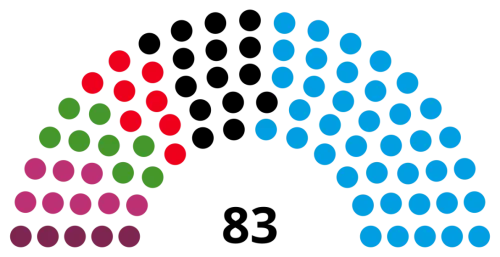
Composition of the Saxony-Anhalt Landtag following the elections (from left to right): BSW: 5 MPs – Die Linke: 8 MPs – Die Grünen: 8 MPs – SPD: 8 MPs – CDU: 15 MPs – AfD: 39 MPs
On 6 September a new Landtag assembly was elected in Saxony-Anhalt. Saxony-Anhalt is the smallest of the territorial Länder (regions) by population, with 2.1 million people. It was clear in advance that there would be considerable changes. At the last Landtag election in 2021 the AfD, which the Saxony-Anhalt domestic intelligence service has classified as confirmed right-wing extremist, took over 20 per cent. In the run-up to this election the standing of the federal government of CDU (centre right) and SPD (centre left) reached a low point, as the opinion polls had indicated. Accordingly the task for all the other parties was at least to prevent an absolute majority for the AfD, in percentages as well as in seats.
When the first projection was published on the evening of 6 September, showing the AfD on 44.2 per cent, the election-night parties of the other parties fell completely silent. The shock the result produced was too great. It looked altogether different at the AfD, which many people call a Nazi party. The party’s leading figures around the [national] co-chairs Alice Weidel and Tino Chrupalla crowded around the lead candidate Ulrich Siegmund to celebrate together what they called their historic election victory.
Centre parties punished
The CDU, the large bourgeois party, was punished terribly above all. It lost more than half of its votes and of its deputies. The liberal FDP did not make it into the Landtag at all and goes on wasting away. For Die Linke (the Left), too, the evening was not a happy one: three weeks before the election it had still been recorded at 13 per cent, and it has now ended up on only 8.4 per cent. The SPD and the Greens, by contrast, were able to improve slightly on their result at the last Landtag election, reaching 9.1 and 8.9 per cent respectively, a little more than Die Linke.
The decisive factor was a massive campaign by influential civil-society organisations which had called for tactical voting, so as to ensure that the SPD and the Greens got back into the Landtag at all. That had been in the balance for a long time. It was certainly a surprise that the BSW party (Sahra Wagenknecht Alliance, a split from Die Linke) also entered the Landtag, which it managed with 5.3 per cent.
In the new Landtag, made up of deputies from six parties, forming a new Land government will not be easy. Since the AfD with 39 of 83 seats did not obtain an absolute majority of the seats, it depends on coalition partners or on support from others. All the other parties have refused to form a government with the AfD. The BSW too rejects a coalition with the AfD. Instead, according to the BSW, an independent minister-president should be elected, who would put a government together and would have to win a majority every time. This model existed in the Netherlands as well, at the election before last, when the party of the racist Geert Wilders narrowly missed an absolute majority and nobody wanted him as prime minister. It remains to be seen whether the AfD will agree to it. The SPD and the Greens have already declared themselves in favour.

Afd campaign poster: Time for our culture….time for Germany
Disappointment for Die Linke
For Die Linke this election result was a disappointment. It lost 2.4 per cent compared to the last Landtag election. The party certainly did not have an easy campaign, since it has a good base only in the cities and its results in the countryside are traditionally poor. That showed again at this election. In the two large cities of Halle and Magdeburg it was able to win three direct mandates. All 38 other constituencies went to the AfD.
Die Linke has to become clearer and more radical. Many people simply assign it to a red-green camp together with the SPD and the Greens, which the “vote tactically” campaign also showed. It has to become clear that Die Linke stands for clear opposition to the status quo, that its representatives are not “politicians” like all the others, that it wants to overcome capitalist class society, and that this will not be achieved in parliament alone. However good its parliamentary demands may be, and however much such measures would noticeably improve people’s lives if they could be implemented, there will be no majorities for them in parliaments.
What is needed is a party that is both represented in parliament and that is able to change the social balance of forces through pressure on the streets, through embeding itself in workplaces and neighbourhoods, and through fostering the self-confidence and self-organisation of the working class.
9 September 2026
Featured image above is a mass protest against the Afd in Germany
First posted in International Viewpoint
Translated by International Viewpoint from SoZ.