

Volunteers scan the countryside around the villages throughout the night, taking turns on guard duty. Any rustling sound, even the slightest movement, is monitored and reported to sentries at other key locations and to the other villages via dedicated WhatsApp chat groups. Most of them are young people, often teenagers. They are unarmed; they hold only torches in their hands to provide light and send signals. In some areas, they have stockpiled stones ready to throw at Israeli settlers intent on carrying out raids on their villages. They have also hidden a few sticks. ‘For self-defence, because the aim of this system is simply to deter the settlers from attacking our homes through a massive presence of people on the streets,’ explains N.A., a journalist from Ramallah. He is following the development of the coordination among the Palestinian popular committees that have been revived to protect villages and communities under attack.
Popular self-defence committees against pogroms
“The organisation of the committees is improving day by day, as is the determination of our people,” he adds. “We don’t always manage to stop them, but the mobilisation of so many people has already had a deterrent effect, at least in the larger towns and to a lesser extent in the small, isolated villages, which are more difficult to safeguard.”
Following the Hamas attack on 7 October 2023 in southern Israel, settlers in the West Bank initially launched punitive raids against the Palestinian population, before implementing a strategy of displacement and land occupation. Dozens of small communities have been forced to flee under threat from gangs of armed settlers. Since the start of 2026, over 3,200 Palestinians have had to leave their homes due to a combination of violence and demolitions, reports OCHA (UN). In 2026, it adds, there was an average of six attacks per day resulting in deaths, injuries and damage to Palestinian property.
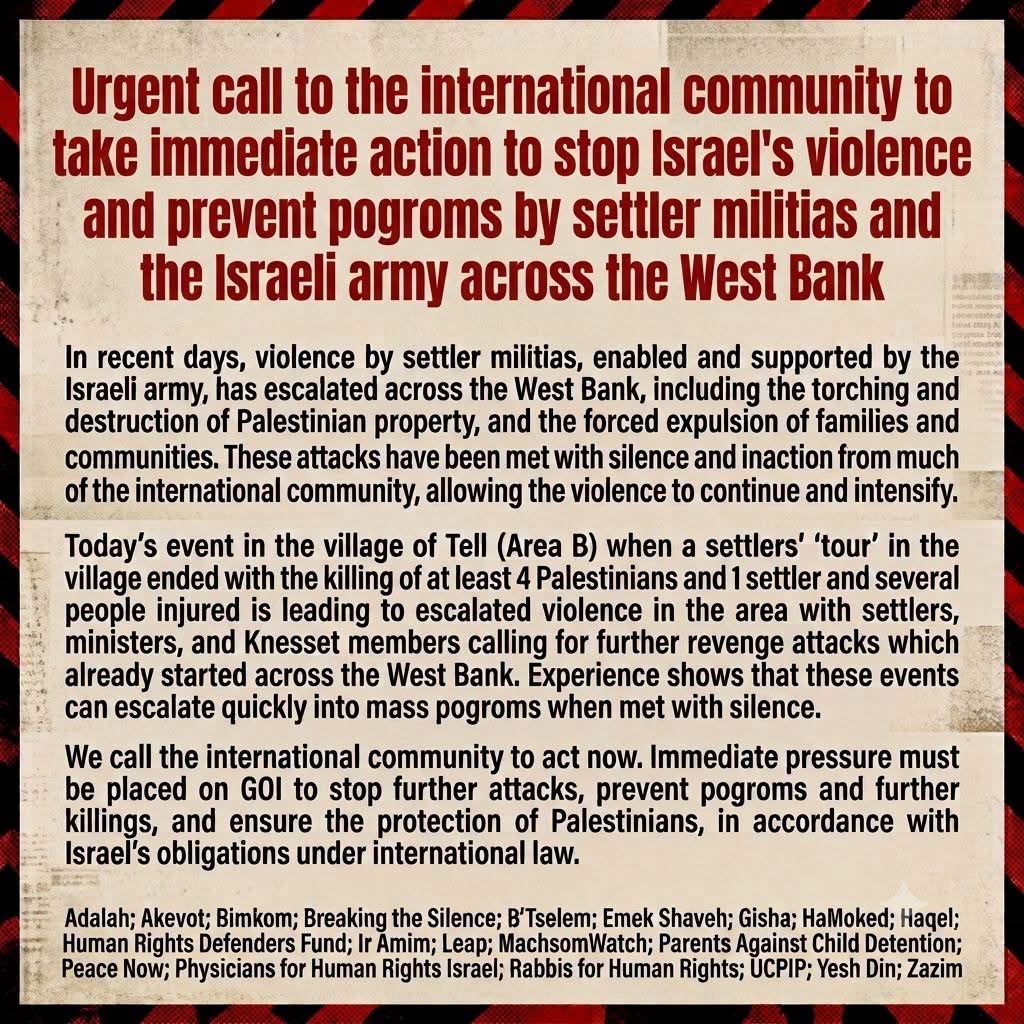
Following the clashes last Friday in Tell (Nablus) – which were followed by a shootout in which four Palestinians, one settler and one Israeli soldier were killed – punitive raids were launched from the settlements, resulting in the burning of homes, mosques, farmland and cars in various Palestinian villages. The Israeli army has done very little to stop the settlers. On the contrary, it has confined Palestinians to their own communities and launched sweeping raids, resulting in dozens of arrests.
Government and IDF back the settlers
‘Organising our self-defence was a natural, inevitable response, because we have been left to fend for ourselves. We are facing settlers backed by their government who are becoming increasingly violent and overbearing. We must protect our citizens,” said Bahaa Fuqaha, deputy mayor of Sinjil, east of Ramallah – one of the Palestinian villages most frequently targeted in that area, along with al-Mughayyir, Turmus Ayya, Deir Jarir, Abu Falah, Jiljilya and Taybeh – in an interview with *il manifesto*.
“For a long time, we have kept calling the police and the army to stop the settlers’ raids. It’s no use. Usually the soldiers don’t turn up, and if they do intervene, they do so to help the perpetrators rather than the victims of the violence,” Fuqaha denounces. Sinjil, surrounded by a high fence and barbed wire erected by the Israeli armed forces – its young people have been accused of throwing stones at settlers’ cars – is under pressure from six settler outposts. “Since they built the fence,” Fuqaha points out, “Sinjil has lost access to hundreds of hectares of farmland and twenty families no longer have a home.”
Walid, a volunteer with the self-defence committee, who asked us not to reveal his real name, explains the steps taken in the event of a settler incursion. “When we’re certain they’re on their way, we raise the alarm at all the watchpoints,” he says. “Immediately, via WhatsApp, we issue the mobilisation order – also using the mosque loudspeakers – and alert the neighbouring villages. Then we take to the streets by the hundreds. The sight of so many people deters the settlers, preventing them from advancing.’ Sometimes it works, but often it doesn’t, Walid points out. ‘But it’s not like it used to be,’ he adds emphatically. ‘We’ve suffered for too long.
Social Organisation develops
The fear is gone; now is the time to defend ourselves.’ The popular self-defence committees also collect donations for families who have lost their homes, cars and crops set alight, and for those from whom the settlers have stolen sheep and other animals. The same is happening in other villages in the districts of Nablus and Ramallah and south of Hebron, in the Masafer Yatta area – regions with a high concentration of right-wing extremists. In Silwad, when danger approaches, the alarm siren sounds.
Elderly people, women and children are moved to safer homes, whilst young people gather at the village entrance to hold back the attackers. Jihad Ramadan, an activist from Tell – the scene of Friday’s shooting – confirms that fear has given way to organised popular defence. ‘The army only intervenes when it thinks the settlers are in danger. So we have organised ourselves to defend our lives, without any further fear,’ he said in an interview with a local TV station.
A third intifada?
What the escalation sought and desired by the settlers will lead to is the question on everyone’s lips. In the background lies the possibility of a mass uprising by Palestinians under occupation. But those who are currently speaking most about a Third Intifada smouldering beneath the ashes are not the Palestinians, but rather current and former Israeli security officials, who believe that the West Bank is rapidly approaching a breaking point and that the current government is creating the conditions for an uncontrollable clash. Israel’s Shin Bet warns that Palestinian self-defence committees could become ‘models of resistance’.
For the analyst Ghassan Khatib, however, the return to the fore of the popular committees – which sprang up spontaneously during the first Intifada (1987–1993) – is significant above all from a social perspective, as it responds to the needs expressed by millions of Palestinians under threat. ‘Settler terrorism has triggered a reaction: our people are uniting,’ he says.
ACR translation from the Italian. See original at Il Manifesto
July 25 statement from Na’amod – British Jewish organisation
British Jews say: THE TIME FOR ACTION ON THE WEST BANK IS NOW
Since Andy Burnham entered Downing Street, Na’amod has demanded he end Israeli impunity and act for Palestinian freedom.
Settler violence is now surging across the West Bank with the backing of the Israeli army. The need for action could not be more urgent.
On Friday, armed settlers raided Tell, a Palestinian village in the West Bank. Israeli soldiers then shot dead at least four Palestinians, all from one family. Two Israelis, one soldier and one settler, were also killed.
Now settlers, ministers and Knesset members are calling for revenge. The reprisals have already begun across the West Bank. Left unchallenged, this could become a wave of pogroms.
If Burnham means what he says, he must act now to stop further attacks and killings.
We reiterate our demands to him:
• Ban all trade in goods and services with the settlements
• Enact and enforce meaningful sanctions