

This is a fact of our lives under capitalism. We have no means to sustain ourselves except for selling our labour to someone in exchange for wages.
Capitalists would like you to believe that this is normal, it is natural. This is not true. They created this system by enclosing the lands, forcing peasants into towns and cities where they had no choice but to work for some boss.
Workers are exploited under capitalism because we make value for the bosses in the shape of commodities or services and then these are sold for money on the market. The difference between our wages and the value of what we make is surplus value – this is where profit comes from.
Imagine you are a boss – horrible I know! – how will you increase surplus value from your workers? Here are some options:
- Increase length of working day
- Speed up production
- Reduce wages
So the struggle between the capitalist who wants to create more surplus value and the worker who is exploited is a real one and it happens globally in every workplace.
The capitalist is in competition with other capitalists. They recruit workers to fight in their economic war for domination.
To make maximum profit the bosses try to push our wages down to the level of subsistence as much as possible. Subsistence does not necessarily mean ‘poverty’ though it can for many workers. Marx said that subsistence was also itself a product “of history and depends, therefore, to a great extent on the level of civilization attained by a country, in particular they depend on the conditions in which, and consequently on the habits and expectations with which, the class of free workers has been formed.”
Subsistence must also include the means necessary for the recreation of the labourer, the raising and training of children.
Sometimes in competition they drive wages down so low, or make you work such long hours that they wear out the working class, they begin to erode the basis of social reproduction. This happened in the early days of capitalist development, under dictatorships as well, in ‘developing countries’ where capitalism is forcing people into sweatshops to make our clothes or smart phones.
People were so overworked at the Foxconn factory in China they were throwing themselves from the roof of the factory. Foxconn’s response?Not improved their working conditions, not increased their wages or reduced their working day. They installed netting. Other workers swallowed poisons – the bosses responded by forcing workers to sign a contract absolving them of legal responsibility for suicide attempts.
Unemployment
Being in work is often alienating and miserable. But what about those who need to work but cannot.
Because capitalism is a system of competition and unplanned chaotic production for the market it cannot include every working class person in meaningful work. This is why a section of the working class is unemployed, they cannot work.
Then there are other working class people locked out of the labour market – or segregated into the most exploitative part of it – because that is in the interests of the bosses. Many disabled people are excluded from work because their employers refuse to adapt their physical environment or their working practices in ways which mean that the potential worker’s impairment(s) would not exclude them from that role. Many parents, particularly mothers, are confined to jobs where the hours (and weeks) worked match the (extremely expensive) childcare they have access to. And suprise suprise most of these jobs are very poorly paid. Black people are also often segregated within the labour market as too are to an even greater extent those who don’t have the right to work – and in the case of many migrants, to appear publicly at all.
These and other similar factors are useful to the ruling class. There is a direct economic benefit to those who can employ people extremely cheaply. But there are dynamics beyond that too.
Economically a large super exploited segment makes it more possible to drive down wages overall or step up the rate of exploitation through mechanisms such as compulsory overtime. And there is a political benefit in that a working class divided on the basis of gender for example is less likely to put up a united fight for better wages or safer working conditions.
There is a debate amongst Marxists over what is called the labour aristocracy, not that some workers have crowns on their heads but that in imperialist nations like Britain, France, USA, Germany and so on, that the huge amounts of wealth transferred from the global south to those nations creates a better off section of workers, higher wages and better living standards. But this is not only a descriptive phenomena – equally key to this theory is the idea that these workers form the bedrock of reformist and anti revolutionary politics within the working class.. This idea was first written about by anarchist Bakunin and by Engels and was later elaborated by Lenin,
Now some Marxists totally reject this, and I won’t go into the debate now but I want you to be aware of it because it is something that is still debated today because it matters what you think working class ‘spontaneous’ consciousness can reach.
Two important points – we do not blame people for being “lazy” if they are unemployed, we blame the capitalist system for discarding people and leaving them alienated, in poverty and desperate.
The second point is the working class is not just those with jobs. Unemployed people are also part of the working class.
But the unemployed are used by the bosses as a ‘reserve army of labour’ – to frighten workers into obediency. “If you don’t like it there are 10 other workers to take your job!”
But the working class movement is not afraid. Workers are not objects of pity. Working class people are subjects of action! This is why they have combined and formed trade unions from the earliest days of capitalism.
Engels described Trade Unions in The Condition of the Working Class in England “as schools of war” Strikes he referred to as “the military school of the working men”
Capital is a powerful social and economic force that also enjoys political power. All workers have is each other, and the political organisations and institutions of struggle that we can build.
Trade unions
This is why workers in the early 19th century came together in their trades to create organisations to demand higher wages, better working conditions. It is a life and death struggle for a good life on the Earth. And the revolutionaries are the ones that want the best life for everyone.
Lenin described the power of trade unions and strikes “When the workers refuse to work, the entire machine threatens to stop. Every strike reminds the capitalists that it is the workers and not they who are the real masters—the workers who are more and more loudly proclaiming their rights. Every strike reminds the workers that their position is not hopeless, that they are not alone”. As one Prussian minister famously said once “behind every strike lurks the hydra [monster] of revolution.
As novelist John Steinbeck said “A Red is a person who asks for 30 cent an hour when the boss offers 25”.
The unions usually fight for more pay, shorter working hours or dignity at work, to remove bullying managers for instance. The big fight in the 19th century was for the 8 hour day, now it is for the 4 day week.
Trade Unions in essence, because they recognise that in work there is a contradiction, an antagonism, between the boss and the workers, in their solidarity, are the beginning of class consciousness.
Some trade unions started off as what we call craft unions, skilled workers that united to defend their industries from low wages but also sometimes from ‘deskilling’ by younger workers, or women workers. But as capitalism developed more ‘industrial unions’ developed, unions that represented all workers in a particular sector and they fought to overcome sectionalism between workers.
There is a constant battle between the trade unions and the bosses. But also trade unions can clash with the state, particularly if you have a militant strike, a picket line, an occupation of a workplace, the police will come and fight you.
This is why being disciplined is so important. If trade union members vote for a strike then we expect all workers to respect that vote and to not cross the picket line and not work – this undermines the democratic decision and the strike. People who do this are called scabs – they put their own selfish interests before the interests of their workmates or the wider class.
A number of countries have legislation limiting the power of trade unions, in the UK there are laws against political strike action, against solidarity action with other workers and so on.
Class struggle in the unions
But the trade unions can have their own limitations.
What do socialists ultimately fight for – higher wages or abolishing money and commodification? yes higher wages for now but we try to connect the immediate struggles with the struggles for overthrowing capitalism.
Trade Unions – for the most part – are only there to reform capitalism, to fight for a better share of the profits, not to abolish profits.
Marx said
“Trade unions work well as centres of resistance against the encroachments of capital. They fail partially from an injudicious use of their power [poor strategy]. They fail generally from limiting themselves to a guerrilla war against the effect of the existing system, instead of simultaneously trying to change it, instead of using their organised forces as a lever for the final emancipation of the working class, that is to say the ultimate abolition of the wages system”
Rosa Luxemburg said in Reform and Revolution that “the objective conditions of capitalist society transform the economic functions of the trade unions into a sort of labour of Sisyphus, which is, nevertheless, indispensable.”
Trade union leaders have as their slogan “a fair day’s work for a fair day’s pay” But Marx argues in Capital that there is no fair day’s pay under capitalism because our work is exploited and we are never paid the full value of what we make or do.
The other issue with trade unions is that as they grow and get organised they also form bureaucracies – castes of full timers, officials, lawyers, accountants, and so on that begin to form a conservative pull on the union.
As trade unions fought for legality and won, it tended towards them becoming more incorporated into capitalist political relations.
The goal of the union officials was to mediate, to negotiate, to facilitate, not to fight, struggle and overthrow.
There emerged a class struggle within the unions, between the socialist left and the reformist right, who were often connected to social democratic parties.
In times of war for instance, right wing trade union leaders have often ended up supporting the wars.
Today in many countries there is a fight within the unions over climate policy, between “fossil jobs first” or “just transition”.

A useful quote from the Transitional Programme by Leon Trotsky outlines the revolutionary perspective on trade unions
“As organizations expressive of the top layers of the proletariat, trade unions, as witnessed by all past historical experience…. developed powerful tendencies toward compromise with the bourgeois-democratic regime. In periods of acute class struggle, the leading bodies of the trade unions aim to become masters of the mass movement in order to render it harmless. This is already occurring during the period of simple strikes, especially in the case of the mass sit-down strikes which shake the principle of bourgeois property. In time of war or revolution, when the bourgeoisie is plunged into exceptional difficulties, trade union leaders usually become bourgeois ministers.
Therefore, the sections of the Fourth International should always strive not only to renew the top leadership of the trade unions, boldly and resolutely in critical moments advancing new militant leaders in place of routine functionaries and careerists, but also to create in all possible instances independent militant organizations corresponding more closely to the tasks of mass struggle against bourgeois society; and, if necessary, not flinching even in the face of a direct break with the conservative apparatus of the trade unions. If it be criminal to turn one’s back on mass organizations for the sake of fostering sectarian factions, it is no less so passively to tolerate subordination of the revolutionary mass movement to the control of openly reactionary or disguised conservative (“progressive”) bureaucratic cliques. Trade unions are not ends in themselves; they are but means along the road to proletarian revolution”
Sectional or class struggles?
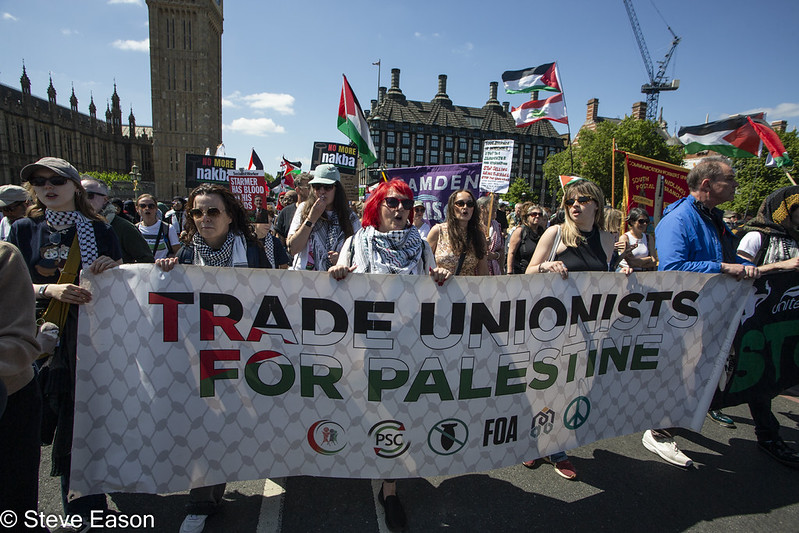
There is also a battle over the role of trade unions – do they just fight for their own members, or do we need class organisations that fight for the class in general. Most trade unions most of the only focus on sectional disputes, their own narrow economic concerns. A strike of workers is important and a fight by working people for a better life under capitalism, but the class struggle is when these demands take on a more generalised and political character.
A union fighting for its members wages to increase versus a united fight by unions and other workers, youth and the unemployed for higher minimum wage for instance.
In Britain now there are attacks on trans people and there is a fight in the trade unions to get them to stand in solidarity and these fights matter because if the 6 million workers in trade unions in Britain can organise and agree to break the anti trans laws being established that is hugely powerful. The fight that goes on in the unions matters – as it did 120 years ago about winning unions to fight for women to have the vote, or join the Civil Rights movement in the USA .
Conclusions
So I will conclude with these points
Trade Unions are important, they are one of the most fundamental instruments of working class organisation we have and the fact they exist in almost every county demonstrates their important role. In some countries trade unions are illegal or they are government run unions, with no independence. If the bosses can’t control the unions then they don’t want the unions.
In whole industries where there are no unions or weak union density then we try to organise workers there – a trade union is an embryonic form of class struggle, the start of class consciousness.
Socialists organise in unions to make them into fighting organisations that is why we advocate for strikes and occupations to win demands.
We fight for unions to coordinate actions, strike together, to form picket lines if necessary to shut down workplaces.
When the class struggle has reached a crescendo and the time is right socialists can call for a general strike, everyone out, join the fight! This has happened many times in many countries, a form of general strike in Minneapolis against ICE, a general strike in Genoa against the genocide in Gaza . On 26 November 2020 between 250-300 million workers in India, mostly farmers, organised the biggest general strike in human history to demand higher pay.
We also fight to politicise the strikes, to radicalise the workers movement.
This is why we fight against the trade union right wing that try to defuse anger, and divert our struggles into purely parliamentary reformist goals.
Our anti-capitalism is rooted in working class self emancipation, the fight by working class people to take control of their workplaces, industries, communities and to form a new revolutionary government that meets the needs of people and planet.
I will finish on a quote from Lenin – he warns us not to just become trade union secretaries but to fight for the interests of the whole class;
“For the secretary of any, for instance English, trade union always helps the workers to carry on the economic struggle, they help them to expose factory abuses, explains the injustice of the laws and of measures that restrict the freedom to strike and to picket…., explains the partiality of court judges who belong to the bourgeois classes, etc., etc. In a word, every trade union secretary conducts and helps to conduct ‘the economic struggle against the employers and the government’. t cannot be too strongly maintained that this is still not Social-Democracy [Marxism] that the Social-Democrat’s ideal should not be the trade union secretary, but the tribune of the people, who is able to react to every manifestation of tyranny and oppression, no matter where it appears, no matter what stratum or class of the people it affects; who is able to generalise all these manifestations and produce a single picture of police violence and capitalist exploitation; who is able to take advantage of every event, however small, in order to set forth before all his socialist convictions and his democratic demands, in order to clarify for all and everyone the world-historic significance of the struggle for the emancipation of the proletariat.”