


In 1966 I was a 16-year-old school student in Darlington, County Durham. When news reached us of the disaster at Aberfan nearly 300 miles away in South Wales I remember everyone I knew was profoundly shocked. That has stayed with me to this day 60 years later.
What happened at Aberfan?
On 2 October 1966 at about 9.15 pit heap number seven at Aberfan, near Merthyr Tydfil in South Wales collapsed. As a result, many tons of colliery waste swept down the side of the Merthyr Mountain. The massive force overwhelmed two cottages at Hafod-Tangglwys-Uchaf farm, killing their occupants. It then crossed the disused canal before going over the railway embankment and swamping Pantglas Junior School and eighteen houses before damaging another school and houses in the village. Only then did the flow cease.
The flow of waste killed 116 children, a small number of whom were aged 14, the vast majority between 7 and 11 though some pre-school age children died in their homes when they were engulfed by the flow. The youngest, Gareth Evans, was only 3 months old. 28 adults also died including 5 teachers and the school dinner lady who died protecting children. In addition, 29 children and 6 adults were injured, some of them seriously. 60 houses had to be evacuated.
The death toll could have been much higher if the collapse had happened a mere 15 minutes later. The pupils at Pantglas Junior School started at 9.00 so were in school when the tip collapsed whereas those at Pantglas Senior School didn’t start the school day until 9.30.
Why did the pit heap collapse with such disastrous results?
A number of factors caused the pit heap to collapse, even though it was not the highest of the coal tips surrounding the Merthyr mine.
- Firstly, it was built on top of a spring, the water from which helped destabilize the tip. This had been reported to the National Coal Board (NCB) but was ignored.
- This was made worse by heavy rain for several days.
- The old-fashioned method of loading rubbish into trams, hauling them up the mountain on rails, lifting them with a crane stationed at the top, turning them upside down and allowing the contents to fall down the front or the sides of the tip depending on the position of the jib of the crane.
- The telephone at the top of the tip had been removed because the wire kept being stolen. Consequently, one of the crew had to make their way down from top of the tip to the colliery to report that the tip had sunk by about 10 feet. By the time he returned with others the point of the tip had sunk a further 10 feet.
- There was mist in the Valley so people there couldn’t see what was happening with the tip. Their only warning was a sudden rushing sound,
- The landslide fractured 2 water pipes in the disused canal thereby adding to the destructive force.
Local people did all they could to rescue those hit by the floe, miners left Merthyr and other pits to help with the rescue, but no-one was rescued alive after 11 am, less than 2 hours after the collapse.
Compensation
The UK Government did make some payments: £500 for the death of each child. £500 is all they considered the life of a child in a pit village to be worth. Survivors received nothing, however much they might have been affected psychologically by the trauma.
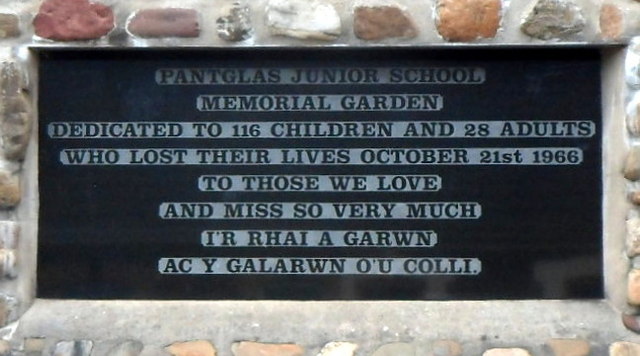
Residents of Aberfan set up an Aberfan Residents’ Protection Association (ARPA) demanding that Aberfan people should have a majority on the committee set up to administer the disaster fund. The ARPA worked closely with the Aberfan Parents’ Association. Both associations insisted that the fund should not be used to build a new school: they insisted that should be paid for by the NCB.
The lack of compassion did not just extend to the value put on the children’s lives. The temporary school rooms set up were in full view of the scene of the disaster and the cemetery where many of the victims are buried. And £150,000 was taken from the disaster relief fund to help the NCB clear up nearby coal tips. This was eventually refunded in 1997 by then Secretary of State for Wales Ron Davies though by 1997 £150,000 had devalued considerably compared to its worth in 1966.
The former mine owners had no problems getting compensation when the industry was nationalized in 1947. They received nearly £50 million in cash and Treasury Stock with a nominal value of £262 million. At the time of the disaster in Aberfan the former mine owners were still receiving compensation which prompted the Birmingham No 11 branch of the Amalgamated Engineering Union to pass the following resolution on 4 November 1966:
This branch demands the immediate suspension of compensation to ex-coal mine owners. This money to be used to be used to make all coal slag heaps safe in Britain. We also demand that representatives from the miners; union and citizens of Aberfan should sit on the Commission of Inquiry into the disaster’.
The Tribunal into the Aberfan disaster was chaired by Lord Justice Edmund Davies who sat alongside two other members, Sir Harold Harding (a civil engineer) and Vernon Lawrence (former Clerk to Monmouthshire County Council). No representative of the National Union of Mineworkers. No representative of the residents of Aberfan.
The Tribunal found 9 officials of the NCB guilty of various degrees of blameworthiness and neglect but none of them were dismissed or suffered demotion. According to the Tribunal’s report published in July 1967 those responsible were ‘not villains, but decent men, led astray by foolishness or ignorance’.
What is the situation today?
There are almost 2,600 monitored coal tips in Cymru, mainly in the South Wales valleys. There may also be over 20,000 other tips as a result of metal mining or mineral quarrying. All of these may have an impact on local communities.
In 1969 the UK Government introduced the Mines and Quarries Tip Act, but a 2022 report commissioned by the Welsh government concluded that legislation at the time ‘did not effectively address the management of disused coal tips’. As a result, the Disused Tips and Quarries (Wales) Act 2025 was introduced. A new authority, the Disused Tips Authority for Wales was proposed to be established in April 2027. The role of the authority will be to protect human welfare from unstable tips.
There are major issues as to who is going to fund the work of the authority. In 2021 the then Labour government in Cymru estimated the cost of coal tip remediation as at least £600 million over 15 years. Plaid Cymru argues that although environmental issues are a matter for the devolved government in the Senedd the overwhelming majority of pits closed before devolution.
Plaid Cymru’s argument is compelling, not least because at the time of the establishment of the Welsh Assembly in 1999 there were only two large pits open in Cymru: Aberpergwm and Tower Colliery. (Tower was famously kept open by the workforce who used their redundancy money to create a workers’ cooperative and buy the pit. It closed in 2008 having exhausted the coal seams. It now operates as a zipwire experience). Aberpergwm remains open despite protests about pollution and harmful effects on the environment.
Climate change
One of the major causes of the disaster at Aberfan was the build-up of water, both from being sited on a spring and from heavy rain. One of the main effects of global warming and climate change is that summers are drier and hotter while winters are warmer and wetter. This is an issue that could have devastating consequences for people, particularly in the former coal fields of the South Wales valleys. This has been recognized by the Climate Change Committee in its report A Well Adapted UK published in May 2026. The UK government is not paying anything like sufficient to ensure all tips are safe and remain safe.
In fact, there have been several landslips in the last 6 years. In February 2020 there was a landslip at Tylorstown in Rhondda Cynon Taf triggered by Storm Dennis: 60.000 tons of coal spoil blocked the river valley and covered a strategic water main with several metres of debris. In 2024 a disused coal tip partially collapsed at Cwmtillery in Blaenau Gwent following Storm Bert. Also, in 2024 a 30-metre section of a 100-metre retaining wall in Ystradgynlais in the Swansea Valley/Cwm Tawe collapsed and fell into the River Tawe after heavy rain. While there is no evidence this was a result of a collapsing coal tip, Ystradgynlais is a former mining town and surrounded by coal tips.
Aberfan remembered
As might be expected the 60th anniversary of Aberfan is being remembered throughout Cymru. Charles and Camilla met a survivor of the disaster when they visited Cardiff recently to attend the opening of the Senedd. The BBC is showing a special programme on the 60th anniversary.
Avant Cymru are taking a piece of documentary on tour. The Silent Volunteer is written by Sue Bevan, based on her play Hiraeth. Sue was 10 years old at the time of the disaster and like many people in Aberfan, was involved in the rescue and then clean-up operations. The cast features people who, like Sue, were involved in the events of 21 October 1966. Sue argues that the play depicts the appalling way in which ‘bereaved families were treated with contempt by a system that places profit above working people’. Her play is, for her, ‘’ a call to action – to make our voices heard, to get involved in the fight for our rights, and to demand change’.
That is a very different message than came from the Windsors or, probably, the BBC.Featured image: Rescuers searching through demolished school after Aberfandisaster. Photo: Wikipedia