


The Together Alliance held the first of its two summits in Manchester on Saturday 17 October. The second is in London on Saturday 24 October. Its interim chair, Kevin Courtney, traces the alarm behind it to Tommy Robinson’s rally in September 2025, and says the alliance brought half a million people onto the streets of London on 28 March. Saturday’s theme was the next step, building local alliances. Asad Rehman of Friends of the Earth put it most directly from the platform: “Today is about moving from just mobilising to organising.”
What that organising will look like became clearer in the afternoon workshop on local alliances. The answer is an alliance of organisations, with no individual membership, and with limits set by the charity law that governs several of its biggest affiliates.
Platform
The plenary showed the breadth the alliance is proud of.
Jon Trickett, Labour MP for Normanton and Hemsworth, opened with family history. His mother, a Jewish girl of seven, was at Holbeck Moor in Leeds in 1936, where a crowd put at 30,000 confronted Mosley’s Blackshirts. He tied the far right’s rise to falling living standards and told the hall that unity on the picket lines was the answer.
Gawain Little, general secretary of the General Federation of Trade Unions and an officer of the alliance, drew three lessons from the 1930s. The first was class unity, which at Cable Street cut across religion and background. The second was that fascism must be confronted on the streets. The third was that confrontation, “whilst it was necessary, was not sufficient”: the unity of Cable Street had come out of strong working-class organisation. He quoted Phil Piratin, the Communist organiser at Cable Street, who sat at the back of a British Union of Fascists meeting and, watching the march that followed, recognised men wearing their trade-union badges. Piratin’s conclusion, and Little’s, was to organise among the people the fascists were recruiting, around their housing and living conditions.
Jane Aitchison, president of Leeds Trades Union Council, described the trades councils’ place in the fight and praised Keighley Together. That group was first set up to see off Nick Griffin, and it has been revived to run sessions in schools, colleges, churches and mosques and stalls on match days. She said unions must educate their members about Reform “even if it means that we risk that some members leave”. She also argued that the most important thing is living standards, and listed fair pay, renationalisation and a fully funded NHS.
Asad Rehman, chief executive of Friends of the Earth and an alliance officer, called the far right “an international political project backed by the billionaire class”. He called for “a movement of movements” organised “at the factory gate and at the school gate”.
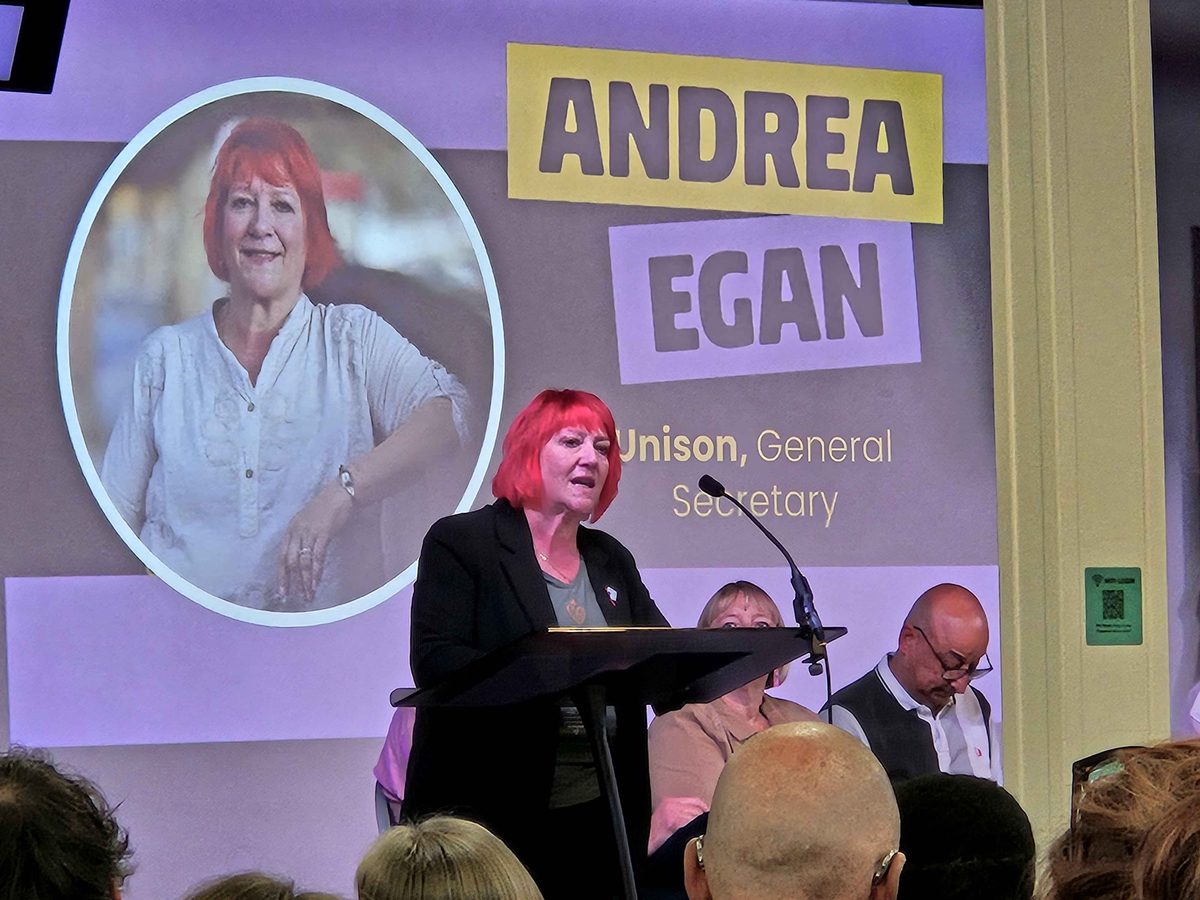
Andrea Egan, general secretary of Unison, said her union was “fully embedded” in the alliance. She was also the plenary’s sharpest critic of the government. She attacked Labour’s proposal to extend the qualifying period for indefinite leave to remain. “Progressive governments copy the rhetoric and proposals of the far right,” she said, and that “validates the far right’s ideas”. “Fighting the far right doesn’t mean dropping scrutiny of the Labour government.”
Kevin Courtney, the alliance’s interim chair, a former joint general secretary of the NEU and vice-chair of Stand Up To Racism, closed the plenary. He gave the alliance two objectives: to “mobilise our side to show that we are the majority”, and to “win people back who are currently thinking about going with the far right”. He pointed to the anti-eviction actions in 1930s Stepney, where, in his account, BUF members tore up their cards after socialists defended them against their landlords.
Workshop: who can join?
Courtney also led the workshop on building local alliances, with Nahella Ashraf of Greater Manchester Stand Up To Racism and Denis Fernando, a senior campaigns officer at Friends of the Earth.
Courtney said Together is not trying to replace anyone. “We’re not trying to create another anti-racist organisation alongside existing anti-racist organisations.” He then set out the rule that shaped the rest of the session:
The Together Alliance is not a membership organisation. You can’t join the Together Alliance. It is an alliance of organisations … You cannot individually join the Together Alliance. The organisation you’re in can join.
A local alliance, he said, should start broad, with around five organisations. He suggested a union branch, a trades council, a Friends of the Earth group and the local Stand Up To Racism group. It should not be “two old white blokes” sitting in a pub declaring themselves the local alliance. If activists cannot find five organisations, he said, they should join Stand Up To Racism as individuals and build that instead. The centre has few resources, he said, but it can offer branding, messaging and contacts.
The rule was challenged at once from the floor. “That is a problem,” came the response. “It is a problem.” A retired trade unionist said he had come “to find how I can get support in dealing with the racism that I face on a daily basis”, and asked why he could not join. Courtney asked whether he belonged to a tenants’ association or a religious community, or could be a retired member of his union. When the answer was no, Courtney said: “Sometimes it’s best not to ask some questions.” He pointed him to organisations affiliated to the alliance, among them Care4Calais, Stand Up To Racism, Show Racism the Red Card and Hope not Hate. Being an alliance of organisations, Courtney said, meant losing something, “the clarity over who you’re voting for”, but the breadth was what had made 28 March possible.
A second speaker from the floor pushed the point further. People outside any organisation were “one of the biggest constituencies”, the speaker said, and membership of organisations of every kind “is dropping dramatically”. Courtney replied that half a million had come on 28 March through this method. Ashraf then made the strongest case for it. Building for the demonstration, she said, Stand Up To Racism had met people who told them: “I’m not part of a group, but I like the fact that you’re working together with all of these groups.”
What a local alliance cannot do
The second limit is legal. Fernando pointed out that charities in the alliance cannot oppose a named party. Friends of the Earth can criticise a council’s attack on climate-emergency declarations, but not name Reform. Courtney spelt out what this means for the alliance itself. As vice-chair of Stand Up To Racism he can say “don’t vote Reform”. As chair of Together he cannot. He can say “vote for love, hope, unity”. The same constraint may stop a local Together alliance from joining a counter-demonstration, he said, though a unity event “might lead to more people being on the counter-demonstration”.
Ashraf described the division of labour from the other side. Where the far right returns to a hotel week after week, as it has in Altrincham, she said Stand Up To Racism had decided “we can’t keep doing this”, and held a unity event in the town centre instead. But she was clear that counter-demonstrations remain necessary. Patriot Platform has threatened to come to Salford, and if it does, “we will have to have a counter demo, even if we think it’s going to be a small number. I don’t think we can ignore them.” Together was good at bringing people to large events, she said. Where “it isn’t able to do some of the more radical stuff”, Stand Up To Racism can.
She also warned of three threats in Greater Manchester: Reform, the far right, and Restore Britain, which she said won around 44,000 votes across the city region.
People in hotels
One of the strongest contributions came from the floor. A campaigner who had come with a man living in an asylum hotel described a new collective led by people in the hotels and HMOs. She urged every local group to find the asylum seekers and the organisations working with them, “so that we don’t end up in a situation where we have fascists outside a building, and we have nobody inside the building able to communicate with us”. Courtney replied that migrant and refugee organisations, including Praxis and Care4Calais, had been at the heart of the alliance from the start.
Attacks on HMOs housing migrants came up repeatedly through the day. A lunchtime meeting was called on recent attacks in Salford. In Heywood, Ashraf said, an attack on an HMO had led local people to set up a new Stand Up To Racism group.
What next?
Courtney told the workshop the alliance intends to hold a bigger demonstration and “a huge concert” next summer, with dates to be announced soon, and that local activity would be needed to build for them. The workshop then broke into groups of two or three to list organisations participants might approach. One participant asked for people to be grouped by area, so that those from the same town could plan together; there was not time, and the session moved on.
Goals
The Manchester summit sets two goals side by side: to organise locally and to remain an alliance only of organisations. They pull against each other. The man who came for help with the racism he faces every day left with a list of other organisations to join. The far right is recruiting individuals in their own neighbourhoods, and that is where the platform said the fight now has to be. But a person who joins no organisation has no way into Together at all.
Ashraf’s answer deserves to be taken seriously. Plenty of people who would never join a group booked a coach to London because so many groups were behind the march, and 28 March is the proof. But that is an answer about getting people to a demonstration. It says less about where they go afterwards, and on Courtney’s own account the place for anyone without an organisation is Stand Up To Racism, of which he is vice-chair. An alliance that nobody can join as an individual still has a door for individuals, and it opens into one affiliate.
The constraints are real, and Courtney was candid about them. Charities cannot campaign against a party, and a coalition with them has to respect that. But the same constraints mean that the counter-demonstrations Ashraf insists on, and the open opposition to Reform that Egan’s union can offer and Together cannot, fall to the organisations inside the alliance.
For trade unionists there is a route in that does not wait on London. A union branch can affiliate to Together, and an affiliated branch can send delegates, move motions in a local alliance and ask in public why it will not name Reform, which an individual on a coach cannot. The question for London next weekend is whether “moving from mobilising to organising” will mean building structures local people can actually join, or a network of affiliates whose local work is done by the groups that already exist.
Get organised: Trade and Tenants Unions Fighting the Far Right
Trade and Tenants Unions Fighting the Far Right (TUFF) is a network of rank-and-file trade unionists and tenants’ activists, set up in January 2026. It presses union leaders to turn their members out on anti-far-right mobilisations, and works to get branches and workplaces active in defending migrants and winning Reform and Restore voters to socialist alternatives. Its open letter to the TUC asks the unions to lead counter-demonstrations themselves, to recruit defensive stewards from their own ranks, and to organise their members all year round. Unlike the Together Alliance, it is open to you as an individual, and ACR activists support it.
- Join the mailing list at tuff.network for invitations to its monthly public meetings, held online and in London in turn. Email contact@tuff.network.
- Sign TUFF’s open letter to the TUC, in your own name or your branch’s.
- Ask your branch or trades council to support TUFF and send a representative, and to affiliate to the Together Alliance and send delegates to your local alliance.
- Not in a union? Join one. In a tenants’ union? TUFF organises there too.