


On 11 November In the Spanish state we saw the first general strike for 14 years. It comes after the huge mobilisations about the cost of housing triggered by the attempted eviction of Maricarmen Abascal, an 87 year old, from a home she had lived in for many years. Her home had been bought by property speculators who wanted to drastically increase the rent. Sadly she died in the days after protests had stopped the eviction. The big square, the Plaza del Sol, in Madrid was occupied by activists for 38 days..
Pedro Sanchez, the left of centre Prime Minister, failed to get some concessionary measures to deal with the housing crisis through parliament because of the opposition of the right wing parties who were supported by a moderate Catalan nationalist party. In response he has called a general election for the 29 November. Opinion polls suggest that the PP, the right of centre Peoples’ party, and the far right, Vox (Voice) party will form a majority. However it is unclear what impact the ongoing mobilisations will have on the outcome.
Scale of the strike
So unusually the existing government was favourable to the strike, hoping that the movement will boost its electoral support. The right wing parties are apoplectic about this situation.
El Diario, a left progressive daily has reported on the strike in the following way:
“The general strike has drawn to a close with protests in numerous cities across Spain, where thousands of people are taking to the streets to demand decent housing and wages. In Madrid, the march drew a massive crowd despite the bad weather: the Government estimates 120,000 attendees, while the Tenants’ Union puts the number at 400,000. The march was also massive in Barcelona, where disturbances broke out after it ended, as several hooded individuals scattered to try to vandalize stores. In Valencia, the housing strike concluded with a massive demonstration, a battle over numbers, police charges, and arrests.
[ACR translation]
Police charges against picket lines and demonstrators have taken centre stage during the strike. The unions denounced “disproportionate” charges against the picket lines, which have so far resulted in at least 50 arrests. One such incident occurred on Madrid’s Gran Vía, where the National Police charged at demonstrators who were blocking the roadway, using batons and pepper spray. CCOO General Secretary Unai Sordo expressed bewilderment at the charges and will file a criminal complaint over the use of pepper spray against “peaceful” demonstrators in Madrid.”
. Both CCOO and UGT (main trade unions) assert that participation is exceeding expectations and that few strikes in Spain have been on the scale of the one called for this Wednesday.
Key role of the Renters Union
The renters union,. Sindicato de Inquilinas, also played a key role in the successful mobilisation. On the BBC Radio 4 Today programme this morning they interviewed a renters’ representative who articulated the reasons for the action very clearly indeed. Rents have gone up by up to 40%. The lack of regulation of the Airbnb takeover of whole neighbourhoods in the tourist centres is a major factor in this. Anyone who has visited a major tourist city in the Spanish State in recent years can see this. Neighbourhoods are hollowed out as useful local shops are replaced by fast food joints or souvenir shops.
The violence of the police in some areas also probably reflects how the far right are well implanted in the police and army. There were police charges in Madrid and Barcelona later on but any looting was limited. Estate agents and property companies were targeted – slogans were painted and locks glued up. A major TV network was peacefully invaded by protestors.
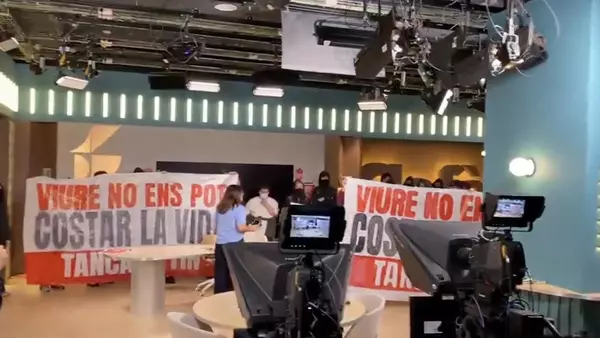
Strikes intervene in TV network studios
Police violence
Amnesty International in Spain has denounced “alarming police actions” in Madrid, Alicante, Castellón, Vitoria, Valencia, Málaga, Granada, and Santiago during the general strike. The organization detailed in a thread on the social media platform BlueSky that it had documented “baton blows against people protesting peacefully,” the “indiscriminate use of pepper spray against the crowd,” and “numerous people treated by medical services, with some being taken to the hospital.”
No doubt if the right wing parties win the general election we can expect much more violence from the police and the use of the army.
It is still very difficult to organise a general strike today which shuts everything down throughout the Spanish state.
Anticapitalistas report on strike
According to the Anticapitalistas website:
“Strike participation varied from 75% in the industrial strongholds of Barcelona to 45% in other parts of the country. Electricity demand fell by 9.7% compared to the same period the previous day, reflecting the strike’s impact on economic activity. The walkouts particularly affected heavy industry, the ports of Valencia and Algeciras, and plants such as SEAT Barcelona and Volkswagen Navarra
The impact is also evident in other sectors. In Asturias, unions report that the strikes have brought the region’s major industries to a virtual standstill, affecting ArcelorMittal, Fertiberia, and the Trubia arms factory. In Andalusia, Canal Sur has suspended its television broadcasts since 8:20 a.m. as a result of the strike.
In Catalonia, the mobilization has taken on massive proportions: thousands of people have taken to the streets, with blockades on more than 60 roads and disruptions also affecting small businesses. Industrial and strategic sectors are experiencing significant work stoppages. According to estimates from the organizers, the strike is having a particularly widespread impact across the region.
In Murcia, picket lines have managed to halt bus departures for two hours. Access to the city has also been blocked, and an impromptu demonstration was organized that passed in front of several real estate agencies.“
It was already an achievement to organise a united union strike after a gap of 14 years. The united action with Renters Union is very positive. Millions took part in strikes and/or demonstrations despite the cold and rain in many places.
The strike provides a good basis for continuing the struggle to force real changes on rents, wages and the cost of living. Whether Sanchez or the right wins the general election at the end of the month the pressure from the streets and workplaces needs to be maintained.