

You hear from people who have seen NAZA how it was a visceral, nearly unbearable experience. People sitting stunned and numb long after the credits had rolled. Many were relatively well informed about how the genocide has been organized but they too were moved by the film. Apart from a short devastating segment of horror shown at the end of the file the director does not provide many images of the human and physical toll in Gaza. In an age of thousands of images that bombard us every day the power of words retains its capacity to shock.
The documentary is very simple and straightforward. You watch a series of interviews with members of the Israeli Defence Force or associated units who are responsible for identifying and carrying out the bombing of the Gaza population. The bombing has killed, at the very lowest estimates, 75,000 people mostly women, children and non-combatants.
They speak very calmly for the most part. They explain in a matter of fact way what NAZA means – it is a technical way of working out how many civilians will be killed in any raid. In Vietnam the US army called it collateral damage. Highly intelligent personnel have worked out algorithms and software that make these calculations. We see some of them sketch it out for us on scraps of paper as though we were students in an IT class.
Like a video game
On the one hand these operatives are like video gamers, it is virtual violence as they sit in their bunkers many kilometres away from the bombing. On the other hand the way they use the mobile phone network to track their targets – Hamas fighter or anyone they define as combatants – means they listen in to children speaking to their parents or the screams of relatives after the bombing has happened. They are both present and absent at the same time.
Contributors describe remote warfare, noting that “you hack her phone, and then you kill her“, that the word “armed” is “not relevant”, and that the process feels “like a video game because everything is done remotely”.
The genius of the film, its aesthetic if you like, is the way the interviews are intercut with what you may call routine, even boring , scenes of everyday life in Tel Aviv. We see teeming traffic jams, the bright lights of the city, people tidying up after a meal or watching the TV. Most of the time we do not see whole figures but their legs or torsos. Immediately you grasp the contrast with the area that the IDF is bombing without the director having to show you much of Gaza.
A settler war where Palestinians are dehumanised
It also correctly identifies the nature of the aggressor. Israel is an advanced capitalist country just like the USA or Britain. They have smart apartment blocks, regular meals and traffic jams. These are not cities of rubble and refugee tent encampments. No stampede to get meagre food rations while avoiding sniper fire. The occupation and genocide is between the first world and the colonized. Between the settler and the people to be displaced violently.
In the interviews we hear the dehumanization of the enemy. They attacked us so we must use any means to eliminate their threat. We hear hardly any remorse at all. There is a recognition that what they are doing is terrible but they justify it as a logic of survival:
They don’t respect the rules, why should we?
The whole people are terrorists, we eliminate terrorists so we eliminate people
One or two of the operatives do recognize that genocide is going on.
A soldier reflects on visiting a camp in Poland (“I still see those Nazis as evil, but what does that mean I am?”), while another admits regret over not opposing the apparatus (“I’m disappointed that I am part of that system”) and states, “We were erasing history“. When asked if the events constitute genocide, an IDF member answers, “Yes. Completely“.
But overall the participants’ relative openness can only be understood if we understand the totalitarian ideology of the Israeli state.
Expressing the banality of evil
One of the producers is Jonathon Glazer who made the award-winning Zone of Interest (ACR review) about the family of a Nazi death camp commandant living next to the extermination ovens. The same banality of evil was conveyed. The family was able to psychologically abstract themselves from what was going on over their garden wall. Regularly showing the clips of everyday life in a big Israeli city employes the same technique.
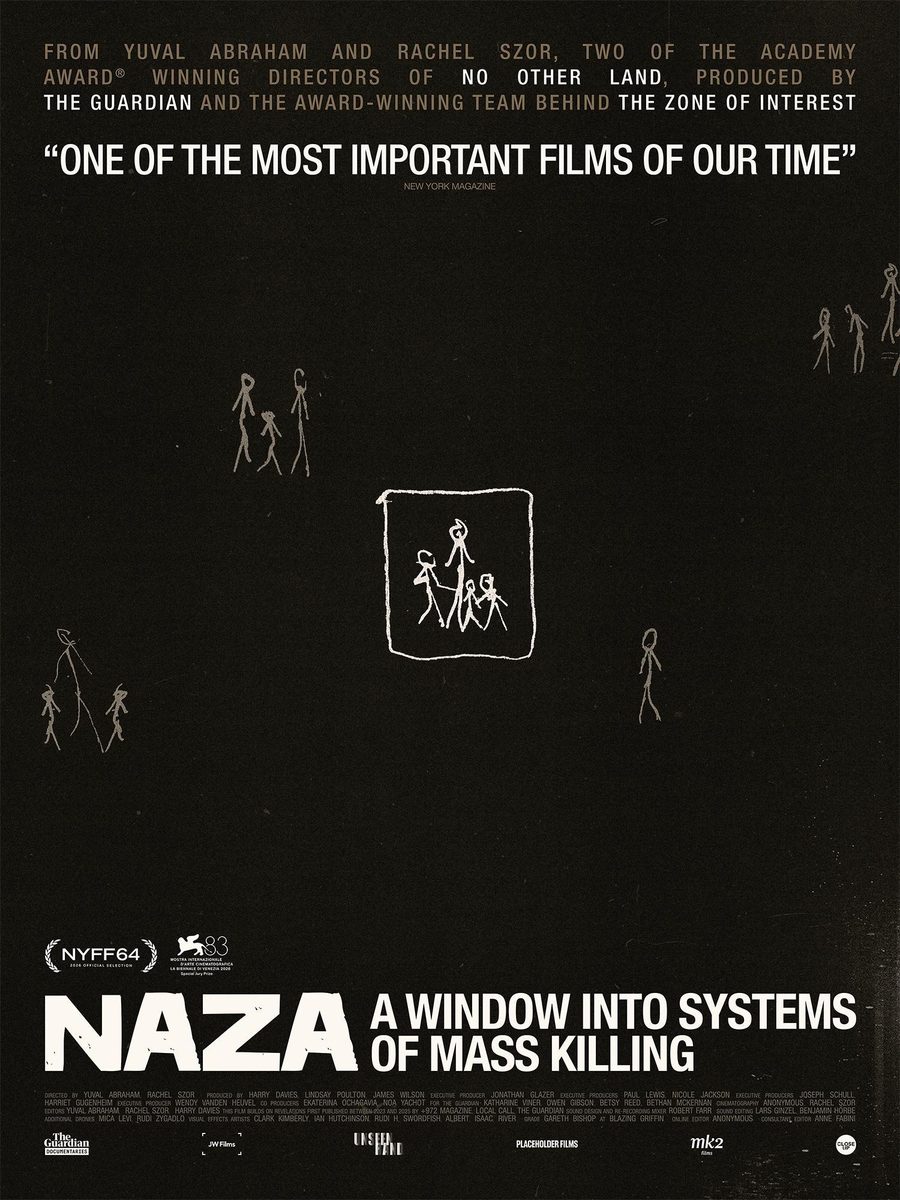
The interviews are filmed in semi-darkness and the faces of the operatives are never shown for obvious security reasons. This rather sombre, static direction makes the weight of the words, reinforced by the subtitles even more striking. There is no visual distraction. Secrets of the targeting and bombing emerge from the darkness of the night. Filmed on the rooftops it reminds us that the bombs they send fall on the rooftops of Gaza, death comes from a height.
The only way to make the whole terrible brutality worse would be for somebody to hack into the live recordings of the bombing and their immediate aftermath at the moment of the killing. No doubt such audio-visual evidence exists and is held by the IDF for evaluation and analysis.
Directors attacked by Israel
The reaction from the Israeli government has been apoplectic since the documentary unveils the reality of a genocide they are unable and refuse to name. Yuval Abraham and Rachel Szor have not been able to return to Israel since the premiere of their documentary “NAZA” at the Venice Film festival where it received a 20 minute standing ovation. The directors remain outside Israel (residing in the UK) due to a wave of severe backlash, death threats, and warnings from family and friends that it is unsafe for them to go back. Prime Minister Benjamin Netanyahu compared the film to “ballistic missiles” targeting Israel and supported measures targeting them, while Culture Minister Miki Zohar called for revoking their citizenship and accused them of treason.
NAZA was co-produced by The Guardian and JW Films, the production company of British film producer James Wilson. Johnathan Glazer was an individual producer. This is positive from the Guardian which has in the past been very careful not to be too critical of the Zionist state.
After its cinema release it is being put onto YouTube so anybody can see it for free. Local solidarity groups, unions or local party branches could use it as a basis for a meeting to discuss what is happening in Palestine.