


Source: Anti-capitalist Musings
In November 2006, on the first episode of The Russell Brand Show, Matt Lucas looked at his Little Britain partner David Walliams and at Brand, who was wearing a top hat, and remarked on how camp the pair of them were for two straight men. Walliams had a question. ‘Isn’t it a wonderful smokescreen?’ Brand was delighted. ‘Isn’t it though? Isn’t it glorious? It works wonderfully well.’ There is a point here at which an interviewer might reasonably have asked what it worked wonderfully well for. Brand was the interviewer.
It is an odd experience watching that exchange now, and some of the oddness comes from the invitation the two men extend to the viewer. We are being let in on something. Other people might take the pair of them for gay, to the considerable advantage, we are invited to understand, of two heterosexual men who like women. Those of us at home are sophisticated enough to get it. Being in on a joke is a small pleasure. British television milked it for years. Once you have accepted the compliment, it takes a certain effort to go back and ask the apparently dim question that would have spoiled the banter.
On 9 November, a judge at Southwark Crown Court sentenced Brand to ten years and six months for raping one woman and sexually assaulting three others between 2004 and 2009. A three-year investigation by ITV News and the Guardian has reported allegations that Walliams used his celebrity to pursue teenage girls and young women for sex. Two women say they first met him when they were fifteen. Walliams denies wrongdoing. The women who gave evidence against Brand established in court what he had done to them. No amount of replaying old television could have done that work. What the archive can tell us, with some precision, is what the people who made British television considered fit to broadcast.
Complicity of that Jonathon Ross joke
Consider what a viewer needed to know to follow Jonathan Ross’s opening at the British Comedy Awards in 2004. The awards were fifteen years old, Ross said, and like other fifteen-year-olds the show was drunk, unpredictable and ‘probably going home with David Walliams’. The camera went to Walliams, who gave it a V-sign. Ross says a writer supplied the line and that he understood it as an exaggeration of Walliams’s publicly known taste for younger women. Of the alleged conduct, he says, he knew nothing. Take that explanation on its own terms. The writer thought of fifteen because it was the age of the awards. Somebody still had to think of Walliams. And the gag was good enough to use because you could reasonably expect a roomful of people to make the connection in the second or so before the camera found him. That is quite a lot of common ground for a single line of television.
‘Everybody knew’ is an unsatisfactory account of an evening like that. What exactly did the person watching on the sofa know? That Walliams went out with younger women, perhaps. Or only that this was what people said about him, in which case the joke itself had just supplied the information needed to get it. A producer could know considerably more about a star’s behaviour at work. And a runner might know something at first hand and have very little idea who else knew it or whom it was safe to tell. To fold all these people into ‘everybody’ is to let those who hired the star, and could have laid down conditions for his continued employment, disappear into the studio audience.
Failure of senior management
Brand’s employers have left us a good account of how this worked. In 2024 Banijay published the findings of an investigation into his years on programmes made by Endemol, among them Big Brother’s Big Mouth. Senior members of the production staff had received informal complaints about Brand asking runners to obtain audience members’ phone numbers. Concerns had reached them, too, about how uncomfortable female staff felt around him. Senior staff, the report found, did not adequately address these complaints either. The same report recorded that nobody had made a formal complaint. Imagine being the runner in that sentence. The presenter wants a phone number. You have come to work to help make a television programme and somehow his interest in a woman in the audience has become one of your duties. Word of this reaches somebody senior. Years later, one of the facts that survives most clearly in the company record is the form your objection failed to take.
This is where I would place Brand in the history I have called the long 1980s. In that piece I followed Jimmy Savile across institutions which conferred authority on him and took remarkably little responsibility for what that authority let him do. Television itself changed over those years. The Peacock report of 1986 urged broadcasters to commission programmes from independent producers, and the Thatcher government wrote a quota into the Broadcasting Act 1990.
By the time Brand was presenting Big Brother’s Big Mouth, a viewer knew which channel to turn on, the production staff knew which company employed them, and both businesses knew whose name sold the show. When the allegations became public, Channel 4 investigated what people at Channel 4 had known. Banijay, which by then owned Endemol, commissioned an investigation into what people at Endemol had known. Read the two remits side by side and you get some sense of the distance a complaint from the studio floor might have to travel. The star had no comparable difficulty making his wishes felt as far back as the audience seats.
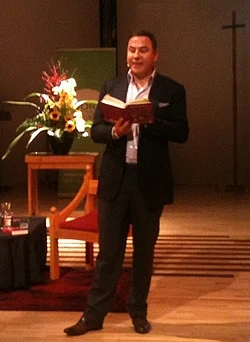
Walliams at the WORD Christchurch Festival 2015, New Zealand (Wikipedia)
Savile got away with it
Savile had flourished in the old BBC, long before anybody needed to consult a production contract to discover where responsibility lay. What survived the reorganisation of television was the deference due to the man who could bring in an audience. Its manners changed. On Have I Got News for You in May 1999, Savile announced that he was ‘feared in every girls’ school in this country’. Later, Ian Hislop asked what he did in his caravan. ‘Anybody I can lay me hands on,’ Savile replied. Dame Janet Smith’s review records the laughter and applause, and also the raised eyebrows. I am interested in those eyebrows. An awkward look is perfectly legible on television. It allows the viewer who finds the guest creepy to feel represented in the room. As a reaction shot, it also plays rather well. The programme can make room for the objection right up to the point where somebody has to put it into words.
Why the word ‘victims’ was cut out
In 2018, at a recording of Roast Battle, Katherine Ryan addressed Brand in the licensed idiom of the evening. The format required the comedians to insult one another. Ryan told Brand how good he was looking and added, ‘I will remind you of that if any victims come out.’ Three people who worked with Fulwell 73, which made the show, later told Deadline that the company cut her remarks. There is an editorial history of British comedy in the distance between those two decisions. A joke about a drunk fifteen-year-old going home with a celebrity could open an awards show. Put the word victims in the mouth of a comedian addressing a celebrity to his face and, on this occasion at least, the audience at home heard nothing. Ryan had even done what television ordinarily asks of a woman with something uncomfortable to say. She had made it funny.
I keep coming back to the V-sign. In the coverage this week it reads like newly discovered footage. The camera went to Walliams in 2004 for one reason: to let us see what he did when he heard his name. He gave the programme exactly what it needed. For a second the viewer was on familiar terms with a famous man taking a joke at his own expense. Look again at where the expense falls. The drunk fifteen-year-old exists for the duration of Ross’s sentence. By the time we might give her a moment’s thought, the camera is already on the celebrity. We remember his face. That was how the joke was made.