


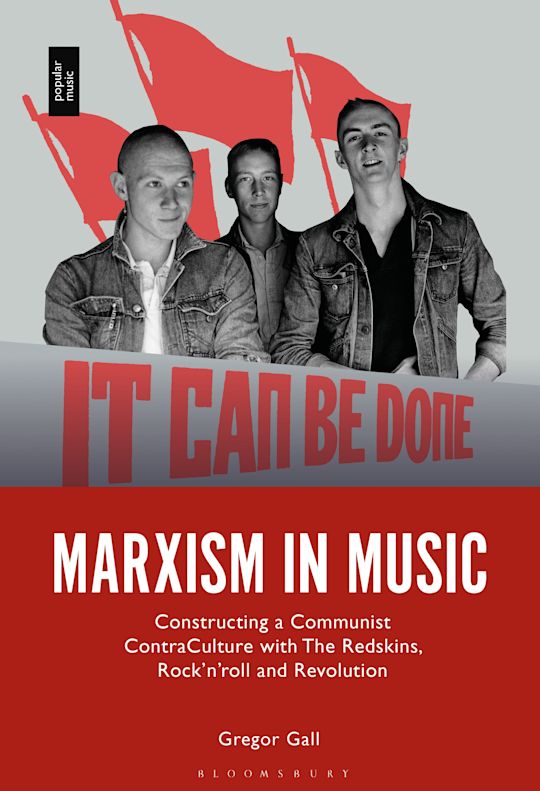
Forty years after The Redskins released their only album and played their last gig, Gregor Gall has given them the book they always deserved. More than that, he has used three young men from York and London, a brass section and a year-long miners’ strike to ask a question the revolutionary left has dodged for a century: why do we leave culture to the other side?
That is the provocation at the heart of Marxism in Music, and it is a bracing one. Gall argues that communist organisations of every stripe have organised strikes, stood in elections, run campaigns and produced mountains of cultural criticism, yet have almost never set out to produce communist culture themselves. The only culture most parties have built, he notes drily, is their own internal party culture. Anarchists built theirs; Black nationalists built theirs; even fascists built theirs. Communists, by and large, did not.
Against that backdrop, The Redskins appear as a glimpse of what might have been, and might yet be.
A contra-culture, not a counter-culture
Gall’s key conceptual move is to distinguish a contra-culture from a counter-culture. Drawing on the sociologist J. Milton Yinger, he argues that the 1960s counter-culture could live quite happily alongside capitalism and was soon sold back to its participants as rebel chic. A contra-culture, by contrast, is defined by conflict with the dominant order and exists to help overturn it. Put in Gramscian terms, it is part of the war of position: the long contest over ideas, feelings and common sense that must accompany any challenge to capitalist power in the parliamentary democracies of the West.
This framing gives the book real reach. It is not a fan’s memoir with footnotes. It is a serious argument about strategy that happens to be told through the most exciting political band of the 1980s.
The band, told properly
And what a story it is. Gall traces Chris Dean from a Maoist sect and a further-education college where a fascist leader taught, through the punk band No Swastikas, a stint as an NME stringer and into the SWP. He follows the band from three-chord thrash to the soul-punk sound that let them, in their own phrase, walk like The Clash and sing like The Supremes. He shows them playing benefit after benefit for striking miners, keeping baseball bats behind the amps in case fascists came calling, and bringing the fighting spirit of socialism to a generation that Thatcherism was trying to teach that there was no alternative.
The research is formidable. Gall conducted some eight hours of interviews with bassist Martin Hewes, who also contributes a generous foreword. He has combed the NME, Sounds, Melody Maker, Smash Hits, the fanzines and the socialist press. Most strikingly, he gathered written testimony from 119 Redskins followers, many of whom describe how the band sharpened their politics, sent them to picket lines and, in some cases, into revolutionary organisation. This is the book’s quiet triumph: it treats the audience as historical actors rather than a faceless crowd, and so can actually answer the question every political musician is asked – did any of it make a difference? The answer, carefully hedged but unmistakable, is yes.
Their reach outlasted the band itself. In 1999 International Viewpoint was still reviewing the Wake Up fanzine’s miners’ benefit album, re-released to raise support for the Liverpool dockers – a reminder that, years after the split, the music was still doing the job it was made for.
Why they ended
The chapters on the band’s demise are among the finest in the book. Gall dismantles the comfortable myths one by one. The Redskins were not crushed by the music industry. They were not finished off by the defeat of the miners. They were not wound up on the instruction of the SWP leadership. Instead, through Hewes’s increasingly candid accounts across four decades, Gall reconstructs a story of personal, artistic and small-p political conflict, rooted in the different class backgrounds and expectations of the band’s two leading members.
There are unforgettable details: Dean insisting that ‘Keep On Keepin’ On!’ be slowed from punk tempo to Motown tempo; the drummer walking out of the album sessions and Paul Weller’s drummer being rushed in as a stand-in; arguments over whether to denounce Band Aid or first stand alongside the people who had given to it. Gall handles all this with fairness and without gossip. Dean, who could not be contacted, is given full voice through his voluminous contemporary interviews, and Gall is admirably open about what that absence costs the research.
Comrades and contrasts
The comparative chapters lift the book further. Gall sets The Redskins beside The Housemartins, who had the hits, and beside Easterhouse, the Manchester band associated with the Revolutionary Communist Party, who had the politics but never the reach. He also gives a clear-eyed account of Red Wedge, Billy Bragg and Paul Weller’s effort to mobilise pop for Labour, and of why The Redskins stood apart from it. The comparison draws out what made The Redskins distinctive: optimism rather than miserabilism, a sound people could dance to, and a refusal to stay inside the small redskin subculture they had named themselves after.
In one of the book’s best formulations, Gall says that many bands rebelled against something, but The Redskins also rebelled for something. Mark Fisher’s capitalist realism had not yet been named, but they were already kicking against it.
Lessons for today
The concluding chapter is where Marxism in Music becomes essential reading for anyone building socialist organisation now. Gall points out, uncomfortably, that the anarchist collective around Crass and the fascist Blood and Honour network both built the infrastructure of their own contra-cultures – communes, labels, magazines, venues and distribution – while the communist left did not. A real communist contra-culture, he argues, would need collectively owned and run infrastructure, not merely a friendly independent label that will in time face big-business pressures of its own.
Hewes puts the point well in his foreword: a revolutionary organisation needs a cultural front as well as a political one, because people come to their politics in many different ways. With the Greens now past 200,000 members and new layers of young people looking for a politics that fits their lives, that lesson has rarely been more urgent.
Verdict
This is a passionate, rigorous and genuinely original book. It restores The Redskins to their rightful place in the history of British political music, it takes the experience of their followers seriously, and it poses a strategic challenge that every socialist organisation should be discussing. Gall writes as a scholar but thinks as an activist, and his book carries the same optimism of the will that powered the music it describes.
It can be done, as The Redskins’ last single put it. Gregor Gall has shown us why it should be.