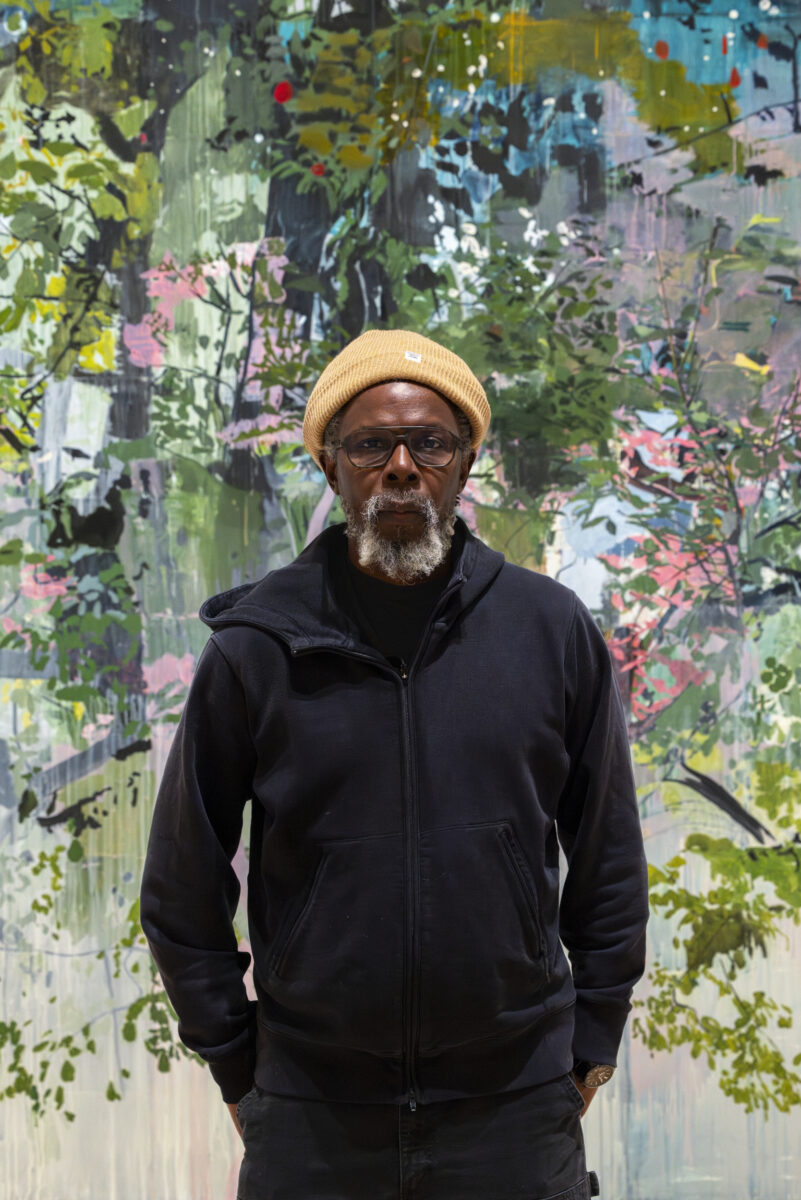
In the new Paolo Sorrentino film, Grazia, about a soon to retire Italian president, the main character several times asks the question, ‘Who owns our days’. How far do we decide how our lives go? How far are we constrained always by objective forces? Who does really own us? Capitalism, religion, family, nationality….
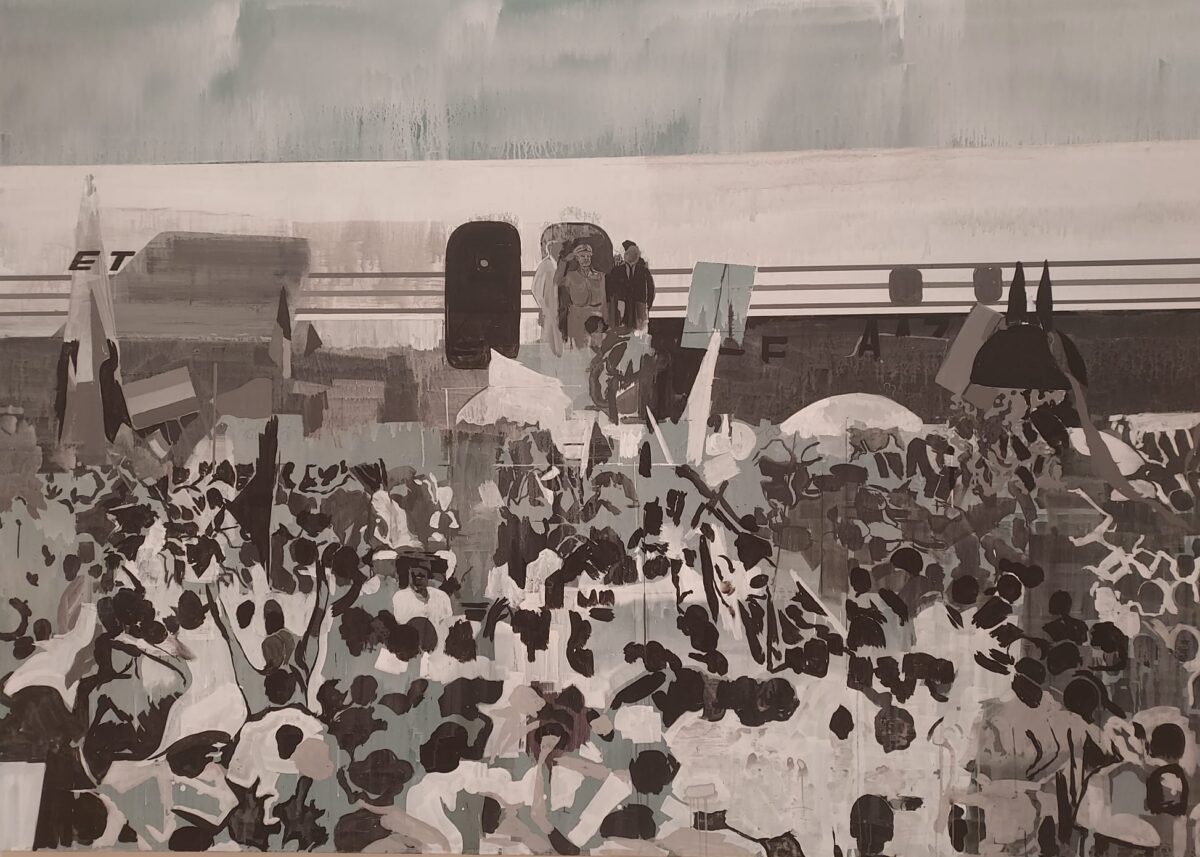
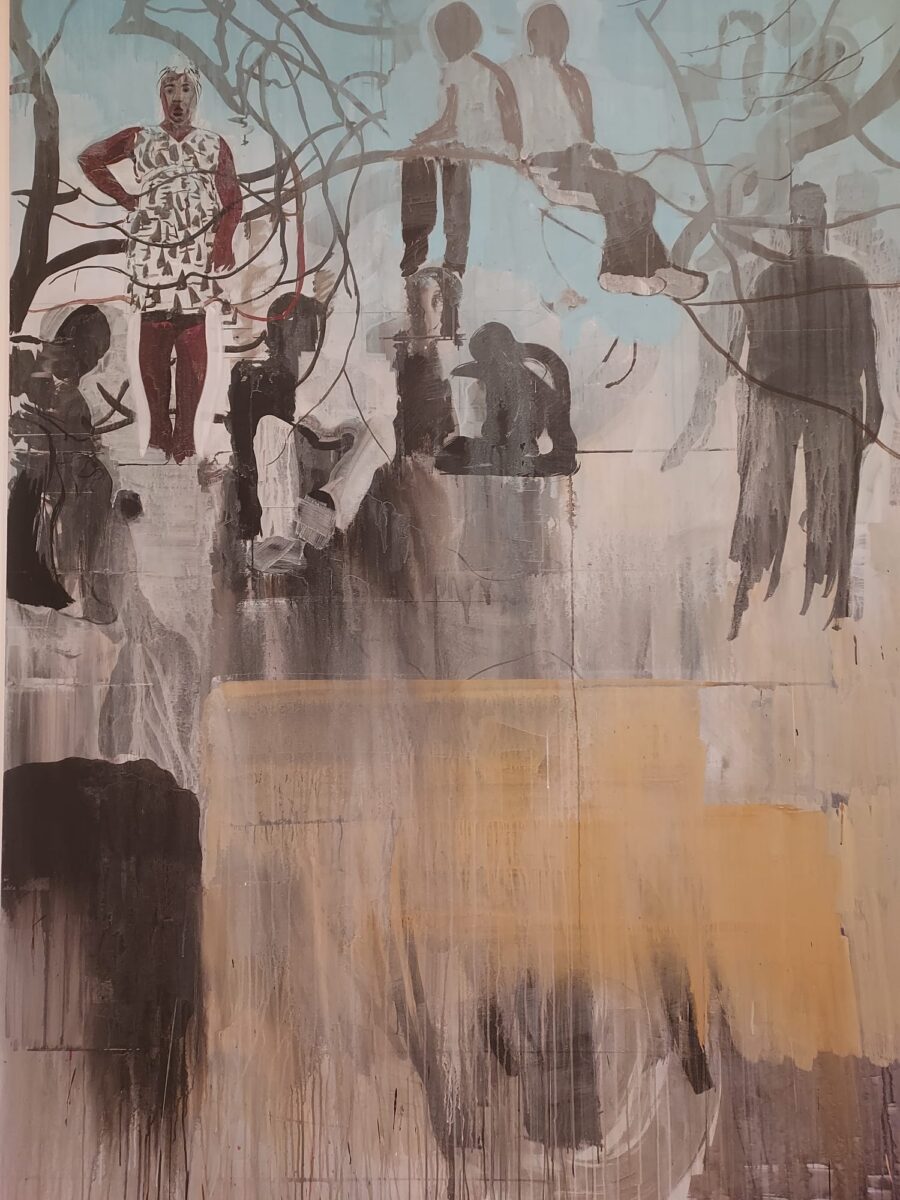
Coming to the last room of Hurvin Andeson’s exhibiton there are a set of two paired pictures. One pair is without colour. The first is of boys sitting in a large tree – scrumping apples or mangoes. The other is again in black and white and is a pictorial rendering of a news photograph of Haile Salessie arriving in a plane in Jamaica in 1966 to a welcome of thousands of people. The boys are looking out towards the Salessie picture. The past and present, Jamaica and Britain are all combined in the artist’s memories about the past and the future. Historical memories and imagined scenes are mixed together.
In relation to these pictures Anderson said:
“I’m interested in self-determination. It started with scrumping apples: this idea of kids in trees formulated something. What does it mean to have our own thoughts and ideas about how to live?”
Anderson is grappling in his art about how to own his days. Born in Birmingham in 1965, his brothers and family were born in Jamaica. He experienced the ambiguities of living in Handsworth and being connected to the Carribbean. His identity, his days, are marked by this movement between two places and two cultures. In the early part of the show there are several pictures of boys in Handsworth pausing their football game to look for the ball someone had kicked in the lake. Anderson puts ships in the lake and other cities on the horizon. He mixes up his memories and those of his family who experienced migration. Often he works from photographs that he had found in relatives’ houses. Here there is a picture of an aunt who had moved to Canada that is based on a photo.
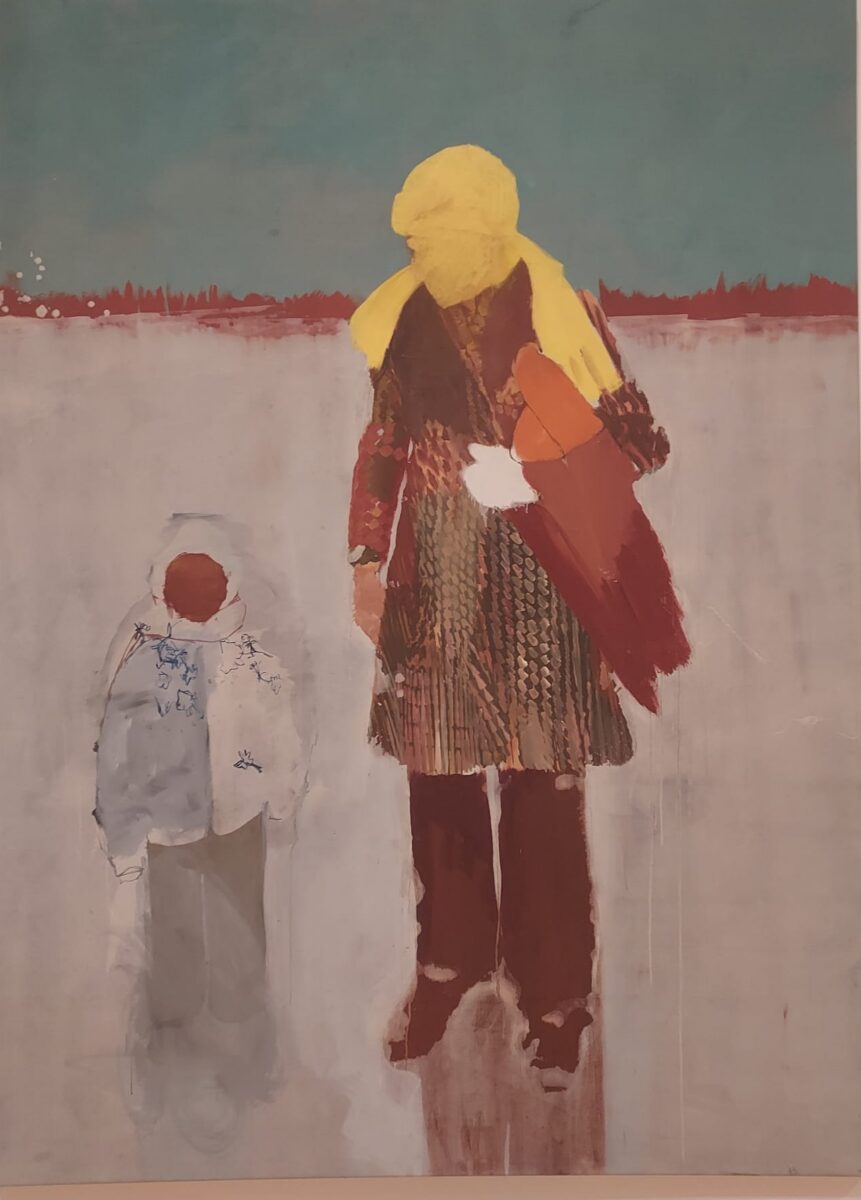
Perhaps he is hinting at the difficulty of migrants settling in another country. Their faces and identities are erased as they stand stiff and cold beside a frozen lake. His use of colour here conveys the cold and the composition really isolates the mother and child from anybody else. His art is figurative but generally within a landscape or history painting genre.
One of the works that he revised for this show is the monumental Passenger Opportunity that we have made the featured image for this article above. Over ten metres wide it takes up a whole wall, slap in the middle of the exhibition. This like a renaissance fresco or a graphic novel telling the story of his family and community.
On the top left, it reproduces some of the advertisment for the passage to Britain with its price of £48 or £28. The first two columns show scenes from life after arrival in Britain. The next two columns right combines more scenes of boys and trees in park here or in Jamaica. The West Indiia docks in London has a panel. A couple embraces in another. In centre of the picture is the bright blue Atlantic. The colours are brighter and the figures more defined on the left side.
The right side is mostly Jamaica and a tropical washed green fills most of the panels. The history of enslavement with shackled slaves in Africa and slave auctions in the Caribbean are sketched out. Always you notice this juxtaposition of themes as he depicts sprinters crossing a finishing line with slaves escaping. More recent meetings – of independence or other political gatherings – take up other panels. A pastor is depicted as well as musical groups.
A recurring image in many paintings is the grill, fence or wall through which he looks out into a town or rural setting. There is a certain reticence, a distance between the artist and this environment he has not grown up in but feels connected to. Anderson lives perhaps in space between.
in the top centre of this painting we see these fences also refer to the way the white colonists and the rich today cordon off their spaces from black people. A man is working on the land in front of a beach or country club. This whole massive painting is like a classical historical or story painting re-imagined in modern forms
Here is an example of the fencing feature in his work. It is almost like bringing in abstract block and geometric shapes into his figurative or landscape compositions.
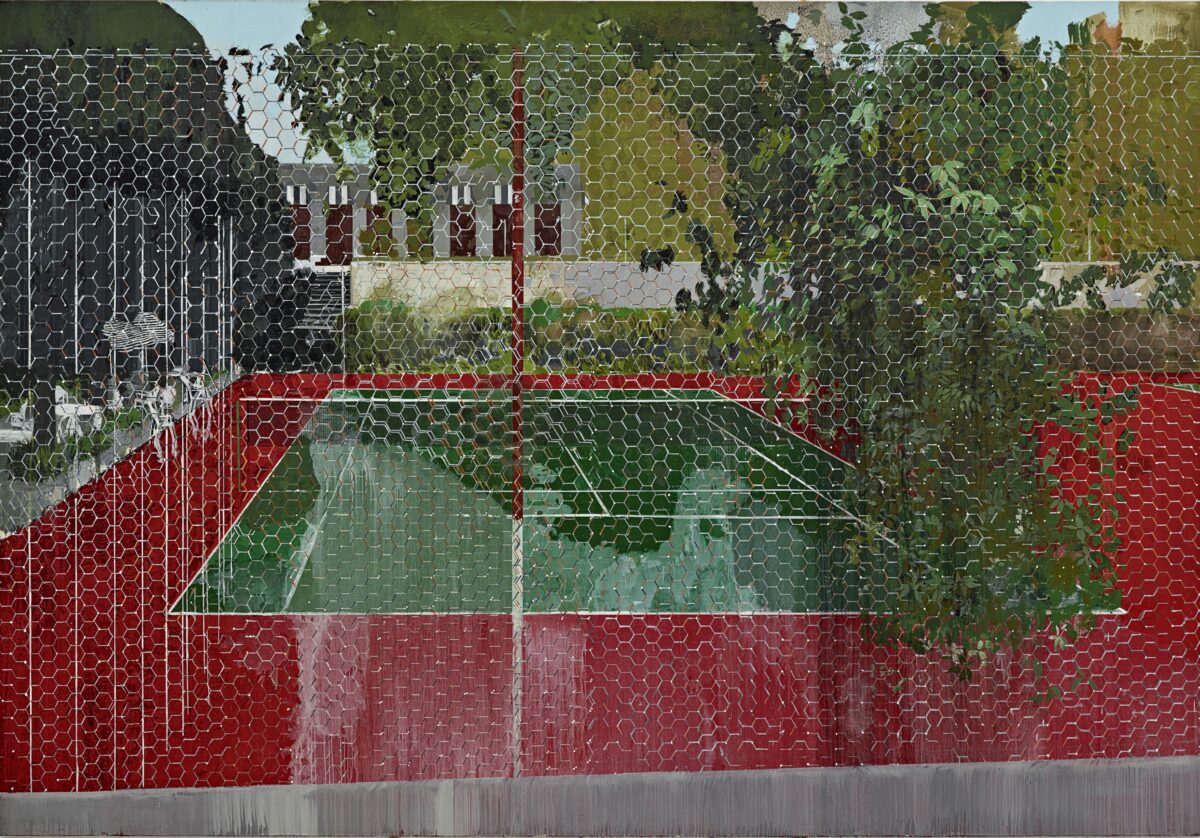
We are looking into a country club for the well off. We are outside looking in. In some other pictures, the grids dominate even more:
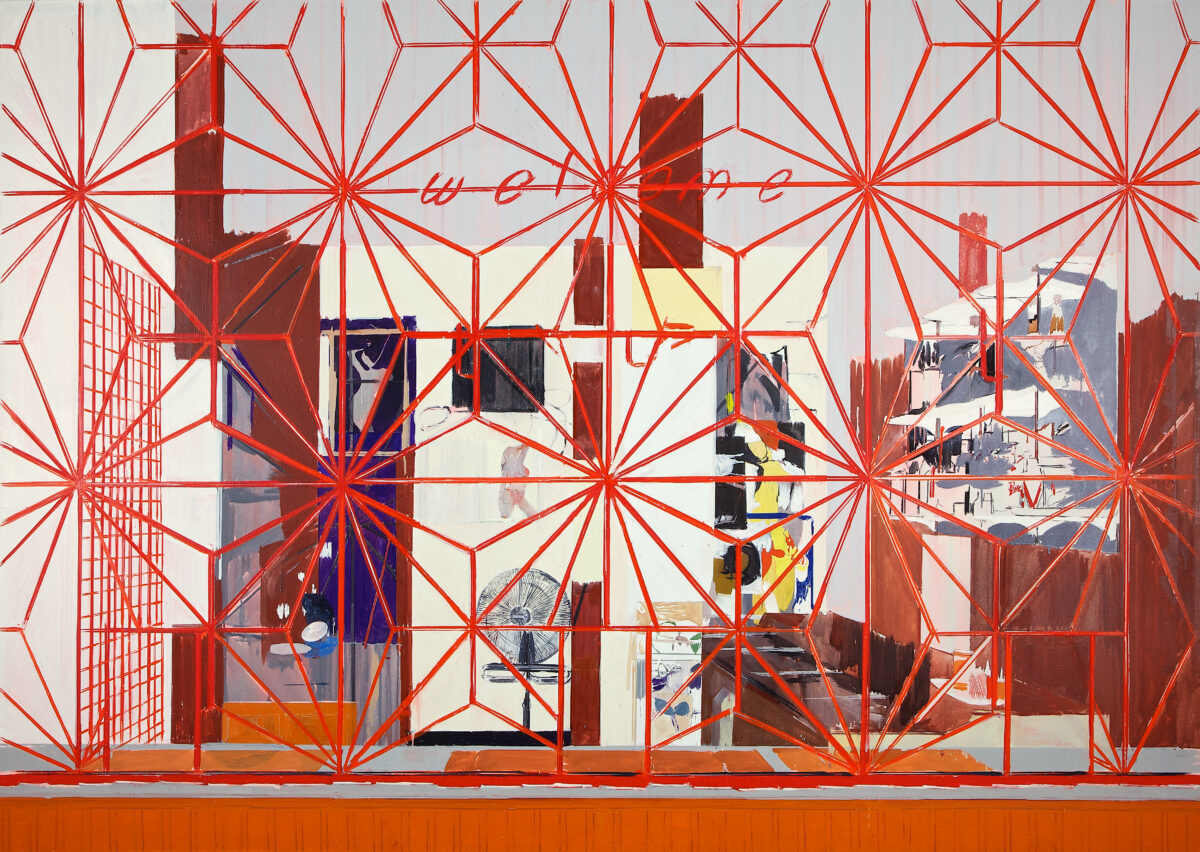
On a trip to Trinidad and Tobaga, Anderson was struck by how grids and grills intervened in front of his eyes as he looked at an urban or rural landscape. The grills are for security, we see them in the Mediterranean too where the warmer weather means there are more accessible balconies of houses. Colonialism was also all about fences and grills, keeping people under control. This dominant red grill almost transforms the landscape painting into an abstract one. Anderson plays creatively and effectively with different art genres.
Anderson was also fascinated by how many of the older hotels and colonial buildings which had become rundown were being invaded, almost taken over by the tropical vegetation. Does the vegetation represent a new order or a new chaos? Is it showing that we are in a post-colonial landscape today?
Irrespective of one’s political interpretation these paintings are really beautiful. This is the one that was chosen for the catalogue front cover.
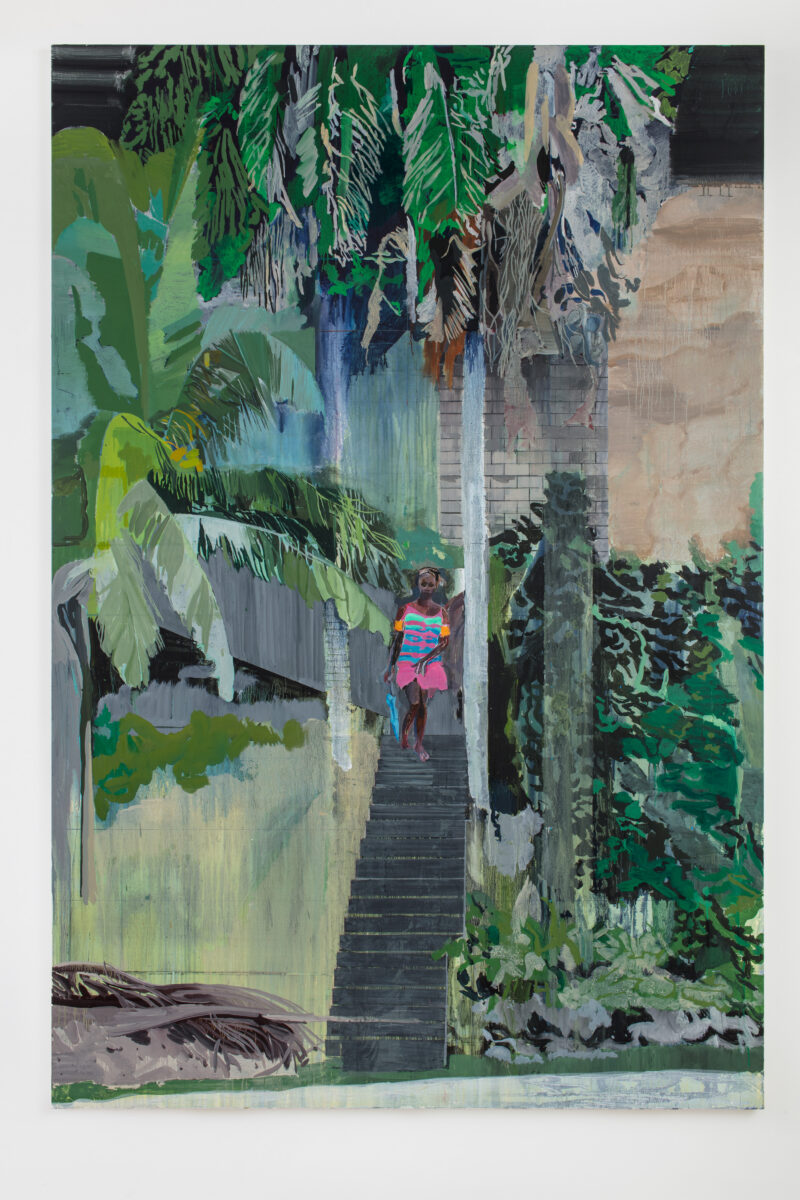
We see one of these dilapidated old buildings, overrun with various shades of green vegetation but right in the centre coming gracefully down the steps like some star or model there is feast of colour in the clothes of the young woman. The sumptious colours and greens assault one’s eyes. It exudes life and energy. The artist is supposed to have commented how in the Caribbean people wear bright colours amid the greenery.
“In Jamaica, people very rarely wear dark colours. There is always a brightness that projects them forward and it was irresistable to have this figure in this colour coming down these stairs”
Anderson , Catalogue p207
Another recurring topic in his art is the barber shop, an important space in Afro-Caribbean culture. There are a number of pictures in the show. Anderson plays particularly with the mirrors and adds his abtract blocks and lines into the composition. One picture (Is it okay to be Black?) has pictures of Martin Luther King and Malcolm X side by side. In others there is the introduction of Mondrian style blocks of colour:
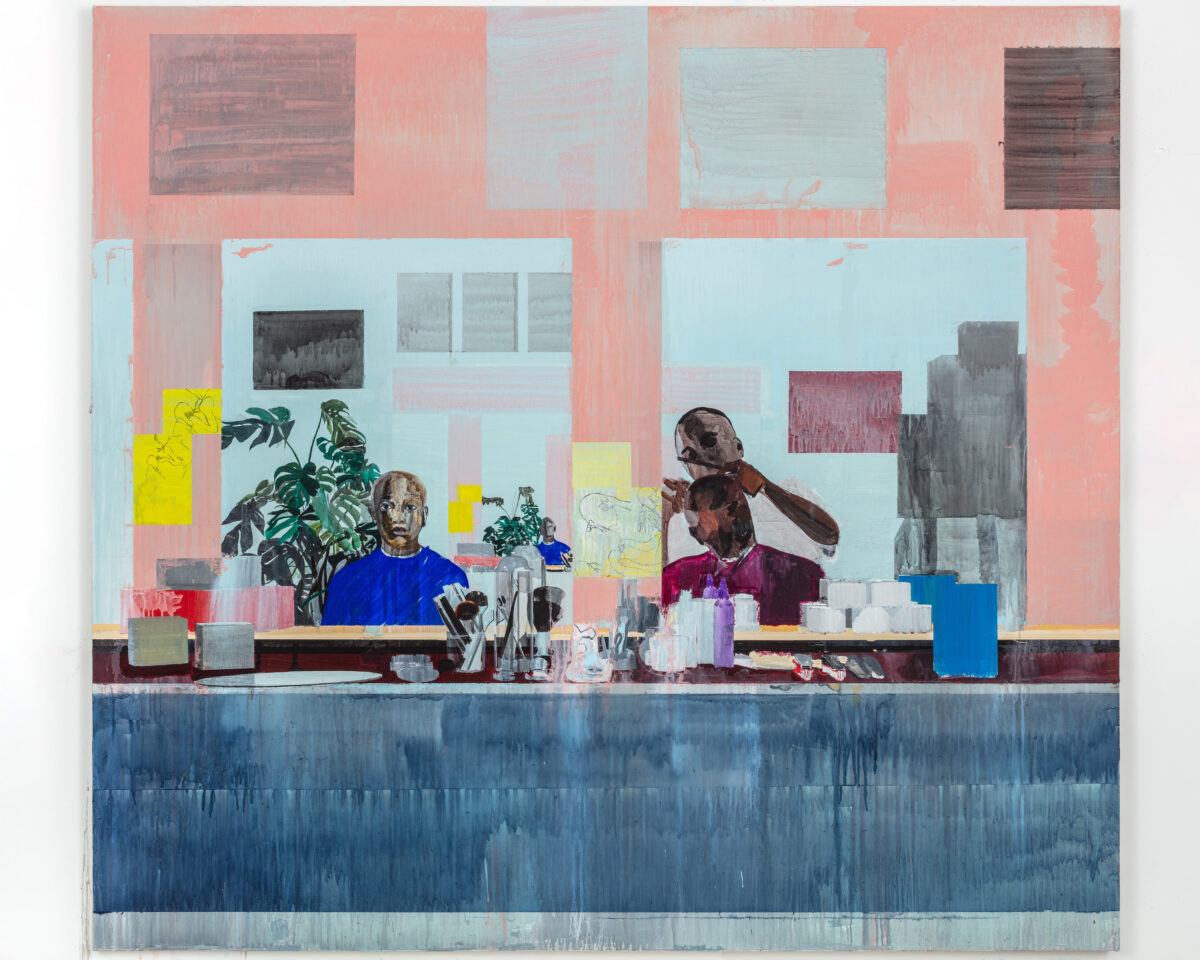
There is a very modern, abtract aspect to this figurative pointing. It shows you how different and often more complex a painting is compared to a photo. Yellow is used rarely but to great effect in this and otherpaintings – it is used in the headscarf of the Canadian picture or in just a little in the red grid one. It gives a point of focus. The subtle tones of blue work well together here.
The exhibition is like a love letter to his heritage, his family and community. It draws the viewer closer to the migrant experience without being over sentimental or glossy. In today’s racist political climate of hostility and othering of migrants and minorities this show is a worthy antidote. Anderson gives a hint of how we can all ‘own our days’