

In February I attended a No More Exclusions conference in Hackney, writes Inbar Tamari, a local National Education Union (NEU) and ACR member. Participants included young people who went through the system, teachers, youth workers, patents and councillors. There were around 50 participants. There were speeches, poetry as well as group based discussions developing a strategy for a better, more inclusive education system.
The Woods review
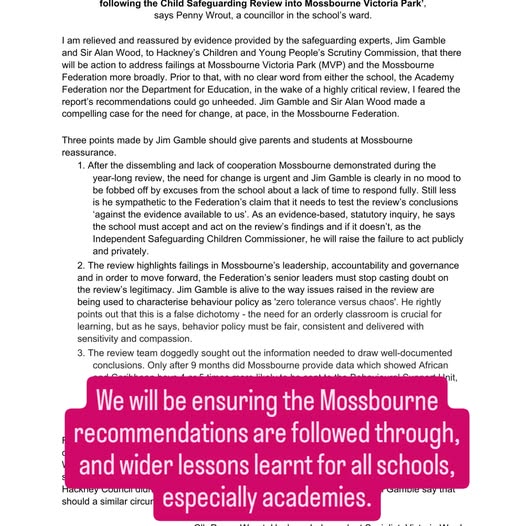
The conference was prompted by the publication of the Independent Local Child Safeguarding Practice Review in December 2025 instigated by Hackney Labour Council after pressure from parents disturbed about how their children were treated in the Mossbourne Academy federation schools in Hackney. Local socialist independent councillors also played an important role. This was mostly but not exclusively centred on the Mossbourne Victoria Park Academy (MVPA -pictured above). Sir Alan Woods led the enquiry that focussed on the school and federation behaviour management policy. Here is his overall finding:
(…) certain students, including children with SEND or from some ethnic groups, were “disproportionately impacted by sanctions”, with Black boys in particular subjected to “racialised language and microaggressions”.
While his review acknowledged the school’s “strong academic results”, Sir Alan said a “climate of fear” and “no excuses” had resulted in a “punishment no matter what” approach.
“Academic excellence that traumatises some pupils is not true excellence,” he wrote. “Discipline through fear is not preparing young people for life as confident, independent adults”.
Hackney Citizen, 9 December 2025.
The conference also heard from past pupils of the original Mossbourne academy which had featured a great deal in the mass media as an outstanding school taking Hackney pupils from deprived backgrounds into Oxbridge and the Russell group universities. The New Labour government of Tony Blair regarded it as the great example of its academy policy which removed schools from local authority accountability and installed partnerships with local businesses. Its Headteacher, Michael Wilshaw, was knighted and became head of Ofsted.
How the scandal emerged
Penny Wrout, who is an ex Labour and now independent socialist councillor, played a significant role in the whole process. In 2023 she had advocated for parents representing their son in a mediation meeting as part of a Stage 3 complaint and before a scheduled tribunal hearing (later cancelled). This experience revealed to her how serious the impact of Mossbourne behaviour policies could be.
In November 2023 she was introduced to Andy Leary-May via a mutual friend concerned about treatment of Special Educational Needs (SEN) children at MVPA. Andy is the parent who gathered all the information together, compiled the dossier and launched the Educating Hackney website. Penny immediately shared general concerns about the treatment of SEN children, using Andy’s son as an example. with Antoinette Bramble, the Hackney Council Cabinet Member for Education.
Andy’s son was then de-registered from MVPA to study for GCSEs at home. Andy gathered testimonies from other concerned parents. The Woods review has over 300 statements that make harrowing reading. Many of the ex-pupils explain how their psychological well being was affected later at university and even up to today. A particularly common traumatic event recounted by a number of female pupils was how the super-strict toilet policy meant they often soiled themselves when on their period – on occasion while being told to wait on a chair in the corridor.
The independent socialist councillors started to raise concerns in summer 24 and kept raising it with the council. The Review report came out at the end of November 25. The mainstream media such as the Guardian, Observer and BBC covered the story.
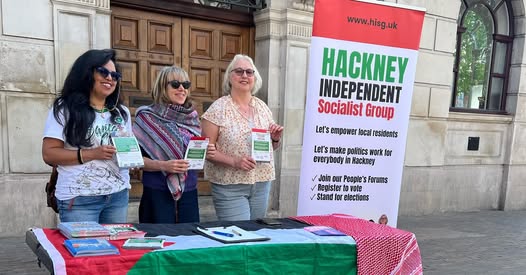
Penny Wrout on right
How did the behaviour management system work?
Teachers were told by the school leadership that fear was an element in their behavioural control system. ‘Mowing the grass’ was one term adopted – a punitive practice of shouting at kids and humiliating them in front of others. Zero tolerance across the board is damaging and can leave irreversible psychological damage. Hundreds of pupils regularly faced detention for the most trivial of offences which was also held on a Saturday morning. Teachers had to remove those pupils not doing work. Each time they break the rules pupils face sanctions. e.g. forgetting your pen. Teachers not doing it would be put on a support plan. Over the years disillusioned staff have reported on the heartlessness of it all. Staff were encouraged to buy into the academy culture. The National Education Union was weakly implanted compared to the average Hackney school.
I had direct experience of this, writes Dave Kellaway, when my son had his phone confiscated and I had to go up to the school at 4 pm to pick it up. I waited around 20 minutes and was eventually told I could not pick it up!
A close friend of mine of South Asian heritage was told in no uncertain terms that he had to come into school because of a serious matter regarding his son. My friend left work – he was a telecoms engineer – and found out his son was accused of putting graffiti on a book. His son denied it flatly and his dad believed him. The teacher was asked to compare his son’s writing with the graffiti. It was clearly not his doing. Basically school culture meant the teacher’s word always trumped the child’s.
Since I was a fellow head at the time I did have a few conversations with Michael Wilshaw. Certainly his system did achieve better than expected results for all classes of students. We know people who were keen to get their kids into Mossbourne as a route to Oxbridge. However, i had the impression that his take on the system he imposed was that it was only the liberal Hackney parents who did not like this regime. The Black and Asian families wanted strict discipline. Of course some parents from those communities do in fact support that approach. Others might consider this was a patronising stereotyping of these communities. In fact Sir Alan in his report said that the school particularly failed these communities who were over-represented in the negative testimonies he gathered.
Positive proposals from conference
At the conference there were workshops on Special Educational Needs (SEN), mental health and wellbeing and safeguarding. The latest government proposals now out for consultation will imply a major shift to integrating SEN students into mainstream schools. Socialists are not against this but it will mean a far greater investment in buildings, staff and retraining than the government is suggesting. Reducing the number of legally enforceable Education Care and Health Plans (ECHP) will save money from public funds and this is a government objective. However a recent report from the Parents Voice Project found only 38% of parents without ECHPs happy with the support they had in mainstream schools.
The experience of Mossbourne shows even those schools with good and outstanding Ofsted verdicts are often failing to meet the needs of SEND pupils. Any practicing teacher will tell you that if their school’s viability, and ultimately their own job, depends mostly on the public exam results, then there is pressure to put most work into those pupils who are good at exams.
Other speakers at the conference argued for the need to decolonise the whole system. It was not enough to decolonise the curriculum we need to do that with the whole system. It is built on repression in the public school system and the historical experience of colonisation.
Schools where pupils voted on their own relationship/behaviour policy said they preferred no rewards and no punishment. A councillor from Islington Community Independents stressed the need to build a parents and carers union to empower parents and carers who know what their children need. Young people want to be involved as well.
As one participant recounted it is not just the external exclusions you have to examine. Islington for example say they have no exclusions but schools encourage off rolling and have internal exclusion rooms. Off rolling is where heads convince parents to home school and so lower-performing students will not affect the school’s exam scores. Internal exclusion rooms can have students staying out of lessons for days at a time.
A defensive response from Mossbourne
The Hackney Socialist independents and Green councillors are following the report up hard. However since then councillor Bramble has met with the schools’ executive leaders but has not exactly got very far. A board has been set up involving the council, the academy and the Department of Education to follow up the review. The terms of reference and objectives of the Board are unclear. A lack of transparency and brutal defensiveness is still being shown by the Federation. An Implementation Committee was set up last week which includes the director of education from Hackney and Thurrock (where the academy has schools) as well as a qualified social worker. It is chaired by Toby Campbell Gray and ‘reports through the Federation’s established governance structures’.
Gray has also replaced Henry Colthurst as the chair of the Federation board. Colthurst resigned at the beginning of March, his position had obviously become untenable.
The Hackney Citizen reports:
Andy Leary-May, the parent who gathered the hundreds of testimonies that triggered Sir Alan’s review, said bluntly: “This isn’t what was needed.
“I wrote last week to the Members of the Federation suggesting that an apology and acknowledgement of the experiences of pupils and families would help to rebuild trust — this does not do that.
“The statement does not even name or meaningfully engage with the safeguarding review itself, nor respond to the detail of its findings or recommendations.
“Instead, it relies on high-level language about governance and process, much of which was already reported weeks ago.
“In several places, the wording appears to implicitly refute or dilute the review’s conclusions.
“There is no acknowledgement of its central finding — that some pupils were harmed — and no recognition that change is required in response.”
Penny Wrout has criticised the new Implementation Committee for having no parent representative and no elected local member.
Previously the Federation, once it knew there would be a review, set up its own enquiry led by a barrister, Anne Whyte KC, at a cost of nearly £200,000. The workings of this enquiry have not been disclosed other than its conclusions were a lot less damaging than the Wood review. A further £200,000 was spent in legal fees by the Federation with reference to the reviews. For instance Alan Woods had to go through the school’s lawyers at all times in his work. Of course these astounding sums are public money. It shows how much money such Federations can accumulate from public funds and how they are able to spend it without much public accountability
End the unaccountable Academy system
At the heart of this crisis is the Academy system itself. It means these schools are not really accountable to local councils which are a basic form of local democracy. The local authority appoints no governors. The academy governors are less likely to criticise the leadership particularly if they get good academic results and Ofsted reports. Academies report directly to government although the council has some responsibility for SEND matters hence its intervention (after a public outcry) here.
The Ofsted system has also been exposed since during all this period when SEND and other pupils were being failed this was not recorded in the reports. We need a different assessment system for schools that works in partnership for improvement rather than judging in league tables.
Keep profit making out of education
Mossbourne, like a number of other academy federations, has also seen leadership taking advantage of their autonomy to make legally lucrative business deals for themselves or their families. The local newspaper, the Hackney Citizen, has the front page story this week on the way Peter Hughes, the current CEO of Mossbourne, has a private company called Progress Teaching Ltd. This company has acquired the intellectual property rights of a software system developed through the Mossbourne Federation charity (i.e. non profit) which has been sold to 60 or so schools. Hughes’ company paid for this deal through a promised loan (subsequently paid) and 1000 shares.
These shares were valued at £300,000 at that time. Subsequently they somehow have lost £200,000 in value which seems like a bad deal for the charity. The charity involved in this was shut down and then re-emerged phoenix-like a year later. The Charity Commission is investigating. There is no evidence that Mr Hughes has done anything illegal.
A society dominated by capitalist corporate logic will naturally lead to the scandal of neglecting SEND or minority ethnic pupils and having school leaders with business ventures who do not accept in full the conclusions of an independent review. Labour, as in everything else, prefers a partnership with capital, linking schools to business, than developing an education system that is truly accountable to parents and our communities.