

The moment worth remembering is not the Piers Morgan exchange, though that one will last. It is the Cardiff speech, buried in Chapter 8 of Gregor Gall’s new study, where Lynch tells an audience that the organised far-left, the figures with the plastic bags and the pamphlets, will never deliver a working-class turnaround. Working-class people educate each other, he says. Not through theory. In the pub. At the football. It is an authentically felt position, not a rhetorical device. And it is, politically, a confession.
Gall is a careful scholar. His book is both a celebration and a critique of its subject, as he says plainly in the introduction, and he means both. The analytical framework, built around Lukes’s three faces of power, the resources of associational, structural and institutional capacity, and a typology of union leadership functions, is deployed with genuine rigour across 270 pages. The result is the most systematic account we are likely to get of how Lynch became, in the summer of 2022, the most consequential figure on the British left who was not a politician. That is the subject’s importance, and Gall understands it.
What political instrument does the working class need?
What the book cannot quite accommodate, however, is the question the Fourth International framework poses directly: why did ‘power to’ so consistently fail to become ‘power over’? Gall circles this question. He documents it meticulously. He does not resolve it, and the reason he cannot is that resolution would require engaging with the strategic category Lynch himself rejected: the question of a political instrument for the working class independent of the Labour Party, capable of transitional demands rather than redistributive appeals.
Lynch’s politics, documented here in extended passages from interviews, speeches and union conferences, are not complicated. He is a reformist in the Attlee tradition, an ‘assertive democratic socialist reformist’ in his own formulation, which means he believes the working class advances through ‘pragmatic reforms to our system’ delivered primarily by a Labour government guided by ‘redistribution’ as its first principle. He admires Harold Wilson. He extols Scandinavia. The abolition of poverty, not the self-emancipation of the working class, is his horizon. He said so repeatedly, on the record, and Gall quotes him at length.
There is nothing dishonest about this. What is dishonest is the media construction of Lynch as a dangerous Marxist revolutionary, and Gall is right to document and dismiss it. But the opposite error, the one the Morning Star and Socialist Appeal committed in real time, is to misread rhetorical combativeness as programmatic radicalism. Lynch’s language was sharp. His politics were not.
Strike funds
The problem surfaces concretely in the dispute itself, and it surfaces in a form Gall’s book documents but does not fully excavate: the strike fund question. The RMT is a wealthy organisation, its assets held substantially in stocks and shares. Unite pays its members £70 per day from day one of any official dispute, on application and without income assessment. The RMT operated a tiny Disputes Fund, subject to a means test, which left striking members bearing sustained income loss during protracted action. Gall, in correspondence after completing the book, is direct about the consequence: the stop-start rhythm of single-day strikes, long pauses, and renewed mandates suited members’ anxiety about wages precisely because the leadership had declined to build the financial infrastructure that would have enabled escalation.
Gall raised the question with Lynch directly. He reports that Lynch’s response was dismissive, deflecting rather than engaging the argument. It is, whatever the precise words, a characteristic move: Lynch regularly deployed the charge that critics had never held real responsibility, never run anything, never been on the tools. Turning that deflection on an academic who had spent years documenting the dispute in granular detail is revealing not because it is unusual but because it is so consistent. A leader confident in his strategic choices engages the substance.
Gall’s own evidence in the book confirms the pattern at the bargaining table. By January 2023, Lynch told a parliamentary committee ‘there aren’t going to be any more [RMT] strikes’, was overruled by the NEC, and then accepted a Network Rail settlement the RDG’s own chief executive characterised as ‘sub-inflation’. The deal that ultimately ended the TOC dispute was ‘essentially the same one’ offered in the summer of 2022, according to one rail executive. Two years of membership sacrifice and public solidarity for something that was on the table at the beginning. The RMT estimated its members’ indemnity fund losses approaching £1,000 million by early 2023: money the train operators did not lose, because they were indemnified from strike losses, while RMT members absorbed the cost of their own dispute without financial backing from an organisation wealthy enough to provide it.
Pushing Labour, not replacing it
Consider what Lynch chose not to do beyond the strike fund. The RMT’s disaffiliation from Labour in 2004, under Crow, opened the possibility of independent political action. Lynch supported reaffiliation in 2018; the membership voted it down. He opposed motions at the 2021 AGM calling for support for Corbyn to stand independently, backed withdrawal from the Trade Unionist and Socialist Coalition steering committee, and rejected proposals for a conference on a new union-based party. When the strike wave came, his political response was Enough is Enough!, explicitly not a political party, designed to push Labour rather than replace it. By the time Starmer had consolidated his grip, Lynch was arguing it was in the ‘class interests’ of RMT members to elect a Labour government. Which duly arrived. And immediately confirmed every prediction his predecessors under Crow had made about Labour’s relationship to organised labour.
None of this is Gall’s analysis; it is what Gall’s evidence compels. He describes Lynch’s politics accurately: ‘old Labour’ social democracy, Attlee and Wilson as heroes, progressive taxation as the supreme mechanism of equality. What he cannot quite bring himself to say is that this political framework was not merely insufficient for the moment. It actively reproduced the very problem it was invoked to solve. Labour’s ‘evisceration’ of social democracy since the mid-1970s, which Gall correctly identifies, was not an accident that a more forceful Lynch could have reversed by pushing harder. It was the structural consequence of reformism losing the capacity to deliver reforms. That capacity does not return through nostalgia for Harold Wilson.
There is something genuinely admirable about Lynch, and Gall captures it. He came up through the blacklist, took a history degree at the LSE while unable to find employment, organised the Eurostar branch from scratch, warned his own union in 1992 against sweetheart ‘check-off’ agreements at the expense of shop steward organisation. His instinct for collective action is real. His contempt for the vacillating layers who talk socialism in meeting rooms and capitulate to management at the table is honest. His media performances were, for a sustained period, the most effective demolition of ruling-class common sense that millions of British workers had witnessed in their lifetimes. That matters.
The hero form itself is a problem
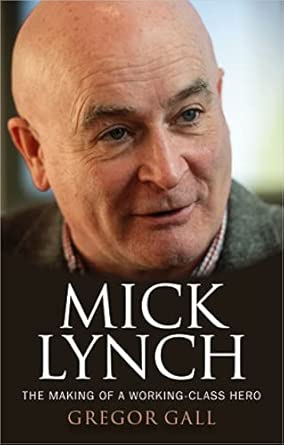
But the book’s subtitle is ‘The Making of a Working-Class Hero.’ The question it raises, without quite answering, is whether the hero form itself is the problem. Lynch’s own formulation, that working-class emancipation must be ‘the act of the workers themselves’, is correct. His practice consistently contradicted it: centralised leadership over an NEC he periodically attempted to bypass, a ‘top and front’ style that Gall gently identifies as carrying ‘authoritarian and autocratic aspects’, a strategic frame that placed Lynch’s negotiations at the apex of the dispute rather than the mobilisation of members as its driving force, and a deliberate refusal to arm those members financially for the prolonged struggle the moment required. The Redskins’ line quoted by Gall, ‘take no heroes, only inspiration’, turns out to be more than a slogan. It is a strategic argument.
Gall’s book is not a Trotskyoid polemic. It does not pretend to be. Within its own terms, as an academic study of union leadership, working-class identity construction and the political economy of the 2022 rail strikes, it is exemplary: dense, honest, methodologically transparent, willing to follow the evidence wherever it leads. The conclusion, that the RMT found itself ‘between a rock and a hard place’ even with Lynch at his best, is exactly right. The question left hanging is what kind of political formation could have changed those material coordinates. Gall’s framework does not address it. Lynch’s politics actively foreclosed it. That gap is not a criticism of this book. It is the argument the book makes possible.
Gregor Gall, Mick Lynch: The Making of a Working-Class Hero, Manchester University Press.
From Duncan Chapel’s Red Mole substack