


Sixteen days. That figure is worth holding onto, because it is one of the few things here that is not contested.
The sequence
Gender-critical members objected that this election was unlawful in light of For Women Scotland v The Scottish Ministers, in which the Supreme Court held in April 2025 that “man”, “woman” and “sex” in the Equality Act refer to biological sex. “The party leadership cannot simply ignore the law,” said Jude English of Green Party Women. The party replied that its elections are held “in accordance with our rules and constitution,” that it always acts within the law, and that trans women are women.
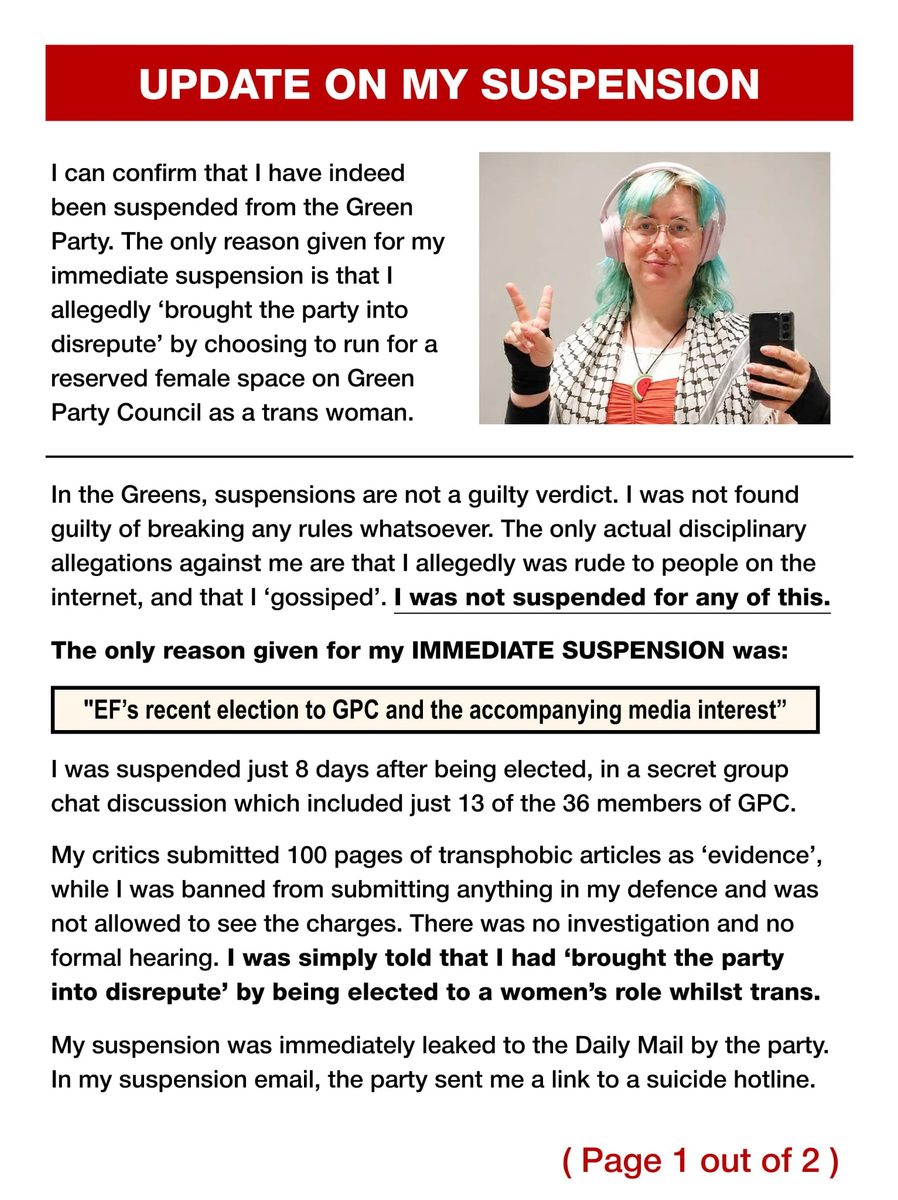
Then, in early September, the objection became a legal threat: gender-critical members were reported to be consulting lawyers over the election. Within days, Eleanora was suspended. The party says that it does not comment on disciplinary matters.
The party defended the election. It was then told the election would be litigated. It then removed the person elected.
A Green Party member in the Eastern region, whose electorate this was, makes one further point: the complaints followed the win. They did not precede it, and nothing new prompted them. Folan had stood openly as “a proud anti-Zionist trans woman”, on a manifesto promising to defend free speech on Israel, to support members “attacked and smeared by the feral Zionist press,” and — the line worth keeping — to “ensure all our members follow the same rules.” Nobody in East Anglia was under any illusion about what they were voting for.
Her opponents make much of the turnout, which was 8.27%. They are right that this is a thin mandate, but not unusually low compared to other large membership organizations, such as trade unions. They are also wrong about what follows from it.
What she actually said
Her politics are hard for some GPEW members to swallow, and were entirely public. She praised “the Iranian resistance, whose courageous fight against the imperialist dogs of the USA has utterly humiliated the Great Satan,” and has argued that Labour is more culpable than Tehran. That is not the position taken here, but it has a long history on the British left and was argued under her own name.
Two other statements are harder, and the left should not pretend otherwise. Describing all Israelis as “bloodthirsty child-killers” is a claim about a population of ten million, not a government. And while the argument that the cross-party antisemitism crisis in 2018 was inflated and factionally deployed against Labour’s then-leader, Jeremy Corbyn, is entirely respectable — the Forde Report found that “both factions treated it as a factional weapon” — the formulation attributed to her, that it was “invented by the Zionist lobby,” is not that argument. It swaps nameable actors, each of whom can be criticised and held to account, for one unseen agency operating across press and state. Nobody in this tradition defends it
Say all of that, and the case for what was done to her is not weakened. It is what makes the case. Because the party’s own constitution says how a member who says objectionable things is to be dealt with, and none of it happened.
Two doors
The Green Party has a procedure for complaints. A Disputes and Complaints Referral Group decides whether a complaint is properly grounded — the grounds being contravention of the constitution, or breach of the Code of Conduct — and refers it, or dismisses it. A Disciplinary Committee of twenty-two, two elected from each region, then hears it, but only “where mediation has been declined or been unsuccessful.” Its decisions can be appealed to the Council’s Appeals Subcommittee, including on the ground that the process “was procedurally unfair to the member.”
The constitution also tells that committee what it may not treat as sufficient. Clause 4(ix): “A diversity of opinions is likely to exist within any organisation, and political difference should not automatically be the basis for expulsion of a party member.”
There is a second door. Clause 4(viii):
“The Green Party Council… shall have the power to expel or suspend any person from membership… if in its opinion it is in the Party’s interest to do so. Where necessary to avoid or reduce the likelihood of further harm to the Party, a member under investigation may be suspended temporarily by decision of the Council or those members of it empowered to act on its behalf.”
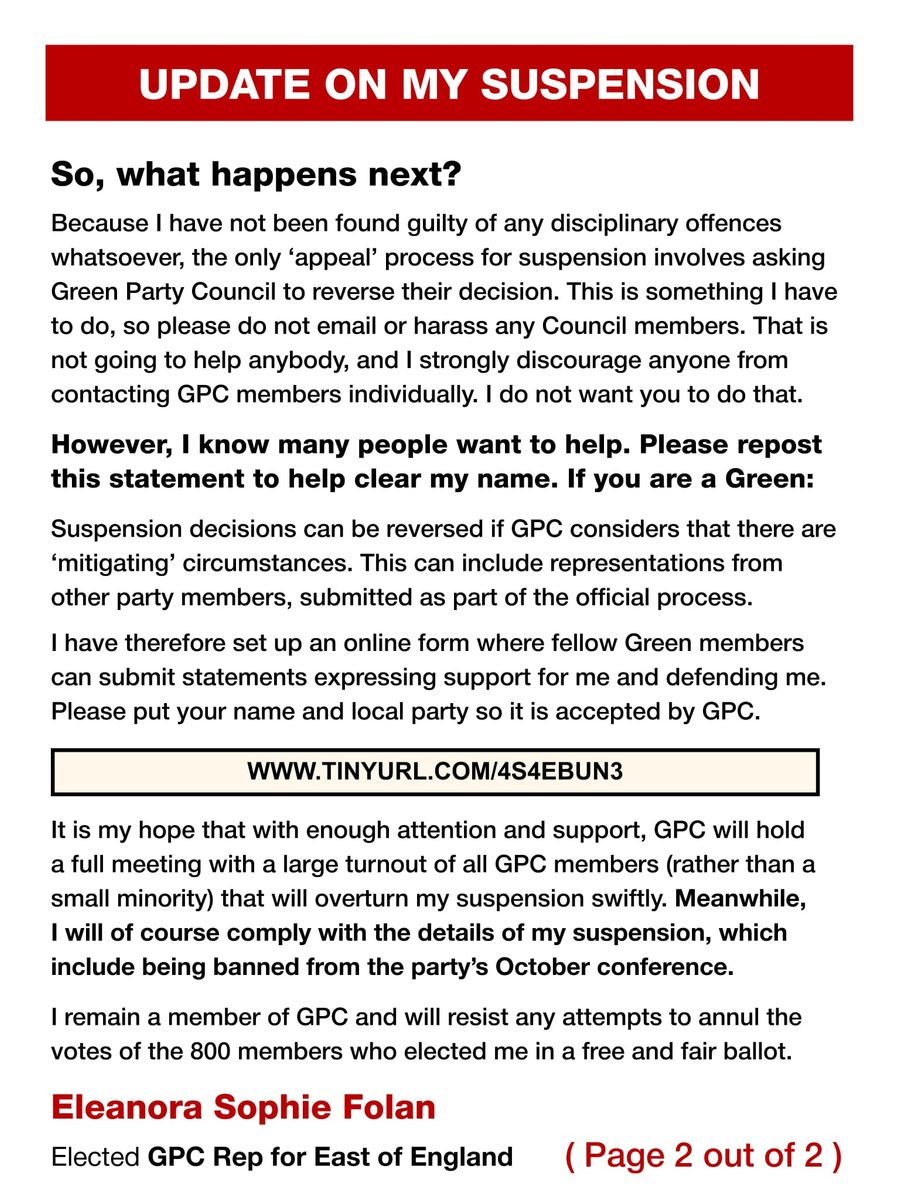
Read the two side by side. The first door has a grounds test, mediation, a hearing before twenty-two elected members, and an appeal. The second has no grounds test beyond the Council’s own opinion of the party’s interest, no hearing, no stated appeal — the appeal right in the constitution runs against decisions of the Disciplinary Committee — and need not even involve the full Council, since members “empowered to act on its behalf” will do.
Now set beside both the clause that governs removal from the Council itself, 6(x): the Council may suspend a member from office “by a two-thirds majority of its voting membership… if there is evidence of sustained conduct which in the opinion of the Council is against the interests of the Party, subject to the right of such a member to appeal.” A supermajority, a requirement of sustained conduct, an appeal.
Folan lost her seat without any of that. Membership carries the entitlement to hold office; suspend the membership and the office goes too. The route that removes a Council member has three safeguards. The route that was used has none, and reaches the same place.
And it is worth noticing what triggers the temporary power: harm to the party. Where a member is the target of a press campaign, that campaign supplies the harm. The more effectively someone is attacked, the stronger the case for suspending them — and anyone who wants them gone need only generate the coverage first.
Who solicited the complaints
On 27 May, the group GnasherJew published a dossier on Folan. Some of it is weak — it calls a misattributed strike in Iran “Holocaust distortion” and closes by likening her to the Nazis. But note how it ends: “Please submit a complaint to the Green Party concerning Ell’s online conduct, and report the matter to Norfolk Police as a potential case of stirring up racial hatred.” Twelve weeks before the election.
So when complaints arrive within days of a result, the question is not only who sent them. It is whether anyone asked why a complaint of such volume was available on demand, directed at a member the electorate had just chosen with all of this already in public view. Under the first door, the Referral Group would have had to decide whether those complaints were properly grounded at all. Under the second, nobody has to ask.
It also leaves the motive permanently unresolvable. One account says she was removed for being trans; the press framing says antisemitism. The member quoted above, who watched the complaints arrive, cannot tell which, or whether both — and says so. That honesty is worth more than either confident version. But it is the procedure producing it. A named charge, heard, would force the party to say which. “In its opinion… in the Party’s interest” never has to.
Whose judgement this is
None of it is new. In April, candidates were suspended after a Greens for Palestine meeting was leaked; deputy leader Mothin Ali told members to take legal advice, because “it won’t be the end. They’re coming after more and more people.” Between 2022 and 2024, more than twenty went the other way — Shahrar Ali won his claim, Alison Teal spent nineteen months suspended. The substance is not equivalent. The second door is the same door, and it is always available to whoever holds the committee majority. Conference opens in Brighton on 2 October, and the leader isseeking to stand in the Holborn and St Pancras by-election. A party in that position has an acute interest in unwelcome stories closing quickly.
So, for the Council and the Executive. Was the complaint referred to the Disputes and Complaints Referral Group, and did it find grounds? Was mediation offered, as clause 4(ix) requires it to be considered? Was Folan suspended under 4(viii) rather than through the Disciplinary Committee, and if so, by the full Council or by members acting on its behalf? What appeal does she have, given that the constitution’s appeal right runs against Disciplinary Committee decisions? Did anyone establish how many complaints originated in a campaign that solicited them in May? And was the legal threat over her election before whoever decided?
There is one more clause. Under 9(vi), if 5% of paid-up members in a region petition their Regional Returning Officer about their Council representative, the seat goes back to election. If 8.27% turnout makes her mandate thin, 5% of the region is the answer the rules already provide, and it belongs to the people whose seat it is.
A mandate is not an indemnity. It cannot cover what nobody could have known. It covers this: material that was public, under her own name, months before a ballot was issued, and read by the people who voted anyway. Whether a woman who said those things may represent East Anglia is a question for the members of East Anglia, and their constitution gives them the means to answer it.
They were not asked. That is the story.
Postscript: Ell shared this statement while we were preparing to post this article
How the hell can you defend this disgusting apologist for the Iranian regime? Nothing to do with the person’s gender identity: everything to do with their support for the misogynistic Iranian regime, just as it is executing women protesters. This person should be ashamed, and deserves no support from the left.