
Now let us mobilise to bring down the government, stop the war and rearmament, and reclaim the civil and social rights taken from the working class!
Press release from the national leadership of Sinistra Anticapitalista published on 24 March 2026
The result of the referendum has resoundingly rejected the Meloni government’s subversive plan. The 15 million ‘NO’ votes in the confirmatory referendum (53.5%) prevailed by over 2 million votes and with a seven-point lead over the ‘YES’ votes.
The 59% turnout marks a break from the trend towards abstention, particularly in recent referendums. The ‘No’ votes alone roughly correspond to the total number of voters in the referendums proposed by the CGIL in 2025 on precarious employment, public contracts and citizenship. Obviously, the call to arms issued by the ‘Yes’ campaign, particularly by right-wing political forces, contributed decisively to this result.
However, the result overturned the political predictions of the right-wing majority, which had strongly pushed for this referendum, confident of its victory. The constitutional reform of the CSM (Superior Council of Magistrates) was approved by the Council of Ministers and passed without a single amendment being adopted during the two parliamentary readings. In the second vote, the constitutional reform was approved by the absolute majority of MPs held by the right-wing majority, without any attempt to secure the two-thirds qualified majority that would have avoided the referendum. Indeed, the referendum was first called for by right-wing MPs themselves, who had hoped to swiftly wrap up this part of their subversive project.
Part of three constitutional changes
The first constitutional change they wanted, which they thought they had secured and which they are still pursuing today, was that of the differentiated autonomy of the regions. This was essentially rejected by the Constitutional Court, but the government continues to pursue the project by signing implementation agreements with the regions. The second constitutional change would have been the subjugation of the judiciary to the executive power comprising of:
*the division of the CSM into two bodies
*the introduction of a lottery system for selecting its judicial members,
*the creation of a Superior Disciplinary Court, also selected by lottery,
*together with another constitutional revision proposal already tabled in Parliament which openly proposed subordinating the investigating judiciary to the Government.
The third constitutional change would have been the transformation of the parliamentary republic into a substantially presidential system, the so-called ‘premierato’, which would provide for the direct election of the head of government. Alongside the government also wanted to introduce a strongly majoritarian electoral reform, with the introduction of a majority bonus of up to 60% for coalitions obtaining 40% of the vote or even just 35% with the introduction of a second round of voting. A plan that fits into the fascist and P2 (a secret masonic lodge of neo-fascist leaders in key state positions influential in the 1970s) tradition of a bourgeoisie seeking impunity and obsessed with ‘governability’ and the repression of social movements and the demands of the oppressed and exploited.
Setback for the right
Today’s popular vote marks a major setback for this project. In 2022, the political forces of the right had secured a parliamentary majority with over 12 million votes (and a turnout of 64%, even higher than that of today’s referendum), to which must be added the nearly 3 million votes for Più Europa, Italia Viva and Azione, which were also largely aligned with the ‘YES’ vote. Today, these forces have secured just 13 million votes, compared to 15 million ‘NO’ votes. This figure bears witness to another indisputable fact: the current Parliament is not representative of the electorate and should therefore be dissolved, with new elections held as soon as possible.
The Parliament is not representative for two main reasons.
The first reason concerns the electoral law under which it was elected. A law that establishes, through single-member constituencies, a first-past-the-post electoral system, thanks to which the right-wing parties, despite having secured around 44% of the vote, obtained an absolute majority of seats. It enabled them to pass a constitutional reform – a key part of their electoral programme – which was then yesterday rejected by the public referendum. It is therefore necessary to proceed with electoral reform that reintroduces a proportional electoral system, in which the distribution of seats in Parliament is proportional to the votes obtained at the ballot box.
The second reason relates to the Government’s actions, which in recent years have significantly worsened the living and working conditions of vast sections of the population, by continuing with capitalist austerity policies and enacting security measures that have curtailed the freedoms of workers, migrants, women and anyone who attempts to challenge the established order. Meanwhile, wages continue to lose purchasing power and the safety of workers is increasingly at risk. On the very day of the referendum, yet another report emerged of a young worker crushed by industrial machinery in the Padua area.
International solidarity helped us win
Above all, this government has aligned itself with the imperialist arrogance of Trump and Netanyahu. It has made itself an accomplice to the genocide in Palestine by continuing trade relations with Israel and even supplying weapons that have been used in Gaza. Meloni has remained silent on Trump’s international crimes in Venezuela and Iran, on the US’s aggressive trade policy, positioning itself in Europe as the American tycoon’s main interlocutor. The government is helping to dismantle energy transition policies and supporting the European Commission in its mad arms race.
The solidarity movement with Palestine that emerged last autumn was a first major sign of the right-wing’s loss of support among the masses. We saw the participation in demonstrations and strikes of many workers (especially in sectors such as education and transport) but above all of many young people, who proved decisive yesterday in the referendum result. Only the short-sightedness of party and trade union leaderships prevented that movement from continuing to make its voice heard in the months that followed. Nevertheless it is clear that something is smouldering beneath the surface in terms of a readiness to mobilise and a desire for radical change. We saw this too in the protests against the Bongiorno bill on violence against women and in demonstrations on the 8 and 9 March.
Let’s build 28 March demo
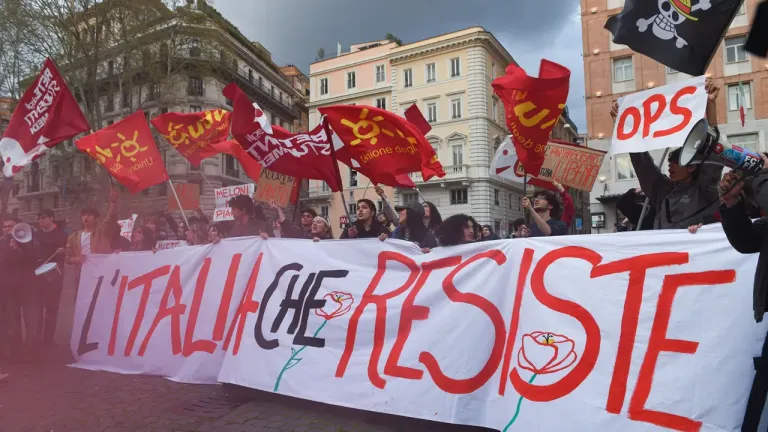
Next Saturday, 28 March, there will be a major national demonstration in Rome against war and rearmament. It is part of the global mobilisation Together No Kings, with demonstrations also taking place in the UK and the USA, organised by a new generation of activists and social campaigners:
*those of the Global Sumud Flotilla, which is preparing to set sail again the following day,
*the Stop Rearm Europe network,
*the A pieno regime network against security measures,
*and the many social and political forces of the class-based left that are driving the disputes and mobilisations taking place in Italy today.
This will be a decisive opportunity to demonstrate in the streets the true opposition to the reactionary right-wing. This is an opposition that begins with the struggles to build a radically alternative political vision. It is unlike that of the so-called broad coalition of parliamentary opposition parties, which are subordinate to the neoliberal bourgeoisie. When these forces were in the majority they laid the foundations for the implementation of the right-wing policies now being pushed by Meloni and her associates.
Only mass mobilisation can defeat the neo-fascist project of the right at its roots. The result of today’s referendum and the success of next Saturday’s demonstration must form the basis for a resurgence of social struggles:
*for the reclaiming of wages, safety and rights in the workplace,
*for the revitalisation of public services starting with education and healthcare,
*and for the building of peace and solidarity among peoples and among the working classes globally, to defeat the policies of rearmament and war, against kings and tyrants!