

Pro Kremlin snipers shooting demonstrators in Maidan square 2014 … preparations for a pro-Russian government held in a hunting lodge while Putin’s army advances on Kyiv in 2022 … the anguish of a young Ukrainian man who does not want to fight … three Ukrainian soldiers and a dying North Korean face a moral dilemma … a desperate mother trying to find her daughter abducted to Russia.
These five plays take us on a journey through Ukrainian history from the Maidan square’s mass uprising for a democratic Ukraine to the horrors of the war today as Russia illegally removes 20,000 children from their families.
Nicolas Kent wanted to repeat the artistic feat he carried off twenty years ago when he put the history of Afghanistan on stage during the US/British intervention. The Great Game –Afghanistan ran to 12 half hour plays and it played at the Tricycle Theatre in London and four cities in the USA. Even the USAID and Pentagon requested a performance!
Kent has also produced plays on contemporary events such as Grenfell and Bloody Sunday. His work is always based on meticulously researched accurate detail. Often he uses official documents or court/inquiry proceedings. Nobody has seriously questioned the integrity of his work.
Consequently Ukraine Unbroken provides us with a brilliant exposition of the complexity and contradictions of the conflict. It confronts the mythology of Putin and the campist left that it is a proxy war, that Putin is resisting an imperialist threat, that fascists are dominant behind Zelensky and that each side is as bad as each other. The argument is not abstract but expressed in human interaction and emotion. It is never sentimental or simplistic.
Repression on the Maidan
The first play shows how Ukrainians were divided over the Maidan uprising. We observe a member of the government who comes to a hotel on the Maidan to try and get his son away from the protest. He has heard that there were plans to clear the square. The boy’s mother is much more sympathetic to what her son is doing, she wants a new Ukraine too. We know that his dad has benefited from corrupt deals, acquiring privatised factories.
Abruptly two Kremlin agents arrive and we work out that they want to use the hotel room to start shooting the demonstrators. They had been informed the government MP was there. The father had not realised the full plan and vainly attempts to buy them off. They offer the parents the chance to phone their son and get him out. His mother refuses, siding with the struggle in the square. It is on the historical record that 40 odd protesters were shot in this way, triggering the flight of the pro-Kremlin president, Yanukovyich, and Putin’s invasion of Crimea.
Training the quislings
The breathless drama packs in a lot of politics and keeps you totally involved. We then move ahead to February 2022 and the Russia march on Kyiv. We move from the hotel room to a hunting lodge forty kilometres from Kyiv. People arrive one by one and they all use code names like Alpha, Victor and so on.. Gradually it emerges that these are the people being lined up to form the new pro-Kremlin government. It is like a training day so that they would present well to the national and international media. They rehearse how to justify the special military operation.Of course reality filters in when they find out that the Russians are not able to secure the airport which would enable them to fly in the troops they need to take Kyiv.
This playlet was written by David Edgar and is particularly effective. There is some black comedy as these characters jostle to get the best posts or make unintentional lapses from the required propaganda. One of them goes a bit rogue and as reality sets in they realise that they are not going to Kyiv but over to Moscow
Understanding cowardice
Perhaps the most creative and emotionally harrowing play is a near monologue. A young Ukrainian does not want to fight. He is alone in a darkened room unable to sleep after waking. We hear about his group of friends who had been together in the music college. One had paid 15,000 euros to escape to Vienna as there is conscription. The other is someone who hardly ever comes back on leave from the front line. At the same time the sirens go off and bombs explode. We see a woman in the bed beside him but we soon realise this is imagined as she remains silent throughout. She is a refugee in London. You understand how hard the war is for ordinary Ukrainians. Putin’s illegal invasion is not just about killing or maiming hundreds of thousands but also emotionally scarring just as many, racked with guilt and anguish. The cowardice that he owns is not his fault.
A soldier’s honour
Three Mates, the next play takes us to the front line. Two Ukrainian soldiers are holed up in a house under enemy fire. They discover a North Korean soldier who is slowly bleeding out lying in a corner. Their sergeant, a motorcycle rider, arrives. He is due to take that back to their lines. But he sees the North Korean and says he needs to take him first and then come back for the others. We then observe almost a philosophical and ethical discussion about a soldier’s honour and duty. One guy says it is us or the Korean since they could be overwhelmed before the sergeant can return. Again it is a thought provoking piece of drama.
Finally the whole issue of the abduction of 20,000 children by the Russian invading army is dealt with in two scenes. First we see a Russian soldier interrupting a meagre birthday party a mother is organising for her daughter. He claims to be organising for her to go on a two week holiday camp away from the conflict. The next scene is a year later somewhere in Russia where the mother has arrived to recover her daughter. We see how getting into Russia is quite difficult and requires detailed organisation by a rescue agency. Once the mother is there the Russians let them go but only after recording a propaganda video whitewashing the abduction.
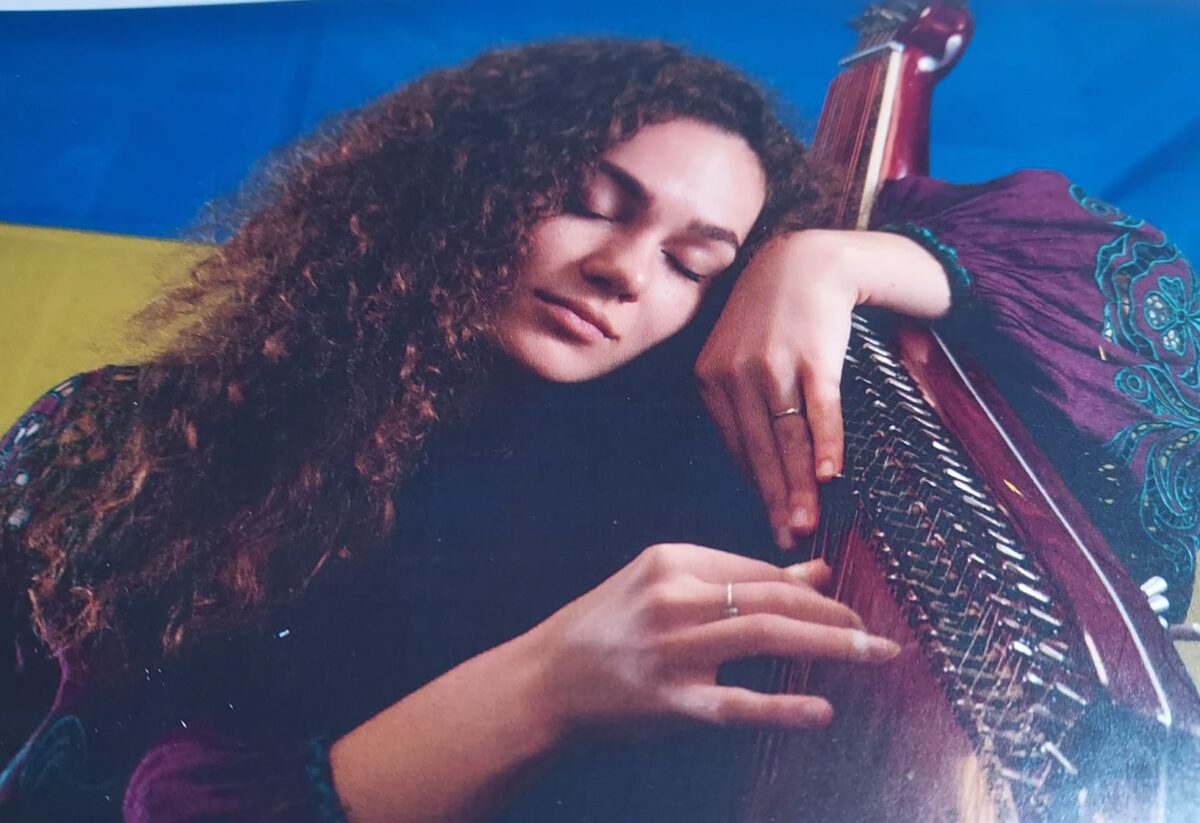
The five plays are knitted together by the glorious singing and music of bandura player, Mariia Petrovska. The bandura is a many stringed plucked instrument. It is the national musical instrument of Ukraine. For centuries, blind wandering folk musicians known as kobzars played the instrument. Through their music they preserved historical memory at times when Ukrainian culture was under threat.
The Stalinist Soviet government persecuted the kobzars and the instruments after the 1933 Holodomor (a man made famine caused by Soviet policy). They have tried to spread the truth about it. I had never heard either the instrument or the singing and it was a revelation for me and much of the audience..
This is a joint production between the Arcola, Hackney’s premier community theatre, and Nick Kent’s production company. It will be running until 28 March. Fortunately it has had the backing for this run and for great directors, actors and some serious set production. It is a real quality show and it can make a contribution to raising awareness about Ukraine.
The general public have welcomed refugees and trade unions have organised some solidarity. However the ‘official’ antiwar campaigns in this country like Stop the War Coalition have not supported the Ukrainian people, refusing to take sides in what they define as primarily a proxy war.
Encourage your friends, particularly on the left, to see this production. An excellent brochure has been produced to accompany the play which will also raise funds for Ukraine.