


Mosley based his politics on Mussolini’s fascist Italy and its corporate state. Inspired by Hitler’s Mein Kampf he produced his own version of an authoritarian vision of the future – ‘The Greater Britain.’ Mosley was backed up by establishment figures including Viscount Rothermere, the press baron, whose Daily Mail proclaimed “Hurrah for the Blackshirts.”
Though muted in the first couple of years the BUF foregrounded antisemitism as its main means of recruiting members, appealing to the worst possible prejudices by blaming Jews for everything from economic collapse to cultural contagion. At a time of severe hardship and mass unemployment Mosley’s message appealed to the most dispossessed and impoverished sections of the working class embittered by years of neglect. Some formed the backbone of the BUF’s para military organisation of ‘stewards’ that often violently attacked and severely beat hecklers at their public meetings. Jewish properties, organisations. Jewish individuals were frequently intimidated, attacked and insulted as were left gatherings.
Though there have long been significant Jewish populations in Manchester and Leeds the vast majority of Jews settled in the East End of London in and around Whitechapel. Many had fled from the antisemitic pogroms in the Russian Empire. others from Nazi Germany. This concentration of Jews, in one of the very poorest parts of Britain, provided fertile ground for the BUF to find scapegoats. Their scare stories also included condemning Jews paradoxically as both exploitative capitalists and dangerous communists unpatriotically loyal to the Soviet Union.
The BUF also became a pole of attraction in other ways. Many Catholics joined the party because of the mass killing of priests by the left during the Spanish Civil War. Some women, including former suffragettes, were attracted because of the – disingenuous – promise of improved rights for women. Others were drawn towards Mosley’s ‘pacifism’ in avoiding war with Germany. The BUF also created some sense of belonging and purpose that other groups lacked.
The battle for the East End
Mosley advertised a march on Sunday 4 October 1936, the fourth anniversary of the party’s founding. The plan was an ambitious one consisting of four columns of marchers heading off from Tower Hill to separate locations for open-air public rallies in Limehouse, Bow, Bethnal Green and Hoxton.
The Jewish People’s Council, a strong local organisation in the East End which had come into being to oppose the day to day antisemitism faced by the community, began a petition calling for the march to be banned. Despite gathering 100,000 signatures including the Mayors of five London boroughs, it was rejected by the Home Office.
To add insult to injury The Labour Party, The Board of Deputies of British Jews, the Daily Herald, News Chronicle and Jewish Chronicle urged people to stay away from any counter-demonstration. The Communist Party initially rejected direct action because, like the others, they did not wish to be seen as ‘hooligans’ bizarrely missing the point that the opposition was meant to stop the well-drilled, thuggish Blackshirted ‘hooligans’ from terrorising the Jewish population. Under pressure from the CP’s East End branches they relented in the end, cancelled the planned Trafalgar square rally in support of Republican Spain, and joined the counter-demonstration.
The local Independent Labour Party called for a counter rally as did The Jewish People’s Council including the mostly Jewish Ex-servicemen’s Movement Against Fascism that later emerged after the war as the anti-fascist 43 Group. Thousands of leaflets were distributed throughout the East End as vans toured around with loudspeakers blaring to mobilise local communities. Even the Evening Standard posted billboards advertising the counter-demonstration!!
Unsure of the exact route the fascists would take , anti-fascist opposition forces decided to block several possible routes including Leman Street to Aldgate, Cable Street and St.George’s Street (now ‘The highway’). In well organised and highly co-ordinated actions crowds occupied the most important road junctions including Brick Lane and Commercial Street. Thousands waited in side streets and the Communist Party attempted to seize speaking platforms that the BUF intended to use.
There are no exact figures for the number of participants but approximately 2,000 to 5,000 fascists took part. There were between 6,000 and 10,000 police involved . The huge anti-fascist counter-demonstration numbers vary from 100,000 to 500,000. The crowds were so densely packed that police reinforcements by vehicles could not be deployed at key points.
The main confrontation on Cable Street was preceded by fighting in other areas. Fascists were attacked as they gathered at Tower Hill and fighting intensified as the Fascist Defence Force arrived in armoured vehicles. Fighting broke out on Whitechapel Road when the Ex Servicemen were blocked by the police. There are many other instances of flair ups prior to the main event.
The fascists never made it to Whitechapel. Practically every route they had tried to follow had been blocked and the police had come under heavy fire from anti fascist protesters. Finally Mosley was forced to follow a route along Cable Street. Barriers were built from old mattresses, corrugated iron and furniture among other things. Eight barricades were built also in surrounding streets.
Pelted
A rumour had spread around that a tram driver had abandoned his vehicle to block the route in solidarity with the counter-demonstration. The police attempted several times to clear barricades but were driven back. They were pelted with everything from rotten vegetables, to bottles, bricks and paving stones. Even the contents of chamber pots were dropped on them from windows and children threw marbles under the feet of police horses and burst bags of pepper to confuse them.
Fierce hand-to-hand fighting continued until the police finally decided that they could not defeat the anti-fascist forces and Mosley’s march through East London had to be abandoned. He was allowed to march to the West End instead though scuffles broke out as his column was harassed all the way by counter-demonstrators. After a final rally in Hyde Park the fascists broke up and departed.
What was impressive about the battle of Cable Street and those in surrounding areas was the participation of local communities in the fight against fascism. It wasn’t just the ‘usual suspects.’ Jews, communists, trade unionists, socialists, Irish dockers, women and children and other East Enders were all involved and this collective act of unity and solidarity against fascism gave people a new sense confidence in their ability to fight for social justice together against racism, bigotry and authoritarianism. ‘No Pasaran’ (They shall not pass) was the clarion call in homage to those fighting fascism in Spain.
After the 4 October success the Jewish People’s Council continued to organise, playing a central role in local rent strikes for example which demonstrated to other workers in the neighbourhood that contrary to the fascist lies, the Jewish community lived in at least as impoverished conditions in the east end as other working class communities such as the Irish.
The Jewish community is not the main target of today’s far far right – who focus on anti-migrant attacks and by implication on all oppressively racialised communities as well as against trans groups. There are parallels with the mass mobilisation of Cable street with the battle of Lewisham in 1977 against the fascist National Front with huge community involvement especially black youth or even with some of the mass demonstrations that have happened more recently in Walthamstow or in Brighton .
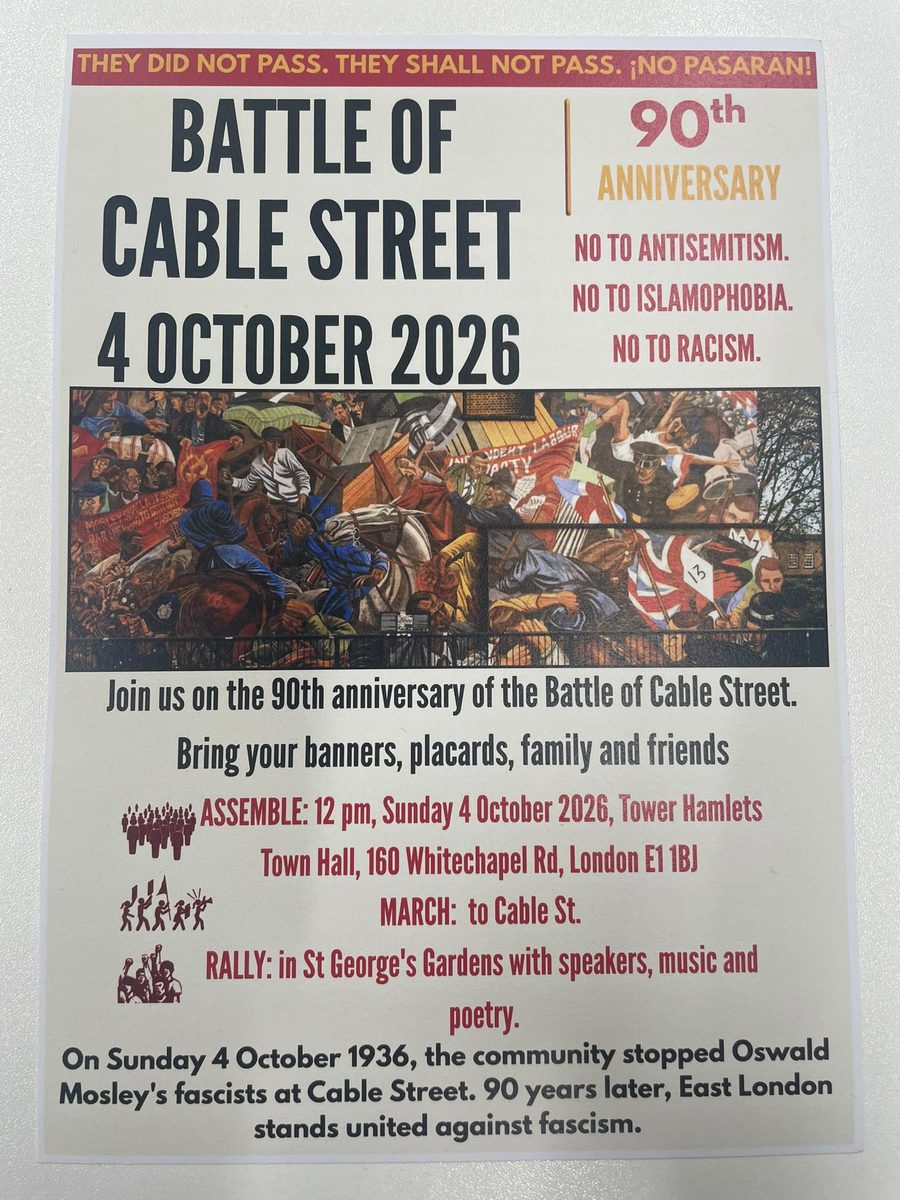
Join the 90th anniversary demonstration
A footnote on the CP’s change of line, which the article rightly flags.
The original instruction survives in writing. Six days before the march, the Communist Party’s East London organiser wrote to a member in Stepney:
Arrangements re Mosley’s march. A party meeting at Salmon and Ball and another at Poplar, i.e. near to each end of the march. Meetings to be kept orderly. Avoid clashes, keep order: no excuse for government to say we, like BUF, are hooligans. If Mosley decides to march, let him. Don’t attempt disorder (time too short to get a “they shall not pass” policy across). It would only be a harmful stunt.
Dated 28.9.36. The recipient was Joe Jacobs, the Stepney member who argued the other way, was expelled not long afterwards, and spent the next forty years outside the party — first with the Trotskyists, later the anarchists. He died in 1977, the year the letter was printed in Socialist Press “by kind permission of Solidarity”, in a piece making much the same point this article does about the CP’s initial line.
And one small thing worth rescuing for an anniversary. In 1975 the IMG’s journal International reviewed a Centreprise anthology of poems by East End pensioners and quoted one in full — by Milly Harris, called October 1936. It ends:
So we stopped them there at Gardiner’s,
We fought and won our way.
We fought the baton charges,
No fascist passed that day!