


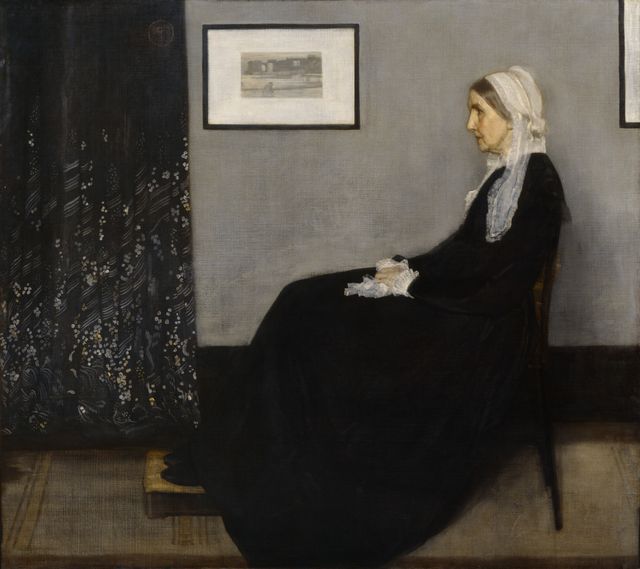
The centre piece of the current Whistler exhibition at Tate Britain (on until 27 September 2026) is the artist’s celebrated portrait of his mother, entitled ‘Arrangement in Grey and Black’. (see below) On display in Britain for the first time in twenty years, it is widely regarded as an iconic image of motherhood, endurance and resilience. It hangs between a self-portrait of the artist and a portrait of his brother, William Whistler. The Tate hails the arrangement a ‘triumphant familial triptych, a poignant exploration of family identify.’
Whistlers and white supremacy
If family identity is indeed the issue, we might as well recall the deep-rooted Southern sympathies of the Whistlers. William Whistler served as a surgeon in the Confederate army and had arrived in Britain following defeat in the Civil war. His wife had been a passionate secessionist. Anne Whistler had arrived in Britain three years earlier, fleeing North Carolina on a Confederate blockade runner and installing herself in Whistler’s lodgings in Cheyne Walk. She too was a staunch supporter of the Southern cause. Her brother, her uncle and her cousins all owned plantations:
‘As to slavery at the south’, she wrote, ‘I never saw servants so free to idle, the owners have the severest task & such a weight of responsibility in the care & training of such families! But it has long been my conviction [through] the Providence of our Lord that heathen Africa may be enlightened by their people of our Southern States.
At its earliest exhibition, audiences assumed from the portrait an intimacy with the sitter herself – the steadfast gaze, the stillness of the pose, the sense of quiet restraint seemed to speak to her own qualities. Whistler firmly resisted such readings: ‘Take the picture of my mother, exhibited at the Royal Academy as an ‘Arrangement in Grey and Black. Now that is what it is. To me it is interesting as a picture of my mother; but what can or ought the public to care about the identity of the portrait?’ But his insistence on the primacy of colour over subject matter – which has continued to influence readings –was disingenuous, for the image was drenched in signifiers that located it specifically as an icon of Southern loss.
Take, for example, the large grey oblong that occupies the left of the painting. Draped in the fashion of a curtain, this length of Japanese cotton is printed with a design of blossoms falling on turbulent waters in the dark of night. In their softest terms, these were symbols of transience and seasonal destruction, but the inky silhouette of falling blossom had long served in China as an expression of the trauma of dynastic change. Anne Whistler had experienced her own dynastic loss:
‘The distressed state of my beloved native land depresses my circumstances, but the Lord will order all as most to promote my future & eternal interests. The struggling South is not fighting for Slavery! but in defence of its homes.’
To another correspondent she wrote, ‘I have been at the south & you have not. My daily prayer is that God will bring North & South to repentance for it is His rod of indignation has taken away the pride of Union.’
The sense of a changing world permeates her correspondence. ‘None can realize more than I do the uncertainty of all temporalities, truly a sojourner, no continuing city, no homeland, but that for which I must be prepared by the trial to faith I am I hope being purified now’, she wrote in 1864 and living with her son in Chelsea.
Signifiers of white supremacy
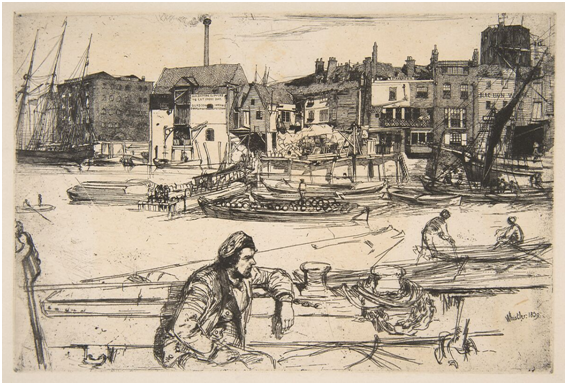
In the painting itself, the theme of transience is reiterated – in different terms – in the dusky forms of the picture that sits to the left of Mrs Whistler’s head. This was an etching Whistler had made ten years earlier of Black Lion Wharf, one of his acclaimed Thames series reprinted the same year that the maternal portrait was painted. Celebrated for its detailed depiction of decaying timbers and blackened brickwork, it captured the canting buildings of the wharves just as the construction of the Embankment threatened them with demolition. In the foreground is the profile view of a solitary man who surveys his crumbling environment just as Anne Whistler surveys her curtain. He faces to the left, his tiny form carefully placed at eye level with Anne Whistler’s face to the right, both witnesses of seismic change.
But the maternal portrait was a subtle vindication not just of the lost Southern cause, but of the belief in white superiority that underpinned it – to which Whistler himself fully subscribed. He had notoriously come to blows with a black passenger on the return passage from an abortive confederate-related arms-dealing expedition to Chile in 1866.
The passenger, he wrote, ‘was simply a Negro, among several forced upon our company on board. The degree to which he offended my prejudices as a Southerner who for the first time found Negros at the same table, led finally to our coming into collision.’ On the same voyage he came to fisticuffs with an elderly abolitionist.
Racial superiority had its own insidious iconography, namely the blush, considered physical evidence of innate moral sensibility, vulnerability, and civilization – traits explicitly denied to Black Americans in pro-slavery visual culture. One of the most notable features about Anne Whistler’s portrait is the rosiness that suffuses her cheeks, that seems at odds with the solemnity of her gaze. We could read it as an expression of her ‘trial to faith’ through which she believed she was being purified: we can also read it, in related iconographic terms, as a signifier of racial and therefore moral superiority. Through the slightly disturbing dab of pink in his otherwise sombre palette, Whistler inserted his mother not just in an iconography of Confederate loss, but of pro-slavery visual culture.
Rivers and limits of existence
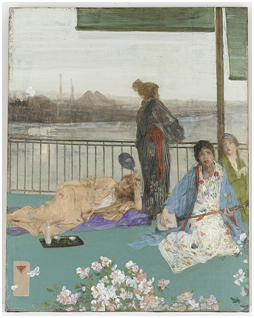
Whistler’s visual conceits form something of a private language in his work. Variations in Flesh Colour and Green: The Balcony (1864–1870) was described by his mother, who witnessed its progress, as portraying ‘a group in Oriental costume on a balcony, a tea equipage of the old China, the[y] look out upon a river, with a town in the distance.’ The reality was more complex. The tea equipage is in fact a tray with a sake jar and two sake cups, suggesting the presence of a male client; the women’s lips are painted garishly red, their loosened kimonos suggest a state of deshabille. Two of them look out at the viewer, one strums her samisen, the fourth gazes out over the balustrade toward the river. Whistler modelled the work on a print by the 18th century Japanese artist Torii Kiyonaga of prostitutes in the brothel area of Shinagawa looking out onto Edo Bay. Eighteenth century Japanese prints were overwhelmingly invested in the depiction of prostitutes – brothels occupied a seminal position in urban structures and most other subjects were censored. But in nineteenth century British art, prostitution featured only within safely narrative contexts – for example ‘The Awakening Conscience’ (1853) by the Pre-Raphaelite painter, William Holman Hunt, depicting a mistress abruptly leaving her lover’s lap; or George Frederic Watts ‘Found Drowned ‘(c. 1848–1850), depicting the suicide of a prostitute in the Thames (below),.
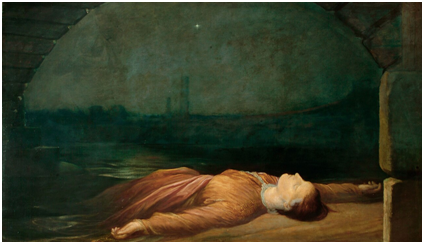
The riverbank, in fact – both in contemporary painting and literature (Oliver Twist, David Copperfield), came to mark the limits of existence both as the place to which the desperate had been driven, and as the means of their self-destruction. The fallen woman became deeply associated with the north bank of the Thames.
Whistler summoned up these associations by locating his own models on a balcony – another precarious space – overlooking the Thames (it was in fact his own balcony at Lindsey Row in Cheyne Walk). Across the water can be seen two prominent slag heaps, part of the newly industrialized profile of Battersea. These mini-Fujis, a witty nod to his Japanese inspiration, would feature in a number of the nocturne views of Battersea, but never in such perfectly conical form. They are, most literally, aestheticized industrial refuse. Given the well-documented link between industrialization and the rise of prostitution in the nineteenth century, they become a visual conceit of a contemporary phenomenon. Together with the butterflies and the flowers – another East Asian trope of promiscuity – they were Whistler’s private joHis prime aim, in fact, seems to have been to depict a group of prostitutes shorn of the moralizing narratives that determined readings of the subject in existing visual and literary culture (a kind of response to Manet’s Olympia first exhibited in 1865). Such paternalistic narratives were anathema to him: art, as he wrote, ‘should be independent of all clap-trap—should stand alone, and appeal to the artistic sense of eye or ear, without confounding this with emotions entirely foreign to it, as devotion, pity, love, patriotism, and the like. All these have no kind of concern with it; and that is why I insist on calling my works ‘arrangements’ and ‘harmonies’.
Arrangements of colour cannot erase people
But there are consequences to cutting the clap-trap. The first of the famous Nocturnes was painted in Valparaiso, in Chile. Whistler had sailed from Southampton to Chile with a group of confederates in March 1866, with the aim of supplying missiles to General Tucker, the former confederate general. Tucker was supposedly directing the Chilean navy in its defence against the Spanish in the deeply absurd Chincha Islands war. The arms arrived late and the mission was abortive. Whistler painted a first seascape the day before the Spanish bombarded the town. It is entitled ‘Crepuscule in Flesh Colour and Green: Valparaiso’. It depicts – though you wouldn’t know it – the withdrawal of British, American and French ships, a withdrawal that left the port totally undefended and unarmed. The following day the Spanish pounded the city for four hours at almost point-blank range. By this time Whistler had fled to the hills on horseback. ‘The riding was splendid’, he wrote, ’and I, as a West Point man, was head of the procession. By noon the performance was over. The Spanish fleet sailed again into position, the other fleets sailed in, sailors landed to help put out the fires, and I and the officials rode back into Valparaiso’. That evening, he sat down to paint the next in the series, entitled ‘The day after the revolution’. We are invited to savour the serenity, harmony, musicality of these paintings. But if we just stop to think, what we are really looking at is the prelude and the postscript to an atrocity. It makes a difference.
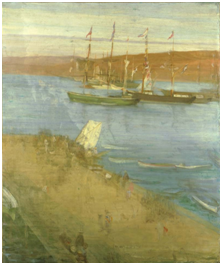
Social art history is absent
Tate has steered well clear of any kind of social art history in its ‘luscious and seductive blockbuster’, despite the truly vast amount of scholarship and archival resources available on the subject. Here we celebrate Whistler as a man who battled for truth and beauty all his life (whatever that means), who turned night-time views of factories along the Thames, into timeless atmospheric works of art. There is something regressive in this notion of art as a realm that transcends the historical circumstances of its creation. John Barrell alerted us long ago to the dark side of nineteenth century landscape painting, and many scholars have noted the evasions and erasures through which Whistler stripped any social or human concerns from his art. His nocturnes may be ethereally beautiful, in their frequent aestheticization of industrial squalor, they also commodified for a newly genteel middle-class with money to burn, what was an increasingly disturbing phenomenon. It is the work of curators to lay this out for wider audiences: for when humanity can experience its own destruction as an ‘aesthetic pleasure of the first order’, as Benjamin wrote, mankind’s self-alienation has reached its tragic extreme.
References:
https://www.whistlerpaintings.gla.ac.uk/catalogue/searchdisplay/?mid=y073
Toutziari, Georgia (2002) Anna Matilda Whistler’s correspondence: An annotated edition. PhD thesis
https://theses.gla.ac.uk/3779/3/2002Toutziariphd3.pdf
https://www.journals.uchicago.edu/doi/pdf/10.1086/424223?download=true
file:// Whistler_and_Battersea_The_Aesthetics_of_Erasure_a.pdf