


photo above : Max Horkheimer and Theodor Adorno in 1964.Credit: Jeremy J. Shapiro/Creative Commons
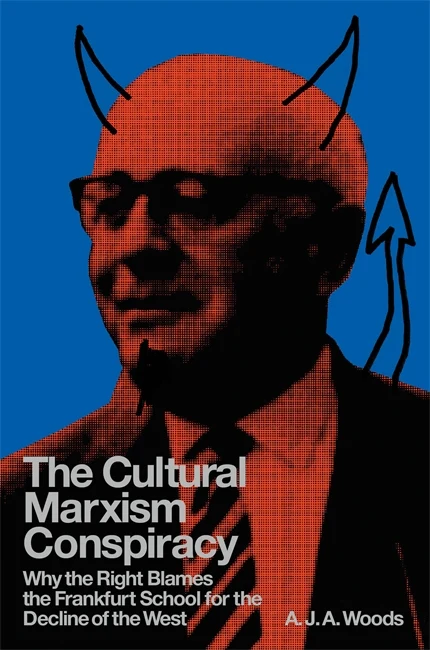
Whilst preparing this review, I found my old copy of Herbert Marcuse’s Eros and Civilisation that I must have bought in 1970. My scribbled notes last until about halfway – it was heavy going for someone who had not really studied Freud. Woods in this book effectively explains how the hard right wing in the USA successfully constructed a false Cultural Marxism conspiracy around thinkers like Marcuse.
Marcuse was a leading light of the Frankfurt School alongside Adorno and Horkheimer. A number were Jewish and they fled Hitler and came as leftist refugees to the States. According to the Cultural Marxism conspiracy theory they had systematically ‘infected’ a generation or more with an ideology that undermined Western civilisation and was responsible for the radicalisation of the 1960s and 70s.
The Frankfurt School’s ideas supposedly led to a progressive ‘New Class elite dominating the state and even big business. This state was in hock to the ‘Groups’ – Blacks, Chicanos, Women and Gays. All were conspiring against the decent white family/Christian values of the suburbs. American civilisation could only be saved if this social base was mobilised to clear out all the pernicious progressive thinking.
Certainly we were interested in Marcuse’s ideas in the 1970s. Alongside radicalising youth in the United States, we demonstrated against the Vietnam war, against racism, for women’s and gay rights and in concrete solidarity with striking workers like the miners. We formed the new left that was internationalist, anti-capitalist and anti-Stalinist.
A key idea of Marcuse was that the capitalist state does not just help reproduce an unequal and unfair economic system but crushes the potential creativity and pleasure of most people. We were not just fighting for social justice but for liberation in all its senses. The relative gains of the post-war boom did not mean that a revolution was no longer needed. It made sense to a lot of young people whose teachers had been telling them that the class struggle was extinguished in a managerial society where workers were becoming integrated.
An idealist view of history
However people did not take action just because a few of us had half read Marcuse or were following teachers who had read all his books. Lots of other factors played a big part such as popular music, the TV images from Vietnam, peer group discussion and direct contact with workers who were taking much more workplace action than today. These hard right ‘theorists’ have a completely idealist or essentialist version of how history and society works.
Social economic relations and class conflict exist over and beyond an individual’s action or someone’s writings. As Marx famously said, social being determines social consciousness. For the new hard right, the superstructure became the determinant of everything. They assigned a ‘magical agency’ to these exiled sociology professors.
Nevertheless the ideologues who manufactured the conspiracy were not bothered about the internal coherence or accuracy of their analysis. They would often misquote or invent statements made by the Frankfurt School. Unlike earlier rightist ideologues they were not really interested in winning an academic debate – they were always working to win power.
Woods uses the Gramscian concept of organic intellectuals to explain this phenomenon. These people are not academics worried about validation by their peers. They were helping organise a ruling class coalition to roll back the gains that the majority of ordinary people had benefited from after the 1960/70s – civil rights, non discrimination in hiring or access to higher education. They wanted to build a political movement not win professorships, just as organic intellectuals of the working class help build its unity in struggle and its political advancement as a protagonist of change.
Trump is their victory
At the start, these right wing thinkers only represented one sector of the ruling class. This sector wanted not just to defeat the organisational power of the trade unions as Reagan or Thatcher did but wanted to fundamentally change the culture so that progressive ideas and practices would be decisively weakened. Whereas Californian Big Tech people like Bill Gates or Steve Jobs used to be rather progressive in their social thinking the current crop of billionaires like Musk or Peter Thiel have adopted the Cultural Marxist conspiracy theory wholescale and are part of the Make America Great Again (MAGA) constellation. In this sense the Cultural Marxist conspiracy theorists have won a victory.
Today in Trump’s America, even the moderate and often cosmetic effect of Diversity, Education and Inclusion policies are being dropped by many businesses and public institutions. In Britain, the Tories and most of the mainstream media have led a huge campaign against supposedly ‘woke’ culture and the ‘politically correct’. For instance Tory leader Badenoch is insisting all her candidates renounce net zero and oppose the European Commission on Human Rights. Reform and Restore pursue the same offensive in a higher gear and more viciously. The Labour leadership – despite previously proclaiming its attachment to such ideas – have been retreating fast.
This book is a deep dive into the various factions and currents that built up the Cultural Marxism conspiracy. Readers may be familiar with a few names such as Steve Bannon or the Heritage Foundation but Woods introduces us to the whole galaxy and shows how it has led to the Trumpian USA we can observe and experience today. The final chapter makes the link with what has happened here too.
Rightist ideologues contextualised
At the start there was even an ex-Trotskyist, Lyndon Larouche who accused Marcuse, Adorno et all as being manipulated by the CIA, which of course was part of the conspiracy. It reminded me of the evolution of the Furedi led Revolutionary Communist Party (RCP) who went from an ultra left sectarian position to becoming allies of the Brexit hard right. It is easier for groups which have little contact with mass working class organisations or actual living struggles to move in this sort of direction. Money and corruption also plays a role. Larouche got the far right to pay for one of his electoral campaigns. Ex-RCP people have found lucrative positions in the media or in Furedi’s case with Orban’s people in Hungary.
In each of the chapters mapping the various architects of the CM conspirac,y Woods uses the method, again from Gramsci, of conjunctural analysis that links the evolution of ideas to the political and social context.
These hard right thinkers, Woods says:
performed ideological work for specific political forces, to tell people why a crisis has happened and to persuade them to support a particular vision for a better society
So when people were hit by the subprime mortgage crash, the hard right explained it not by economic analysis but by the effects of Cultural Marxism. The vision they put forward was a society based on the patriarchal family with strict sexual morality and opposition to ‘gender ideology’. The economic model was for small family companies to be able to flourish with little state regulation. Obviously this particular part of the vision is changing today with the ideas of Peter Thiel and his notion of the Technological Republic where Big Tech is the new saviour of the white middle class.
Lind and Weyrich
The Free Congress Foundation for Cultural Conervatism led by William Lind and supported by Paul Weyrich who wrote the keynote Letter to Conservatives in 1999 understood that the traditional right wing current was not equipped to carry out the counter revolution required. The language it used was too academic, even aristocratic. To win support you need to use ordinary language and simple narratives. The fight was not for abstract principles but for traditional values you could concretely lay out.
Finally the right had to use the new media. For a while they used direct, targeting mailing with good effect then TV (Network Empowerment TV) and independent Radio stations (shock jocks) moving on to the social media of today. One of the features in the rise of Rupert Lowe’s Restore Britain party is a sophisticated use of social media. The defining difference with the old right wing was the new right was is in the game to win power – winning power was more important than being judged right by some external observer.
Think tanks and single issue campaigns
The creation of think tanks was an important weapon in the new right arsenal. The Heritage Foundation is probably the mother of all think tanks. It still plays a big role in the Trump camp today – drawing up the plan for an even more aggressive second term. This type of think tank is a different animal to the traditional one. These were populated by academics, policy makers and worked in a non-partisan way by accumulating evidence and producing papers that could be validated by others. The new bodies were constructed as machines to win support and build a social/political base. George Monbiot has written about a similar phenomenon in Britain. They were entrepreneurial in their approach of seeking out rich donors. The Coors family of the well known beer company were an early donor.
Single issue campaigns such as against abortion rights and the Equal Rights Amendment were very important in the rise of the new right. Politics was taking place outside the two traditional parties, the Republicans and Democrats. Indeed you could argue Trump built his base outside the party and then took it over.
Woods has sections on the Tea Party and the Evangelicals and how they played an important role. Even though the Tea Party has since been subsumed into the MAGA empire. it formed a strong grass roots component of the New Right as it reacted to the shock of Obama becoming president. The use of watch parties for DVD right wing documentaries was a new element the Tea Party championed.
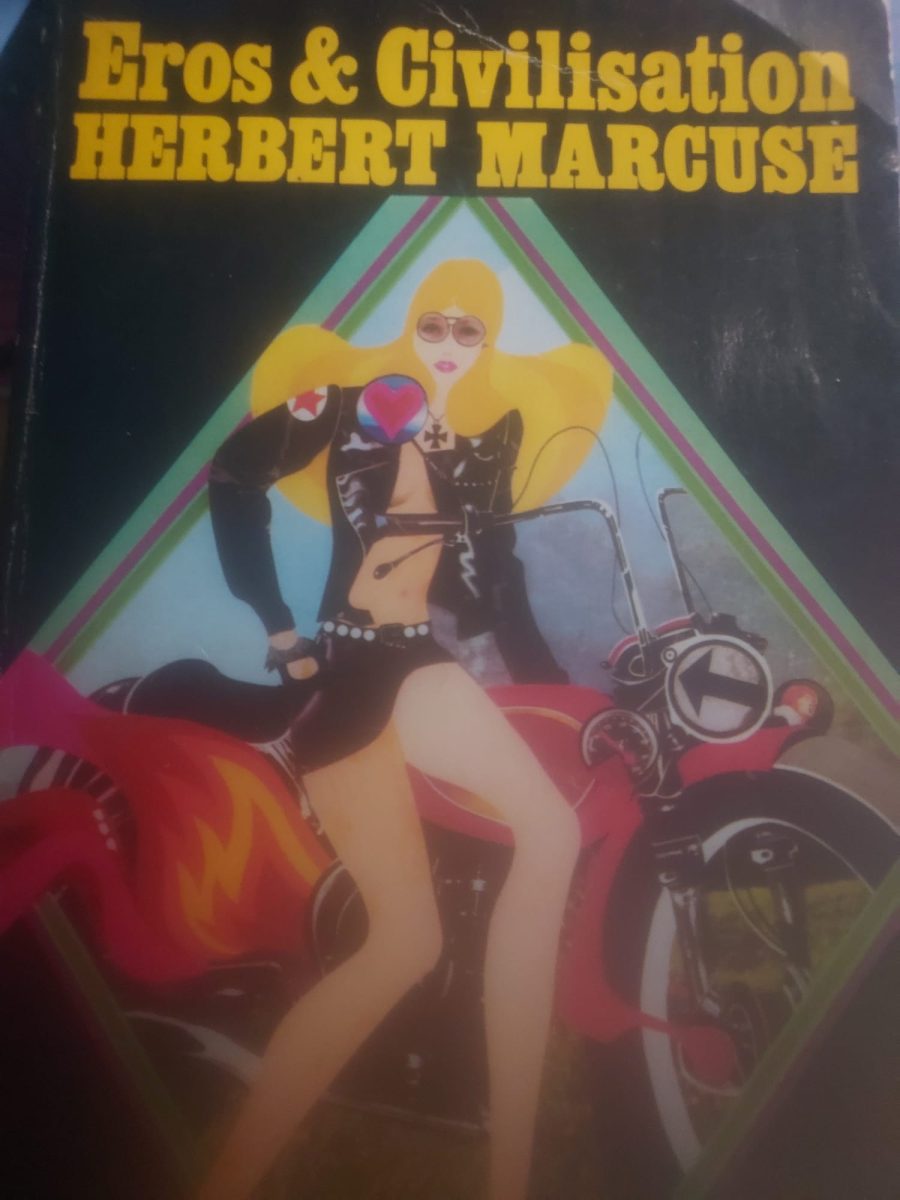
Original 1970 copy of Marcuse book
White suburban family values
At one point, some of the right wing argued for a withdrawal from the state and institutions dominated by the new elite. So they argued from home schooling rather than keep pushing on religion in schools. Some wealthy rightists have even started to set up new mini states run under their new conservative rules and values with the crypto digital currencies based there.. One was set up in Honduras but has been shut down. However the mainstream hard right in MAGA concluded that they had to take back the institutions from the ‘new class’.
Behind the focus on family values there is an attempt to dismantle welfare which they claim is not necessary if the ‘strong’ family is left to manage things. In that way support would be withdrawn from the Groups (Blacks etc.) who claim welfare.
Military might and US strength is another area that has to be reclaimed from the attempts of people like Marcuse who with all their ‘pleasure principle’ ideas and gender ideology are weakening the masculinity needed to defend America. Within the right there is also a tension between those who want to have a more isolationist foreign policy, avoiding foreign wars and others who are gung ho for them. Big Tech to a degree can overcome this tension through the use of new weaponry than can reduce American causalities.
International dimension
Although the big focus on the Cultural Marxism of Marcuse et al is more specific to the US since these sociologists were based there, the subsequent ideas produced by the conspiracy theorists have been taken up internationally. There are also material connections between extreme right wing ideologists and the British far right. It attends the conferences stateside and receives money too. I did not realise that Andres Brevik, the fascist who killed hundreds in Norway in 2011 had a manifesto mostly copied from these American thinkers. In the dystopian novels people like Lind have published, violence is openly advocated to eliminate the New Liberal Class
Woods deals with the more recent right wing demagogue like Andrew Brietbart, Rush Limbaugh and Matt Drudge who have flourished since Obama, whose election was seen as a big setback. These are the people we may have heard of since they paved the road of the rise of Trump. Steve Bannon was Trump’s campaign chief of staff and had worked under Brietbart. One feature of their intervention is a certain swagger and arrogance. The shock jocks were not just building support through ideas but also through a form of entertainment and showbiz to get people to sit up and notice them. The Right were the insurgents, the rebellious. that really had to get moving now that Obama was in power and the Cultural Marxists were hanging on.
Breitbart’s insight was that for him politics was downstream from culture. People changed not because of policy heavy political discussion but to narratives that hit their perceived identity in the guts. Look at the Brexit campaign – the story about taking back control hit a spot that all the rational arguments about the economic benefits of EU membership did not touch.
Impact in Britain
In a closing chapter Woods shows how the right wing ideologists have even influenced politics in far right Bolsinaro’s Brazil and in Milei’s Argentina. The Cultural Marxist conspiracy is remodelled and there is less connection to Marcuse and Adorno. So Paulo Freire, the great revolutionary pedagogue, is targeted in Brazil.
In Britain an offensive against critical race theory, ‘wokeness’ and gender theory is continuing. If a watchword for the left is to always know your enemy then this book is a very useful aid in understanding the strengths and possible weakness of this international right wing conspiracy.
One suggestion for any future editions would be to include a graphic of a timeline with all the currents of this far right that shows their connections leading up to Trump. It would be a neat way of summarizing the story.
We can finish this review with Woods’ final message which AntiCapitalist Resistance certainly supports:
“The strongest possible counterargument against Cultural Marxism/s is the collective mobilisation of people who are willing to stand up for one another and fight for a better future. These people will not agree about everything; they will not even look like each other. Yet they will share in a vision of a world where freedom is no chainsaw and where equality is no dream. Only when we show that this human solidarity is more powerful than any conspiracy will we finally refute the right’s facile talk of Cultural Marxism”. P 235
About 15 years ago someone put up a poster in my small town, Smash Cultural Marxism. I did not think it would help to remove the poster. I thought this would just harden the views of whoever put it up.
Instead I decided to have some fun with it. I put up my own poster, Cultural Marxism is Good for You, Try some Today. And then I added the URL for International Viewpoint.
Did anyone read my poster? I’d like to think so.
That’s great Ken, thanks
Just to say Frank Furedi was not the Guru of the Revolutionary Communist Group, but the Revolutionary Communist Party. The RCG still exists, I think, ur at least its paper, Fight Racism, Fight Imperialism does. So you need to change the several mentions of RCG to RCP.
Also, this sentence below is too susceptible to misinterpretation:
“In that way support would be withdrawn from the Groups (Blacks etc.) who claim welfare.”
Thanks will change and i remember reading his stuff too at the time!