

After hearing about the Tolpuddle Festival for many years and knowing the story of the original martyrs and their historic role in the founding of the trade union movement in Britain, I decided as a lifelong trade unionist, now a pensioner and retired union member, to finally go. I had already visited the historic county town of Dorchester nearby and visited the Shire Hall, the museum which incorporates the historic courthouse where the five martyrs were tried and which also includes the cells where they were held before their transportation to Australia for the crime of swearing an oath to form a trade union.
I booked an Airbnb in Dorchester and was pleasantly surprised to learn that it was a Leftie household. Vicky was a black woman schoolteacher active in the NEU who regularly assisted with their stall at the festival and her husband, Chris, was a barrister in a leftwing chamber. Both were regulars at the festival.
The village of Tolpuddle is set in bucolic Dorset countryside complete with thatched cottages and looks like something from a tourist catalogue about the West Country. In the 1830s it was occupied by farm labourers but nowadays its inhabitants are mainly well-off retirees or those with a second home. The quiet mediaeval churchyard contains the grave of James Hammett, the only one of the martyrs to remain in England – the others departed for Canada after their pardon and return from Australia.
I was glad to visit his grave in the quiet of the Saturday because on the Sunday, the grave is at the centre of a crowded wreath laying ceremony in which many union leaders participate along with a direct descendant of Hammett, who told us that she was grateful for the voice of the unions and for the role that her ancestor played. The Sunday is the traditional main day of the festival and there is no entrance fee on that day, ensuring increased attendance and is also the day when leading union and TUC figures give speeches from the main stage, following a parade which winds its way through the village complete with numerous union banners and, on this occasion, three brass bands including the RMT band. It makes for an impressive sight.
Some useful discussion
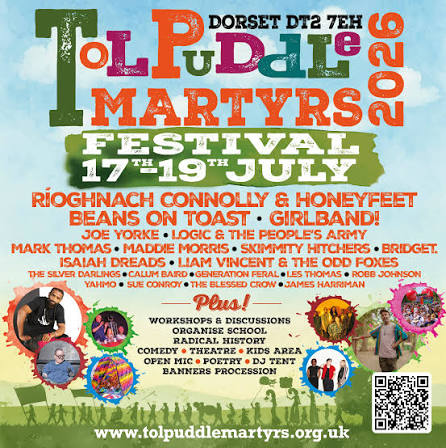
Being in the Southwest, many of those attending were from surrounding areas, including Bristol and coachloads arriving on the Sunday included trade unionists from Plymouth and Cornwall. I was told that the numbers were considerably down on the Saturday and whether this was due to the £65 entrance fee or the World Cup was a moot point. The Friday and Saturday is when a lot of the serious discussions are held both in the fringe tent and the main tent. I attended one session on workers’ rights and employment law where an all-female panel of union officers and activists discussed the Employment Rights Act and general issues affecting union activists. One commented that there were 6 million union members in Britain which was the same number as vegetarians! This resulted in some hilarity and a comment from one of my friends wondering how many trade unionists were vegetarians. There were also sessions on the war in Iran, Palestine and a range of other issues.
Many unions and campaign groups had stalls and at my union’s stall (UNITE) I picked up a free t-shirt celebrating the centenary of the General Strike. There’s lots of merchandise at many of the stalls and the general view was that the best bags were those from the NEU stall. I met a woman from the Musicians Union, who had a stall, who I later saw playing in a group on stage.
Fun and culture too
The cultural aspect of the festival is very important, and it is this part which makes it feel like a mini-Glastonbury or country festival. I saw some great radical groups playing in the fringe tent on Saturday evening one of which had a song called “At the Austerity Inn” where the lines were: “Austerity Inn where the beer is flat and the hope is thin and Rachel plays her little violin. No you can’t have it! You can’t afford it!” A choir called Red Dorset sang workers songs from the 1930s outside the village pub suitably named “The Martyrs Inn” and one of the highlights for me was the performance by Attila the Stockbroker of his poetry.
He said that he hadn’t been at the festival since 1997 and continued to treat us to his poetry which was roughly divided into 3 themes – politics, poems about his wife and knob jokes. He did warn us at the start of the reading that he was born without an embarrassment gene. This soon became obvious in his performance. He had just published a new book, the title of which seemed very apt for the times we live in – “Fiery Words For Hellish Times”. These were his most political and most angry poems where he poured scorn and contempt on Reform and the Right. He also gave us a rendition of his new dub poems, soon to appear on Spotify, one of which was about the Clacton byelection, the first part of which is below and which recently appeared in the Morning Star.
Binface Dub
Check out Farage and the trouble he’s in
Up against a man who dresses as a bin
It’ll be hilarious if he doesn’t win
The dustbin of history is what he’ll be in
Vote Binface — put Farage in his place
Vote Binface in a two horse race
Vote Binface, end Clacton’s disgrace
Turn out for the Count and get rid of knob face! The Green Party Trade union group were there with a stall plus a variety of paper sellers ranging from the SWP to the Morning Star. On Sunday evening as I headed for Dorchester train station in a shuttle bus funded by UNITE, I felt very glad that I had come, honoured the Tolpuddle Martyrs and celebrated with friends and comrades in the sunny Dorset countryside. It’s great to meet fellow trade unionists in such a relaxed setting and compare notes and share ideas. I will return to Tolpuddle again