

Every year people in Italy moan about the way the ‘spiaggia libera’ (free access beach) is becoming smaller and smaller. At the same time the private lidos, where you have to pay for a sun parasol and a couple of loungers, defend their privatised territory with all sorts of barriers and walls to prevent people from moving across their beach. The law says that 5 metres of the foreshore has to remain open to anybody – the privateers cannot put their sun loungers right up to the water. So often they make it difficult to walk from the free beach to the paying beach.
The right to take the sun and have a swim on a coastline that is the domain of the state should belong to everyone. This truly is a class issue and an expression of the capitalist control of resources and the resulting extreme inequality in Italy. Remember only a minority of the working class in Italy (and also in Britain) go on holiday in another country. For those families below a certain income the only possible holiday is to go to the local beach or go into the hills for a walk or a picnic.
At our local beach in Vietri Sul Mare on the Amalfi coast the lidos are run by local cooperatives. They hire local people and they have proper seasonal contracts. So they are not the worst. However you pay upwards of £30 a day for a parasol and two sunbeds. You pay more the closer you are to the water and whether it is a weekend or not. On a Sunday you are talking £50 at least and that is before buying a coffee or ice cream. Many workers in the South of Italy do not earn much more than 1100 euros a month after tax so you can see a whole sector of working people are excluded from the well maintained, cleaner private beaches.
Dire state of the ‘free beaches’
When you find the five or ten percent of the beach that is the ‘free beach’ you discover that there are no showers, toilets and infrequent cleaning even though it is supposedly managed by the local council. Often it is close to a river inlet bringing dirty water or squeezed at the end of a long beach. Worst you often find unregulated cowboy entrepreneurs who rent out parasols and loungers. The other summer we had a stand up row with one of them who had moved our parasol so they he could squeeze in a few more of his ones. In effect it is not a totally free beach.
In the whole of Italy well over 50% of the coastline is privatised but this underestimates the dominance because there are coastlines that do not have beaches or are urbanised or very inaccessible. In the Naples region the percentage is 70% which is similar to Emilia Romagna (Rimini area) or Liguria (Genoa). Each year the size and quality of the free beaches is reduced. In Vietri the local council is basically in hock to the cooperatives – to build up a decent public, free beach would mean cutting back and/or regulating the cooperative area and confronting serious local interests. In some regions organised crime is involved too – it is a good way of recycling money and the profit margins are very good.
One reason the margins are so good is the contracts – that are directly made with the Italian state which owns and manages the coast – have not been reviewed for many years. The local councils manage this process. In practice the same contracts have been renewed for decades and the beaches are run by the same families. However this type of procedure conflicts with EU rules about capitalist competition and the EU with the Bolkestein Directive has told the Italian government that it must change the system. The Italian government passed a law that has temporarily stabilized the contracts until 30 September 2027. Municipalities are legally required to launch open, competitive public tenders for all beach lots by this deadline.
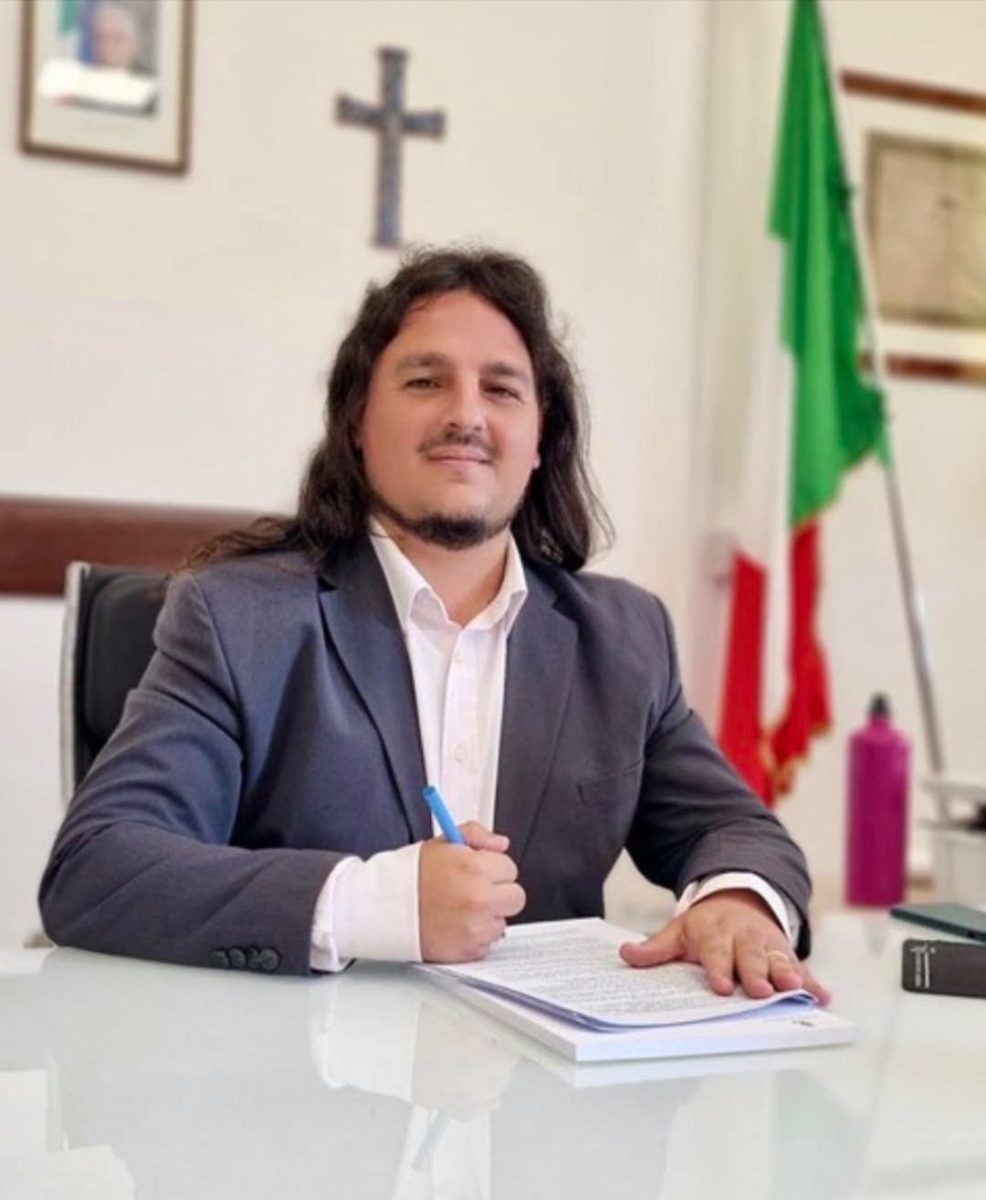
Local councils could take back control
Local councils could at that stage decide how big the private lidos should be and could launch their own publicly controlled beaches. It is even possible now. The local mayor in Bacoli, Josi Della Ragione pictured above, in the Flegrian Fields area north of Naples, has won national and international acclaim after he re-established public free beaches in his area with toilets, showers and a cleaning operation. After a lady had gone from the free beach to the private beach to buy a drink, when she asked to use the toilet she was denounced as a ‘pezzente’ – a piece of trash. Class hatred is alive and well. The mayor publicised this to broaden his campaign and local activists are calling him up from all around Italy. Borelli a green left MP is leading a campaign on this – he denounced the wall you can see in the image at the top of the page.
Reclaiming the natural beauty of these coastlines is another aspect of this struggle. For example there is a lovely promenade – built with public money – in Vietri Sul Mare but during the summer season it is inaccessible since it abuts the entrances of all the lidos. The beautiful view across the bay of Salerno becomes off limits for nearly 4 months of the year.
Managing the transition
A transition to more public ownership and control has to take account of local employment. One solution would be more cooperatives but operating to strict regulations. These could be managing the free beaches where there could be a choice between paying a reasonable price for your parasol or lounger but with plenty of space for people who want to bring their own. Amenities such as toilets and showers should be available free to both spaces.
This is a political fight because the balneari (the lido bosses) form a significant social base of hard right parties like the Lega (Salvini) and Brothers of Italy (Meloni). Salvini has been frequently photographed at his favourite lido, even deejaying . Organised criminal interests are sometimes involved. The national government may well try and fix new laws that prevent local councils really taking back control. Campaigning for new, locally controlled free beaches organised on an ecological basis could be a vote winner for the official left opposition if they are willing to take on entrenched local interests. In places like Emilia Romagna that means the PD (Democratic Party) challenging a part of its traditional small business base.
Josi challenges the lido operators
As Josi, the Bacoli mayors says in an open letter on social media to the lido operators:
‘Dear former public beach concessionaire, listen to me carefully,’ the mayor begins in his post (referring to the fact that the concessions have now expired), ‘You’re right, I love the ‘pezzente,’ the poor. I love them so much that we’ll ensure over 80 per cent of our city’s coastline consists of free beaches with proper amenities. Free for everyone. No more owners. But with new concessions for kiosks on organised public beaches, and beach establishments, awarded through public tenders. No favours, my friends. But on merit. And with clear rules: for bathers and for workers. In this way, we’ll ensure more rights and greater protection for citizens and those who work on the beach. In this way, we’ll free the seafront from unscrupulous profiteers. It’ll be a revolution. Because your time is up.”
No more bosses. Because the beach and the sea are not private property. They are for everybody. They are among our most precious assets. It is the end of an era and the beginning of a new one.”