


October 2026 marks 40 years of bus deregulation, a failed policy from the Thatcher era. It encouraged privatisation and brought in competition among bus companies for popular routes, undermining any rational planning of bus services. That’s why activists will be gathering in York and online on 24 October for a conference.
There will be a range of interesting workshops, on topics such as free public transport, what makes for successful transport campaigns, accessibility and rural transport. The conference is hybrid and free to attend. If you wish to attend in person please book soon, because there are only 120 in-person tickets available.
This event is a follow-on to a successful conference in 2023 which led to the development of the UK-wide Better Buses network with local groups in many different places. It will be an opportunity to learn more about campaigns for public transport in different nations and regions
Different starting points
There may be very different starting points depending on circumstances. In some rural issues the main focus is the demand for restoration of services and more access to public transport. Some areas have almost no public transport at all, leaving residents with no option but to drive private motor cars. If people become unable to drive, on account of health or economic circumstances, they are forced to move or suffer severe isolation.
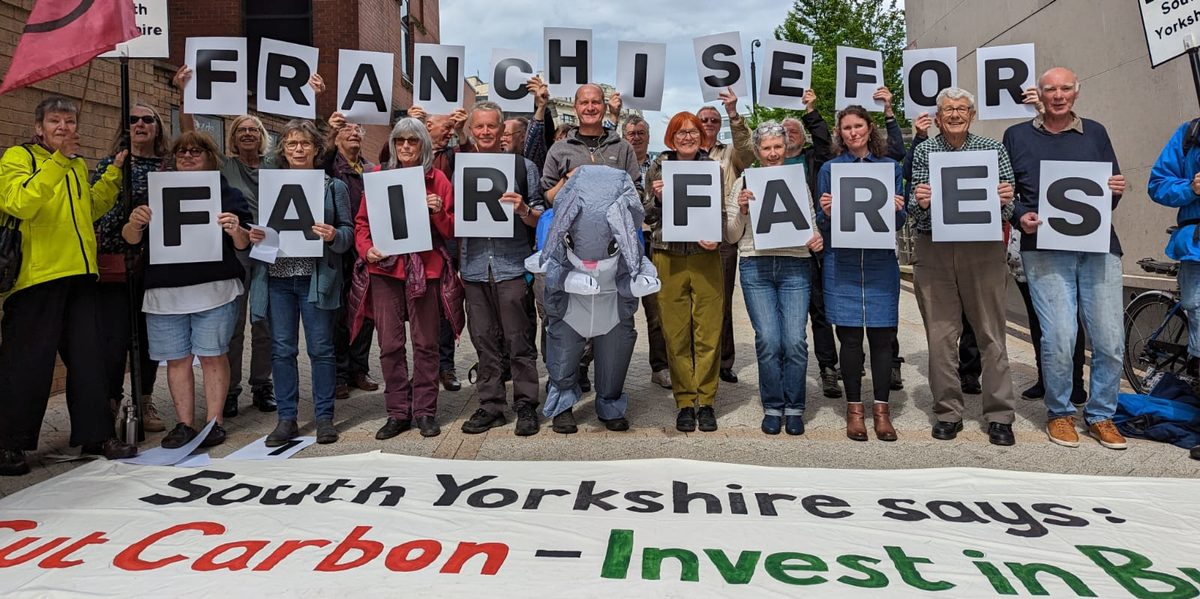
In some places such as Greater Manchester, West and South Yorkshire franchising has been introduced to bring in an element of public control of bus services. The Manchester Bee network is a key aspect of what Prime Minister Burnham trumpets as his legacy from his time as Mayor of Manchester. Regional elected mayors have been able to achieve some improvements in transport services and Burnham’s election as Labour Party leader and Prime Minister hopefully will put more of a spotlight on the importance of good public transport for improving people’s lives.
The next step, once franchising has been agreed, is to push for the best possible variant of franchising and to make the case for bringing buses back into public ownership. This involves arguing for the franchising authority to have as much control as possible over routes, timetables, vehicles and garages. The South Yorkshire Better Buses Campaign has also raised the demand for elected boards of bus workers and service users to be involved in planning bus services. This illustrates how the Better Buses Campaign is both identifying all the ways in which bus services can work better for people and raising questions of democratic public planning.
Cap costs, campaign for free transport
The cost of bus and other public transport is often a barrier. As people struggle with a cost-of-living crisis, the cost of getting to work, to school or college, to health appointments or to stay in touch with family and friends is a real issue. The announcement from Burnham that the time limits as to when disabled people can use free buses will be lifted from April 2027 should be welcomed. The same lifting of time limits should be extended to older and younger peoples’ travel passes.
The demand for free public transport is increasing in popularity. There are cities and countries in the world which have already managed to achieve fare free travel as the website and campaigning activity of Fair Free London makes clear. The provision of universal public services can help to protect living standards in periods of inflation and is a demand the labour movement should loudly support.
For many disabled people with impaired mobility the failure to design or provide fully accessible buses is another major obstacle, Too often wheelchair users and those travelling with small children are pitted against each other – even in circumstances where there is plenty of space in the rest of the vehicle. Some designs make it very difficult to manoeuvre large wheelchairs and buggies especially in rush hours or bad weather.
Accessibility is key
While bus drivers are told that the Equality Act means they should prioritise those in wheelchairs, this can be challenging for workers without the support a conductor would have provided. All of this is frustrating enough if the next bus is less than half an hour away, but where it might be the only one of the day it can compound isolation that already exists. These are all issues that will be addressed in the workshop on accessibility run by Disabled People Against the Cuts.
Linked to the equality issues around disability access is the issue of safety when waiting at bus shelters and using bus Ac. The more frequent and reliable bus services are and the more bus shelters are placed in safe and well-lit locations, the more willing and confident people will feel about using public transport. The way bus services are organised and run really matters for anyone who has to think about personal safety when out after dark or in an isolated location. This is the case for most of humanity, especially women, Black people, older people, disabled people.
Support bus drivers
Another important theme of the conference will be the pay and working conditions of bus workers. The recent heatwaves have raised the issue of temperature control in drivers’ cabs as well as other key issues which need addressing from pay to toilet breaks. Unless the pay and conditions are acceptable, so that workers are prepared to take and stay in jobs driving buses, there is no prospect of improving bus services. Good conditions for the workforce and good services for bus users must be addressed as part of the same campaign for better public transport.
All in all, a packed agenda and lots to campaign over. Register for the conference here.