
Andrew Griffith arrived in Birmingham promising to strip away costs. Planning rules, environmental requirements, employment protections and producer levies appeared in his speech as obstacles to growth. Laura Trott arrived with a different proposition. Teachers needed more rules, unions needed tighter legal limits, Ofsted needed stronger investigatory powers and politically contentious work inside schools required closer supervision. The two speeches fit together more comfortably than the language of “small government” suggests.
Griffith’s promise to abolish what he calls Labour’s “packaging tax” is a good place to start. The policy is Extended Producer Responsibility for packaging, or pEPR. Companies placing packaging on the market contribute towards the cost of collecting, sorting, recycling and disposing of it once households have finished with it. In his conference speech, Griffith presented the charge as another cost weighing on business.
The money is substantial. PackUK’s annual report says packaging producers paid £1.41 billion into the system in 2025-26 and £1.34 billion went to local authorities. PackUK’s own figures make the transaction unusually easy to see. One side pays because another side has to deal with the material left behind.
Who pays for recycling?
Removing the producer charge leaves companies with more money. The packaging remains. Bottles still need collecting. Cardboard still needs processing. Plastic still has to be sorted, recycled, burned or buried. Refuse workers still have to be paid. Collection vehicles still need fuel and maintenance. Recycling plants still cost money. Abolition changes who carries the bill.
Birmingham puts a precise figure on that transfer. The city hosting the Conservative conference is due to receive £15,376,045.37 from the scheme in 2026-27. That matters because Birmingham’s bins and municipal finances have been repeatedly used as conference scenery. The Conservatives have attacked the state of local services while proposing to remove a funding stream worth more than £15 million to the same council.
A future Conservative government could replace the money from general taxation. The business saving would then remain a public cost. It could leave councils to absorb the loss, which would push pressure into local taxation, charges, recycling provision or other services. Griffith has not set out a replacement mechanism. The physical work that the charge currently funds cannot be legislated away.
Dumping producer responsibility
Costs visible on a company balance sheet are treated as evidence of state failure. Once they move outside the firm, they become less visible politically. Lower building standards can cut construction costs while raising future energy bills. Removing developer contributions can make schemes cheaper to deliver while leaving roads, schools, drainage and health provision to be financed elsewhere. The accounting changes before the underlying need does.
Producer responsibility was developed on exactly this point. In 2018 Michael Gove’s Defra said producers should meet the full cost of dealing with packaging waste. The aim was partly fiscal and partly behavioural. Packaging that is expensive to recycle should become more expensive to produce, encouraging firms to use less of it or design materials that are easier to reuse.
That does not make the current scheme beyond criticism. Businesses have complained about complexity, fee levels and poor implementation. PackUK’s first year needed a £102 million intervention after problems with data and calculations. The design can be simplified or replaced. The question of who pays still has to be answered.
State enforces tory rules in schools
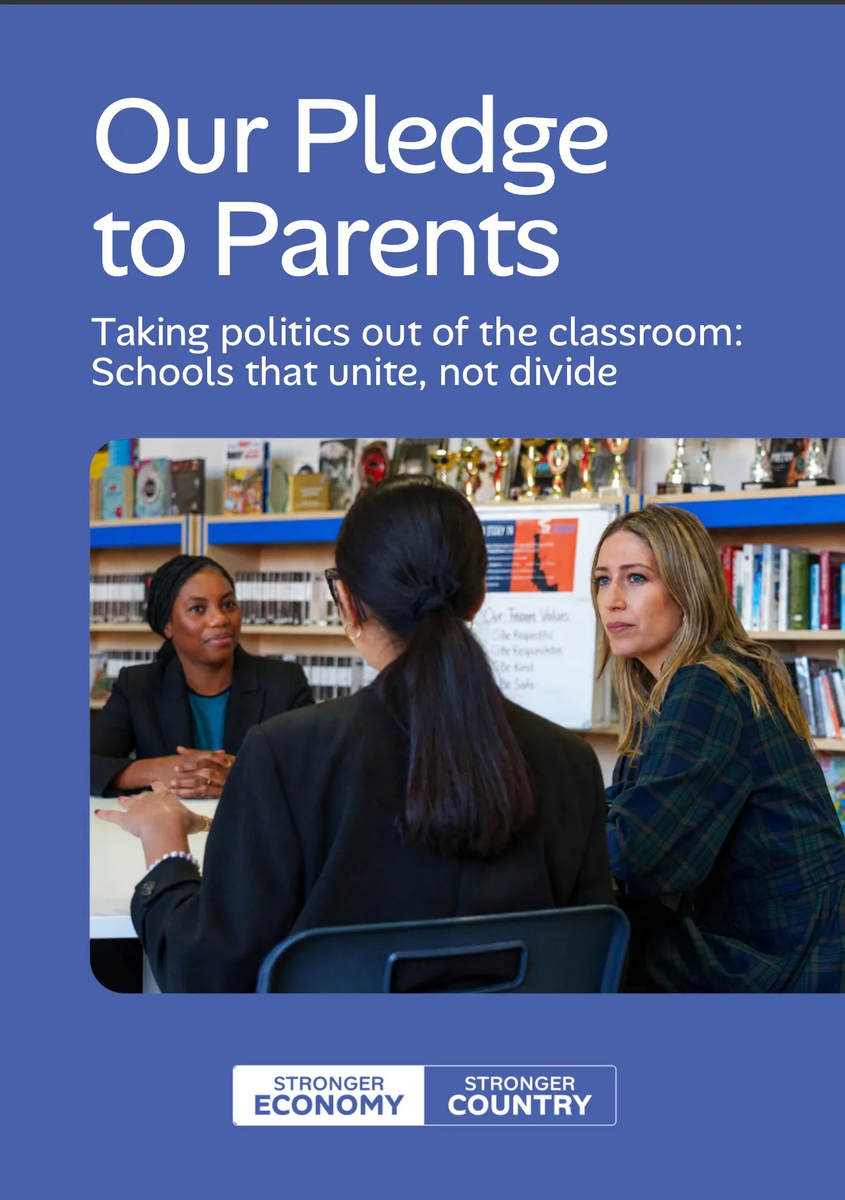
Trott’s education proposals reveal the other side of the same political method. Schools already operate under statutory duties of political impartiality. The Education Act 1996 prohibits the promotion of partisan political views and requires balanced treatment where political issues are taught. Department for Education guidance already covers outside organisations, campaign materials and contentious subjects.
Trott wants an enforcement structure built around those duties. Political impartiality would be pushed further into teacher training and professional standards. Ofsted could investigate individual complaints, examine lessons, assemblies and staff training, and refer serious cases to the Teaching Regulation Agency. Parents would gain another route for complaints. Schools could face restrictions on vaguely defined “culture” and “identity” days. The detailed proposals reported by Tes go well beyond a reminder that teachers should remain politically impartial.
Trott also promised “a specific law around trade unions involved in education” and said unions “must not bring politics into schools”. No draft law exists and no clear definition has been offered for the political activity that would be restricted. The ambiguity matters because schools are workplaces. Education unions campaign over pay, workload, pensions, academy structures, funding, special-needs provision and legislation affecting their members. Those subjects are political because government decisions shape them.
Caring for refugees = political activism
One of Trott’s examples was Schools of Sanctuary, the programme run by City of Sanctuary UK that works with schools seeking to create welcoming environments for refugees and people seeking asylum. Trott described the programme as having an “agenda” and treated it as evidence of political activism in education.
The organisation has already faced regulatory scrutiny. The Charity Commission opened a compliance case after allegations about political activity linked to the Schools of Sanctuary programme. On 7 April 2026 it closed the case and found no evidence of inappropriate political activity. The regulator said misleading claims had been fuelled by online misinformation and noted threats against the charity and its staff.
Charity law and education law apply different tests, so the Commission’s decision cannot establish that every resource used in every participating school complies with every rule on political impartiality. Trott could identify a particular lesson or piece of material that crosses the line. She has not yet done so. The example currently being used to justify stronger state supervision is an organisation that has already been investigated over similar allegations and cleared by the relevant charity regulator.
Environmental bodies are marked for abolition or absorption into departments. Judicial review is attacked as a barrier to growth. Developers are promised fewer obligations. Employers are promised relief from employment law. Packaging producers are offered the removal of a £1.4 billion liability. Teachers are offered more inspection. Education unions are offered new legislation.
Fewer constraints for bosses more for everyone else
Welfare claimants face tighter conditionality. Migrants face an enlarged removals apparatus and wider use of facial recognition. Prison capacity expands. Defence spending rises. The state is being reorganised around a different set of priorities.
The language of freedom obscures who receives it. A producer gains freedom from part of the social cost attached to its packaging. A developer gains freedom from some planning and environmental obligations. An employer gains freedom from employment protections. Teachers gain another layer of scrutiny. Trade unions gain another possible statutory restriction.
Economics viewed from the firm tends to treat money leaving the corporate account as a cost to society. The same expenditure looks different when it appears as local authority waste collection, lower household energy bills, public infrastructure or workers’ protections. The underlying activity has not vanished. Its cost has moved.
Birmingham’s £15.4 million packaging allocation makes that movement visible in pounds and pence. Schools of Sanctuary makes the political side visible in a different way. One policy removes a cost from business while leaving councils with the material problem. The other expands regulation after an independent regulator has already rejected the central allegation directed at one of the chosen examples.
The emerging Conservative state would therefore feel very different depending on where you stand inside it. Companies encounter fewer constraints. Workers, claimants, migrants and public institutions encounter more supervision and more conditions. That distribution of power matters more than whether the resulting state can be described as large or small.
The bottle still has to be collected. The teacher still has to watch what they say.