

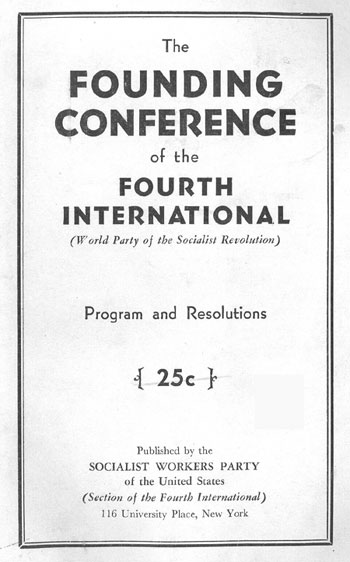
On the 3 September 1938 under threat from Stalinist assassins, delegates from a dozen countries launched the Fourth International at a gathering at Alfred Rosmer’s home in Périgny, a Parisian suburb.
In the 1930s, those who refused to resort to invective in the Stalinist style reproached first the Left Opposition and then the Fourth International with a fundamental lack of realism. Not all of Stalin’s decisions, they said, could be endorsed, and building socialism in a single country entailed contradictions. But in the given context, they maintained, there was no alternative, and the duty of every revolutionary was to defend the Soviet leadership unconditionally. When the USSR then made an essential contribution to the defeat of fascist imperialism in the Second World War, the “realistic” argument appeared enormously strengthened. Subsequently, the reconstruction of the USSR from the ruins of war and its rates of economic growth throughout that period were cited as further proof of the correctness of the choice made at the end of the 1920s. It was seen as a further condemnation of those who had criticised it and had thus deserved the defeat they suffered.
Today, sixty years on, a very different overall balance sheet is possible, starting from the very denunciations and admissions of the Gorbachev leadership of the Soviet bureaucracy (a first balance sheet had already been possible thirty years ago, starting from the Twentieth Congress of the CPSU and Khrushchev’s criticisms of the “cult of personality”). The substance — forgive the schematic summary — is that what was built in the USSR was not a socialist society, even within the borders of a single country, but a society that has very little to do with socialism as Marx, Lenin and the leaders of the October Revolution and of the Communist International at its foundation conceived it.
Certainly, there has been no restoration of capitalism, and in this sense some fundamental conquests of the revolution have not been swept away. But power is in the hands of a bureaucratic caste which enjoys enormous privileges and constitutes an ever more serious brake on the development of the productive forces. The most glaring example, on the economic terrain, is agriculture, which has still not overcome the catastrophic consequences of the forced collectivisation of the early 1930s. More generally, bureaucratised structures and management have prevented the creative potential of the workers from expressing itself, producing distortions, bottlenecks and paralysing contradictions of every kind.
There is hardly any need to recall, moreover, that Stalin bore the principal responsibility for the tragic military failures of the first year of the war, which brought the USSR to the brink of defeat. He had decapitated and disorganisied the Red Army with the bloody purges. Also he based his policy until the very last day on the assumption that Hitler would respect the non-aggression pact signed in August 1939. The situation could only be turned around once the people of the USSR, and first of all the peasants, grasped what Nazi imperialism meant and threw all their forces into the victorious counter-offensive.
No less correct have proved the criticisms of Trotsky and the Left Opposition on the terrain of international politics. The subject is addressed in other articles in this special issue. It is enough to recall here the critique of the sectarian and irresponsible policy of the Stalinised Comintern and the German Communist Party in the crucial phase of the struggle against Hitler. It was one of the essential factors in a historic defeat from which, in terms of anti-capitalist political consciousness, the German proletariat has still not recovered.
The battles of these decades
Trotsky, the Left Opposition and the Fourth International did not counterpose merely generic programmatic assertions to Stalinist political choices. Anyone who wishes can verify that from 1923–24 onwards, at every moment when problems of decisive importance were on the table, the Opposition put forward alternatives in concrete political terms. It did not neglect the conjunctural framework and tactical requirements. This was the case, for example, during the battles against the bureaucratisation of the party, for a correct approach to the problems of industrialisation, and over policy in the countryside. The same holds for its international choices. What is even more important, our movement never confined itself to criticism and denunciation, but took a direct part in the struggles, despite the hard blows it suffered and the persecution of its militants.
We were defeated, in the sense that Stalin succeeded in imposing himself both in the USSR and in the international communist movement. But we were not the only ones defeated. The Soviet masses were defeated: the exercise of political power was torn from them, and they paid, dramatically and in every sense, the price of Stalinism. The workers and peasants of all those countries on which the Stalinist leadership imposed a policy and a form of organisation that led to catastrophic defeats were defeated too. As for the “victors”, there are not many left who still care to claim certain “victories”.
The reality is that, from a general historical standpoint, the great battles begun in the aftermath of the First World War are still in full swing. Who will be the victor in the end is by no means predetermined. But revolutionary Marxists, in the light of experience, can lay claim to the fundamental validity of their critique. Beyond all the errors and all the contradictions, their battle has been fought in the right direction. That is why we are determined to continue it.
The question now arises of the context in which the construction of an international workers’ movement is situated today. Without ignoring what is happening in other regions of the world, we must underline that the most important event of recent months is the crisis convulsing the Soviet Union from top to bottom — the bureaucratised society that seemed ever more sterilised by the caste of old men who dominated it.
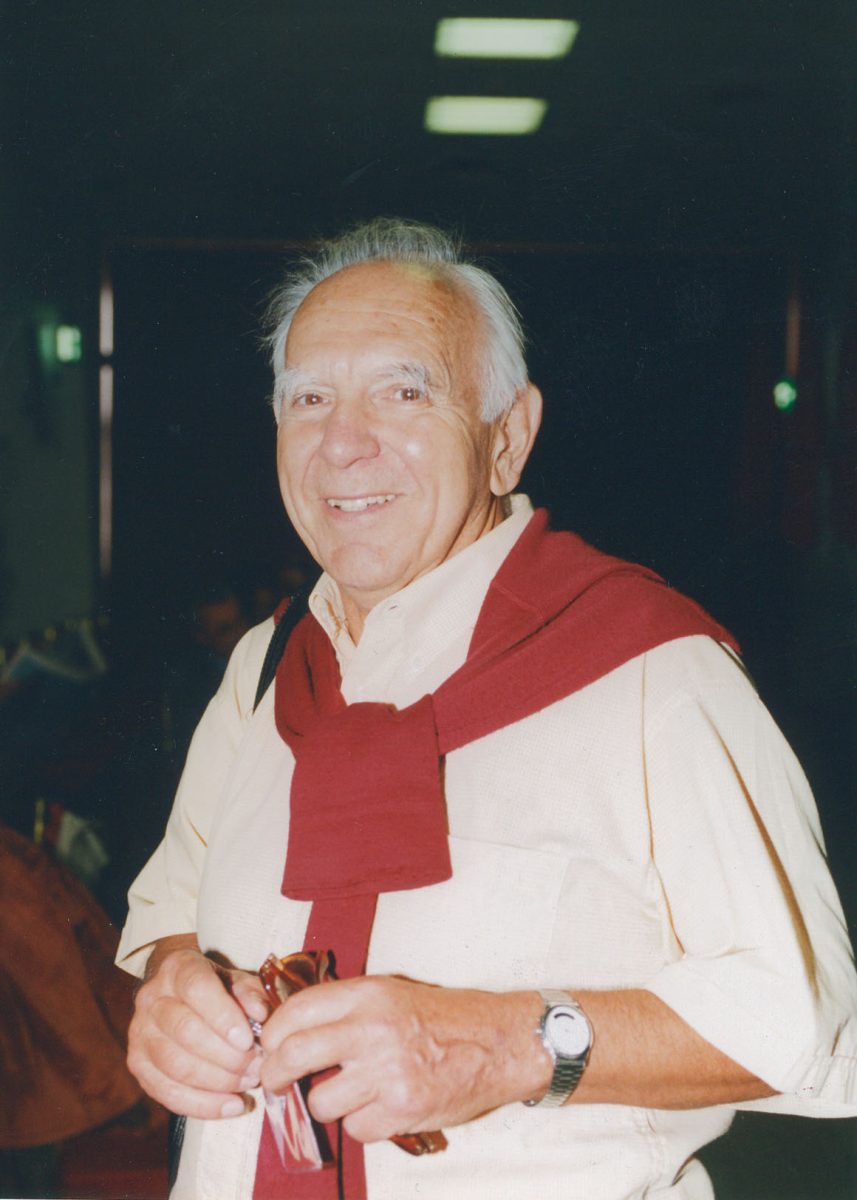
Livio Maitan (1923-2004)
New possibilities in the countries of the East
We were always convinced that the “ice age” in the USSR would not last forever, because we believe in the underlying truth that the dynamic of social forces is, in the final analysis, more powerful than all structures and political apparatuses, and even than the most systematic police repression. We ourselves are astonished by:
- the depth of the wave that has shaken the Soviet Union in so short a time
- the breadth and level of consciousness reached by broad layers of the population
- the intellectual and political courage of the vanguard groups now taking shape
- by the strength of certain mass mobilisations.
A new historical phase has effectively opened, with a dynamic of anti-bureaucratic revolution. This revolution will not, however, be completed by Gorbachev, nor by any bureaucratic leadership group. Our international press has amply explained the reasons, and we shall not return to them here.
Gorbachev is in fact proposing a new version of peaceful coexistence. More precisely, he speaks of a “peaceful conception which necessarily requires cooperation”. In his view, “it falls to history to judge the merits of each particular system. History will make the choice. Let each nation decide for itself the best system, the best ideology.” The underlying idea is that capitalism still has an entire historical phase ahead of it, and that one must therefore wait patiently for history’s verdict.
From this standpoint one can only abandon any perspective of overthrowing capitalism, and hence of revolutionary struggle on a world scale. At the same time one is led to evade the historic choices of the international workers’ movement. The communist parties, or what remains of them, are consequently induced to carry their neo-reformist course through to its conclusion, and the question of relaunching any international organisation does not arise. The Italian Communist Party (PCI) has understood the message well, and its leaders are among Gorbachev’s most enthusiastic supporters.
All this indicates that the battle for internationalism and for the construction of a revolutionary International will continue to be very difficult in the USSR. It will be no less so in the countries of Eastern Europe, where for decades the bureaucrats presented their subordination to the Moscow bureaucracy as “internationalism”, and where the political disorientation is far from being overcome. Those who have a real understanding of the meaning of internationalism, and of the need to give the workers’ movement an international framework, amount only to very small nuclei.
Internationalism in the capitalist and dependent countries
The internationalist battle is also very difficult in the capitalist countries of Western Europe, and all the more so in North America and Japan. Dramatic events of the past decade — the China–Vietnam war and the Soviet invasion of Afghanistan — have caused deep disillusionment and demoralisation, first and foremost in those sectors of the workers’ and internationalist movement that had committed themselves to solidarity with Vietnam. The hammering of the bourgeois media, which seeks to relaunch the values of capitalist society, has wrought real destruction. The bureaucrats of the workers’ movement have often capitulated before this offensive, which went hand in hand with attacks on living standards and on workers’ conquests and rights. When any perspective of overthrowing capitalism is renounced, and the idea that it will last indefinitely is accepted, not much room is left for internationalism, and any project of international proletarian organisation looks like the residue of a bygone era.
The panorama is more encouraging in other regions of the world. In Latin America, the victorious revolutions in Cuba and Nicaragua are engaged in a courageous struggle against imperialism, while other revolutionary movements are shaking the colonial regimes in their countries. Internationalist ideas retain their power of attraction, and internationalism itself keeps a real meaning.
Cuba and Nicaragua have given shining examples of this. But not even the leaders of these two countries share the conception, fundamental for us, of the dialectic of the three sectors of world revolution. While they have helped and continue to help revolutionary movements in other countries, they have not posed, and do not pose, the problem of building an International. More particularly, the Cuban leaders are largely inspired by a campist conception which has led them to unacceptable positions, such as approval of the Soviet intervention in Czechoslovakia and support for the Polish bureaucracy against Solidarność and the revolt of the working masses.
What role does the International play today?
In this context, our battle for the internationalist principles that were at the origin of our movement, and for the construction of a mass International, is more necessary than ever, and we shall continue it whatever the difficulties.
Does this perhaps mean that we hold a self-proclamatory and narrow conception of the International, as our adversaries and critics claimed fifty years ago and as some still maintain today? The decision to found the Fourth International was dictated neither by an abstractly self-proclamatory concern nor by conjunctural considerations or perspectives. Rather it was the conviction — founded on many experiences — that it was necessary to provide a programmatic and political answer to the crisis of the workers’ movement and to the problems that crisis posed. It was dictated by the conviction that only an international organisational framework, however limited, would make it possible to:
- maintain the indispensable links between the existing revolutionary groups,
- ensure the continuity of Marxism and Leninism
- confront the new problems that would arise
- and — what counts most — to commit the forces thus gathered to the battles of the workers’ movement in the various regions of the world.
It was a necessary historical task, and one that we have, in substance, fulfilled.
To conclude: we never argued that the revolutionary mass International would be built with our forces alone. From the debates of the 1930s to the resolutions of the last World Congress in 1985, we have explicitly maintained that this International will arise from the convergence of different revolutionary currents and movements. Our project was not the linear growth of the organisations that had joined first the Left Opposition and then the Fourth International. Today this approach is more valid than ever,. If we defend the existing International with the greatest tenacity, and fight to strengthen it, it is precisely because it represents an irreplaceable instrument for advancing towards the formation of a qualitatively superior International: the revolutionary mass International.