

Donald Trump’s war against Iran has helped detonate an autumn of discontent across Europe. Soaring energy prices, falling living standards, unaffordable housing and the relentless squeeze on wages have brought hundreds of thousands onto the streets. Young people, facing a future of precarious employment, astronomical rents and deteriorating public services, have been at the forefront of the revolt.
From Paris to Rome, Madrid to Lisbon, governments face an increasingly militant challenge. Their typical response has been to denounce demonstrators as mindless rioters, mobilise the police and attempt to discredit the radical left. But behind the burning barricades and sensationalist headlines lies a profound social crisis.
France has experienced the most dramatic confrontations, but Albania, Italy, Spain, Portugal and Belgium have all witnessed significant mobilisations. Their immediate demands vary: lower food and energy prices, higher wages and pensions, affordable housing, better-funded education, an end to austerity and action against government corruption. Yet the underlying grievances are remarkably similar.
Zombie neo-liberalism
Following the 2007–08 financial crisis, the top bankers and politicians refused, as some expected, to return to some form of Keynesian managed economy. Instead, they doubled down on neoliberalism — zombie neo-liberalism — entrenching a system that pillages state finances for the billionaires and, in the process, massively increases the gulf between the ultra-rich and everyone else. As French revolutionary socialist Olivier Besancenot argues in an interview published on 20 October, what is remarkable about the current movement is the convergence of revolts by different sections of society outside the traditional frameworks of the trade unions and political parties.
Besancenot describes the mobilisation as something unprecedented in his experience. Speaking of the demonstration on 17 October, he declared, “It was a tidal wave, a human tide.” His central argument is that the authorities and much of the media have concentrated on scenes of destruction while obscuring the extraordinary scale and social breadth of the movement.

The authorities have also deployed an extraordinary level of repression. Besancenot points to record numbers of people taken into police custody, the imposition of a partial curfew and discussion of banning political organisations. He also refers to reports of deaths whose circumstances remain unclear.
For Besancenot, the repression is not an accidental excess but an expression of the increasingly authoritarian character of neoliberal government. As resistance grows, the state resorts more readily to coercion. An ominous showdown is approaching.
The spectre of a new economic crash
The background to this European revolt is the deepening crisis of neoliberal capitalism itself. The major economies have never fully escaped the consequences of the financial crash of 2007–08. Governments rescued the banking system through enormous public interventions, while ordinary working people were subsequently told that public spending had to be restrained, wages held down and social provision cut.
‘Quantitative easing’ and bank rescues helped stabilise financial markets, but they did not resolve the underlying problems of debt, inequality, financial speculation and weak productive investment. Nor did they prevent the transfer of enormous wealth towards the owners of financial assets.
During the Covid-19 pandemic, further scandals involving public procurement and contracts for personal protective equipment exposed the intimate connections between political power and private profit. Now the additional economic shock of war, rising energy costs and mounting international instability threatens to push already fragile economies towards a new crisis.
The danger is not simply another recession. It is the possibility of a series of sovereign debt and fiscal crises in which governments find themselves unable to sustain public services, pensions, healthcare and other social obligations.
Argentina’s collapse in 2001 provides a terrifying historical warning. The breakdown of its financial system, sovereign default, unemployment and mass impoverishment devastated millions of lives. A comparable crisis affecting several European countries would have catastrophic consequences.
Of course, Europe is not Argentina, and a generalised collapse is not inevitable. But the lesson is unmistakable: when capitalist governments confront financial crises, they invariably attempt to make working people pay the price. The present wave of demonstrations is, in part, a revolt against that prospect.
France: The largest and most militant demonstrations
France has experienced the most extensive nationwide unrest, with a combination of school strikes, trade-union protests, mass demonstrations and serious confrontations with the police. The movement emerged from several overlapping struggles.
High-school students began mobilising in September against overcrowded classrooms, inadequate staffing, deteriorating buildings and poor cafeteria provision. Public-sector workers and trade unions protested against cuts to services and declining purchasing power. Wider demonstrations demanded action on inflation, energy prices and the cost of everyday necessities.
A mobilisation promoted through social media in early September drew support from students, workers, pensioners, farmers and activists associated with the earlier Yellow Vest movement. The decisive escalation came on Saturday 17 October. The French Interior Ministry said that 1.5 million people were on the streets.
Paris, Marseille, Lyon and Lille witnessed particularly serious incidents. Vehicles were set alight, barricades erected and shopfronts smashed, and confrontations took place between demonstrators and police. Police used tear gas and water cannon. Reducing this enormous movement to the violence of small groups would be a grotesque distortion.
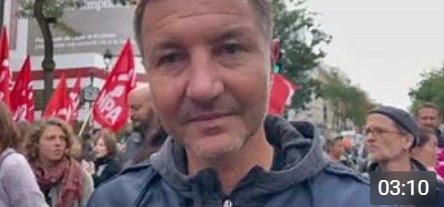
NPA leader Olivier Besancenot
Hundreds of thousands participated in demonstrations whose overwhelming political significance was the breadth of opposition to the government’s policies. Besancenot emphasises that the movement has brought together different social layers in a way that goes beyond the normal boundaries of organised politics. This, he argues, is what makes it potentially so explosive.
His assessment of the repression is equally significant. He argues that methods developed against working-class neighbourhoods have subsequently been extended to other forms of social protest.
But repression has not extinguished the movement. On the contrary, police violence risks further radicalising young people who already regard the political establishment with contempt.
For the radical left, the central question is whether this youthful rebellion can unite with organised workers and develop into a sustained confrontation with the government. Besancenot identifies the intervention of the working class as decisive. A cross-sector day of action has been called for 5 November.
But beyond the current upsurge, the election for a new president is only six months away, and current polling suggests that far-right potential candidates Marine Le Pen or Jordan Bardella could win in the second round. Olivier Besancenot’s New Anticapitalist Party (NPA) has decided not to run its own independent candidate but to campaign to form an anti-fascist front and back a single left candidate. In a June 2026 statement, the party noted that Jean-Luc Mélenchon of the France Unbound party was the candidate most likely to gain support on the left.
Albania’s Flamingo Revolution: From environmental protest to political revolt
Albania’s Flamingo Revolution began in May 2026 as an environmental protest but quickly grew into a broader movement against corruption, economic inequality and the government of Prime Minister Edi Rama.
The movement originated in opposition to luxury tourism developments threatening the Vjosa–Narta wetlands on Albania’s Adriatic coast. The area is an important habitat for flamingos and other migratory birds. Environmental campaigners argued that the proposed developments would damage a fragile ecosystem while benefiting politically connected investors. The flamingo consequently became a symbol of resistance to a neoliberal economic model that prioritised private development over environmental protection and public welfare.
The protests soon expanded beyond environmental concerns. Demonstrators challenged the government’s promotion of large-scale tourism, property development and foreign investment, arguing that these policies enriched a narrow business elite while ordinary Albanians faced low wages, rising housing costs, inadequate public services and limited employment opportunities. Young people, many contemplating emigration, were particularly receptive to these grievances.
The movement emerged despite Rama’s decisive victory in the May 2025 parliamentary election. His so-called ‘Socialist Party’ secured 83 of the 140 parliamentary seats, giving him an unprecedented fourth consecutive term. However, low electoral turnout and longstanding allegations of corruption and political patronage suggested that parliamentary dominance did not necessarily reflect widespread support.
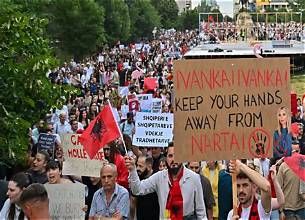
Albanian’s ‘flamingo’ protestors
During the summer of 2026, demonstrations spread from environmental campaigning into wider anti-government mobilisation. Protesters increasingly demanded Rama’s resignation and investigations into corruption. Significantly, many also rejected the established opposition Democratic Party, led by former prime minister Sali Berisha, regarding both major parties as components of the same entrenched and corrupt political system.
The movement escalated dramatically in October, when thousands of university and secondary-school students joined the protests. Their demands included increased education funding, affordable accommodation, better employment prospects and an end to corruption. The government replied with escalating police violence.
By late October, demonstrators were demanding Rama’s departure and the establishment of a transitional technocratic government. Rama refused to resign, insisting that political instability would jeopardise Albania’s ambitions to join the European Union.
The Flamingo Revolution thus developed from the defence of a threatened wetland into a challenge to Albania’s political and economic order. Its distinctive feature was the combination of environmentalism, student activism and opposition to both established political parties. Whether this mobilisation could generate a durable political alternative remains uncertain.
Italy: Trade unions, students and transport workers mobilise
Italy has experienced overlapping mobilisations involving industrial workers, students, farmers, fishers, transport workers and political activists. The demands include higher wages and pensions, action on energy and fuel prices, affordable housing, greater investment in schools and healthcare, and opposition to the policies of Giorgia Meloni’s right-wing government.
On 17 October, the CGIL trade-union confederation organised a major demonstration in Rome, with reported participation approaching 100,000. Speaking ahead of the demonstration, CGIL general secretary Maurizio Landini made the connection between social demands and political resistance explicit.
He argued that defending the Italian Constitution meant increasing wages, rejecting precarious employment, protecting public healthcare and guaranteeing the right to education. His indictment of the country’s unequal tax system was particularly sharp: workers and pensioners were being made to bear the burden while profits, financial wealth and tax avoidance enjoyed preferential treatment.
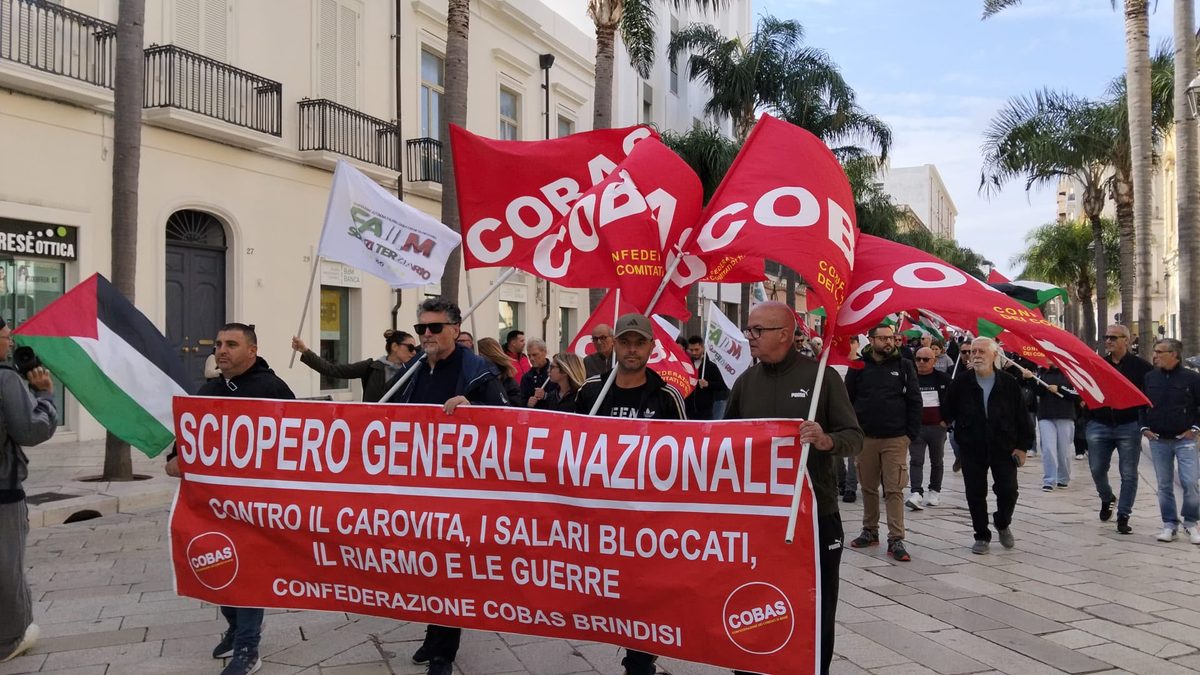
Successful one day general strike called by USB minority trade unions
On the day of the demonstration, Landini said people could no longer endure the situation, demanding higher wages, functioning schools and action against the rising cost of living. He also stressed the younger generation’s desire for change.
This was not simply another ritual trade-union protest. It expressed growing opposition to a government whose nationalist rhetoric cannot conceal its commitment to policies that favour business and the wealthy.
In Milan, a demonstration against war and rising living costs was followed by serious confrontations near Piazza del Duomo. Masked participants reportedly threw objects at police, erected burning barricades and looted shops.
Turin and Bologna also experienced confrontations. High-school strikes spread through several cities, while farmers, fishers and lorry drivers organised roadblocks and protests over fuel costs in Calabria and Campania.
The Meloni government has attempted to portray militant demonstrators as a threat to public order. But behind the government’s denunciations lies a society in which years of wage stagnation, insecure employment and cuts to public provision have generated enormous resentment.
The CGIL has also been discussing further industrial action, including a possible general strike in November. The essential political question is whether the trade unions will move beyond isolated demonstrations towards coordinated industrial action capable of imposing real concessions on the government.
Spain: Housing, pensions and teachers’ strikes
Spain’s mobilisation has been particularly significant because of the sustained character of its housing protests. Since late September, housing campaigners have organised demonstrations and encampments, including protests in Madrid’s Puerta del Sol and mobilisations in Barcelona, Valencia and other cities.
Their demands include stronger protection against eviction, affordable rents, improved access to housing and measures against property speculation. The housing crisis is especially severe for younger people. Madrid rents have risen dramatically over the past decade, far outstripping wages.
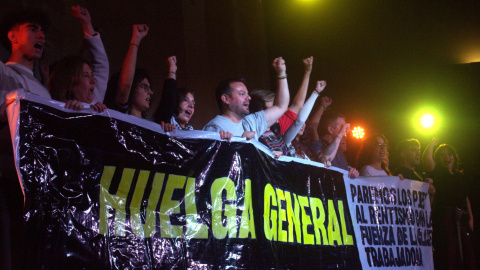
Many young adults remain trapped in their parents’ homes, unable to afford independent accommodation. Others spend an enormous proportion of their income on rent, leaving little for food, transport or other essentials.
The result is a generation increasingly convinced that the housing market is organised not to provide homes but to enrich landlords, property companies and financial investors. Valeria Racu, spokesperson for the Madrid Tenants’ Union, has been among the most forceful advocates of escalating the struggle.
In a interview published by El País on 25 October, she argued that successive governments had promoted a system in which housing functions as a source of private rental income. Her criticism extended to governments of both right and left: the former had liberalised the market and encouraged investment funds, while the latter had failed to reverse these policies.
Racu has called for rent controls, restrictions on the concentration of property ownership and a greatly expanded stock of public housing. Her argument points to the political heart of the struggle: housing must be treated as a social right, not a commodity.
The housing movement has been accompanied by other struggles. Teachers have organised rolling strikes over pay, class sizes, building maintenance and public education funding. Pensioners have demanded inflation-linked increases, higher minimum pensions and action to close the gender pension gap.
Trade unions have increasingly connected wages with the housing emergency. On 7 October, the major union confederations UGT (General Confederation of Labour) and CCOO (Workers’ Commissions) announced agreement in principle on a general strike during the autumn, subject to ratification by their governing bodies.
Their demand was clear: decent wages that would allow workers to secure decent housing. This represented an important development. The housing movement was beginning to converge with the organised labour movement, opening the possibility of a much broader social confrontation.
With a general election scheduled for 29 November, the struggle also raises fundamental questions about the failures of parliamentary politics to resolve the housing emergency.
Portugal: Housing protests and mass demonstrations for wages
Portugal has witnessed one of the clearest combinations of housing protests and organised labour mobilisation. Demonstrators have demanded higher wages and pensions, affordable homes, protection from eviction and action against property speculation.
Housing costs are a central grievance. House prices have more than doubled since 2017, although this figure is disputed by the right wing.
For many Portuguese workers, especially the young, the possibility of securing a home has become increasingly remote. Tourism, property speculation, short-term letting and investment-driven development have contributed to a housing system in which residents’ needs are subordinated to profit.
On 17 October, demonstrations organised by the CGTP trade-union confederation took place in Lisbon, Porto and Coimbra. Reports described several tens of thousands marching in Lisbon, demanding higher wages and action on living costs and housing.
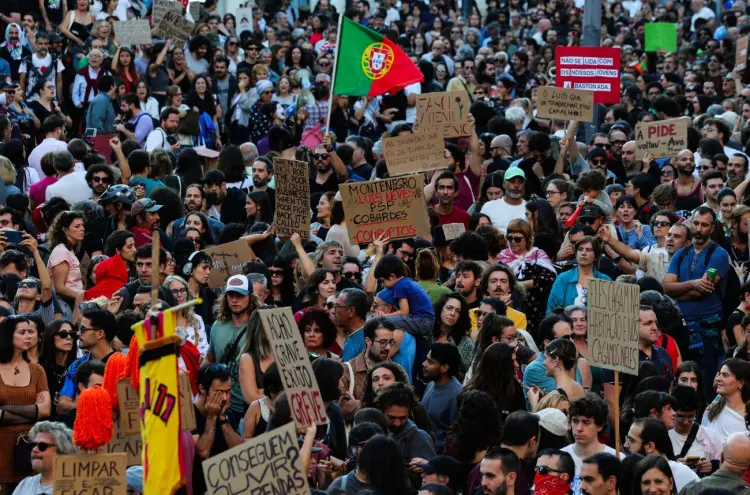
Housing campaigners also established tent encampments in Lisbon’s Rossio Square and in Porto. Some pledged to remain until their demands were addressed.
Although the demonstrations were predominantly peaceful, police interventions against encampments intensified the conflict. Reports described arrests and minor injuries during operations in Lisbon, although the precise figures need further verification.
The central issue is the same as in Spain: housing has become an arena of class struggle. For property investors, rising rents and house prices represent increased returns. For workers, students and pensioners, they represent a direct attack on living standards.
The Portuguese radical left, including the Bloco de Esquerda (Left Bloc), has long argued that the housing crisis cannot be solved by leaving provision to private developers and landlords. A serious programme would require expanded public housing, stronger tenant protections, restrictions on speculation and policies that put the needs of residents before property profits.
The potential for coordinated action between Portuguese and Spanish workers is particularly important. An Iberian general strike, bringing together trade unions and housing movements on both sides of the border, would represent a significant escalation of the struggle. But whether such coordination can be achieved remains an open question.
A search of official sources produced particularly useful material that outines the arguments of the ACR’s Portuguese cothinkers in the Bloco.. On 18 October, the Bloco de Esquerda National Committee discussed the struggles for housing, rising living costs and pension cuts, together with the proposed 2027 state budget. Its parliamentary website also records legislative proposals on affordable rents, VAT reductions on essential food, gas and fuel, and pension protection.
On 25 October, Bloco coordinator José Manuel Pureza denounced the police response to housing demonstrators, declaring: “Este Governo é um enxovalho para a democracia.” Translated: “This government is a disgrace to democracy.”
Belgium and the wider European revolt
Belgium has also witnessed major demonstrations against austerity. On 9 October, tens of thousands protested in Brussels against federal spending cuts and attacks on living standards.
High-school demonstrations began in Liège, while further protests on 17 October drew smaller crowds in Brussels and Liège, with reports of clashes and police use of water cannon. The grievances combined education, public spending and declining purchasing power.
Serbia has continued to experience student-led anti-corruption protests, with government accountability and political institutions at the centre of the movement. Their immediate origins and political demands differ, but they share a profound distrust of governments, political elites and institutions that increasingly appear unable or unwilling to address the needs of ordinary people.
France: The campaign against Jean-Luc Mélenchon and the militant left
In his address to the nation on 17 October, French President Emmanuel Macron made a point of blaming the ‘radical left’ for street disorder. He did not talk about specific leaders or organisations, but much of the attack from the right was aimed at Jean-Luc Mélenchon, the main spokesperson for France Insoumise (France Unbowed), the left-wing political leader most likely to face the extreme right in the final round of the upcoming presidential election.
But the attack on Mélenchon is an attack on the whole radical left, blaming it for the violence in the streets. It comes at a time when attacking the radical left has become a stock-in-trade for right-wing leaders in the United States, Italy and other countries.
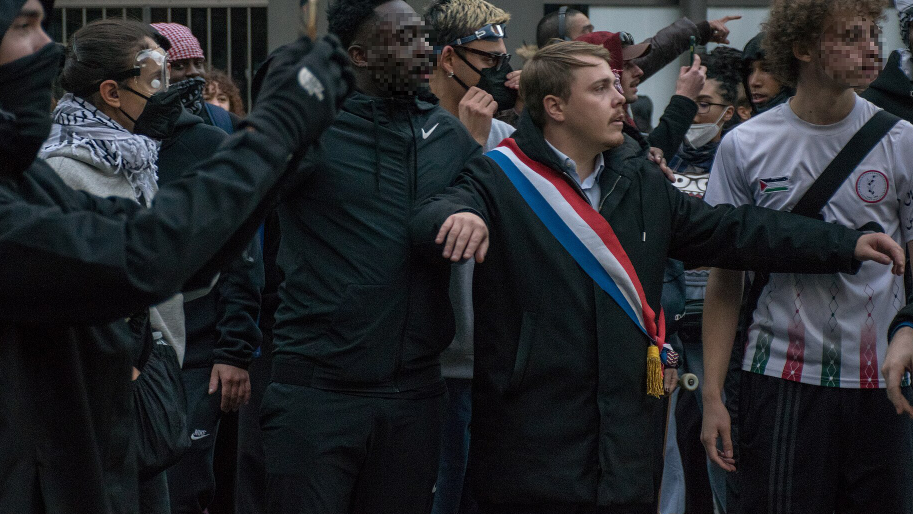
French LFI MP trying to calm French police aggression to protestors
Prime Minister Sébastien Lecornu has accused LFI of contributing to the unrest through its connections with radical-left groups. He demanded that Mélenchon choose between supporting republican institutions and siding with rioters.
On 20 October, French Senate president Gérard Larcher reportedly suggested that the possibility of banning LFI could be discussed. Such a proposal, if seriously pursued, would represent an extraordinary attack on democratic rights.
It recalls the French state’s banning of the Ligue Communiste, the French section of the Fourth International, in 1973, following confrontations surrounding a far-right meeting. Mélenchon has categorically rejected the attempt to hold LFI responsible for rioting.
Interviewed on LCI TV on 18 October, he argued that the real division was between young people experiencing a profound social crisis and a government responding with repression. Mélenchon did not endorse looting, arson or attacks on buildings. Rather, he accused the government of mishandling public order and using the disturbances to discredit its political opponents.
The political significance of this campaign goes far beyond Mélenchon himself. The right is attempting to establish the principle that political organisations can be held responsible for acts committed by individuals during demonstrations they support.
If accepted, this would provide a powerful weapon against trade unions, socialist organisations and every movement prepared to challenge the government in the streets. The implications for democratic rights are enormous.
The authorities’ emphasis on violence also serves another purpose: it diverts attention from the social grievances that have brought hundreds of thousands into action. The real scandal is not that young people are angry. It is that a wealthy society offers so many of them a future of insecure work, impossible rents, declining services and permanent austerity.
24/10/26