

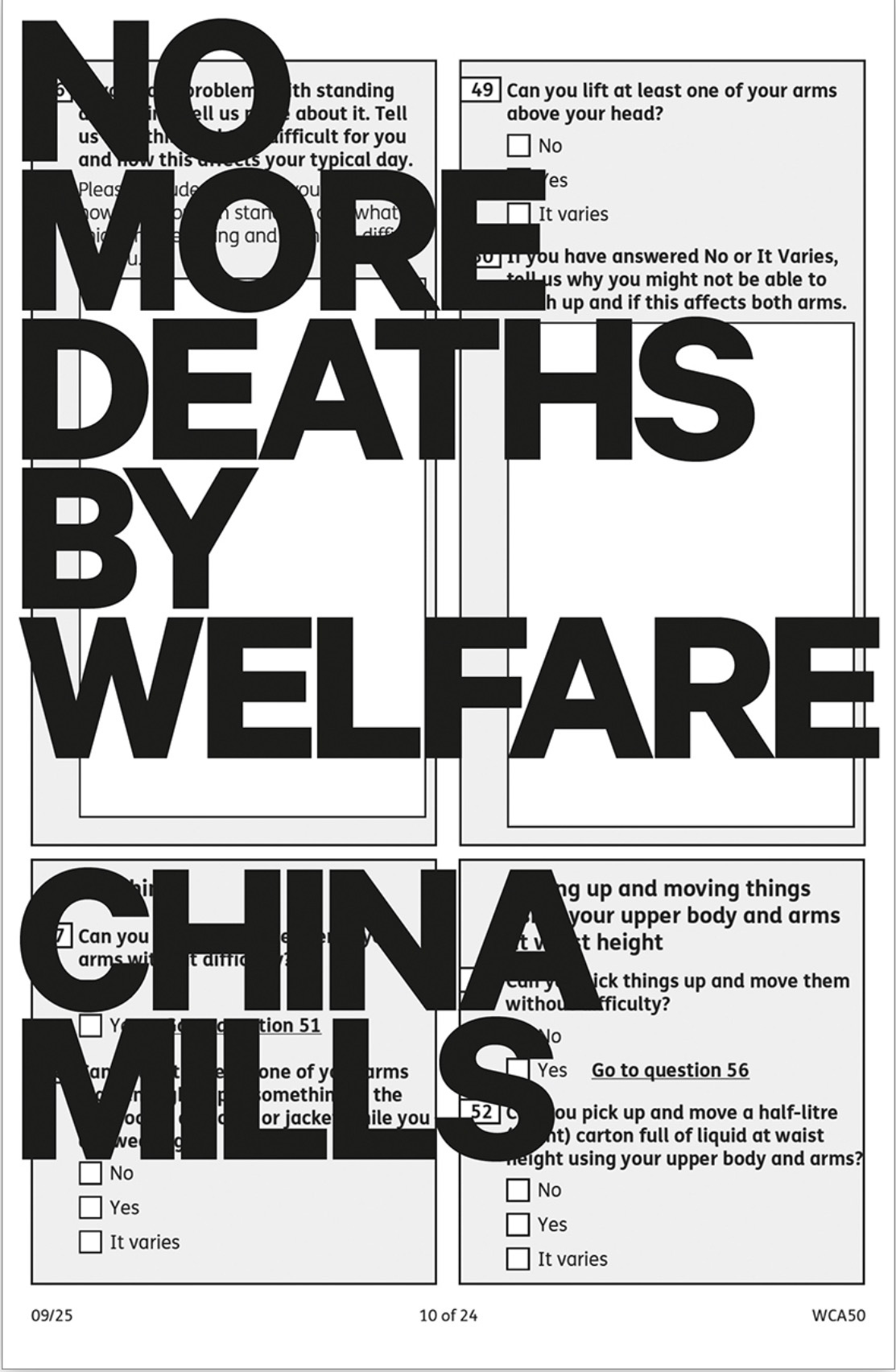
China Mills’s No More Deaths by Welfare (Pluto Press, October 2026) asks what happens when a system ostensibly designed to keep people alive becomes something they fear may kill.
Near the beginning of No More Deaths by Welfare, China Mills asks a series of questions that gradually turn the usual relationship between research and government upside down. “How many people have to die before people start listening and making change?” she writes. “Do we think that if we reach a certain number of deaths, people would suddenly start to care?” Then come the harder questions: “Do we think those in power don’t already know? Do we think they care?” For years Mills believed that evidence was the answer. Find the cases. Document the deaths. Establish the links between welfare policy and deteriorating mental health, destitution and suicide. Put the evidence before ministers and officials and wait for them to act. The Deaths by Welfare project, which she developed with the journalist John Pring and disabled activists, grew partly from this conviction. It assembled a timeline from coroners’ reports, safeguarding reviews, government documents, newspaper reports and the testimony of families. Mills describes her method as “rigorous rage”: she makes no pretence of dispassionate distance from people whose deaths she has spent years investigating, but the anger is attached to an extraordinary accumulation of evidence.
Something changed as the evidence accumulated. Mills came to doubt the premise that government simply did not understand what its policies were doing. In the preface she describes the shift with unusual candour. She had once thought her task was to show government that welfare policies were harmful and therefore were not achieving what ministers intended. “The government knows,” she now writes. What happens under the name of welfare, she argues, is punishment, stigma, humiliation and sometimes death. From there comes the question around which the whole book turns: “What if violence is a feature of the welfare state, and not a bug?” It is an enormous claim, and No More Deaths by Welfare spends the next 180 pages trying to earn it.
Mills starts not with theory but with the dead. Stephanie Bottrill died by suicide after becoming frightened about finding another £20 a week following the reduction of her Housing Benefit under the bedroom tax. Her final note told her son: “The only people to blame are the Government.” Paul Wilcoxson left a note expressing anxiety about government cuts. Brian Sycamore, who had run out of money for electricity while experiencing problems with Universal Credit, left a note sarcastically asking that the DWP be thanked. Philippa Day wrote about the payday loans she had taken after her disability benefits were cut and the financial hole from which she could see no escape. Other people left different kinds of evidence. Roy Curtis was found dead six days after being called for a face-to-face Work Capability Assessment. On the covering page of his capability-for-work questionnaire he had written in red ink: “This is when my nightmare began.” Errol Graham starved to death after his benefits were stopped. He weighed four and a half stone when he was found. In a note apparently intended for those assessing his fitness for work, he asked them to “judge me fairly” and explained that depression overshadowed him. All he wanted, he wrote, was “to live normally”.
Lining up the causes
Mills understands what these fragments do and do not prove. Suicide is rarely reducible to a single cause, and the DWP has repeatedly relied on precisely this difficulty when challenged about deaths. The response is familiar: correlation is not causation, individual circumstances are complex, no direct causal link can be demonstrated between a particular policy and a particular death. The burden then falls upon the bereaved family, disabled activists or journalists to prove otherwise. The first chapter, “Evidence of Violence, and the Violence of Evidence”, is the strongest sustained argument in the book because Mills does not simply complain about that evidential burden. She shows what happens when the cases are put beside one another.
Michael O’Sullivan died by suicide after being found fit for work. In 2015 a coroner concluded that his death had been a “direct result” of that decision. Stephen Carré had died five years earlier after being found ineligible for Employment and Support Allowance. His coroner identified the rejection of his appeal as a trigger and warned the DWP about failures to seek further medical evidence from a claimant’s GP or psychiatrist where mental illness was involved. Four years later, Mills notes, another coroner wrote to the DWP after O’Sullivan’s death raising essentially the same concern. That repetition matters more to Mills than the search for a single spectacular revelation. Pring tells her that the coroners’ reports and internal government reviews have been “building up into a giant pile of evidence”. Yet the DWP’s own review processes separate one death from another and largely keep wider policy outside their scope. The institutional structure therefore helps prevent the pattern from becoming visible.
Mills and Pring nevertheless find themselves attracted to the idea of what they call the “smoking gun”: the internal memorandum, email or secret recording that would demonstrate that senior politicians knew their policies would kill people. Mills then catches herself. Why should such a document be more authoritative than the evidence already assembled? Why should an admission by government carry more weight than the testimony of disabled people, families and coroners? “Do we need the government to admit it,” she asks, “when the policies it cooks up and signs off on kill disabled people anyway?”
Welfare violence is less visible
Here Mills is more careful than some of the slogans surrounding the book suggest. She concedes that harms can initially be unforeseen. Her question is what happens after government has been shown the harm and continues regardless. At what point does knowledge followed by repetition change the political meaning of what is happening? Time itself becomes part of the answer. Mills calls it a weapon. Welfare violence often lacks the visibility we conventionally associate with violence because the administrative act and the eventual harm may be separated by weeks, months or years. A letter arrives. An assessment is scheduled. An appeal fails. Money is stopped. Anxiety increases. Debt follows. Food and heating become harder to afford. Somebody’s mental health deteriorates. By the time they die, the chain has become sufficiently long for cause to be detached from consequence.
Mills borrows Rob Nixon’s concept of “slow violence” to describe this process: harm unfolding incrementally and often outside public view. The Deaths by Welfare timeline is intended to defeat precisely this dissociation. Put the events back together and what appears to be a series of isolated administrative failures begins to acquire a history. The history becomes much longer in “Work Does Not Define Our Worth”. The Work Capability Assessment, introduced under New Labour in October 2008, is the immediate target, but Mills refuses to allow its brutality to be explained as simply a badly designed piece of contemporary bureaucracy. Michael O’Sullivan’s experience shows why. His 2012 assessment lasted twelve minutes. He had depression, agoraphobia, social anxiety and general anxiety disorder, yet was found fit for work. He appealed and lost. After an unsuccessful attempt to take his own life, his GP declared him unfit for work for six months. Four months later he was called for another assessment. Mills records that he had disclosed suicidal thoughts on his ESA50 form. He died shortly before he was due to begin a four-week job placement.
The figures Mills cites are grim. Research linked the rollout of the Work Capability Assessment in England between 2010 and 2013 with hundreds of additional suicides. A Mind survey of more than a thousand people found that 87 per cent said the assessment system caused them distress and 51 per cent reported suicidal thoughts as a result. One claimant described panicking whenever the post arrived because of the possibility of another brown DWP envelope.
A culture of suspicion
Yet Mills is less interested in proving that the assessment is unpleasant than in asking what sort of institution requires it in the first place. A researcher who spent time inside the DWP tells her that the WCA appears to perform three different functions badly: testing whether people’s conditions are genuine, translating impairment into work capacity, and imposing conditionality and sanctions. Assessors are encouraged to notice apparently incidental movements: which hand somebody uses to take a tissue from a bag, for example, and whether such behaviour appears inconsistent with what they have reported. This culture of suspicion has a history. Mills traces the development of functional capacity assessment through government collaboration with the insurance industry and the extraordinary 2001 conference on “Malingering and Illness Deception in Welfare Benefits”. The word matters. If the claimant is potentially malingering, subjective accounts of pain, exhaustion or distress become suspect. The problem ceases to be an inaccessible labour market and becomes the supposedly unreliable person asking for support.
Mills follows this intellectual history into the assessment industry itself. Atos became the sole provider of the government’s assessment contracts and, while its Work Capability Assessments were increasingly associated with deaths, became an official sponsor of the 2012 Paralympics. Disabled activists responded by taking a coffin to its headquarters. “Atos Kills” became one of the slogans of the movement. Eventually Atos withdrew early from its contract after extensive reputational damage. It was replaced by Maximus. Mills’s point is devastatingly simple: changing the company did not change the structure.
Outsourcing for profit
Maximus had already built a business around privatised welfare in the United States. In 2023, Mills notes, the DWP awarded it a disability-assessment contract in the north of England and Scotland worth an estimated £800 million over five years; a year later, chief executive Bruce Caswell’s total compensation package reached $10.2 million. The DWP also awarded Capita two five-year assessment contracts worth £450 million and £110 million despite a coroner finding that Capita’s actions were “the predominant factor and the only acute factor” leading to Philippa Day’s death. Former assessors describe the system plainly: disability assessment “is run as a business. It is not run to help people.” The claimant is called a burden while the machinery for assessing the claimant becomes profitable.
That contradiction runs deeper than outsourcing. Mills argues that the very idea of eligibility contains a history of classification: separating those legitimately unable to work from those considered able to work but unwilling. She follows this back to the Poor Laws and the principle of “less eligibility”, under which relief was deliberately kept less attractive than the condition of the lowest-paid independent labourer. Workhouses, she writes, were designed to be a “terror to the able-bodied population”. The continuity does not require the Jobcentre to be literally a nineteenth-century workhouse. What persists is the political question around which both systems are organised: who is a legitimate non-worker?
The old classifications separated the “impotent poor”, the able-bodied poor and the idle poor. Contemporary welfare uses different administrative categories, but Mills argues that the underlying sorting mechanism remains surprisingly familiar. Capacity for paid labour becomes a measure of entitlement, and paid labour quietly becomes a measure of human value. Near the end of the chapter she quotes the warning that believing work is a condition of membership in the human race reduces people to “labourers first and human beings second”. This is where the title of the chapter stops sounding like a slogan. “Work does not define our worth” is an argument against an institutional history in which the refusal or inability to perform wage labour repeatedly makes a person suspect.
Reject the deserving/scrounger distinction
The next chapter, “No ‘Burdens’ and No Perfect Victims”, is more uncomfortable because Mills turns the criticism back on some of the language used to defend people harmed by welfare policy. After David Clapson died following a benefit sanction, his sister protested that he “was not a scrounger”. He was diabetic, had £3.44 left in his bank account and could no longer afford the electricity needed to refrigerate his insulin. The defence is entirely understandable. Families confronted by a culture that has represented claimants as fraudulent, idle or irresponsible naturally want to establish that their relative was none of those things. Mills asks what the defence concedes. Jodey Whiting’s mother, Joy Dove, encountered online abuse after her daughter’s death because Jodey had nine children. It was possible to answer the trolls by explaining the circumstances of Jodey’s family. Mills instead asks the more important question: “so what if there were loads of dads and loads of kids?” Jodey would still have deserved to live.
The search for the deserving victim reproduces the distinction that made the system possible. Mills runs deliberately towards the people an easier politics avoids: people who never worked, hated working or did everything possible not to work; people who took drugs, annoyed their families, missed birthdays, cancelled arrangements, were difficult, complicated or simply disliked. “Do they not deserve to live?” she asks. It is one of the best passages in the book because Mills refuses the cheap moral victory of proving that someone killed by welfare was secretly respectable. A politics that can defend only the diligent worker wrongly classified as a scrounger leaves the category of scrounger intact.
Why we oppose the language of ‘burden’
The language of “burden” is similarly material. Welfare is represented as a cost to be reduced while the people receiving it are represented as drains upon resources. Mills contrasts this with another possible understanding of welfare: “social investment or redistribution of wealth”. She then complicates any nostalgic account of the British welfare state by tracing how post-war provision was entangled with colonial extraction. Drawing on Gurminder Bhambra and David Fieldhouse, she notes that Britain built its post-war settlement while subordinating colonial economies and drawing upon resources that could otherwise have supported development elsewhere. The welfare state in Mills’s account is therefore never allowed an innocent origin. By the time she reaches “Policing Welfare”, the word welfare itself has become unstable. Rick Burgess tells Mills that the DWP is a “shadow penal system” which punishes people “for the crime of living in poverty”. Mills proceeds to show why the comparison is not simply rhetorical.
In 2019 Greater Manchester Police admitted that it had an arrangement to share information about disabled protesters with the DWP. The obvious question was asked by Brian Hilton of the Greater Manchester Coalition of Disabled People: if someone is capable of attending a protest, is that now evidence that they are capable of work? What about attending a festival? Dancing? The fear travels beyond formal investigation. One disabled person tells Mills that they have become “institutionalised”, automatically considering the risk of DWP sanctions before deciding whether to attend an art class or any event at which they might be photographed. “I’m living in a fucking panopticon,” they say. The power lies partly in not knowing whether anyone is actually watching.
Mills’s strongest evidence that fear is not merely an unintended emotional response comes from the government’s own anti-fraud campaigns. A report on DWP advertising stated that campaign objectives included increasing “the perception of risk and fear of getting caught”. The state spent millions on campaigns intended to alter public attitudes towards benefit fraud and encouraged people to report one another through the National Benefit Fraud Hotline. This is a crucial point in Mills’s larger argument about design. Fear does not have to be inferred here. It appears as an explicit administrative objective.
Destitution as punishment
Sanctions make the logic still clearer. Mills calls them “destitution as punishment”. David Clapson died three weeks after being sanctioned. Faiza Ahmed died by suicide after previous sanctions and only hours after telling a work coach that she was suicidal. Ben, an activist Mills interviews at length, describes being sanctioned shortly before Christmas and being left with no food. After his work coach subsequently told him that the sanction demonstrated his lack of a work ethic and directed him towards unpaid workfare, he went home and attempted to take his own life. “You can’t think properly when you’ve got a sanction,” he tells Mills. “It’s just all consuming.” By now “welfare state violence” no longer depends only on the final outcome of death. The system is violent, in Mills’s account, through fear, humiliation, surveillance, enforced destitution and the constant threat that the resources required to live may be withdrawn. Chapter Five finally says outright what the previous chapters have been building towards. Mills writes in italics that “disproportionately distributed harm and premature death” among racialised, poor and disabled populations is “a feature of the welfare state, not a bug”. The system, she says, is “violent by design”.
This is the point at which the book must be pressed hardest. Its evidence strongly supports the claim that particular forms of harm are designed. Anti-fraud campaigns were designed to cultivate fear. Sanctions deliberately withdraw income. Workhouses were designed to deter. Conditionality deliberately ties subsistence to approved behaviour. Assessment regimes were consciously constructed around suspicion of malingering. Outsourcing makes disability administration profitable while helping government distance itself from decisions. Mills documents all of this convincingly. Death presents a harder problem. To her credit, Mills knows it. Earlier she asks why she and Pring are so attracted to the fantasy of a smoking gun proving intent. She accepts that some harm may initially have been unforeseen. Her argument becomes most powerful not when it depends upon proving that somebody intended a particular death, but when it asks what repeated warning followed by repeated continuation means.
Deaths are not simply mistakes
John Pring tells her that deaths are not simply mistakes because government has been warned by disabled people, coroners, internal reviews, MPs, activists and researchers. Ellen Clifford describes a system “deliberately designed to push people into poverty”. Tumu Johnson talks about the relentless accumulation of controls across welfare and care: the schedules, assessments, fear of being reported for appearing to enjoy yourself, the exhaustion. What makes it “deadly by design”, she argues, is the repetition and the wearing down.There is a difference between designing a system to kill and knowingly maintaining a system designed to punish and deter after it has repeatedly been associated with death. Mills sometimes allows the first formulation to crowd out the second. The evidence she has assembled makes the second accusation devastating enough.
Her treatment of justice is stronger because she permits contradictions to remain unresolved. Many families want individual accountability. Paula Peters tells Mills that she would like to see the ministers responsible put in the dock. It is easy to understand the desire after reading about Sheila Holt. Holt, who had bipolar disorder, became terrified that her benefits would be withdrawn after she was placed in a work-related activity group. She was eventually sectioned and suffered a heart attack. While she lay in a coma, letters arrived asking whether she was “closer to the job market”. She died after fifteen months. But Mills then asks what would happen if Iain Duncan Smith or another minister actually went to prison. Would anything structurally change? What about the officials, advisers, researchers and contractors who helped build and administer the policy? And what does it mean to demand salvation from a criminal punishment system which itself disproportionately harms many of the same disabled and racialised people whose deaths the book mourns?
Reforms or transformation of DWP
The chapter’s best phrase comes from an activist describing reforms that sacrifice an individual official or alter a policy while leaving the institution intact: an “aesthetic of liberation and change”. Inquests, judicial reviews, appeals and official investigations can matter enormously to families. They can establish facts that the state resisted acknowledging. Mills does not dismiss them. But she asks whether a system can absorb accountability without surrendering power. Philippa Day understood the problem with horrible clarity. Before her death she told her sister Imogen that, if the welfare system caused her death, she wanted her family to campaign. During Philippa’s pre-inquest reviews, Mills writes, the DWP’s legal team “strongly implied” that Imogen had written Philippa’s suicide note “for political gain”. Even after death, the burden of proof could return to the family. It is from these failures that Mills reaches abolition.
The final chapter begins with Rick Burgess saying that disabled people will not be able to relax until the DWP no longer exists. Imogen Day is similarly unequivocal. Accountability, she says, would require “an apology, an explanation, and proven change”, and the DWP has failed on all three. She wants the department “demolished and built back up from scratch”. Mills immediately recognises the problem: what would prevent a supposedly new institution from reproducing the violence of the old one under another name? This is where the book becomes considerably more nuanced than the language of abolition might suggest. Mills writes that “many things can be true at once”: welfare can be “a site of extractive abandonment” while some people have benefited from it, “albeit often at the expense of others”. Abolition therefore cannot simply mean destruction. Drawing on Ruth Wilson Gilmore, Mills understands it as transformation: building the conditions that make punitive welfare and prisons obsolete.
She is also wary of the purity that can attach itself to radical politics. Disabled people cannot wait for a distant revolutionary rupture while sanctions and assessments threaten their lives now. Hence her turn to André Gorz and “non-reformist reforms”: changes that produce immediate material improvements while building power towards larger transformation. The distinction is useful because Mills has spent an entire book showing what has happened under the label “welfare reform”. A reform can alleviate harm while leaving the institution that creates it stronger. The question becomes whether a demand reduces the reach of surveillance, conditionality and punishment or merely administers them more efficiently.
Some alternatives
Mills proposes divesting resources from the DWP and investing them in community-led institutions, community wealth and forms of collective support. She argues for the radical redistribution of wealth, living wages and serious consideration of universal basic income. She wants assessment systems designed around the knowledge of disabled people rather than suspicion of them. An anonymous contributor proposes reversing the burden of proof so that people accessing welfare are treated as authorities on their own circumstances. Mills reduces the principle to a question which, after everything that precedes it, sounds almost revolutionary in its simplicity: “what about if we just believe people?” The abolition chapter remains the least complete part of the book. Mills is much better at showing what must disappear than specifying the institutional architecture capable of replacing it. Community wealth, mutual aid and basic income indicate directions rather than a worked-out system. She knows this. The chapter is full of questions about how not to recreate the DWP and about how immediate reforms can keep people alive without making a violent system harder to dismantle later. The uncertainty is real rather than concealed, which is preferable to a fake blueprint.
No More Deaths by Welfare is at its strongest when it makes bureaucracy visible as political power. Its horror does not principally lie in discovering a uniquely sadistic official or a secret instruction telling assessors to kill people. It lies in letters, appointments, eligibility criteria, points, sanctions, targets, outsourced contracts, reviews and the demand for one more piece of evidence. It lies in what Mills calls the weaponisation of time: one decision separated from another until no single act appears responsible for what the sequence produces.The book is also strongest when Mills refuses to rescue welfare claimants by proving their respectability. Her argument eventually leaves no room for the distinction between the deserving claimant killed by mistake and the undeserving claimant who may legitimately be punished. There can be no “perfect victim” because the category itself concedes too much.
Early in the book Mills imagines cutting up the vocabulary used against people who claim welfare — “burdens”, “scroungers”, the undeserving — and rearranging the letters into something different: “No one is a burden. Work does not equal worth. Our dignity and worth are non-negotiable.” After the cases she documents, this does not read like therapeutic affirmation. It amounts to a demand for a different organising principle. The welfare system Mills describes begins from disbelief. The claimant must establish eligibility, demonstrate incapacity, prove need, satisfy conditions and remain sufficiently legible to the institution administering support. The more completely that principle is accepted, the more natural it seems that somebody’s means of subsistence can be withdrawn when they fail the test. Mills asks what welfare would look like if it began somewhere else.
Her answer is unfinished. It may have to be. But after No More Deaths by Welfare, the burden of proof has shifted. The difficult question is no longer why we should abandon a system organised around suspicion, punishment and deservingness. It is why, after everything documented here, anyone still believes that system merely needs another reform.