

Walking through this exhibition for a while you could well believe you have stumbled into a natural history photography show or an anthropology event. You see lots of photos of landscapes and what look like Neolithic rock drawings. Then looking more closely you see a silhouette in many of the photos. These are the works Ana Mendieta (1948 -1985) is best remembered for – her earth body works or siluetas (castellano for Silhouette). In an age where humanity is still destroying nature and preparing its own extinction if nothing changes, these images make even more sense than they did when they were made. There is a feminist slant to these works too as she evokes mother nature and ancient female deities. One capiton in the show summarises the sense of these works:
“Mendieta’s work presents viewers with open ended symbols .While these can be interpreted in different ways, a consistent interest is metamorphosis runs through her practice. She dissolves her own body in the form of other beings – crawling on all fours like a dog, covering herself in feathers or camouflaging intoa tree. In each case the act becomes a means to convey the power and magic she saw in nature initiating a transfer of energy between beings”
Birth, life, death, regeneration all recur throughout here practice
The work, Imágen de Yágul 1973, that is used on the exhibition posters expresses this so well. Ana is naked and covered with white coloured flowers that emerge, growing, from her body. She is lying in what could be an ancient burial site if you look at how the stones are arranged.
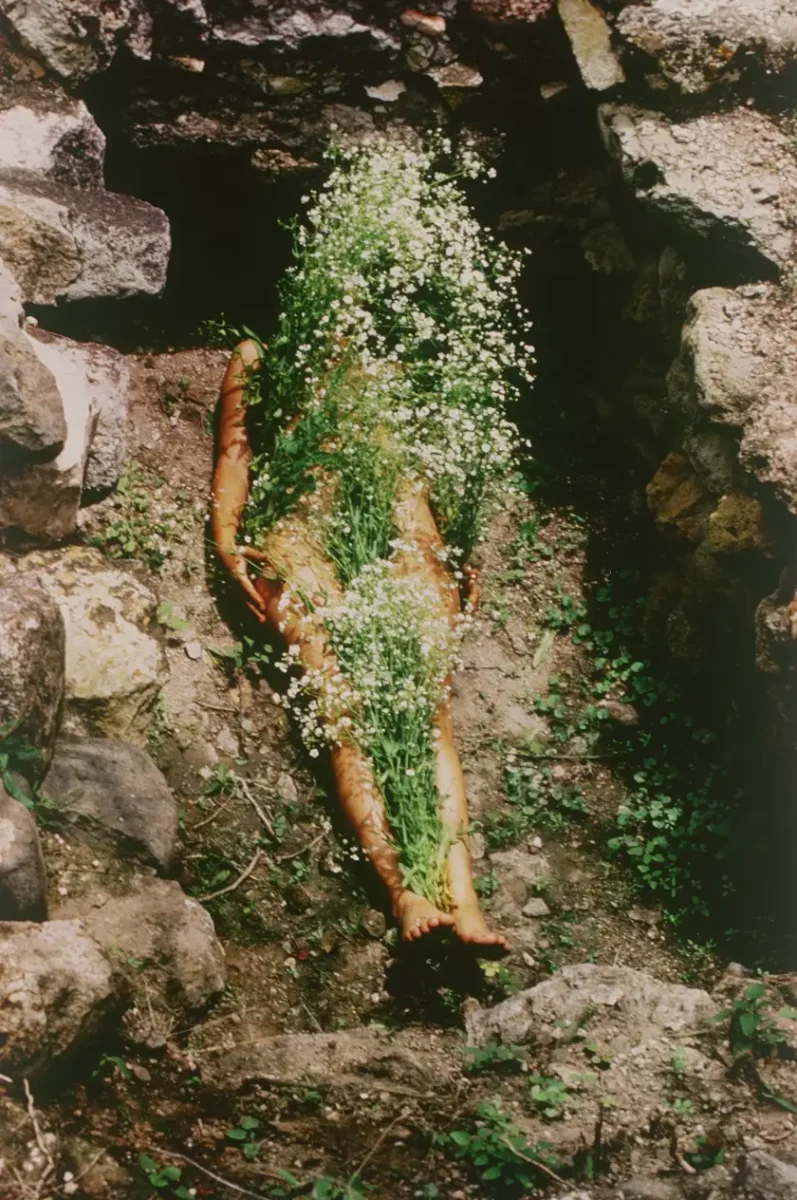
“My work is basically in the tradition of a Neolithic art’, Mendieta said in 1984, ‘I’m not interested in the formal qualities of my materials, but their emotional and sensual ones” (from Tate press handout).
Mendieta studied and worked with ancient archaeological sites and related her work to tribal societies such as the Taino – a first people who lived in Cuba. She absorbed their sense of ritual and use of the fundamental elements of earth, fire, water and air. Santeria religious beliefs also still present in Cuba also interested her a great deal. Some of her siluetas are traced in fire, using gunpowder. Some of them are made to erode away through the action of water and air. Mendieta said that time passing and change are undeniable aspects of the world around us. Nature is never static. The siluetas are nearly always horizontal in the living earth.
There is a mystical, almost religious aspect to her art:
“My art is grounded in the belief of one universal energy which runs thorough everything from insect to man, from man to spectre from picture to plant from plant to galaxy My works are the irrigation veins of this universal fluid.” (Tate preview)
The exhibition is beautifully curated, there is lightness and space that seems to welcome nature into the Tate. A whole installation featuring a forest and one of her siluetas has been re-established using real trees, leaves and so on. It is not cluttered and mercifully free of too much text to read. I liked the way they positioned all the screens showing her films of siluetas in water, fire, earth and air – you walked through the double sided screens as you neared the end of the show.
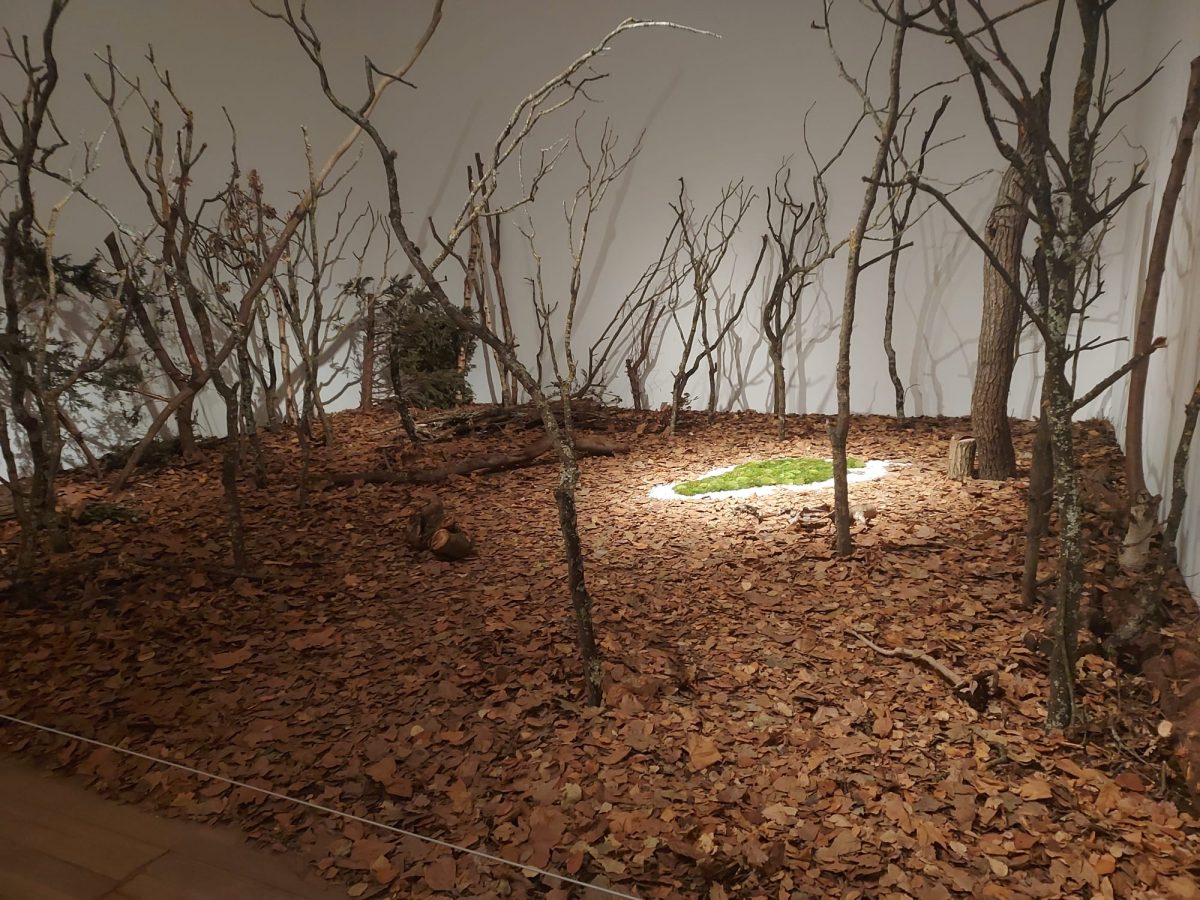
Old Westbury – a re-installation for the show of an earlier work
Ana Mendieta explains her earth body works partly as a result of her sense of displacement from Cuba where she was born. Her father and uncle has connections with the Battista regime overthrown by the Castro revolutionaries in 1959. She went into exile under a special programme to ‘rescue’ children of those families who could not stay in Cuba. She had to stay in several different places and institutions before being reunited with her parents. So this sense of dislocation, being torn away with a powerful need of re-connection and belonging is very strong:
“I am overwhelmed by the feeling of having been cast from the womb (nature). My art is the way I re-establish the bonds that unite me to the universe. It is a return to the maternal source.Through my earth/body sculptures, I become one with the earth … I become an extension of nature and nature becomes an extension of my body. This obsessive act of reasserting my ties with the earth is really the reactivation of primeval beliefs … [in] an omnipresent female force, the after image of being encompassing within the womb, is a manifestation of my thirst for being (Wikipedia)
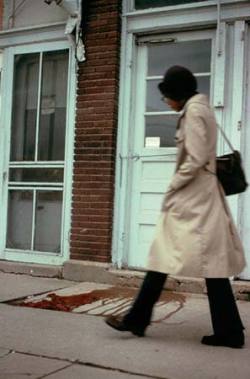
While at the University of Iowa she was politicised, identifying with third world artists and the rise of second wave feminism. One of the few works set in an urban setting and involving other people is her installation responding to a rape and murder of a student in the Molfitt building. She poured animal blood by the door in building and photographed people’s reactions as they passed. A much more visceral and shocking artwork she made in relation to this violence as Rape Scene (1973). Mendieta invited friends and other students to visit her in her Moffitt Building apartment on East College Street. Upon arriving at her apartment, viewers were confronted with the image of Mendieta, naked from the waist down, smeared with blood, bent over, and bound to a table. This work is not included in the exhibition. The Tate owns an image of this, you can see it here.
Despite her family’s political background she reconnected with her homeland and did work there. She made her Rupestrian sculptures in Jaruco state park in Cuba. Often she would use blood in a ritualistic way in her works – this is a feature of the Santerian religion. Some art critics have questioned whether she ‘re-appropriated’ indigenous or ancient cultures. An example of this sort of work was her creation of totems while she was in Italy on a year’s placement. I am not sure how relating to such forms is re-appropriation or necessarily wrong. I suppose the way Picasso and others used African masks as one of their unacknowledged sources of Cubism provides a precedent for this sort of criticism. Mendieta rather respects these forms in my opinion.
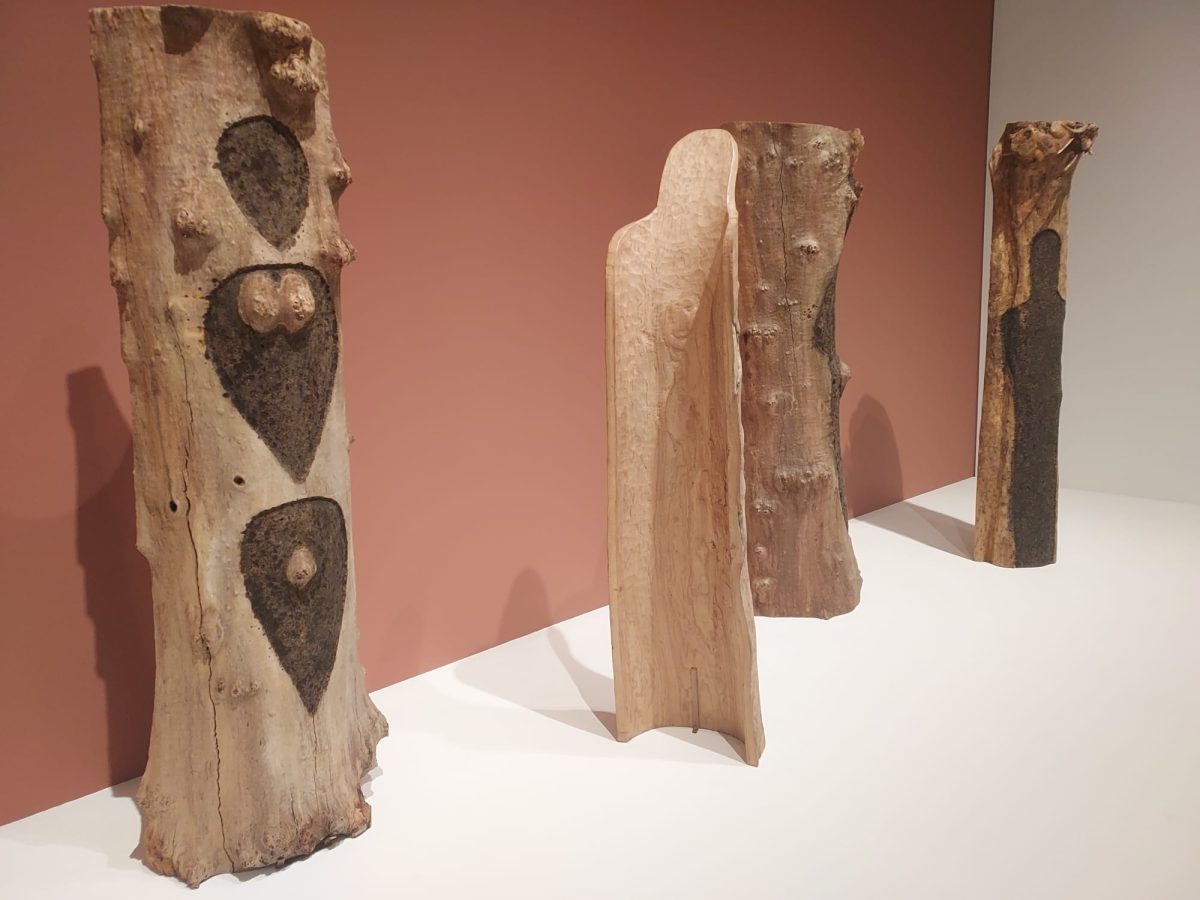
La Jungla – Totem grove
What the museum caption does not say
Only after I saw this show and in conversation with former art professor, Jenny Preston, did I discover a whole new side to Ana Mendieta which the exhibition did not include – her violent death at the age of 37.
When she ended up in New York where the most vibrant modern art scene was she started a relationship with Carl Andre the famous minimalist artist who put a pattern of bricks on the gallery floor and scandalised the tabloids who could not see the art in it. Ironically his art mirrored her horizontal vision although he used modern industrial materials. He was older and more famous than her. Carl cultivated a working class background, He had worked on the railroads for four years and usually wore working class overalls. Carl Andre was left wing and a Marxist. Both of them drank too much. One evening while they were together in their smart apartment in downtown New York she went out the window of the 34th floor.
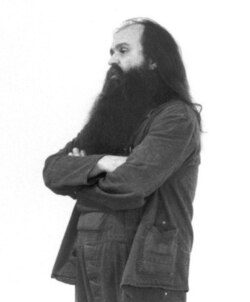
A passerby said he heard someone shouting ‘No, No!’ Friends of Ana said she was gathering evidence about Carl’s affairs with other women. She was seeking a divorce. Another said she had a fear of heights. Carl’s version of events has varied. In one he accepted that they had had an argument after a drinking session and at one stage followed her into the other room and found she had gone out window.. In a later version he said she had gone to close the window because it was cold and he only discovered she had gone out the window when he woke later. Carl had a scratch on his nose that he claimed had been a door banging into him, others claim it could have been evidence of a fight.
Andre’s defence smeared Ana
Andre was indicted and stood trial for murder. He was acquitted. The defence made a lot of her Latin American ‘exuberance’, her drinking and the nature of her art. This is where there is a clear link to the exhibition. The lawyers made out she was obsessed with the Santeria religion, the blood rituals and that she had some sort of death wish. It is less likely that this line of questioning would be so easily accepted today after the MeToo movement.
So Carl’s story was that it was either an accident or suicide. Friends of Ana claimed she was not suicidal and that the window sill was too high for the rather short Mendieta just to slip out. The apartment had not been secured properly and more advanced forensics could have perhaps discovered signs of an attack on Mendieta’s body.
In 2022, the American curator and writer Helen Molesworth made a lengthy series of podcasts examining Mendieta’s death. I have listened to all six episodes – about four hours and the case against Carl seems strong.
Molesworth explains how the art world was divided and some witnesses did withdraw their evidence against him. Andre’s tactic of remaining silent, not taking the stand,refusing a jury and instead accepting a judge led trial was effective. A jury might have been less favourable to this rather weird leftist artist. The judge was somewhat sophisticated and knowledgeable about art.
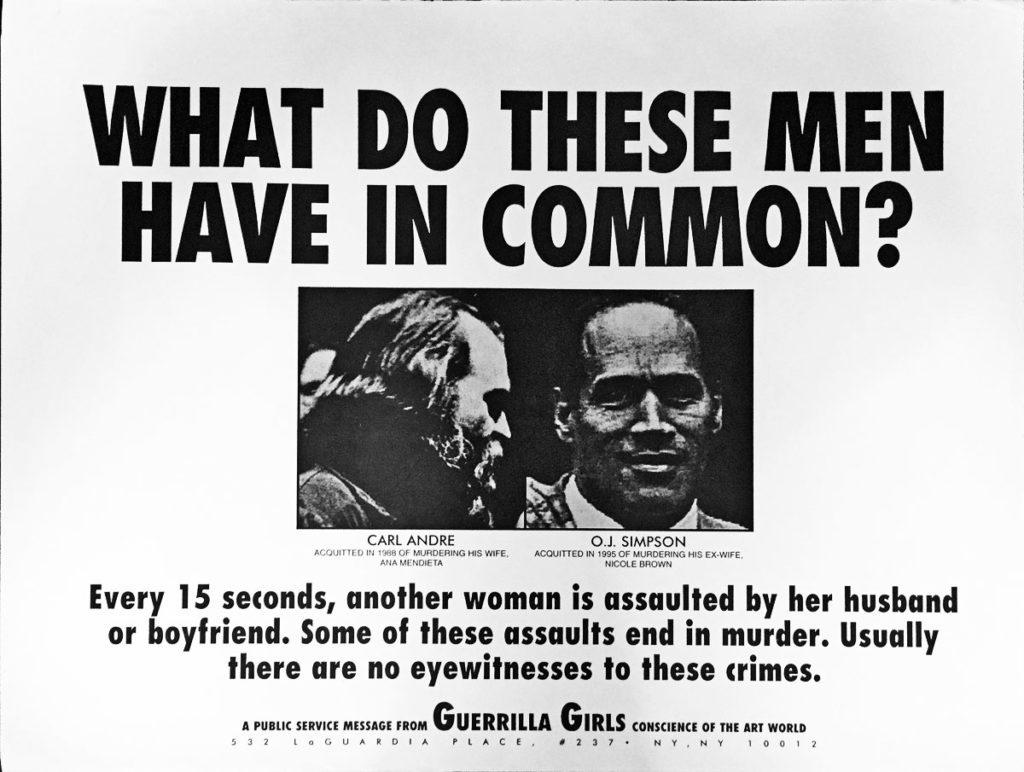
Andre’s work still sold and although his star was dimmed somewhat by the controversy he did not suffer too much. He remarried and stayed in the same apartment till the end. However feminists and others did protest when a big retrospective of his work was staged in 2014. People chanted outside Where is Ana Mendieta? and poured animal blood. The feminist artist group, Guerilla girls did an effective poster campaign linking Andre to OJ Simpson who was notoriously acquitted of killing his partner.
Can art be autonomous from the artist?
Of course this raises the historic debate about whether you can look at an artwork and enjoy it by separating it from what the artist might have done in his or her personal life. John Berger in his wonderful Ways of Seeing invites you to look at a Van Gogh picture and then asks you on the next page whether it makes a difference if you know it is the last picture he painted before he committed suicide.
For example there is the case of Wagner’s music and his association with the Nazis, Erza Pound’s poetry and his support of Mussolini or Picasso’s treatment of his lovers. Certainly cancelling such art – refusing any access to it – eliminates the relative autonomy of all art that is always socially produced and never the result of one individual. However we have a right to at least know of the personal background of the artist. Communities need to know. Curators have a responsibility to at least make reference to it.
There is no reference, not even a footnote to what happened with Carl Andre.
Of course the art was all produced before it happened. The family estate also do not want Ana’s work to be seen through the prism of the Carl Andre controversy. Presumably this explains the lack of reference to her violent end in all the materials produced by the Tate that I have seen.
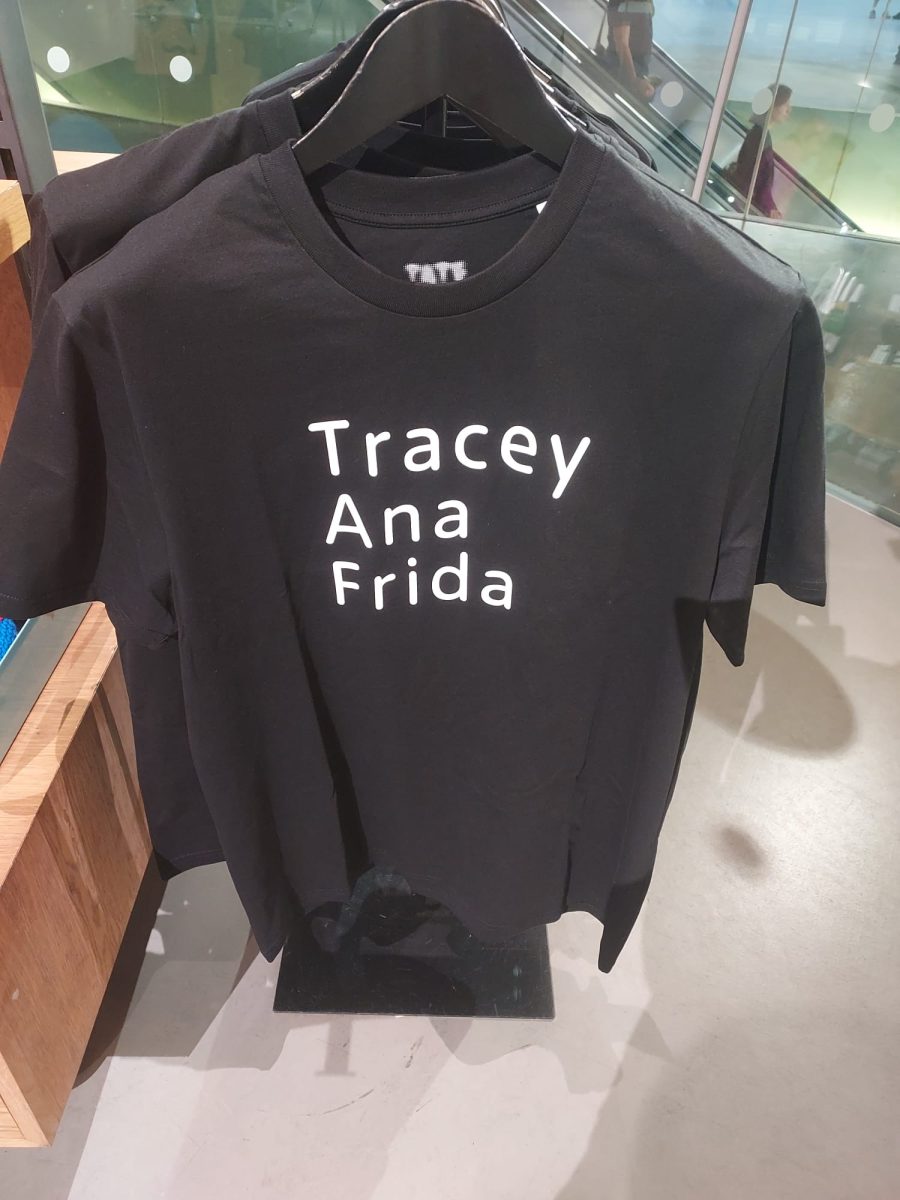
Mendieta’s show should be seen alongside the other concurrent shows at the Tate of Frida Kahlo and Tracey Emin (both reviewed on our site). They even put out a tee shirt commemorating that event. It is a sign that curators and galleries are re-balancing the art canon to include women artists in a way that did not exist even in the 20th century.
All three artists put their bodies at the centre of their work. Both for Tracey and Frida terrible physical pain informed their art. For Ana it was the relationship of her body to nature and the life force. All three took up feminist themes, rejecting male violence and projected an independent strong female identity. Frida was the most political, Ana the most ecological and Tracey the most perceptive on sexual relationships. It has been a privilege to have access to these three great artists. All three shows still have time to run.
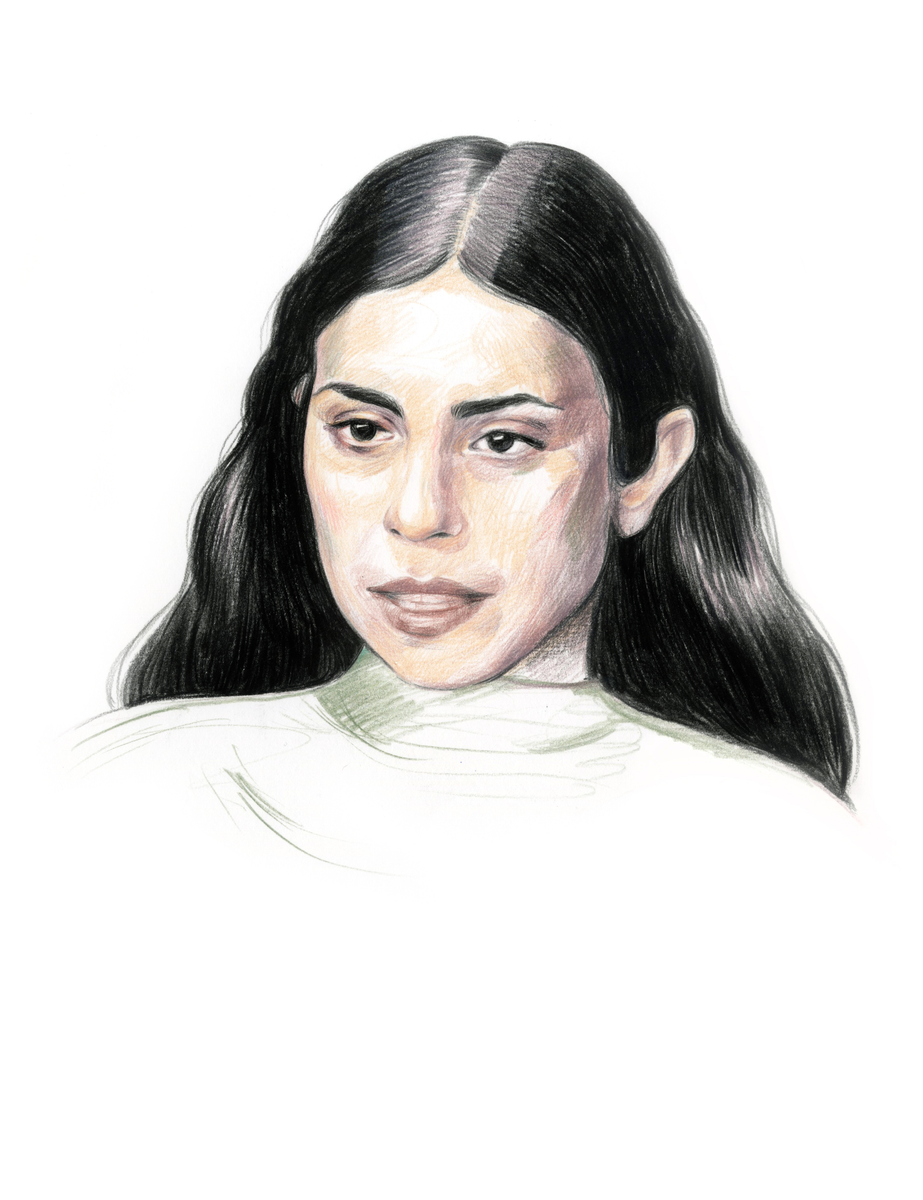
Thanks to Jenny Preston for her comments on the exhibition and the Carl Andre controversy