

Source: Fourth International
On 18 October, the Fourth International organised an online conference bringing together young comrades from Brazil, Belgium, Spain, France and India. More than 150 people took part in this discussion, which aimed to gain a better understanding of what is driving Gen Z onto the streets. A further conference will take place this Sunday, 15 November, this time focusing on the protests shaking several European countries.
For several months now, we have been witnessing an unprecedented wave of protests across the world, driven mainly by young people in revolt 1 against the established order and in favour of decent living conditions. What the media have long portrayed as ‘spontaneous’ demonstrations are, in fact, characterised by forms of self-organisation that are beginning to bear fruit.
The first observation is that when spontaneous outrage meets pre-existing organisational structures, the mobilisation becomes massive and sustained. This is what happened in Spain, where young people took to the streets en masse to voice demands relating to housing, but also to the cost of living in general, as well as in opposition to the rise of the far right. Whilst the occupations of public squares are reminiscent of those of the Indignados movement (2011), there is a notable difference in terms of organisation: “A trade union played a major role in organising these occupations: the Madrid Tenants’ Union, whose membership rose from 3,000 to 8,000 in a week,” explained Nicolás Monterde Izquierdo during a conference entitled “Gen Z is in the streets worldwide”.
In France, the historic mobilisation on 17 October called by the trade unions joined forces with the secondary school students’ movement, which was itself organised “through general assemblies and student coordination groups at city and national level”, as Estelle Joannin (a member of the NPA-L’Anticapitaliste and the Jeunesses Anticapitalistes) pointed out.
More recently, the electoral victory of Lula and the Workers’ Party (PT) in the second round of the presidential election in Brazil was only possible following a broad, intense and creative mobilisation, which succeeded in reversing the voting trend in favour of the far right seen in the first round. Self-organisation played a crucial role in this: “Following the results of the first round, young people (but also the general public) took to the streets to block the path of the far right; there were large assemblies bringing together thousands of students, not just to demonstrate but to campaign for Lula as the last line of defence against Flávio Bolsonaro’s fascism. ‘The people have taken their destiny into their own hands’, explained Fabi Amorim (a member of the MES and its youth organisation, Juntos).
The youth is influencing political power
That same weekend, in Serbia, students who had been protesting for months against the ruling regime dealt an electoral defeat to Aleksandar Vucic, winning the parliamentary elections with their ‘Students’ List’. In India, young people have organised themselves within the ‘Cockroach Party’, turning around the insult hurled at them by one of the Supreme Court judges.
Inequality, study conditions, wages, the cost of living, housing, the effect of climate change, structural racism, democracy, impunity, the rise of the far right… Taken in isolation from country to country, these demands may seem specific, but taken together they outline an emergency programme challenging the capitalism of the early 21st century. The Fourth International and its sections aim, at their own level, to be a useful instrument in contributing to the development and expansion of this movement.
Towards a global political movement?
We wish to contribute to this, in particular through our analyses and strategic discussions. This is why one of our objectives is to continue developing our online conferences. The next one, entitled ‘A Wind of Rebellion is Sweeping Across Europe’, will take place this Sunday, 15 November at 6.00 pm (CET), featuring Olivier Besancenot, spokesperson for the NPA-L’Anticapitaliste (France); Natalija, a member of the student movement (Serbia); Lorena Cabrerizo, a member of Anticapitalistas (Spain); Eliana Como, a trade unionist with the CGIL and an activist with Sinistra Anticapitalista (Italy); Jorge Costa, a journalist, author and member of the leadership of the Left Bloc (Portugal); Aphrodite Mara, a teacher, trade unionist and activist with the Gauche anticapitaliste (Belgium); and Wolfgang Alles, a long time activist in the labour movement (Germany). ( Zoom link https://us06web.zoom.us/j/82644917024 – Password: 603325)
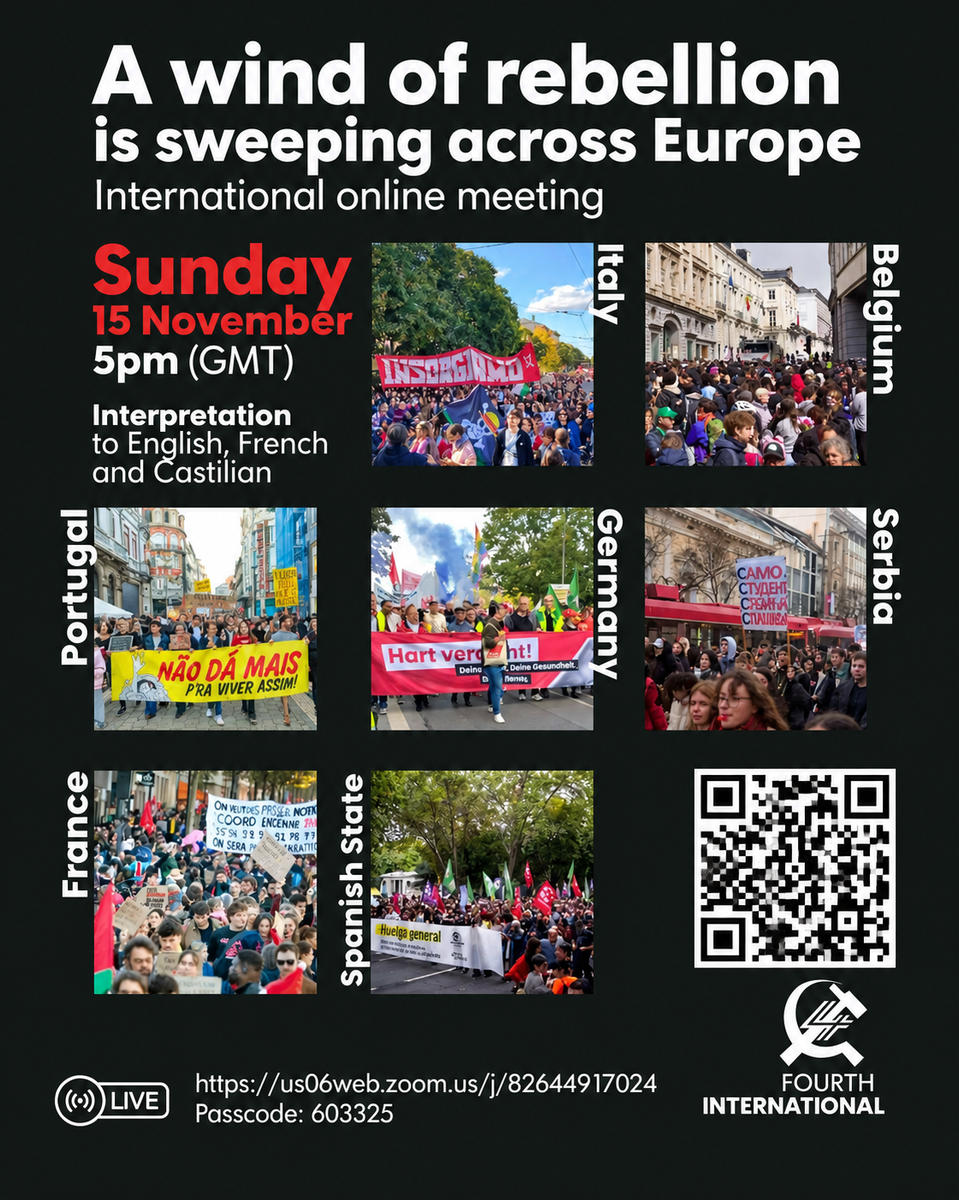
Beyond the youth, it is the working population who is taking to the streets in many European countries to oppose neoliberal policies. They are fighting for housing, education, the climate, pensions and working conditions; against racist policies and impunity; against genocide; and in solidarity with the Palestinian people, amongst other causes. Following the electoral defeat of right-wing and neo-fascist forces in Brazil, Serbia and the United States, is the tide turning in favour of our class in Europe? This is what we will be discussing at this new conference on Sunday 15 November.
Now is the time to build a broad-based movement in the face of the crisis of capitalism, and to establish a transitional programme to overthrow the system. The Manifesto for an Ecosocialist Revolution provides the building blocks for such a struggle.