

“You’re disregarding your power in the relationship of manufacture.”
This man was a stitch. “manufacture of music?”
“It’s your product. Workers are always taught to undestimate their own value. When you can take ownership of your labor, you feel worthless yourself. That’s alienation. (…)
“Sometimes I feel like I’m getting trained here to be unessential.”
“That’s alienation, he said again, pronouncing it like a disease, as if my unusefulness might also have a cure.“
Exchange between Livia, a gifted student musician and Sigurd, typesetter and Trotskyist militant, from Partita (page 18, Barbara Kingsolver’s latest book)
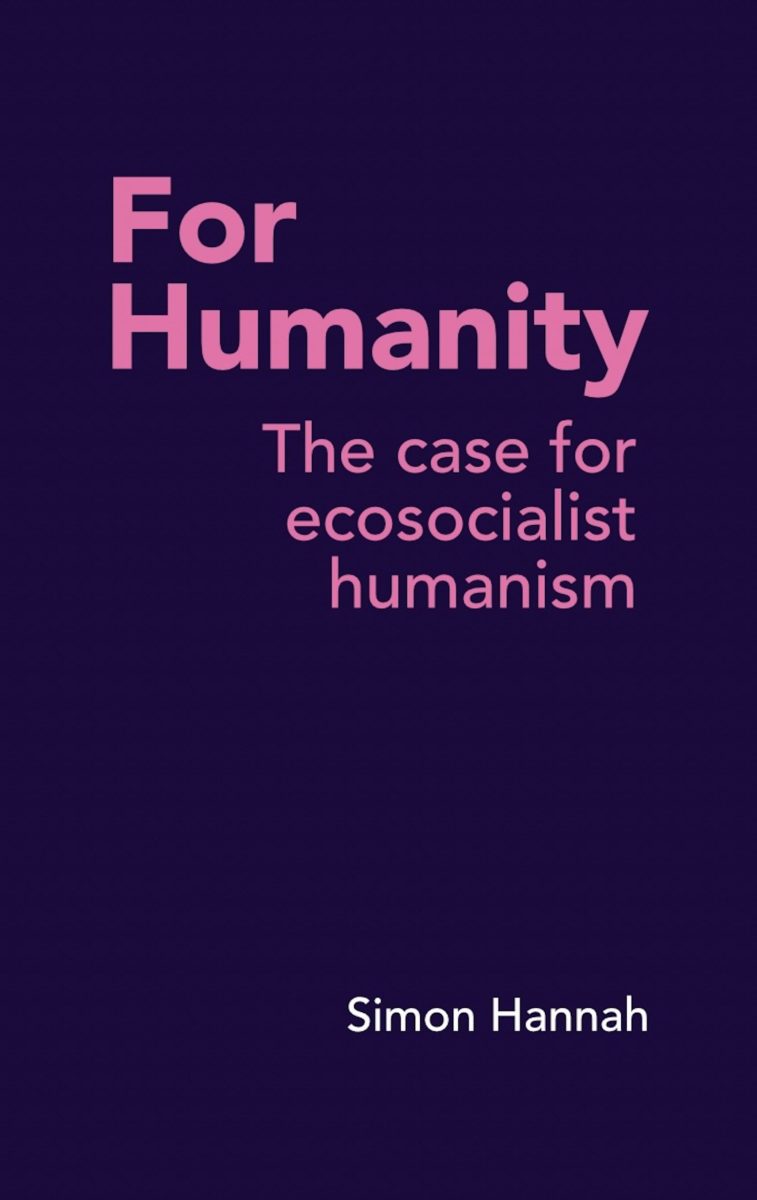
If you want an accessible primer that takes you step by step through the history, philosophy and political practice of ecosocialist humanism then Simon Hannah’s latest book, For Humanity, the case or ecosocialist humanism will be a really useful addition to your library. In one hundred and thirty two pages he walks you through a series of well argued chapters.
The transition from feudal society to capitalism and the notion of universal humanism was progress. But basing it on the isolated individual at the mercy of exploitation and class meant it could never constitute a general universality that could truly liberate humanity. Big corporations can trumpet progressive ‘inclusive’ policies for women, gay or black people but the system depends on huge inequality and the crushing of real rights in practice. How free is the undocumented migrant gig rider on a zero hour contract delivering take away food?
Marx’s theory of alienation
Marx was key in rejecting liberalism’s timeless, abstract notions of humanism and putting forward the philosophy of historical materialism where humanity is socially constructed through interactions with nature and other humans. His theory of alienation has four aspects:
We are alienated from
- our labour
- the products of our labour
- our species being as humans
- from each other
Just think of the way our work is controlled and monitored today, it is less and less possible to have pride in what we do. Bosses continue to find ways of extracting more surplus value through new technology or making us into the fake self-employed such as the delivery drivers who are treated as individual contractors. We feel the ‘enshittification’ of our jobs – being low paid security guards stopping people stealing nappies in our local Tescos. Encouraging punters to gamble their salaries away in the multiple betting shops on our highs streets…we could go on. Often we find real job satisfaction outside of workplaces in our hobbies or coaching sports.
Capitalists do everything they can to separate worker from worker. They use special companies and lots of money to prevent unionisation and are helped by the anti-union laws implemented by Thatcher and not really repealed by Labour. All the advertising and everyday ideology in the mass media or in the practice of schools and other institutions encourages individualism, dog eat dog competition. Never cooperation – think how few reality TV or game shows are based on team effort or cooperation. We are encouraged to become entrepreneurial. Shows like the Apprentice are promoted and schools are encouraged to make students ‘work ready’.
Alienation is alive and well
In the Guardian of 23 November John Harris wrote a critical article on the Milburn plans for young people not in education, work or training. He cited a Resolution Foundation analysis of the latest British Social Attitudes survey
“The headline findings were that job satisfaction in the UK has dropped to the lowest level ever recorded and that “the proportion [of workers] willing to work harder than required to help their employer succeed has fallen to its lowest ever level over the past decade” (it stands at a pretty miserable 55%). The proportion saying they had an interesting job fell from 74% to 63%. The share reporting opportunities for advancement went from 35% to 26%.”
That is what alienation looks like today.
Post-war Marxist humanists
Hannah has a chapter on post war socialist humanism where he examines the contributions of Raya Dunayevskaya, Edward Thompson, Erich Fromm, Aime Cesaire, Franz Fanon, the Praxis current in Yugoslavia, the Combahee River Collective and Lise Vogel.
The structuralist Marxism of Althusser is criticised for its evacuation of a humanist dimension and the messy business of the class struggle. I remember well how our generation of Marxists of the 1970s were attracted by what seemed to be a more rigorous approach of these thinkers. Certainly there were some woolly analyses in the works of those criticised by Althusser and Poulantzas. Using the concepts of social formation, productive forces, relations of production, overdetermination and so on did result in some excellent analyses for example by Perry Anderson to name one writer.
However it is true that they reified theory so it became a ‘practice’ over and above the class struggle. Paradoxically although it criticised the totalising ontology of people like Fromm in the end Althusser et al created a new all encompassing idea that Marxist theory could become a science similar to the natural sciences and become a complete epistemology for all knowledge. The role of intellectuals in all this seemed like a mirror of the bourgeois academy.

Identity politics
Hannah addresses the issues surrounding identify politics and how they relate to the class struggle, universalism and emancipation. The argument is nuanced:
Listening to the oppressed must always be filtered through a degree of class argument because what bourgeois women will want for their liberation is not the same as working class women, and is often actively antagonistic towards it. The difference here is fundamental and points to entirely different political conclusions of strategy and organising. (p 76)
He neatly outlines the twin dangers of:
- Workerism or economism – refusing to engage at all with identity issues because the class struggle is key and will determine everything
- A purist identity policies – where there is no connection between a myriad of identity struggles and the material reality of capitalist society with its antagonistic classes.
Ecology at heart of our humanism
One of the strongest arguments for an ecosocialist humanism is the ecological crisis today. In the past Marxists assumed once you overcame the contradiction between the development of the productive forces and constraints of the social relations of production (ownership) you can proceed to socialism. It matters how humanity uses the forces of production. Ignoring the effects of extractivism on nature, whether what was produced was really useful and the danger of unsustainable growth meant a non capitalist Russia did not treat the environment much better than the West. Just changing property relations was necessary but insufficient.
Those Marxists had forgotten the writings of Marx on how workers were alienated from nature – in later writing Marx talked a metabolic shift. We have to place humanity within nature albeit as its most conscious physical expression. Stalinists with their 5 year plans or forced collectivisation had placed human beings into a dogmatic, abstract framework. Anybody critical of the party line were no longer seen as human beings deserving respect but became enemies of the people and had to be exiled or eliminated.
Today the effects of the environmental crisis are experienced by far more than just wage workers. Much of the middle classes and even some managers are concerned about the air we breathe and the water we drink. Ecosocialists can practically show that a victory for working people against capital can also save humanity from the climate crisis. Never has the universal liberating role of the working class movement been so obvious. The capitalists are not going to provide clean air or water and sustainable growth because their system cannot accept that.
Our big task today is to link the green agenda to the socialist one. New radicalising layers inside the Greens already are beginning to understand that. The dismissive, sectarian approach of some of the Marxist radical left to the Greens and to an ecosocialist agenda is a failure to recognise the universal humanism at the heart of what we do.

Eco-socialists and violence
Although it is not particularly discussed in this book the left’s approach to violence can sometimes betray a lack of ethical, humanism. We do not glorify violence as some sort of revolutionary purity. I will never forget when Tomas Borge, a leader of the Nicaraguan revolution, encountered his torturer after the victory in 1979. He did not demand retributive violence against him but explained that the morality and the ethics of the left were superior to the reactionaries.
We pose the issue of mass violence as only necessary to defend the working class against the violence of the ruling class if it attempts to stop a potential revolution. Revolutions do not have to be bloodbaths, Cuba is a good example of this.
On the other hand when the ‘communist’ Pol Pot and the Khmer Rouge slaughtered over a million in Cambodia after the liberation of their country from the US imperialists they were not defending the peasants or workers. It was a crime against humanity and a massive setback for the global struggle for socialism.
On a more mundane level certain elements on the left have shown an anti-socialist lack of humanity when they cheer on or relish the death of their right wing opponents. When Ann Widdecombe was violently murdered Socialist Worker published an article that positively noted the callous reaction of somebody or other – seeing it as a healthy expression of ‘class anger’. The same thing happened when some public school boy was killed by a polar bear on some school trip. When Mangione murdered the Heath Insurance CEO in the states we had a similar round of applause from some on the left. We are less likely to attract people to our ranks if we present ourselves in this way. The heritage of Stalinism already creates a perception that socialists are violent against anyone who disagrees with them.
Radical empathy
Hannah is spot on when he examines the notion of radical empathy. Anybody who has been around the left knows that at times the culture of organisations can lead to a certain lack of such an approach:
“This patient work of organising with new people, not just mobilising the existing left, is what can get lost in the drive for political purity and ‘cancellation’ as a form of shaming people. If you were at a meeting about poverty and someone came in with a confederate flag stitched to their jacket, it is understandable that it might be advisable to try and speak to them first and seek out a commonality of views and struggle (if you can) before denouncing them as racist.”
It is very easy to live life within the bubble of the radical left and lose touch with how ordinary people look at the world. Even trade union branch meetings do not necessarily reflect the views of all people in a workplace. Ash Sarkar from Novara Media once said, we need a left that does not look weird. She has a point.
Campists are the anti-humanists
Some on the left look at the world as a struggle between the camp of US imperialism and other anti-imperialist, anti-Zionist or anti US regimes such as Russia, China, Iran. Consequently since Iran is suffering from US military attacks we should not raise the terrible repression of the theocratic regime against its people, particularly women. How can we convince people of our ethical values as ecosocialists if we are selective about which human beings we can support? Left groups in Britain who see Ukraine as a proxy war between different camps rarely denounce the Putin regime’s crimes or its victims in the war. Their vague calls for peace covers any real empathy with either the Ukrainian or Russian people. Anybody rising up in a regime deemed to be fighting US imperialism can be sacrificed on the altar of these abstract ‘global’ formulas.
It is only possible to sustain this distorted view of political reality if you remove any real contact with the average person in the camps. You have to extract any humanist understanding. The humans who rise up are deemed to divide the ‘progressive’ camp and can justifiably be sacrificed on the altar of some higher abstract notion of the ‘advance of the anti imperialist struggle’.
Let’s continue the discussion
The last pages of the book provide some useful, practical ideas about how to ensure ecosocialist humanism is embedded in our everyday politics. It shows how the book wants to be a starting point for further discussion. The author will be available for meetings anybody wants to organise on its main argument, just contact the ACR website.
We can finish with Barbara Kingsolver (Partita), Livia reflecting on Sigurd the left activist:
“Sigurd could make you see what he believed in, clear as day – there’s no denying that. I had teachers galore who made me feel small, but Sigurd wasn’t one of them. He lifted people up. All the Mrs. Robinses on the stairs, the people he met on the sidewalk, his acolytes.” (Page 147 ibid)
Ecosocialist humanism lifts people up.