


Let’s not call the collapse of the COP31 climate negotiations in Antalya, Turkey, a “failure”. For a start, some countries’ refusal to sign the deal, because it didn’t mention ending fossil fuel use, may help puncture the myth-making that surrounds the talks.
And what would “success” have looked like, anyway? A vague commitment to move away from fossil fuels – like the one signed in 2023, at COP28 in Dubai – plus fulsome support for fake carbon capture technology?
After “decades of broken pledges and hollow commitments”, an agreement built on more empty promises would have been “unforgivable”, Asad Rehman of Friends of the Earth said, with good reason.
The dramatic rejection of the final text by the EU, the UK, small island states and others “restores some level of faith in its recognition that a deal of this caliber is no deal at all”, Rehman argued.
It’s not that the EU and UK are the good guys. Their hypocrisy is “staggering”, as Mohamed Adow of Power Shift Africa pointed out.
Rich-country governments “demand fossil fuel roadmaps from others, while expanding fossil fuels themselves and blocking the finance poorer countries need to make the transition. Without money and credible action at home, those demands are hollow”,
Adow wrote.
The collapse of COP31 surely reflects the breakdown of US-centred multilateralism. Saudi Arabia and Russia, two of US president Trump’s closest allies, insisted most aggressively that the deal omit any mention of moving away from fossil fuels.
To call this “capture by fossil fuel lobbyists” underestimates the problem: it is statecraft. The more steps are taken away from fossil fuels, the greater will be the resistance. Will multilateralism survive in any form?
Understanding all this will take time and thought. For activists in the labour movement and social movements, who I think are the most likely readers of this article, I would suggest five places to start.
First: recognise that COP31 is the outcome of a process designed to “fail”
Binding targets for cutting greenhouse gas emissions were ruled out from the start, at the Rio conference in 1992 that launched the climate talks. International action under the 1997 Kyoto protocol was limited to market schemes that commodified emissions and have been a discredited failure. Voluntary targets (“nationally determined contributions”) fall far short of what scientists say is needed to avoid 2 degrees of warming, let alone 1.5 degrees.
The proof of the pudding: globally, fossil fuel use has risen by more than 60% since 1992. Annual subsidies to fossil fuels – which in 2009 the G8 countries promised to “phase out” – are down from their 2022 high of more than $1600 billion, but still hover above $900 billion.
Delusions persist. The Guardian reporters who provided excellent coverage of COP31 nevertheless concluded with analysis suggesting that renewables have “overtaken” coal in China, and that investment in “clean energy” and electric vehicles constitute an “irreversible” transition from fossil fuels. Wildly inaccurate (see note below).
In my view, we need an approach that separates the reality of government actions from the discourse around the talks that is used to constrain discussion about how climate change can really be tackled.
We need to recognise the depth of the crisis for the world’s leading states reflected in the talks. They ground their legitimacy in terms of representing society as a whole, but have clearly abandoned the common social interest to the private interest of elites, over the whole process of more than three decades.
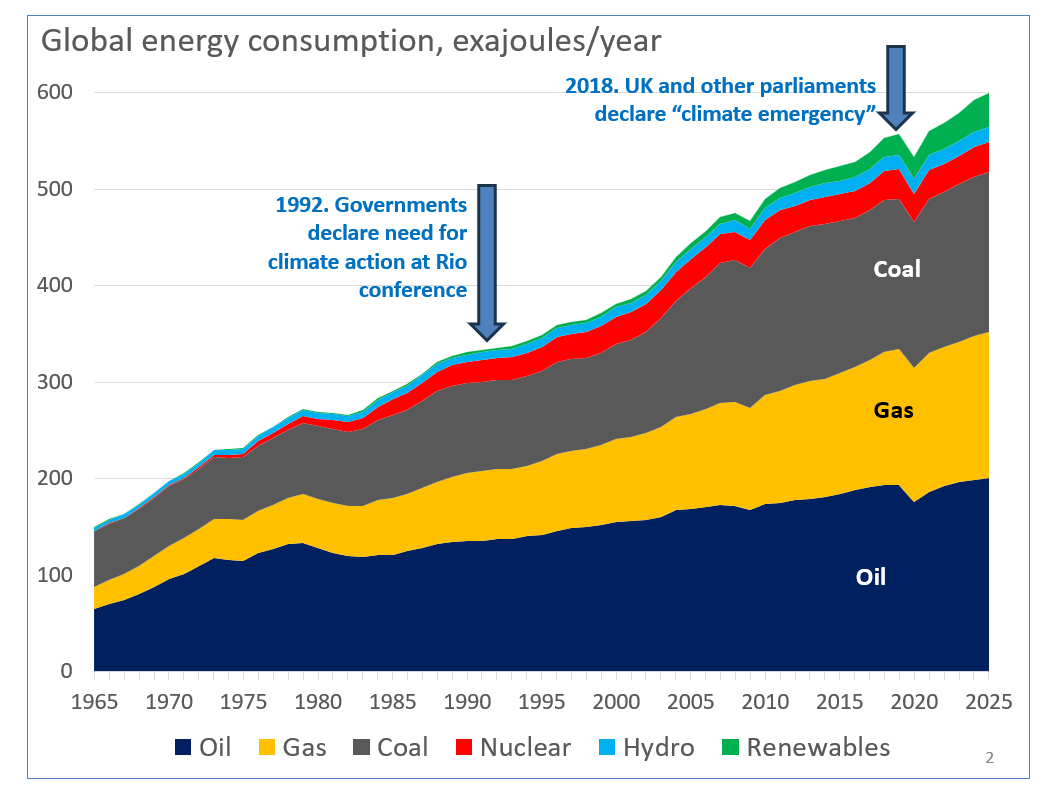
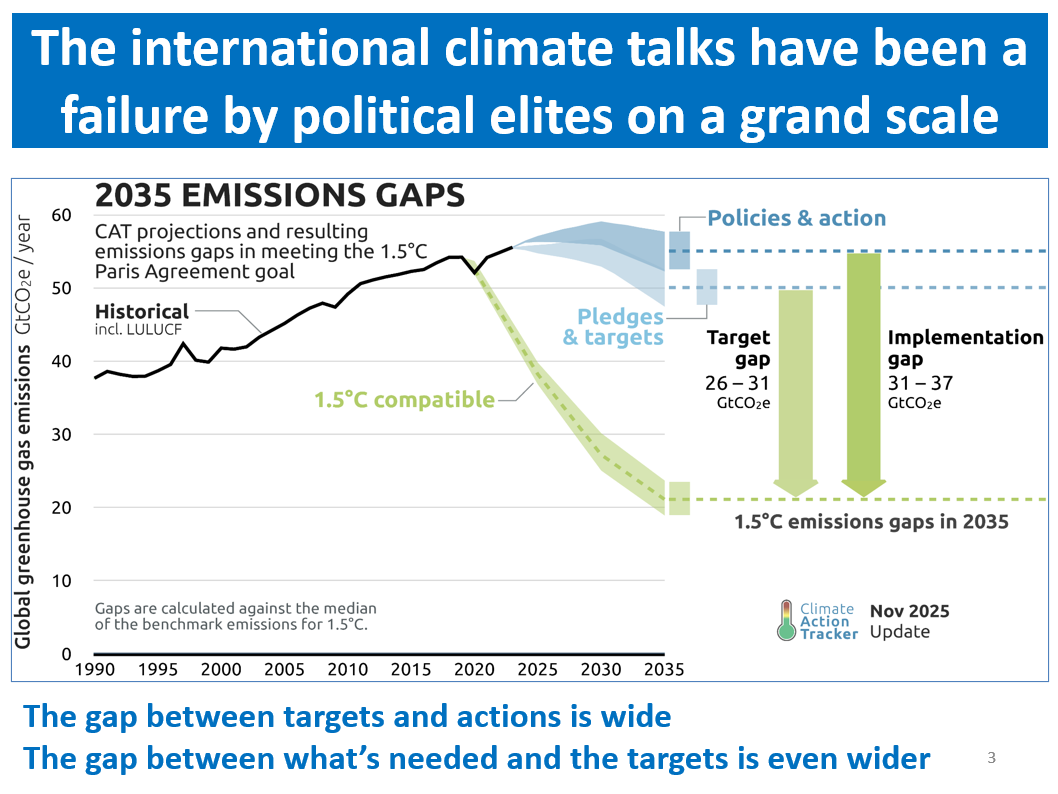
Slides from a presentation at the recent Campaign Against Climate Change trade union group conference
Second: false technological solutions, in the first place carbon capture – and the fiction of “net zero” built on them – play a central role
The draft deal at Antalya had welcomed efforts “urgently and rapidly” to scale up carbon capture technologies, and even named targets. The technologies, which are expensive, energy-intensive and inefficient, have been pushed by fossil fuel interests for decades to parry discussion about emissions reductions.
Carbon capture is supported with lavish subsidies by the EU and UK, as well as by Saudi Arabia, Russia and their allies. Its false promises have increasingly wormed their way into the mitigation agenda of the Intergovernmental Panel on Climate Change (IPCC).
This technological fiction has over time been used to transform “net zero” from a scientific term (indicating the point at which annual greenhouse gas emissions are balanced by removals e.g. naturally into forests and oceans) to a political term justifying huge, delusional reliance on artificial removals.
Scientists who were initially neutral have denounced “net zero” as a “dangerous trap”. The idea has “fostered a misleading sense of security”, and created the impression that science has found a technology-driven path to halt global warning, as the historian Jean-Baptiste Fressoz has argued.
I propose some well-overdue self-critical reflection by socialists and the labour movement on this score. While we are hardly responsible for governments’ reckless, anti-human behaviour, we can influence the tone of discussions in civil society.
Why don’t we subject carbon capture nonsense to the same severe challenge as we do climate science denial or vaccine denial? “Left” Labour politicians pour billions into oil companies’ pockets for carbon capture, and Marxist journals and publishing houses facilitate earnest discussions about this hocus-pocus. This we can, and must, change.
Third: we have failed to build an alliance of social movements and scientists adequate to the challenge.
Extinction Rebellion at its height implored politicians to “listen to the science” – a misunderstanding, since there is no one “science” that stands outside politics.
Thus the IPCC’s tendency, under political pressure, to support “net zero” politics clearly at odds with the scientific conclusions in its own reports.
In a world where the forces of reaction from Trump to Putin are assaulting science, our movement should work closely with those climate scientists who have steadfastly denounced this trend – for example Kevin Anderson of the Tyndall Centre at the University of Manchester, who on Sunday wrote that “the whole [Antalya] jamboree is part of a widespread delusion, and not just among the political leaders and negotiators”.
Anderson warned that, rather than face the threat even to keeping global heating “well below 2 degrees”, declared at the Paris talks in 2015, “we’re being fed an increasingly comfortable, but deeply misleading, narrative built around 1.5 degrees, overshoot and return”.
That’s what “net zero” has become: “wishful thinking, obfuscation and, frankly, deliberate misinformation surrounding carbon dioxide removal (CDR) and negative emissions technologies (NETs), including from some senior figures acros both the scientific and media communities”.
Gaurav Gharde and Alice Larkin, also of the Tyndall Centre, having travelled to Antalya by train, wrote: “Our concern is that ‘overshoot’ was turned from a warning into a plan long ago, when the 1.5 degrees pathways assessed by the IPCC came to rely on carbon removal at huge scale, as a way of avoiding more politically challenging decisions.”
We need a long-term plan to put the work of these scientists, who have long ago recognised the social context in which the physics of climate change happens, at the centre of our movements.
Fourth: the labour movement in rich countries is working with ideas about “just transition” and mitigation that fall short of what we need.
Worker activists in the UK have rightly challenged the false arguments of union leaders who, in response to the proposed ban on new oil development in the North Sea, coined the slogan, “no ban without a plan”.
Comments by Sharon Graham, leader of the Unite union, that workers must not be “sacrificed on the altar of Net Zero” recalled right wing and climate denialist narratives, the Campaign Against Climate Change trade union group warned.
Workers are treated as expendable, the group acknowledged, but the greatest “sacrifice” is that of “millions of people, predominantly from the poorest countries, to the dangerous impacts of climate breakdown”, to facilitate fossil fuel profits.
This is surely the starting-point for building alliances with powerful movements in the global south in response to environmental calamities.
Again, science must be at the centre, including vital research of the complex way that the impacts of climate-related phenomena – heat waves in the first instance – are magnified by the fragile infrastructure and inadequate health systems born of colonialism.
Fifth: political programmes for post-carbon economies matter much less, in the short term, than building alliances around effective carbon reduction measures.
The most alarming thing about COP31 is that it exposed, once again, the refusal by all the leading governments – not just Saudi’s, Russia’s or the US’s, but also the likes of the EU and the UK – to take the sort of drastic action needed to reduce greenhouse gas emissions in time to avert catastrophic consequences of global heating.
Faced with such paralysis, some socialist organisations and writers put together ambitious programmes of political action on climate. These can be useful for unmasking the rhetoric around governments’ feeble market- and tech-focused efforts, but without a powerful alliance of social-democratic or socialist governments internationally, can not be expected to change things in the short term.
There are, though, many actions that can be fought for on the local and national scales, while simultaneously building movements for political change.
It is well worth considering the three “overlapping stages” for action in rich countries, highlighted by Gaurav Gharde and Alice Larkin of the Tyndall Centre:
(1) Cut discretionary emissions (frequent flying, very large and second homes, large and powerful cars, other forms of high-consumption living, etc);
(2) Accelerate the roll-out of existing technologies and solutions – that is, stuff that, unlike carbon capture, actually works: “for example, home insulation and retrofit, rooftop solar, batteries and a shift towards public transport”; and
(3) Reconfigure energy and transport infrastructure, such as large-scale renewables and energy storage, expanded electricity grids and new bus, tram and rail networks.
The movement that has sprung up almost overnight against the proliferation of data centres shows the potential. We can connect the local to the global. One step of the real movement is worth a dozen programmes.
Note. The need to tell it like it is
In their summary analysis of Antalya, Fiona Harvey and Graham Readfearn of the Guardian cited, approvingly, the conference president Chris Bowen of Australia, who said: “The transition away from fossil fuels in the real world is inevitable. It’s happening, it’s happening at speed, and it’s irreversible.”
To stand up this claim, Harvey and Readfearn wrote: “Renewable power has overtaken coal in China, reaching 60% of generation capacity, investment in clean energy around the world is twice that into fossil fuels, and electric vehicles have taken off, making up a third of new car sales in Europe and a majority in many other countries.”
It is misleading to pretend that renewable power, i.e. renewable electricity generation, has “overtaken coal” in China. It has not. The IEA put coal’s share of electricity generation in 2024 at 59%. The Energy Institute put it at 54%, and renewables at 36%, in 2025.
This year, renewables capacity has risen sharply (i.e. more wind and solar farms have been built). But (a) renewables capacity is less efficient than fossil- or nuclear-fired capacity, for technical reasons, and (b) this capacity has not been used as much as it could have been. So coal-fired electricity generation, and electricity-sector carbon emissions, have kept going up.
If we count China’s primary energy supply (a statistic that includes all energy uses, including transport and industry, not just power stations), coal accounts for 56%, oil likely around 18%, and gas 8%.
Is investment in clean energy “twice” that of fossil fuels? Yes and no. The IEA’s World Energy Investment 2026 report reckons that $1.2 trillion will go into oil, gas and coal this year, and $2.2 trillion into “clean energy” – a very wide term that embraces not only renewables and nuclear, but also (accounting for at least $1 trillion) investments in electricity grids and energy efficiency.
Is it such great news for the climate that electric vehicles have “taken off”? No. If the vehicles are made and used e.g. in Iceland or Paraguay, then the electricity will come from hydro, and the cars will probably emit fewer greenhouse gases over their lifetime than a comparable petrol car. Great. But in China or India, where most electricity is made from coal, they will likely be more emissions-intensive over their lifetime than petrol equivalents.
That’s too much unfounded optimism in one sentence of analysis, in my view.
==