

Ukrainians have been fighting against occupation since 2014 when Russia occupied Crimea. Many more have been involved fighting since Russia’s all-out invasion, which started in February 2022. At the time of the all-out invasion in 2022, many thought Ukraine would soon be occupied, Zelensky in exile and a puppet government installed. This did not happen. The Ukrainian people fought back. It is increasingly clear there is no easy path to victory for Putin.
Ukraine’s cities suffer from heavy Russian bombing, hitting housing, schools, colleges and hospitals. This bombing of civilian targets is a war crime. Often rescue workers and ambulances are targeted in a second wave of attacks. Ukraine urgently needs more defensive missiles to protect the civilian population.
Ukraine is increasingly taking the war into Russian territory with long-range drone attacks on military and economic targets. Unlike Russia it is not targeting hospitals, schools and civilian housing.
Russia’s war
The Russian government is telling the peoples of the Russian Federation that the war is a re-run of 1941-45, when the Soviet Union was part of a war against fascism, forgetting the period of the Hitler-Stalin pact of 1939-41. The Russian state puts out disinformation both within the Russian Federation and to the world, claiming the Ukrainians are all neo-Nazis, that Ukraine is corrupt etc. Ukrainians increasingly feel that it is the Russians who are the fascists, as they experience war crimes and occupation.
It is estimated the Russian Federation has suffered 1.4 million battlefield casualties (including dead, wounded and missing in action). Increasingly Russia is looking to troops recruited from other countries to fight its war on Ukraine, rather than risk a high death toll amongst their own citizens leading to growing anti-war sentiment in Russia.
Putin continues to bring in troops from North Korea. Up to 50,000 may be deployed. The Russian army is also supplied via human trafficking operations in which civilians from other countries are promised jobs in Russia, and then find themselves in the Russian army and sent to the front, often with minimal equipment and training.
Occupied territories
One of the major reasons for continued Ukrainian resistance is the situation of Ukrainians in Crimea and the other occupied territories of Ukraine. There is compulsory Russification, with requirements to take a Russian passport to access pensions and healthcare and to maintain ownership of homes.
Teachers have to teach a Russian-imposed curriculum in schools. Even those Ukrainians not involved in active resistance to the occupation may face theft of property, violence, rape and death.
Russia has abducted around 20,000 Ukrainian children from the occupied territories. Some of these children are in military academies where they are being brought up to be soldiers who will attack Ukraine. There cannot be a peace settlement without the return of the missing children.
People who say the Ukrainians should make concessions to end the war should ask themselves whether they would be prepared to live under these conditions. If the answer is “no”, do not ask it of Ukrainians.
Ukrainian prisoners in Russian captivity
As prisoner exchanges have taken place many Ukrainians have been shocked by the contrast between the health of the Russians being sent home and the appearance of the Ukrainians returning from captivity.
Putin calls Russia’s invasion of Ukraine a “special military operation”. He has not formally declared war on Ukraine, because he denies Ukraine is a country.
One brutal consequence of this is that Ukrainian soldiers in Russian custody have not been given prisoner of war status. They are held in general prisons often along with Russian prisoners. Returning Ukrainian prisoners have often lost a third of their body weight and been subject to torture and severe ill-treatment in Russian custody. Some have died on return to Ukraine as a result of the conditions of their imprisonment.
Zaporizhzhia power workers
One example of the brutality of Russian occupation is the treatment of the workers at the Zaporizhzhia nuclear power station. This plant came under Russian occupation on 4 March 2022. Many of the workers endured harsh treatment and 15 workers were abducted, have faced show trials and received long prison sentences. There is a campaign for their freedom. The NUM has submitted a motion to the TUC on the subject.
A public meeting in support of the Zaporizhzhia power workers is being held in London on Thursday 27 August. Please register here for the meeting: free-the-zaporizhzhia-15
Ongoing solidarity
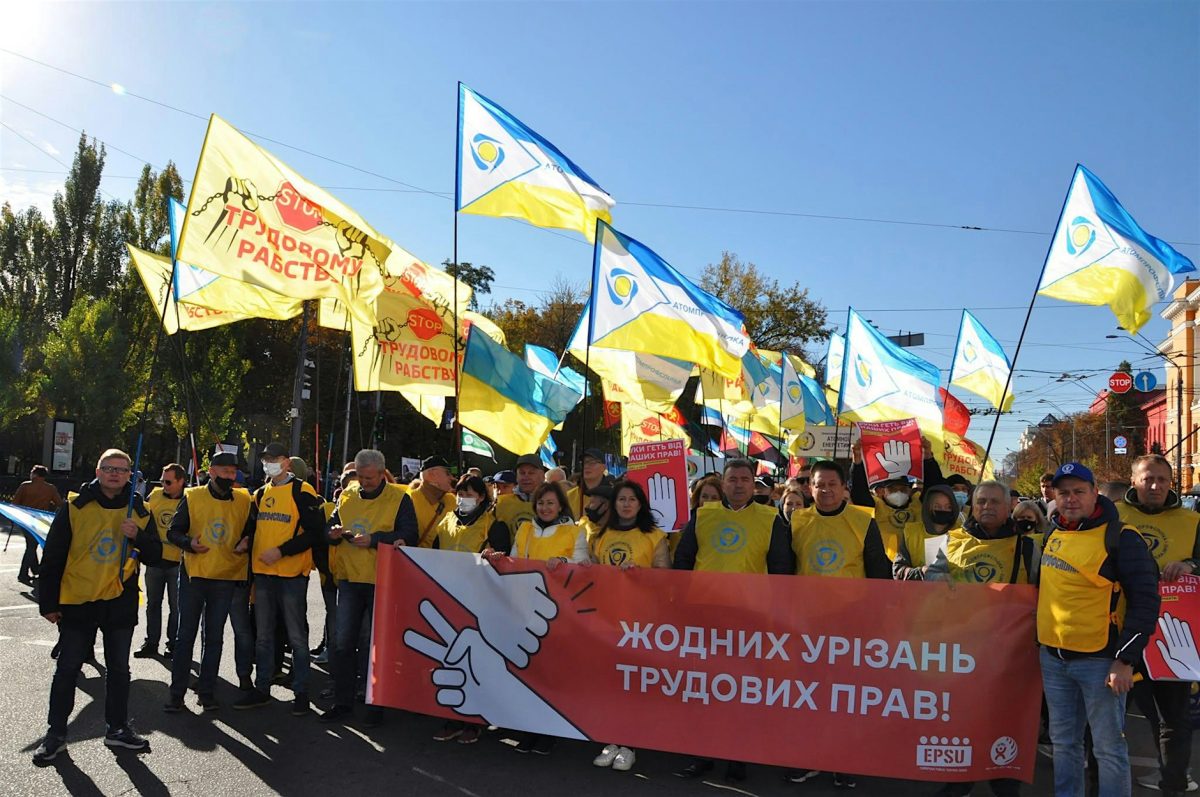
in the face of continuing invasion, war crimes, and brutal treatment of prisoners, the Ukrainian people need solidarity as much as ever. This can take the form of material aid, support for sanctions against Russia, support for Ukrainian refugees and building the international solidarity convoy.
It is also about supporting the left and labour movement in Ukraine who are not just fighting the Russian invasion, but on the home front fight against the neoliberal measures of the Zelensky government. They are fighting for a future after the war with a socially just reconstruction for the people, not the oligarchs. We can support them in that by campaigning for Britain and other countries, to cancel the debt owed by Ukraine. In Ukraine, the left organisation Sotsialnyi Rukh (Social Movement) , a permanent observer to the Fourth International, campaigns strongly for workers rights in Ukraine and has members serving in the armed forces of Ukraine. It has supported the call for the convoy.
One important part of the struggle to protect Ukrainian independence is the maintenance of sanctions on Russian oil and liquid national gas. The sale of these products directly funds the Russian war effort. Russia is operating a shadow fleet to transport sanctioned goods.
Refugees
Ukrainian refugees are coming under attack in several countries. This is part of general anti-migrant sentiments, fuelled by the far-right. Ukraine solidarity movements must defend the rights of Ukrainian refugees and the rights of Russian war resisters, who if deported to Russia may be drafted or imprisoned.
Build the convoy
The International Network in Solidarity with Ukraine (INSU) is building an international convoy to take aid to Ukraine and to remind the world of the sufferings of the Ukrainian people and the need for solidarity. It is an overland global flotilla.
The convoy will leave from departure points in Scotland, England, Belgium, Barcelona, France and Italy and Scandinavia. Public meetings will be held at stopping points on the journey to publicise the work of the convoy and build support for Ukraine.
- To find out more about, to sponsor, volunteer and donate, please see https://solidarityconvoyukraine.com/
- Ask your trade union branch, trades union council, or community group to sponsor the convoy and donate to the aid for Ukraine, and plan to hold public meetings with Ukrainians and/or Ukraine Solidarity Campaign speakers about Ukraine and the convoy.
- Please share information on social media
Two reports on Irish Trade Union Solidarity With Ukraine : 1) https://irishleftwithukraine.blog/2026/08/26/ukraines-reality-and-the-power-of-international-solidarity-presentation-to-irish-congress-of-trade-unions-ictu-2026-global-solidarity-school-kateryna-maliuta-osaulova-t/ 2) https://irishleftwithukraine.blog/2026/08/26/ukraines-reality-and-the-power-of-international-solidarity-presentation-to-irish-congress-of-trade-unions-ictu-2026-global-solidarity-school-kateryna-maliuta-osaulova-t/