


The death of Professor Arday has put the spotlight on racism in higher education and the press. The large gathering at a memorial vigil in Trafalgar Square on 17 August was a powerful expression of protest against racism, solidarity and resolution not to accept continuing injustice.
Black academics do not experience universities as safe places and university leaderships have responsibilities to address concerning how they protect staff who come under fire from the press. Whatever people tried to do in the way of support, Professor Arday resigned because he suffered an intolerable level of media attention and targeted criticism. He faced not only charges of plagiarism, which had been rebutted by investigations, but also scrutiny of aspects of his life, such as charity work and sporting achievements. which had no relevance to his employment as a university professor.
The higher Black academics climb the more likely they are to be targeted by those who do not accept that Black people have a right to be in the university in the first place. Professor Arday was not the first to be targeted. Professor Claudine Gay, the first Black President of Harvard University was forced to resign as President in 2024 following allegations of plagiarism.

These plagiarism investigations have been cases of wholly disproportionate levels of scrutiny applied to the work of Black academics compared to their white peers. This cannot be explained as anything other than racism. Similarly, the media reporting has been wholly disproportionate. People have asked where are the stories about alleged plagiarism or other misconduct by white academics. There is nothing comparable. This level of media reporting and scrutiny has constituted a witch hunt.
The discrimination and public hounding of senior Black academics will not encourage young Black people to consider careers in universities. What harms Black staff also harms Black students.
Right wing attacks on universities
The far-right regularly attacks affirmative action and policies which promote diversity, equality and inclusion (DEI). Where they have been able to, far-right politicians have removed such policies from public institutions, employment and education. They have sacked staff employed to implement equality policies.
They rubbish DEI as the opposite of appointment on merit. This ignores the history that affirmative action was brought in to remedy discrimination. The term ‘diversity hires’ is used to undermine people and imply that Black people, women and disabled people are not appointed on merit or cannot do the job.
What we see in the case of Professor Arday is a number of far-right actors, who label themselves ‘race realists’, targeting a senior Black academic, because they do not believe Black people should be in universities in the first place.
The far-right also targets some academic disciplines. In Brazil, Bolsonaro, who was President from 2019 to 2023, opposed the teaching of Sociology and Philosophy in the universities. He did not believe it was the job of university teachers to encourage critical thinking qualities among students.
Professor Arday was a sociologist, not something that would endear him to the far-right. It’s a popular right-wing theme that social problems exist because sociologists and other social scientists write about them and because councils employ social workers. Sometimes there is deliberate confusion of sociology and social science with socialism, even though not all social scientists are on the left of the political spectrum.
The far-right also attacks academics whose teaching and research findings do not suit their political views. This includes attacks on scientists who research on the climate emergency and report the dangers of global warming and social scientists who document inequality and failures of government policies. These groups can find their research defunded and tenure denied.
Turning Point USA has been established to mobilise students and young people against ‘woke’ politics. They form chapters in universities and colleges and encourage students to report teachers for left-wing views. They define freedom in terms of free markets and limited government. The American Association of University Professors warns of the danger of Turning Point’s professor watchlist, which encourages students to report academics for left-wing views and can be a source of harassment of academics.
Another academic who was targeted by the far- right was Professor Tom Alter, who was dismissed from the University of Texas in 2025. Professor Alter was sacked for being a socialist. He made a speech at a socialist conference he attended, in his own time. He was recorded covertly by a right-wing activist, who used this recording as a basis for a campaign for Professor Alter’s dismissal.
The far-right has also targeted academics for solidarity with the Palestinian people. Both free speech on campus in regard to Palestine and academic freedom to study the history and politics of Middle East have come under attack.
Trade Union responses
Education trade unions are increasingly aware of the attacks on academic freedom and on equality policies. Learned societies too, particularly in the Humanities and Social Sciences, are alert to the dangers.
The American Association of University Professors has issued excellent advice to its members about how to respond if Turning Point tries to organise on their campus. This includes points about how to talk to colleagues and students and how to get university administrations to recognise their responsibilities to support staff.
One aspect of some right-wing attacks on university staff and academic freedom has been to try to mobilise students against their teachers. It is important for academic unions to work with student unions and societies to prevent this divisiveness. The far-right will also attack academic freedom for students.
One issue that has arisen in a number of cases is the question of covert recording of speeches, lectures and meetings and then use of sometimes selective extracts. This can happen at in-person and online events. In different countries there are different laws which deal with this matter, but universities should have policies to oppose covert recording.
Unions and professional bodies must defend their members when they come under attack, but it is not simply a question of waiting for attacks. It is necessary to build a strong culture of respect for academic freedom, to be alert to early warning signs of attacks on staff, and to build genuine staff-student unity around a struggle for a good education for students, with proper resourcing of education and fair employment practices for staff.
Professor Arday will not be the last to be targeted, but we must build solidarity so that no more Black academics die or are broken by racist persecution.
Elitism and exclusion
Professor Jason Arday was targeted by the far-right and sections of the press, led by the Daily Telegraph (a newspaper which has traditionally supported the Conservative Party). What was their particular animus against Professor Arday? He was a Black person from a working-class background who had succeeded in becoming a professor at an elite university. He also taught and researched in the Sociology of Education.
In the current opposition from the far-right to DEI programmes, there can be elements of traditional elite theories in which only a small, fixed percentage of the population are credited with the academic ability to engage in higher education. This viewpoint rejects the possibility that dedicated and well-qualified teachers can make a difference to educational attainment.
Those who think that Black people and disabled people do not belong in universities may also extend their prejudices to women and working-class people. In many countries these groups long suffered exclusion from universities. The University of Cambridge did not award degrees to women until 1948. It was the last British university to admit women to degrees.
First-wave feminism, in the Nineteenth Century, when campaigning for women’s rights to access education and employment, had to challenge the view, advanced as a serious medical opinion at the time, that if women exercised our brains too much and studied seriously our wombs would shrivel up and we would become infertile, leading to ‘race suicide’! (Naturally sociologists of education and women’s studies always tell students about this because it livens up lectures and holds the attention of the audience.)
Elite universities similarly failed to welcome students from working-class backgrounds, despite some attempts in more recent years to encourage students from state schools to apply to Oxford and Cambridge.
Widening participation
Within UK universities from the second half of the twentieth century onwards there were initiatives to expand access to higher education, often under the banner of ‘widening participation’. In the 1960s several new universities were created. In 1969 the Open University received its charter and in 1971 started admitting students, who were taught mainly on a distance learning basis, providing the opportunity for people in employment and others to study on a part-time or full-time basis towards a degree.
In 1992 the polytechnics, who were already awarding degrees accredited by the Council for National Academic Awards, received university status and the right to award their own degrees. Many former colleges of education became universities, offering degrees and professional qualifications to teach, but also offering other degrees, especially in liberal arts subjects.
In short, there was a period of expansion of university education, opening the doors of learning to many who were the first person in their family to go to university. This enabled the student population to increase in size and become more diverse in many respects.
As universities recruited in greater numbers and recruited a more diverse student body, principles of equal opportunities and inclusive pedagogy became embedded in many universities, especially those with a strong teaching focus. This meant that teaching was treated seriously, not simply as something that took time away from research. Some universities provided courses and qualifications for staff in how to teach in higher education, valuing pedagogic skills as well as specialist subject knowledge. Departments developed to provide support services for disabled students.
This attention to teaching quality in higher education, even if at times it had its elements of tedious bureaucracy and excessive standardisation, affirmed the value of education and the right of students to a good quality education.
Underlying widening participation and a focus on teaching quality was an assumption that good quality teaching and the provision of learning opportunities could support an increasing percentage of young people to study and achieve in higher education. It was the complete opposite of a narrow elitist view that university education is only for a select few.
I spent most of my working life as a sociology lecturer in a post-92 university (a former polytechnic). I was the first person in my family to go to university and taught many students who were in the same position. Some of my students came from family and school backgrounds where they had not been well prepared for higher education and needed help with study skills. Some students were combining their university studies with working part-time (sometimes substantial part-time hours) to cope financially or were helping their families with looking after younger siblings and working in the family shop. Some were coping with health problems or if they were mature students with family responsibilities. It was not easy for them to succeed in higher education, but many managed to do so.
From what I remember of the organizational culture in the university where I worked many of the staff, both academic and professional services staff, were committed to education as a social good, and, despite work pressures, did believe that overall education was a worthwhile project and a contribution towards a better society. They did believe in helping each student progress in education as far as they could. This idealism and optimism have been eroded by education cuts. It could now come under challenge from far-right groups, who do not believe in education for the masses.
Cuts in higher education
Much of the educational progress discussed above is now threatened in the UK by a failed funding system, which is reliant on student tuition fees; savage cuts to staffing; marketisation of education; and a horrific escalation in staff workloads. We need to recognise that the attacks on Professor Arday occurred in the context of a university system which is in crisis.
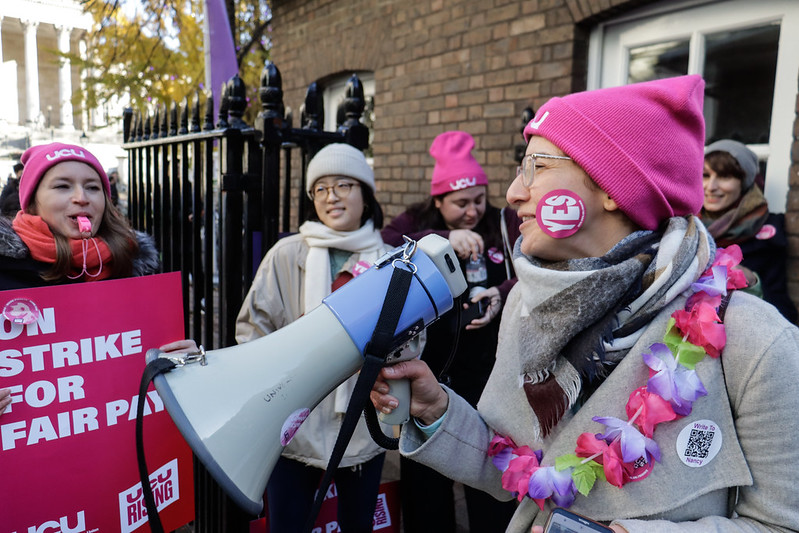
UK universities have shed more than 30,000 jobs in the last few years. In many universities UCU has been negotiating and taking industrial action in the face of job cuts which are in the hundreds at a time. This is not the case of the terminating of a few posts which can be managed by redeployment and early retirement packages. Some universities have got rid of a quarter of their workforce. This cannot be done without reducing the services to students and often the range of subjects on offer. For instance, the University of Sheffield has closed its Archaeology degree, despite public interest in Archaeology.
These cuts and deterioration in service conditions are having a major impact in the sector with some universities at risk of closure and staff wondering how much longer they can stay working in higher education.
In the post-92 sector, which contributed so much to widening participation, the loss of student services and reduction in available staff to teach students will harm students from disadvantaged backgrounds. These are the students who cannot flourish with minimal tuition and need encouragement because they do not have super levels of self-confidence acquired by some students from public schools (the term confusingly used in the UK for elite private schools).
Higher education as a human right
Against all these cutbacks in educational provision, challenging of equality and diversity principles and targeted attacks on academics, such as Professor Arday, the labour movement and the left should defend the principle that access to education, including higher education, is a human right. The doors of learning should be open and welcoming to all, not restricted according to race, disability, gender, and class background. Does one really need to write this in 2026? If struggles of the past for access to higher education, and equal treatment of staff and students within the sector, have to be fought again, then this is what must be done.