

Consider the speed of that. A man who spent a decade in Egyptian prisons, who was tortured, who went on hunger strike, who watched his father die while he sat in solitary confinement, who missed his son growing up, who became a symbol of democratic resistance across the Arab world, sets foot on British soil and within 48 hours a politician is demanding the police investigate him for tweets he wrote during a revolution fourteen years ago.
No one asked el-Fattah if his views had changed. No one interviewed him. No one sought a statement. He has not been permitted a single moment to address what he wrote. The pile-on began before he had unpacked his bags.
Establishment hypocrisy
British politics forgives its own constantly. Peter Mandelson resigned twice from Cabinet, was sacked as US Ambassador in September after emails revealed he had called Jeffrey Epstein his “best pal” and urged a convicted child sex offender to “fight back” against prosecution, was then photographed urinating against a wall in Notting Hill, and remains a Labour peer. Nobody has reported him to counter-terrorism police. Nobody has suggested revoking his citizenship. The man gave strategic advice to a paedophile and the worst he faced was losing his ambassadorship. He is already said to be plotting his return.
Boris Johnson wrote columns comparing Muslim women to letterboxes and bank robbers, called gay men “tank-topped bumboys,” referred to Black people as “piccaninnies” with “watermelon smiles,” and became Prime Minister. The Conservative Party is full of MPs who voted against gay rights in the 1990s and now wave rainbow flags at Pride. We allow growth. We allow evolution. We allow the quiet burial of past positions. The rehabilitation arc is a staple of British public life.
El-Fattah was not extended the courtesy of a question.
Iain Duncan Smith says he regrets signing a letter calling for el-Fattah’s release because the man’s views “have since come to light.” They have not come to light. They came to light in 2014 when el-Fattah lost a nomination for the Sakharov Prize. The tweets were public then. They were public when Priti Patel’s Home Office granted him citizenship in 2021. They were public when Duncan Smith signed his letter. They were public when Rishi Sunak called his release “a priority.” Everyone knew. Everyone proceeded anyway. What has changed is not the information. What has changed is that el-Fattah is no longer a useful symbol. He is a person, standing on British soil, and persons are harder to manage than symbols.
Citizenship no longer a right
When el-Fattah was in an Egyptian cell, his Britishness was a lever. It was useful for diplomacy, for looking principled on the world stage, for pressuring Sisi. Conservative ministers raised his case. Conservative Prime Ministers lobbied for his release. His British passport was a tool of foreign policy. Now he stands in Britain, that same Britishness becomes a garment that can be stripped off. Robert Jenrick’s government gave it to him. Robert Jenrick now wants it revoked. The passport was not a recognition of belonging. It was an instrument. Instruments get put away when the job is done.
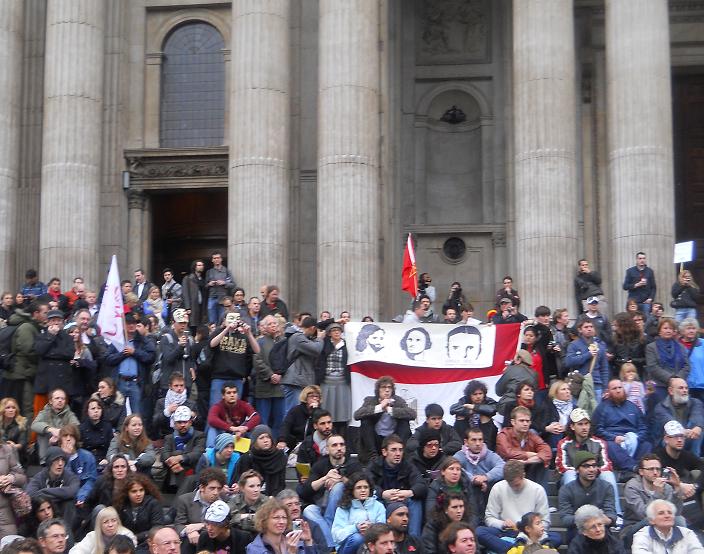
Occupy at St Pauls in 2011 campaigns for el-Fattah
This is the logic of conditional citizenship. For some people, nationality is settled, inalienable, beyond question. For others it is provisional, contingent, subject to review. Jenrick was born in Wolverhampton. No one will ever suggest his citizenship be revoked, no matter what he says or does. He could stand in Parliament and call for the drowning of migrants and the worst he would face is a motion of censure. El-Fattah was born in Cairo to a British mother. His citizenship comes with asterisks.
The same newspapers now baying for el-Fattah’s deportation have spent years defending the right of British politicians to say inflammatory things. Free speech, they told us. The right to offend. The importance of robust debate. When Suella Braverman called migrants an “invasion,” when Lee Anderson said the Mayor of London was controlled by “Islamists,” when Farage stood in front of that “Breaking Point” poster, the defence was always that speech, even ugly speech, is protected. You cannot police opinion. You cannot criminalise offence.
Unless, it turns out, you are foreign enough.
El-Fattah wrote his tweets during the Arab Spring. He was in Tahrir Square. The Mubarak regime was shooting protesters. His friends were disappearing into torture chambers. The police he called “not human” had just killed 24 Coptic Christian demonstrators at Maspero and tried to hide the bodies. The Israelis he raged against were bombing Gaza. None of this excuses calls for violence. But it provides context, and context is what we offer our own. When a British politician says something regrettable, we ask about the circumstances. We note the provocation. We allow for heat of the moment. We ask if they
Rightwing cynicism
El-Fattah gets no context. He gets no opportunity to explain. He gets Farage on the phone to counter-terrorism before he has had a chance to see his son.
This was never really about el-Fattah. Most of the people demanding his deportation could not have named him a week ago. This is about establishing a principle, about demonstrating who can be made to disappear from public life on the basis of things they said long ago and who cannot. It is a sorting mechanism. Farage says worse and sits in Parliament. Anderson says worse and keeps his seat. Braverman says worse and gets a newspaper column. Mandelson coached a paedophile and got an ambassadorship. Jenrick endorsed a flag campaign organised by Tommy Robinson allies, appeared at a protest alongside a former BNP activist, and remains Shadow Justice Secretary.
El-Fattah wrote ugly tweets during a revolution and now faces exile.
The double standard is not a flaw. It is not an oversight, not a failure of joined-up thinking, not an inconsistency that will be resolved once someone points it out. The double standard is the system working as designed. It tells you who is protected and who is not. It tells you whose past can be forgiven and whose cannot. It tells you whose citizenship is solid and whose is sand.
El-Fattah may well have views that deserve challenge. He may need to account for what he wrote. He may owe people an explanation, even an apology. Indeed he has made such an apology But he has been in the country for three days. He has been given no hearing, no platform, no opportunity to speak. He has been tried in absence by politicians who said worse last week and will say worse again tomorrow.
The rules are clear. They are just not applied equally.
Join the campaign here: Statement: solidarity with Alaa Abd el-Fattah | MENA Solidarity Network
Statement in solidarity with Alaa Abd el-Fattah
We affirm our solidarity with Alaa Abd el-Fattah and extend a warm welcome to him as he is reunited with his family in Britain after spending years unjustly incarcerated alongside thousands of other political prisoners in the jails of a dictatorship for speaking out against human rights abuses. Successive British governments have for decades supported Egypt’s authoritarian regimes through arms transfers and trade deals, including issuing a licence for military radars worth £79m in 2023, while Alaa was still detained.
Alaa rejects racism, antisemitism and homophobia, as his statement in response to vicious attacks in the media makes clear, and has paid a heavy personal price for his commitment to resisting oppression in Egypt.
We are appalled by the intense campaign vilifying him which includes calls to revoke his British citizenship, particularly by Tory and Reform politicians whose motivation is to whip up a racist storm in the media. Unlike those attacking Alaa, we will continue to organise and campaign for a world free of all forms of apartheid, colonial occupation and racism, including bigotry directed at Jews, Christians and Muslims because of their faith, and we applaud his courage in standing up for justice.
MENA Solidarity Network