
Social Media is one part of the larger discussion on capitalist technology: access to ostensibly free (as in, free to use without paying) web services (such as gmail, search, and corporate social media) has become so ubiquitous that most people do not think about software use as a means of organising against capital. While most leftists would (rightly) balk at the idea of buying anything from food at McDonalds to a car from Tesla, the same sense of revulsion does not extend to using software from companies that are at least as (if not more) harmful to our goals of dismantling capitalism.
The problems
Corporate social media is built to benefit capital. Everything done on, through or via social media owned and maintained by for-profit tech companies—including anti-capitalist organising—serves only to buttress the capitalist system. From surveillance capitalism, content moderation, exploitation of vulnerability and anti-democratic manipulation, for-profit social media corporations exist to maintain capitalist systems and, thus far, have not demonstrated any line on human decency that they are unwilling to cross for the sake of profit. These are important considerations for leftist organising, because we cannot expect to succeed in dismantling capitalism while allowing all of our organising, labour, resistance and our very minds and bodies to be consumed by these companies for profit.
Surveillance capitalism
Corporate social media follows the business model of surveillance capitalism, as described by Shoshana Zuboff. Under this model, companies claim ownership of the totality of human experience as raw material producing behavioural surplus, which is then used to anticipate, manipulate and direct human behaviour.1 Everything that we say or do is meticulously tracked by smart devices, abstracted into behavioural data points that are then used to create predictive models and user profiles. These profiles are used to manipulate us in various ways, from convincing us to buy things we do not need while hiking prices of goods to specific targets and contribute to the consumerist dystopia that we exist in, to actively convincing us to vote for those who will continue ensuring the safety of capital, the ongoing oppression of minorities, and the destruction of our climate. Now employers are reducing wages of new employees, using surveillance data to check for economic precarity and desperation that would indicate their willingness to accept lower wages.
It would be a mistake to believe oneself immune to the machinations of surveillance capitalism; a study by ProPublica demonstrated that facebook allows advertisers to selectively display ads to targets based on “ethnic affinities”, potentially circumventing anti-discrimination laws in things like housing sales. Such allowances could potentially be used to implement redlining, if not already in practice. We are simply the raw material being processed, abstracted, and commodified by surveillance capitalism in pursuit of new means of exploiting the masses for profit.
Content moderation
The irony of corporate social media is that it is considered ‘free’, that is to say that users are not paying a fee for using these platforms, while they ruthlessly control what may and may not be published thereon. Content moderation in and of itself is not a problem; any good platform that people use to interact with each other ought to have content moderation policies that prevent harassment and abuse while taking into account and correcting for systemic forms of power and privilege that enable such behaviour. The problem arises when such content moderation is entirely dependent on the whims of authoritarian and fascist governments, billionaires, or their companies.
Centralised and corporate-owned social media platforms actively restrict speech that threatens resistance against power, while complying with right-wing governments’ policies to enable and permit speech that actively harms marginalised communities. Examples include facebook allowing speech that describes LGBTQ+ minorities as abnormal or mentally ill (which is additionally problematic for its disablism) while maintaining prohibitions on the same against other minorities, X permitting Nazi propaganda, YouTube deleting hundreds of videos documenting human rights violations in Palestine, and Instagram shadow-banning users posting support for Palestine. Shadow-banning is particularly insidious: users’ posts are not deleted or moderated, but the posts are only visible to the original poster and do not get seen by anyone else. Not only does the algorithm target users with specific content to manipulate beliefs, these platforms seek to retain users, have access to our content and data for abstraction and processing while surreptitiously or overtly sabotaging all resistance. Tracking and surveillance additionally brings the threat of law-enforcement against us, as governments across the world enact increasingly draconian laws prohibiting protest.
For organisers and activists on the left, this means that anything we post on these platforms may be deleted, moderated, result in our accounts being wiped and banned, or simply excluded from the algorithm so that it does not reach the intended audience. Power does not tolerate challenges to itself; we cannot expect corporate social media to allow anticapitalist resistance to exist, operate, and organise on their platforms.
Anti-democratic manipulation
Social media is increasingly being used by governments and political parties for propaganda and campaigning. The UK government in 2024 launched a social media campaign to discourage migrants (without authorisation) from entering the country, while UK media has been accused of simultaneously stoking anti-immigration sentiment in the population through suggestive reporting. This keeps the citizens misdirected onto immigration as the cause of the problems instead of profiteering within the current capitalist system, blocking any resistance against it. Social media surveillance is additionally used to manipulate voters into particular choices. User data is used to create political profiles that are then targetted with specific messaging encouraging them to consider a particular candidate or proposition, or act in particular ways. For example, amnesty has reported that Facebook’s algorithm promoted anti-muslim content on the platform, encouraging violence against the Rohingya in Myanmar and contributing to the atrocities carried out in 2017.
The algorithmic echo chambers created by corporate social media platforms are divisive with the intent of ensuring users stay on the platforms and produce content for the platforms to continue with data extraction and manipulation. We cannot expect to organise and engage with each other in meaningful ways while our actions are being monitored, predicted, and manipulated by companies for their own ends.
Additionally, as people who care about and understand that we are ourselves—like all humans—are vulnerable to manipulation by corporate media, we need to judiciously guard what influences we expose ourselves to. Ensuring we have actual control over this, instead of subjecting ourselves to corporate algorithms that seek to influence us in whatever way best ensures their own profitability, is very much in our interests. Our goals are best served by being among others who share them, and are hindered by being among those who actively seek to stop us, and allowing them to dictate what kinds of media we see, hear, and read.
Platforming fascists
As a parallel problem of content moderation and anti-democratic manipulation of the algorithms is the problem of many social media applications becoming what has come to be known as “Nazi bars”. Referring to the problem of nazis occupying and overrunning spaces the moment they are allowed into them, the issue has become pervasive on many for-profit social media platforms. Corporate social media has taken a hard turn towards allowing fascist and nazi content on their platforms, under the guise of this being a matter of “free speech”. Of course the claim is a guise, as they are still perfectly happy to moderate, block, and delete content that they dislike, such as posts about or in support of Palestine and Palestinian people. Corporate platforms that have allowed and actively encouraged Nazis and right-wing fascists to proliferate on them include X (formerly Twitter), Instagram, Facebook, Spotify, and even Substack. Many of these companies profit from allowing fascists to continue to use their platforms to post their hateful ideologies, claiming that their violent, extremist and hateful content does not go against their terms of service.
The problem with remaining on these platforms does not end with our own exposure to content that is directed at trying to turn us to becoming Nazi sympathisers and consequently, becoming Nazis ourselves. By remaining on these platforms, we allow them to hold our networks, our friends, and our community hostage to the same manipulation. These platforms are actively being used as recruitment tools by far-right groups. By remaining on these platforms ourselves, we become reasons for others to stay and subject themselves to this propaganda as well. While it might be tempting to argue that we should stay to fight back against the propaganda with our own content and responses, this replicates mistaken liberal notions of the ‘marketplace of ideas’ as an ideal and fair playing ground to participatively change people’s minds. The marketplace of ideas as a concept completely ignores power structures, assuming that the owner of the platform and the user—who is really the commodity for the capitalist to profitably harvest data from, rather than a user—are on an equal footing. We categorically are not. Leftist groups cannot out-compete right-wing propaganda by remaining on corporate social media, because we do not own the means of production: the algorithms. The owners explicitly side with the fascists, tuning their algorithms to promote their content. When the bar explicitly allows Nazis, it is either already a Nazi bar or will very soon become one, and it is time to leave.
Enclosure and alienation
Social media companies are in the process of enclosure of human relationships. This mimics the enclosures of land that alienated labourers from the products of work on the land that spurred the establishment of capitalism. By making their platforms addictive, they ensure that people are constantly on one or more of their platforms for validation. This is no longer a choice that the users have, much like labourers were forced to pay rent to landlords in order to have access to a means of livelihood after the commons were enclosed. By locking these platforms, companies ensure that you cannot access networks on the platform without subjecting yourself to the same data extraction. One cannot access media accounts of people whose content we want to see without agreeing to our data being extracted and being manipulated by the relevant algorithms by creating and using an account on the platform. This alienates us from each other, whereby we cannot interact with each other except through the use of these platforms.
With the advent of AI, our interactions are additionally being used as training data for AI models with paid subscriptions, enclosing even our interactions for exploitation by capital. These models are then being sold to us as ‘AI companions’, alienating us from each other with every interaction that we have on these platforms. Despite indications that we are better off texting a human stranger than an AI companion and AI bots being potentially harmful, the bots are being pushed onto us as a solution to the loneliness caused by centuries of capitalist alienation from each other. AI is also being used in horrendously degrading ways, such as the non-consensual production of pornographic images of people, increasing the vulnerability of oppressed groups to targetting, harassment and abuse. Bots are now being used on social media as fake profiles targetting particular posts and people once again, with the aim of ensuring addictive use of these platforms.
As activists, we need to be aware that everything that we say and do on corporate platforms will be used as training data by the same companies. The major social media platforms are all also heavily invested in AI research and training. Every YouTube comment, every Facebook post, every Instagram image will be used to train AI.
Exploitation of vulnerabilities
Corporate social media is increasingly being seen to have impacts on mental health. Recent revelations have indicated that this is by design; former facebook executive Sarah Wynn-Williams accused the company of tracking teenage girls who deleted their selfies and targetting them with ads for beauty products. This is not only invasive of user’s privacy, but both manufactures and targets vulnerabilities in marginalised and oppressed groups. The apps are designed to be addictive, which resulted in a recent lawsuit against Google and Meta where the companies were held liable for harming the mental health of the claimant.
While governments pursue authoritarian bans on children using social media ostensibly as a response to this problem, such bans can only operate with even more data being surrendered to the surveillance capitalists. Indeed, governments often impose such bans to increase surveillance by the state on social media activities of citizens. Child safety is the excuse given to increase and normalise censorship, control and repression of citizens. Social media companies can only prevent minors from accessing their platforms by collecting identity proofs from users, meaning that we cannot remain anonymous on these platforms if we wish it. Such data is usually processed by third parties (again, private for-profit corporations); this data is not necessarily secure, and hacks in the past have resulted in theft of ID documents.
The actual solution to this problem is neither abstinence from social media and online interactions, nor is it submitting to authoritarian control of our interactions. Instead, it is seizing control over the means of production: in this case, control over the social media platforms that we use. That is within our grasp: non-corporate and decentralised social media already exists. Many of these reject addictive algorithms that push particular content at users in favour of users having complete control over their own social media experience. We need to understand that as humans, we are extremely vulnerable to social influence; free (as in freedom) and decentralised social media affords us control over what kind of influences we want to have in our life. Much like picking our closest friends, we need to actively seek out social media platforms that will enable us to curate our own networks to support our experiences, goals and growth in ways that we choose, rather than in ways that are chosen for us by companies in pursuit of their own profiteering goals.
Leaving profiteering platforms
Let us be clear: staying on corporate-run social media when very viable alternatives exist, is a choice for most of us that makes us complicit in our own exploitation. Our continued presence and activity on these platforms contributes to the general sense in society that it is impossible to leave because everyone is on the apps, or that there are no other/better/more convenient ways to keep in touch. Unfortunately, these are self-fulfilling prophecies: the more we believe them to be true, the more likely we are to reject alternatives and refuse to change or move to better systems. It only changes if we make the conscious decision to eschew the convenience offered by big tech, and commit to putting in the effort of moving to alternates. While the effort required is not impossibly large or difficult, it does involve some friction, such as learning new systems/platforms, actively engaging our community in conversations to push more people to move, and ultimately, foregoing some of the conveniences offered by large corporations for our commitment to change.
A number of alternative social media platforms have gained prominence since Elon Musk’s takeover of Twitter. Of these, I will focus on Mastodon (and the larger network of apps that it is connected to, called the Fediverse) since it is decentralised, built as free and open source software, maintained by a non-profit organisation, and runs on open protocols that allows other apps (and users on these apps) to freely communicate with each other, and allows for portability of accounts to ensure that the systems are not enclosed. BlueSky, the main other competitor to the corporate social media platforms, is open source, runs on an open protocol but is owned and operated by a for-profit company, and is meant to be capable of decentralisation but is mainly run on centralised relays.
Mastodon itself is a microblogging platform, it is an ideal alternative for people who prefer the short-posts format, à la X (Twitter) and BlueSky. Where it really differentiates itself from other social media platforms is its interconnectability with other apps run on the same platform. If, for instance, you are someone who prefers to engage with others primarily through images, and are used to Instagram, the open source alternative for it is PixelFed. While PixelFed operates like instagram, you can connect and interact with Mastodon users directly from PixelFed, and vice-versa. You do not need to have separate accounts on both Mastodon and PixelFed for this. You can follow, interact with and comment on WordPress blog posts directly from your account on Mastodon, PixelFed, or Friendica (the alternative for Facebook in this network). This network of interconnected apps all run on the open protocols and is called the Fediverse. To that end, here is a brief guide on how to join Mastodon.
Joining and using Mastodon
- Find a server to join on the Join Mastodon Server Page or this larger Fediverse list. Any server from joinmastodon.org will do, the differences are in their moderation policies and some servers focus on special subjects/regions (eg. servers for people interested in specific hobbies, identities, or activities). If in doubt, pick the standard mastodon.social server. You will be able to interact with people in other servers regardless of which server you join.
- Sign up for the server on the server website, or apply to join it. If the server is listed as invite only, write to the server admin for an invite.
- Once you have signed up, go to the server’s home page (eg. mastodon.social) and login to your account.
- There are three timelines: your homepage, where you see posts of people you follow, the Local timeline, where you only see posts of other people on the same server that you joined, and the Federated timeline where you see posts of everyone using Mastodon.
- You can find other people on mastodon by searching for them. If you know their username and server, enter it in search as “@username@server-address” – so if I am looking for someone with username “person” on the mastodon.social server, I will enter “@person” in the search bar. If you want to see their posts in your account homepage, click the Follow button to follow them.
- To follow the ACR blog from your Mastodon account, search for “@blog” (without the quotes), and select “Follow” when you find the account. You may comment directly on ACR blog posts through your mastodon account by replying to the post in mastodon; these replies will be visible on the blog post as well, once they go through. This is what you should see:
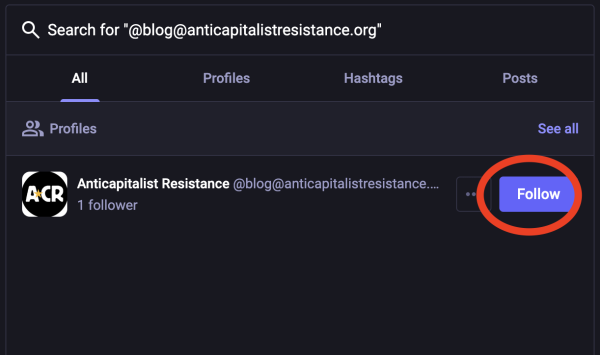

- You can directly share ACR (or anyone else’s) posts via the “Boost” button shown above
- To make posts, use the compose icon. You can add media, caption media, add content warnings, add alt text to media for accessibility, schedule posts and change the display publicity of your posts here.
- You can install the native Mastodon app for mobile phones to use mastodon, or use any alternative apps (listed in the same page) that suit your needs.
- Shoshana Zuboff, The Age of Surveillance Capitalism: The Fight for a Human Future at the New Frontier of Power (Profile books 2019) 67–88. ↩︎
Excellent article and all good points, but you should encourage people to spread themselves over numerous instances of Mastodon, not encourage the “default” of mastodon.social. This one node could prove to be a single point of failure if taken offline by government order or spy agency.
That’s entirely fair; I do think though that this is more of an organic process – I do not suggest here that it’s the only server, but for people moving in from corporate platforms it eases the transition somewhat and that is worthwhile.
I actually would go against the grain and suggest that it might be better for people to start with mastodon.social to get an initial sense of how the fediverse works, and have a clearer idea of what app/instance they’d prefer to be on instead if they do eventually want to move.
In any case, smaller instances and nodes are also not immune to closure even outside of censorship; so being on more than one instance is absolutely a good strategy.