


Starmer wants credit for taking on the tech giants. What he is actually offering is a rule that the most vulnerable children will be best placed to break, and a government that gets to say it acted
Keir Starmer is preparing to announce an “Australia-plus” ban on under-16s accessing social media, and the government wants you to understand this as a government finally taking the side of parents against the machine. That framing is the whole trick. A ban is not a policy. A ban is what a government does when it has run out of policy and needs a headline that looks like tough action.
Start with the mechanics, because the mechanics give the game away. Australia banned under-16s from social media on 10 December last year. Within days, more than 4.7 million accounts were deactivated, removed or restricted. The country’s own eSafety commissioner then reported that a substantial proportion of under-16s kept their accounts, made new ones, or walked straight through the age gates. Two things are true at once here, and the government will only let you see one of them. Yes, the ban removed accounts at scale. And no, it did not remove the under-16s. It removed the easy cases and left the hard ones exactly where they were, which is the opposite of what a child protection policy is supposed to do.
Hard cases are real problem
Because the hard cases are the point. The teenager whose parents are engaged, whose home is stable, whose use of Instagram is mildly excessive but not dangerous, that teenager complies, or gets nagged into compliance, or has a parent who actually reads the settings menu. The teenager with an absent parent, an arms-length parent, a parent who is working two jobs or simply is not coping, that teenager gets an older sibling to set up the account, or a friend’s phone, or learns the workaround from the same friend group that taught the last generation how to get into eighteen-rated films or look at porn. The ban does not discriminate between these two children. It just sorts them by how much supervision they already had, which is to say it reproduces the exact inequality it claims to be correcting.
I keep thinking about the Southampton disorder, and about my own first reaction to it, which was that X should simply be banned. It is, after all, a sophisticated recruiting tool for the far right, and Musk has made no secret of which side of that recruitment he is on. But banning a platform because of what travels through it treats the platform as the cause rather than the conduit. The appetite that found a home on X did not originate on X. It was produced somewhere else, by deindustrialisation, by the hollowing out of the institutions that used to give people a stake and a story, and it would have found another conduit if X had not existed. Ban the conduit and the appetite goes looking for the next one. This is not an argument against ever regulating platforms. It is an argument against mistaking platform regulation for the whole of the work.
What causes children’s isolation
The same logic, only sadder, applies to children and their phones. The phone is not the cause of whatever loneliness or boredom or anxiety it is filling. It is what moved into the space left behind when something else moved out. Youth clubs closed. Public space got enclosed, surveilled, or simply removed, on the basis that loitering teenagers are a problem to be designed away rather than a population to be served. After-school time got eaten by exam pressure that starts earlier every year. Parents work longer hours for less security than the generation before them, which means less time, less energy, and less capacity to be the alternative to the screen. None of this is news to anyone who has watched it happen over thirty years. What is newer is the willingness to pretend that none of it matters, that the problem is the device rather than the absence the device is filling.
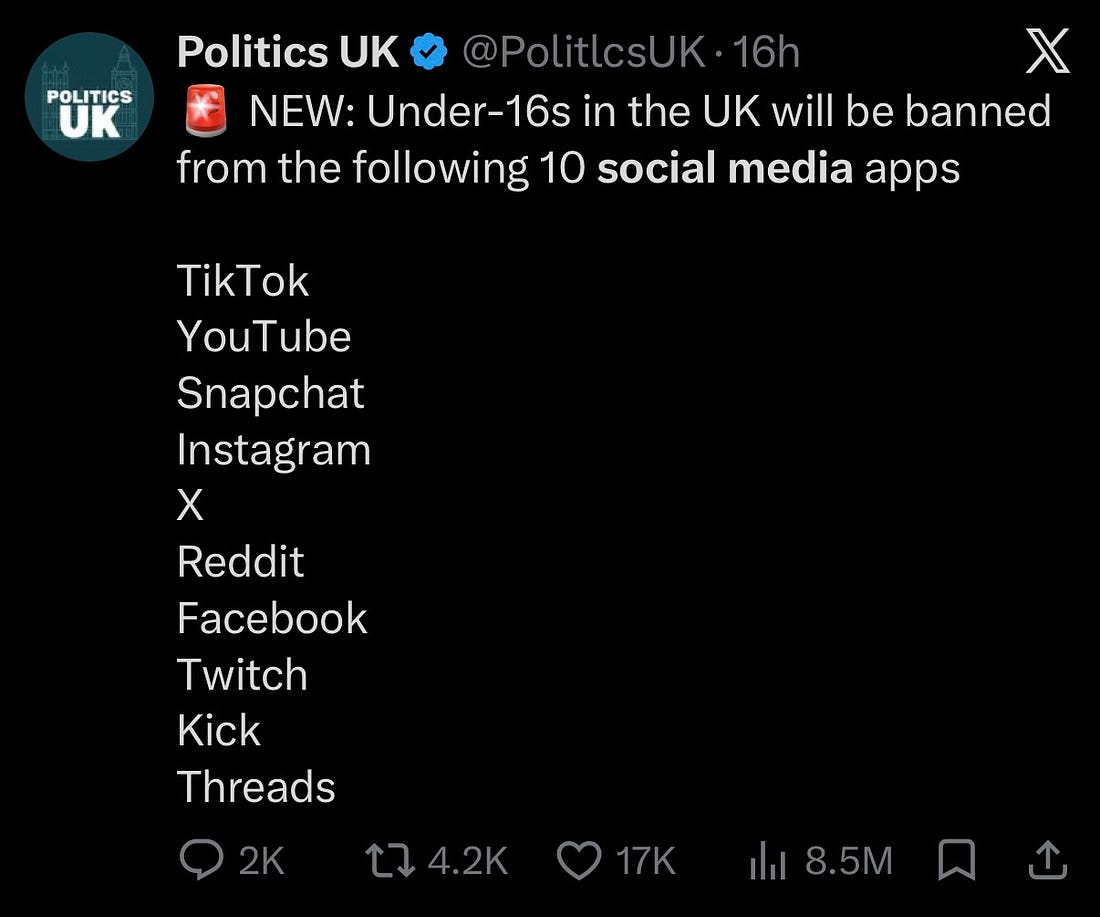
So when the prime minister stands up and frames this as siding with parents against the tech companies, ask what exactly parents are being given. Not resources. Not time. Not space. A rule, which the children who most need protecting will be best placed to ignore, and which the children who least need protecting will experience as one more piece of adult micromanagement layered onto a childhood that is already more supervised, more scheduled, and more indoors than any childhood in living memory. The Molly Rose Foundation, named for a girl who died after viewing harmful content that the platforms allowed to reach her, has called the ban unenforceable and said it masks the absence of any credible plan to deal with the algorithms themselves. That last part is the part that matters and the part that will not survive contact with a press release. An algorithm built to maximise engagement through outrage and compulsion is dangerous to a fourteen-year-old. It does not stop being dangerous on the user’s sixteenth birthday. Restrict it by age and you have not made the technology safer. You have decided which age group gets to be harmed by it.
The alternative for young people
What would an actual alternative look like? Not a vision in the sense the question was asked to me, because I am wary of the word vision, it tends to mean a speech rather than a spending commitment. But the shape of it is not mysterious. It looks like youth provision that exists and is funded rather than announced and then quietly run down. It looks like public space designed for people to be in rather than move through. It looks like regulating the addictive architecture of these platforms for everyone, not just the under-16s, because the engagement-maximising feed that destabilises a teenager’s attention also destabilises an adult’s, just more slowly and with better camouflage. None of this requires banning anything. It requires building things, which costs money, continuously, with no single announcement moment attached to it.
There is a second problem, though, and it is the one that does not go away even if every objection above turns out to be wrong and the ban somehow works as advertised. Age verification at this scale requires infrastructure: some reliable way for a platform, or a device, or a state, to know who a user is and how old they are, before deciding what that user is allowed to see. Build that infrastructure for under-16s and pornography, and you have built it, full stop. It does not expire when the policy that justified it changes hands. A future government inherits the capability along with the precedent that using it is normal, that conditioning access to information on proving your identity to a platform or the state is simply how the internet works now.
Which is where the Farage question becomes unavoidable. Whatever protections Labour builds in around scope and purpose, the next government that holds this infrastructure gets to decide what “harmful content” means, what counts as identity verification, who needs to prove what before they can access what. I do not trust this government with that power particularly, but I trust the next one considerably less, and the handover is not hypothetical, it is the next election. The argument about who operates the architecture and for what ends gets fought later, by people who did not build it and cannot easily dismantle it.
Is Starmer taking on the Tech Giants?
And the VPN question follows directly from that, because age verification only holds if it cannot be routed around, and a VPN is the simplest routing-around tool there is. Every jurisdiction that has tried strict online age verification has watched VPN use spike the moment the gate goes up, for the obvious reason that a wall produces a queue at the nearest gap. A government that actually wants the ban to bite, in the sense Australia’s commissioner means it rather than the cosmetic sense, runs into that gap fairly quickly. Restricting VPN access, or requiring identity checks to use one, or leaning on app stores to delist them for accounts flagged as under-18, is not a slippery-slope fantasy. It is the next step in the same logic, and because a VPN cannot be age-gated without applying the same identity infrastructure to everyone, it is a step that stops being about children at all.
Starmer wants credit for taking on the tech giants. What he is actually offering is a rule that the most vulnerable children will be best placed to break, and a government that gets to say it acted