
Many workplaces are encouraging their employees to give into this temptation. Copilot is bundled into outlook subscriptions and managers are trying to find a way to make it profitable. We are being expected to perform more tasks on the basis that we can speed up our productivity using AI programmes. As ever, we work at the pace of the machines. And we can predict what will happen. The next time someone quits, retires or is made redundant, the boss won’t replace them. Because their role can just be absorbed into yours now with the help of AI. So your workload will increase while your pay stays the same, and profits for those at the top go up.
But much of the time the work doesn’t happen more quickly, the work simply changes. Rather than spending 6 hours working through a problem and drafting a document, I am checking an AI programme’s draft and workings. This is important, because doing the work matters.
Scientists have begun to observe a phenomenon they have named “cognitive surrender”. People who use AI regularly are starting to think differently and less critically. They are losing their ability to work problems out on their own and becoming dependent on a technology that is owned by some of the most evil and self-interested people in the world.
And in an age of runaway climate change and colossal wealth inequality, when it is easier to imagine the end of the world than the end of capitalism, being able to think critically is one of our most vital skills.
But I also find myself asking a more fundamental question which is – what is the point of knowledge? What is the point, actually, of anything?
A particular example is at the forefront of my mind. For 200 years, mathematicians have been attempting to solve the Navier-Stokes equation which aims to describe the motion of fluids mathematically. Mathematicians – who regularly publish their workings online – had been close to solving it.
However, on 8 September OpenAI claimed it had solved the Navier-Stokes problem after an 88-hour assault by around 10,000 artificial intelligence agents. This has caused a controversy in the world of mathematics. The equation is one of six Millennium Problems on a list compiled by the Clay Mathematics Institute in 2000 – if you solve one, you win $1 million. Two mathematicians – Tristan Buckmaster and Levent Alpöge – were making significant progress in the last month towards solving it and were on the cusp of publishing their findings before OpenAI mounted its attack.
Why does OpenAI’s solution feel so unsatisfying? We have potentially solved one of mathematics’ long held problems! We have a solution! Delivered to us by a programme designed and made by other scientists. This is the brave new world we have been working towards, isn’t it?
I’ve been reading Seven Brief Lessons in Physics by Carlo Rovelli, based on a series of articles he wrote for the culture section of an Italian Sunday paper. In the very first one, he succeeded in explaining Einstein’s General Theory of Relativity in such a way that I finally understood it. And it was a wonderful moment. The joy of sudden comprehension, of seeing your way clear. But also the joy of knowing, in a much more novel way and many years ago, Einstein had had the same revelation as I had just had as I sat on my morning commuter train from Croydon.
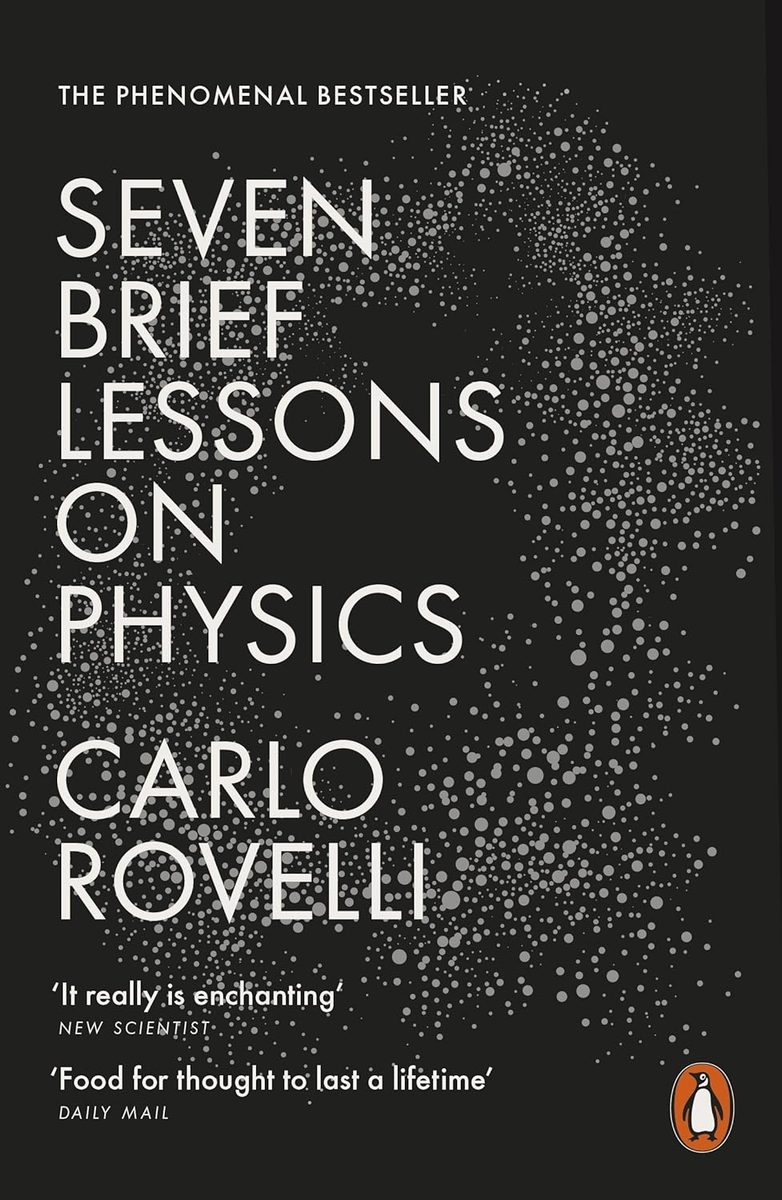
Much like the Earth rolling again and again along the grooves made by the sun’s curvature of space, my mind was travelling along the same turns of logic and thought that millions of other minds have travelled when learning about Einstein’s theory of relativity.
Rovelli ends his chapter by setting out Einstein’s simple equation showing that space and the gravitational field are the same thing. Although I don’t know what the letters mean (really) I appreciate its sparse simplicity on the page.
Rovelli writes:
“You would, of course, need to study and digest Riemann’s mathematics in order to master the technique to read and use this equation. It takes a little commitment and effort. But less than is necessary to come to appreciate the rarefied beauty of a late Beethoven string quartet. In both cases the reward is sheer beauty, and new eyes with which to see the world.”
I think it is that commitment that we are robbed of we give into the temptation to click on the copilot button or ask Gemini for a summary. We lose the ecstasy of comprehension in the opiating fog of cognitive surrender. And life is hard – we are being asked to give so much of ourselves just to survive by working bullshit jobs in an economy that pays us barely enough to live.
But I’d invite you to consider that maybe the answer is not the one being pushed by our bosses and the millionaires in Silicon Valley. That maybe what they are pushing is actually entrenching us further into the daily grind. There is more agency and more power to be won in saying no to this particular temptation.
What is the point of anything if not to experience sheer beauty and connection to other living things?