

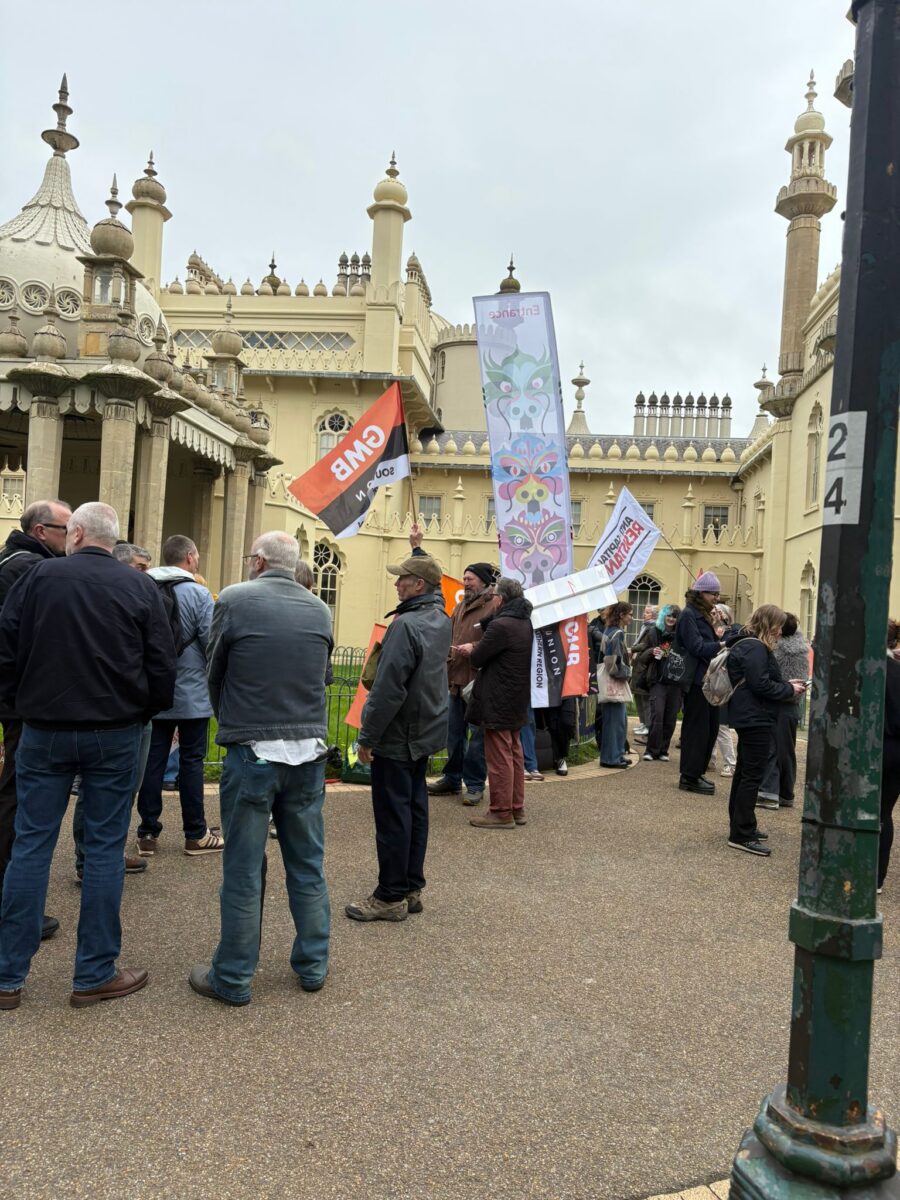
On Saturday, April 4, 2026, ACR Brighton joined GMB union members on the picket lines outside Preston Manor and the Royal Pavilion. Union members recently voted in favour of strike action after the Royal Pavilion and Museum Trust (RPMT) – the registered charity that runs several cultural and heritage sites throughout the city – proposed changes to their terms and conditions of employment.
The strike is a part of a worker-led campaign called “Your Landmark, Our Livelihoods” to show that museum workers play a crucial role in preserving and sustaining Brighton & Hove’s unique history and cultural identity.
“The Pavilion Trust is a Contract Killer”
The story of this dispute goes back to 2018, when a cash-strapped Labour-led Brighton & Hove City council decided to offload the management of the Royal Pavilion and other local museums onto a non-public entity (a move that GMB members opposed).
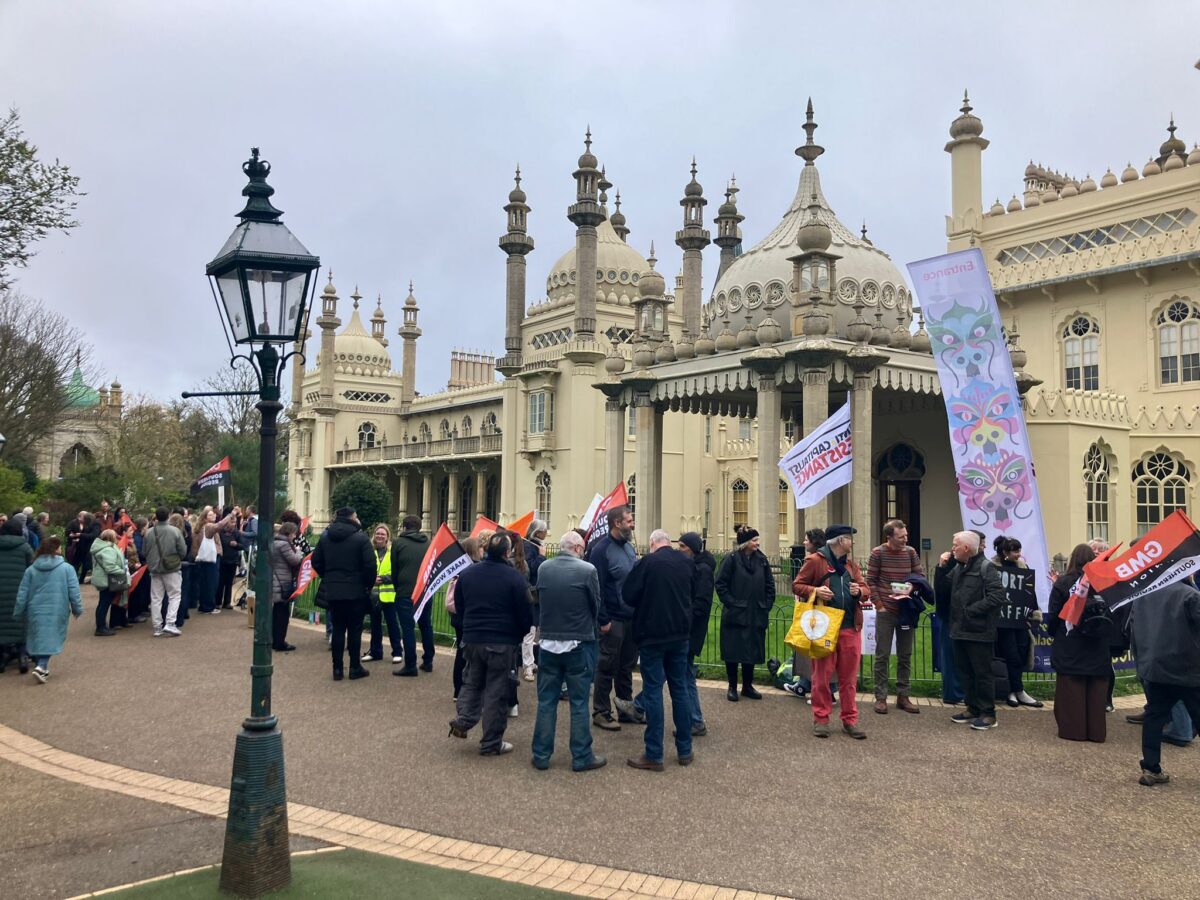
When Brighton and Hove City Council outsourced Royal Pavilion Museums services to the RPMT in 2020, workers were told that they would remain under the previous National Joint Council (NJC) local government contract. Even after the RPMT took over, long-serving staff members continued to enjoy the same terms as council workers, including agreements on pay rises, sick and holiday pay, and parental leave.
However, the RPMT has since hired new employees on lesser contracts, leading to what one GMB member described to us as a “two-tier workforce” where some workers are not entitled to the same benefits as their colleagues. In December 2025, the RPMT declared that all staff members on NJC terms would be transferred onto these less favourable Brighton & Hove Museum contracts.
For those affected by this move, the RPMT’s proposal means they will lose pay protections and face significant cuts to key entitlements, such as sick pay. Instead of compliantly signing new contracts, GMB union members have gone on strike – with 94% of members voting for action – to prove that their labour is essential to the success of Brighton & Hove’s museums and heritage sites.
In the run-up to the strike, Pavilion and museum workers have received the GMB’s full support. In a recent statement, GMB regional organiser Catherine Matthews explained why industrial action was necessary:
the passionate, knowledgeable staff [who work for the Pavilion and local museums] need to be protected from swinging cuts to their employment rights so they don’t need to find jobs elsewhere. Even before these contractual changes, the staff have among themselves set up a food bank to help those among them to help keep their heads above water.
The strikers’ demands are not unreasonable. As one worker pointed out, they are simply asking to keep what they already have.
On April 2, RPMT Management stated that they were “disappointed” by the strike action. They tried to justify their assault on workers’ terms and conditions by claiming that their proposals were “driven by significant financial pressures facing the Trust, including reduced public funding, rising costs, and visitor income that has not yet returned to pre-pandemic levels.”
None of these problems have been caused by the workers themselves, whose labour and dedication have turned the Royal Pavilion and Museums into an acclaimed tourist attraction. A recent Visit England assessment, for instance, gave them an ‘exceptional’ rating of 95 out of 100.
When the Royal Pavilion won a TripAdvisor’s Traveller’s Choice award in 2024 for consistently high reviews (placing them in the top 10% of worldwide TripAdvisor listings), the CEO of Brighton & Hove Museums Hedley Swain, described it as a “huge endorsement of all of our staff and how we look after our visitors.”
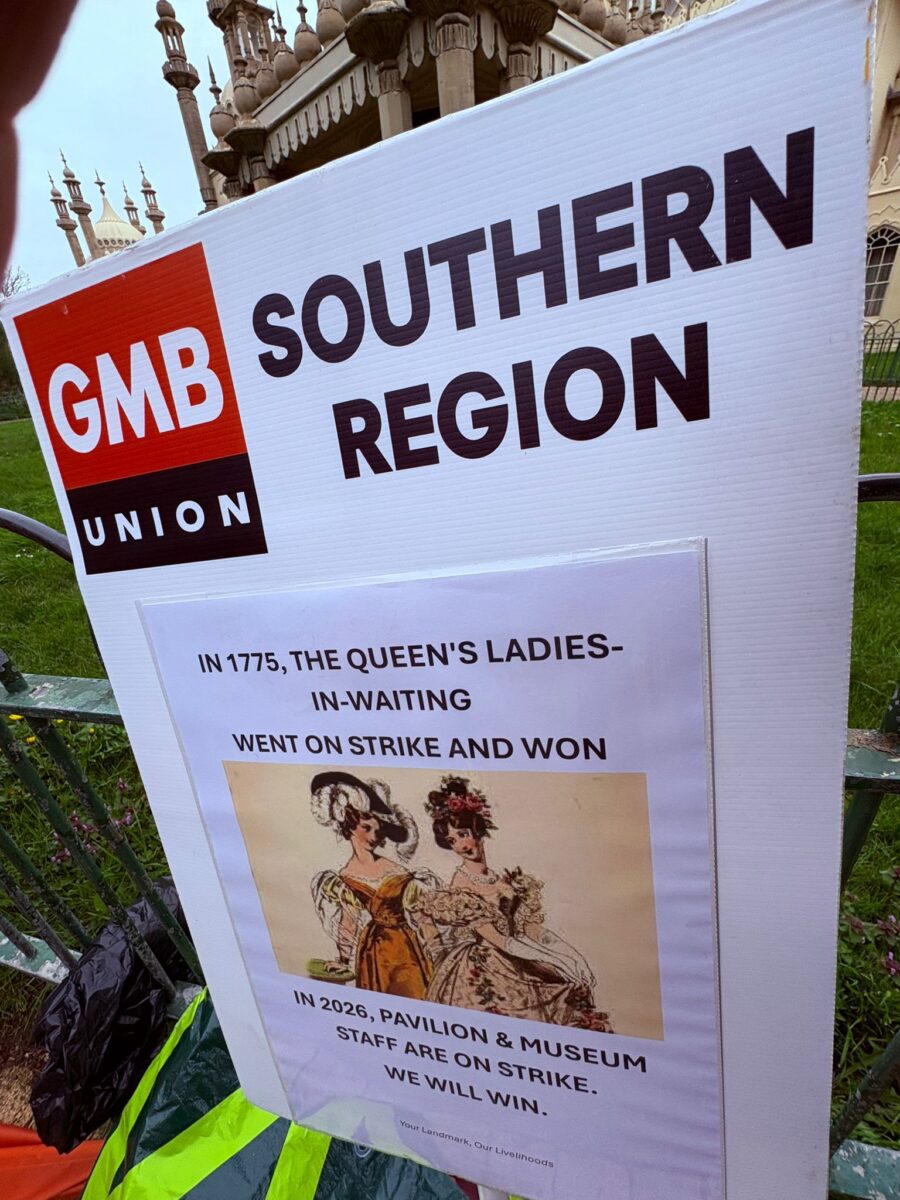
Yet, in less than two years, the RPMT management have seemingly forgotten that they cannot operate sites like the Royal Pavilion without these experienced and knowledgeable members of staff. Without the workers who bring history to life and keep everything running, the Royal Pavilion and Museums are just empty buildings.
The RPMT had planned to keep the Royal Pavilion open all day during strike action. According to our sources, they had to close early. Hopefully, the Trust management will learn the right lesson from this experience.
Museum Workers Fighting Back
This GMB strike is not an isolated phenomenon. Across the cultural sector, museum and heritage workers are taking action. In November and December 2025, over 150 workers at Tate went on strike over pay and benefits. Earlier this year, more than 100 staff members at London Museum took action as part of a pay dispute.
What unites these instances of unrest is the growing sense that museum workers are not taken seriously as workers, as though they are expected to carry out their work as passionate volunteers or keen amateurs rather than respected professionals.
Like other employers in the sector, the RPMT assumes that workers are willing to accept lesser terms and conditions simply because they love working in a museum or are passionate about local history. It is this devaluation of cultural work that has forced union members onto the picket line.
The larger structural context for these recent museum strikes is the persistent underfunding of arts, culture, and heritage over the past 16 years. Since 2010, councils have faced a 42% cut to their budgets in real terms, losing around £24.5 million. Heritage funding for local authorities has fallen from £31 million in 2012 to £17 million in 2023 (a 45% drop).
Under the former Conservative government’s austerity regime, museums like the Royal Pavilion were no longer seen as inherent public goods and were, instead, treated as costly luxuries (or, even, as potential money-making opportunities).
At the 2024 Labour Party conference, the new Culture Secretary Lisa Nandy promised to turn the page on the Conservative Party’s legacy of “cultural vandalism.” Culture, she claimed, would no longer be the preserve of a “privileged few.” Torealise this promise, Nancy recently announced a new £1.5 billion fund that would help to renovate Britain’s cultural infrastructure.
Yet this fund prioritises capital investments and building repairs over the needs of the people who actually do the work at these institutions. While there is certainly a need to improve and update the facilities at local museums and libraries, Nandy is not doing enough to properly support cultural workers.
As Prospect General Secretary Mike Clancy put it, “Our culture is not just about artefacts, sites and buildings but about the people who bring it to life. This sector is facing an ongoing and intractable crisis in pay and retention which has to be addressed.” Ironically, Nandy’s ongoing failure to address this crisis may mean that, very soon, only the ‘privileged few’ will be able to afford to work in cultural heritage and the arts.
A Future Worth Fighting For
In her 2025 essay “A Marxist Defence of Stuff,” Echo Fortune tries to imagine what it might mean to ‘own’ things in a post-capitalist world. She sketches out the possibility for ‘possessions without possessiveness,’ whereby we may find pleasure in public goods without depriving or manipulating other people. This is not a realisation of the old anti-leftist cliche about ‘no one owning their own toothbrush under communism,’ but, rather, a vision of how we would relate to ‘stuff’ if we didn’t have to constantly worry about earning enough to pay for essentials like food and shelter.
For Fortune, utopian thinking helps us to figure out what kind of future we want to fight for – and how we might get there. She suggests that the demand for universal public services – free transport, museums and galleries, libraries, clubs and banquets – could be part of a “powerful strategy towards the decommodifying of our society and the anticipation of a different one.”
This is precisely why we, as socialists, should support heritage and cultural workers whenever they go on strike. They are pushing back against the forces that want to run museums and public institutions like businesses rather than shared goods that should be available to everyone.
In its own small way, the GMB strike on Saturday hinted at a vision of the future where museums like the Royal Pavilion can be run by the people and for the people – a world where we can enjoy art exhibitions and heritage sites without exploiting the labour of others.
It is a future worth fighting for.