

Here’s the challenge: tune your radio to the BBC World Service for a week and you will get the full picture of global crisis laid out before you. Climate collapse, genocide in Gaza, militarisation, ongoing wars, economic crisis, poverty and political-military repression in states that easily cover the majority of the world’s population, conspicuous consumption by the rich, including space trips for billionaires, and the emergence of new ruling elites in billionaire capitalism.
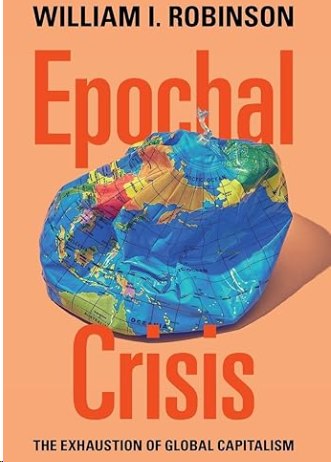
For socialists and the left, a key theoretical task is to pull all this together to grasp where we are going and, as ever, what is to be done. William I. Robinson, in his latest book Epochal Crisis, attempts just that. It is, to put it bluntly, a mind-blowing assessment.
Robinson claims that world capitalism has entered a final, epochal crisis which is multidimensional. It is at the same time a crisis of profitability, a long-term underlying economic crisis which is accelerating. And, he claims, artificial intelligence may be able to hold this off, but like the dot-com bubble two decades ago, not for long.
Underneath this economic crisis lies the workings of fundamental Marxist categories: the over-accumulation of capital by the wealthiest sectors, especially digital capitalist corporations, matched by corresponding under-consumption by vast sectors of the world’s population, especially workers, the marginalised, and the “surplus population” — the latter being “illegal” workers on the edge of rich countries, socially or geographically, able to be integrated into or expelled from the labour force depending on need, generally based on what we call in Britain zero-hours contracts.
The long-term economic crisis has generated a crisis of social reproduction. All the forms of social stability of the “golden age” — the period from about 1950 to 1975 — are breaking down. In advanced capitalist countries like Britain, there is a housing crisis, an education crisis, a healthcare crisis, a prison crisis, and the appearance of what Gilbert Achcar, following Gramsci, calls “morbid symptoms.” (1)
In the same category you could place the crisis in the ghettos, the crisis in refugee camps, and the overarching crisis in the Global South — what used to be called the Third World, where the optimistic theories of “development” were once formulated.
Robinson pulls all this together in a series of overlapping analyses which show how all the elements of this massive crisis generate inevitable systems of control summed up in the idea of global civil war. Some have objected to this terminology, but the reality cannot be denied: a cascading story of massive repression against the poor and exploited when they resist. This overlaps with another key Robinson category: militarised accumulation.
The last five years have demonstrated the reality of militarised accumulation on an epic scale. Donald Trump’s administration has just announced its 2026 “defence” budget: an astounding $1.4 trillion, an increase of 40%. Militarised accumulation includes the rise of military-monster corporations like RTX (formerly Raytheon)n and Northrop Grumman, closely integrated with hi-tech corporations like Apple and Meta.
Did you know that four key AI executives have been awarded the rank of lieutenant colonel in the American army? Andrew Bosworth (Meta), Shyam Sankar (Palantir), Kevin Weil (OpenAI), and Bob McGrew (Thinking Machines) have each received this award. These awards are far from purely symbolic.
They represent a deep-seated integration of the military and computing companies through cloud data storage, surveillance, target acquisition, weapons design, and logistics. You can see all this in action in Ukraine, Gaza, Lebanon, and a host of countries targeted by US-made drones and missiles.
So the epochal crisis finds expression in wars and domestic repression all over the planet. But the boosting of domestic repression agencies aimed at immigrant populations and refugees on borders is also a fundamental aspect of the war on unruly populations, immigrant or otherwise. ICE agents raiding through US cities and terrorising immigrant communities are the most vivid example of this process.
Epochal economic and social crisis comes bundled with political crisis. State repression both gives rise to and is a product of the era of neofascism. Modern fascism strongly opposes climate science, and as the example of the Trump regime shows, neofascism is a major obstacle to fighting climate change.
In any case, we are now in the epoch of climate catastrophe. In the next five years we are likely to have at least one year where the global average exceeds 1.5 degrees above pre-industrial levels. A devastating two degrees above pre-industrial averages would unleash major social catastrophes on a dystopian scale. If this happens, waves of climate refugees would move toward Europe from the Middle East, Western Asia, and Sub-Saharan Africa.
A great deal of this is already under way in our time. On the economic front, we have to bear in mind that key tipping points may be caused by developments “outside” the economy. This was the case with the 1974–75 recession, which was the result of the oil shock caused by the Arab-Israeli war, and which ultimately crashed the Keynesian welfare state and mixed-economy Fordist regime, eventually ushering in neoliberalism a decade later.
Today we are living through a period where another 2007–08-style stock market crash is highly likely, but this time in a much worse situation. That’s because the 2007–08 crash was overcome by swamping the banks with quantitative easing, with states in the UK and US in particular accumulating gigantic amounts of debt so banks could survive. The massive debt overhang has never been paid off. For example, US public debt is now more than $38 trillion and UK debt £2.88 trillion.
In a new major banking or financial crash, it is possible that one or more major capitalist powers would not be able to raise sufficient money to enable banks to meet their obligations, including the personal savings of millions of customers.
A “global Argentina” could ensue: banks unable to allow customers to withdraw cash, credit and debit cards unusable, standing orders failing, people unable to pay mortgages and rent, and a purely cash economy emerging. Millions would lose their jobs. Social catastrophe would follow, just as it did in Argentina after the 2000 government bankruptcy.
In a global Argentina, all bets would be off as far as political outcomes are concerned. If the world entered such a phase without a strong anti-capitalist and workers and ’ movement, fascism would run rampant. Most would be primarily concerned with survival, with little time for politics, but as Argentina, millions turn towards social and collectivist solutions for the basics, when capitalism neither wants, nor can provide the means for people to live.
To be clear, William Robinson does not explicitly predict such an outcome. But you don’t need a weather forecaster to see the dangers and the urgent need for ecosocialist alternatives.
So how can you measure a “crisis of social reproduction”? One way would be to measure healthy life expectancy — not the number of years people live, but the number of years they live healthy lives, free from major long-term illness or disability.
A recent UK report showing an overall decline in healthy life expectancy by an average of two years also showed a 20-year gap between the most deprived areas, such as former coalfields, and wealthy areas like Richmond on the southwest fringe of London. Not just shocking, but way down at the bottom of the league of advanced countries.
Another indicator might be the trend toward rich people trying to live in protected, gated communities. In fact, the ultimate fate of these trends is depicted in the 2013 film Elysium, written and directed by Neill Blomkamp, starring Jodie Foster and Matt Damon.
In this film the capitalist class has fled Earth and lives on a luxurious artificial moon, called Elysium, named after the Greek/Roman word for heaven. Elysium is visible in the sky, and periodically people from Earth try to break in — illegal immigrants seeking access to healthcare and liveable lives. Life on Earth is literally hell: collapsing housing, robot policing enforcing obedience, and above all, labour discipline.
This is a book with immense insights, written in a very accessible style. If you want to understand what is going on in the world in one volume, then read this.
There is one nagging doubt, however, and one area that needs further elaboration.
The first issue is the use of the word “imperialism.” William thinks that globalised capitalism makes assigning capital to particular national states misleading. Probably. But I think he goes too far down this road. There are still nationally based state apparatuses that try to bully weaker states and act as if they are defending national capital. Britain, the United States, and China all fall into this category. Imperialism has changed. But at the level of inter-state competition, it’s alive and well.
The area that needs more elaboration – the book’s author knows this- is how we build an anti-capitalist, eco-socialist movement on a mass scale. But this book vividly outlines the terrain of struggle, and thus where we have to fight. The definitive account of how this catastrophe capitalism gets turned around will be written in the streets, the factories, and in communities.
And here’s something that people in the UIK may not know – on May 1 this year, there were demonstrations against Trump and for workers’ rights in more than 400 US cities (!). Amazing. Workers’ struggles, community struggles, the movements of the oppressed and movements for international solidarity must all turn back the massive attacks on democratic rights – starting with free speech on Palestine.
End notes
- Gilbert Achcar, Morbid Symptoms, Relapse in the Arab Uprising, al Saqi books, 20116. See also his The New Cold War: the US, Russia and China 2025. Achcar provides a very different take on imperialism.
Phil Hearse is a veteran revolutionary socialist, a member of the National Education Union, and a supporter of Anti-Capitalist Resistance.
Link to William R. Robinson interview with Michael Roberts
Epochal Crisis: the Exhaustion of Global Capitalism by William I Robinson, Oxford University Press, 2026. £18.27 paperback and Kindle.