

There is a production line in Westminster. It runs quietly, it runs continuously, and it produces the same thing in slightly different packaging every few months: a document, dressed in the language of social science, that tells you British Muslims are a problem.
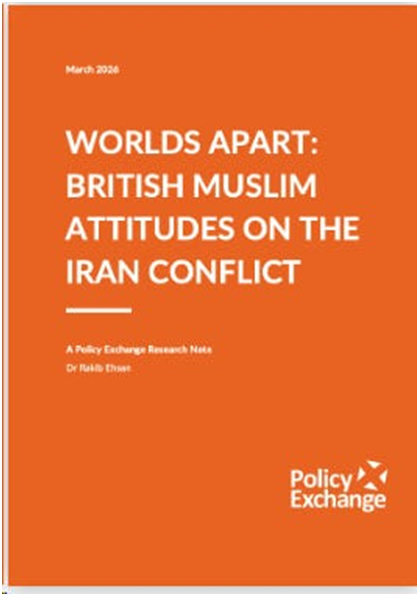
The latest item off the line is Worlds Apart: British Muslim Attitudes on the Iran Conflict, published by Policy Exchange this month. The author is Dr Rakib Ehsan, described as “a prominent national authority on matters of immigration, integration, and identity.” The polling was conducted by JL Partners. The methodology is defensible. The data, taken on its own terms, is mostly unsurprising. None of that matters, because the document is not primarily an exercise in understanding. It is an exercise in framing. And the frame is the same one Policy Exchange has been using for years: British Muslims hold views that diverge from the national mainstream, and this divergence is a cause for concern.
How independent is Policy Exchange?
Policy Exchange was founded in 2002. Its trustees include Andrew Roberts, a military historian whose bibliography reads as a guided tour of imperial apologetics, and Alexander Downer, a former Australian foreign minister who spent his career as a loyal instrument of Anglosphere military adventurism. The organisation describes itself as independent and non-partisan. By any serious measure, it is neither. It has produced reports calling for the banning of specific Muslim organisations, challenged the teaching of “controversial” historical material in schools, and provided the intellectual scaffolding for successive Conservative governments’ approaches to counter-extremism. Its relationship to the British Muslim community is that of a pathologist to a specimen.
This matters because research does not emerge from nowhere. The questions a researcher chooses to ask determine the answers available. Ehsan does not ask whether British Muslims who oppose the US-Israeli strikes on Iran have rational grounds for that opposition. He does not ask whether an illegal war, launched without UN authorisation, targeting civilian infrastructure and killing a head of state, might reasonably produce opposition among people with any knowledge of international law. He does not ask whether the British public’s comparative acquiescence reflects informed consent or decades of media management. He asks only: why do British Muslims see the world differently? The question contains its own verdict.
What the data shows, what it doesn’t
Before examining what the paper does with its data, it is worth examining what the data actually shows, including the parts Ehsan chose not to present.
Take the general population. The paper uses it as a neutral baseline against which Muslim deviance is measured. The baseline is not neutral. Forty-eight percent of the general public oppose the UK joining the US-Israeli strikes, against 18% who support it. Fifty-one percent say the UK government was right to initially refuse the US use of British bases. Thirty-five percent say the strikes were probably or definitely wrong. Only 9% say they were definitely right. On whether Western countries bear responsibility for instability in the Middle East, 41% of the general public say a great deal or fair amount. The general public is not a population enthusiastically endorsing American military action in the Middle East. It is a population that is sceptical of it, worried about the economic consequences, and largely opposed to British involvement. Ehsan does not frame it that way, because doing so would undermine the contrast his paper requires.
The paper’s sharpest number is the comparison between British Muslims who consider the strikes “definitively wrong” (50%) and the general public figure (17%). This is the figure that will be extracted, circulated, and used. What the paper does not say: the largest single response category among the general public on this question is “don’t know,” at 20%. If you combine definitely and probably wrong for the general public, you get 35%. The paper takes the hardest end of one group and compares it to the hardest end of the other, selecting the pairing that maximises divergence, and presents the result as evidence of a profound gulf in values.
Muslims and the threat from the East
The Russia and China figures carry the paper’s heaviest ideological freight. Ehsan presents British Muslim net favourability toward Russia (+2) and China (+22) as evidence of sympathy with authoritarian, anti-Western states. Look at what +2 actually means. The raw data shows 32.5% of British Muslims hold neither favourable nor unfavourable views of Russia, and a further 11.8% say they don’t know. The “very favourable” figure is 10.2%. Ehsan mistakes collective indifference for ideological alignment. A net score barely above zero, built substantially on a large neutral middle, is not enthusiasm for Vladimir Putin. It is the statistical signature of a community that has more pressing concerns.
The paper offers two explanatory paragraphs: Pakistan’s ties with China, and Islam’s legal recognition in Russia. These are plausible partial factors. But the paper ignores the most direct explanation: that when you are watching American bombs fall on Iranian cities, with American-backed impunity sustaining an occupation in Gaza, countries that oppose American hegemony look comparatively less threatening regardless of their internal character. That is not a pathology. It is a rational response to observed facts. Ehsan gestures at this interpretation before backing away from it, because engaging with it seriously would require him to ask whether British Muslim assessments of American foreign policy are accurate rather than simply alarming.
Sunni, Shia or Muslim, which is it?
The denominational section is where the paper’s internal contradictions become most visible. Ehsan notes, apparently puzzled, that predominantly Sunni British Muslims express warmer feelings toward Shia-majority Iran than toward Sunni-majority Saudi Arabia. He resolves this by suggesting that “geopolitical considerations trump denominational tribalism.” He is almost certainly correct. But this observation demolishes the paper’s framing elsewhere, which leans heavily on the concept of the Ummah, a transnational Islamic identity, as the explanatory engine of British Muslim attitudes.
You cannot have it both ways. Either British Muslims are driven primarily by pan-Islamic religious solidarity, in which case their support for a Shia state against a Sunni one requires explanation. Or they are making geopolitical judgements based on perceived power, justice, and self-determination, in which case their attitudes look considerably less exotic and considerably more like those of anyone paying attention to what American foreign policy has actually produced over the past quarter century. Ehsan reaches for the first explanation when it serves the framing and the second when it does not. He does not resolve this tension because resolving it would require him to treat British Muslims as political reasoners rather than as a community defined by its religious identity.
Muslims and the media
The media consumption section is worth pausing on. British Muslims are more likely than the general public to get news from Al Jazeera, TikTok, Instagram, WhatsApp, and podcasts. The general public overwhelmingly relies on the BBC. Ehsan presents this divergence as a feature of a “technologically-able” younger generation branching out from legacy sources, though the surrounding language implies that non-legacy sources are less reliable, more susceptible to radicalisation, more likely to produce distorted views. GB News anyone?
The BBC’s record on covering the conflicts referenced in this paper does not support the assumption that BBC consumption produces better-informed citizens. The corporation’s Gaza coverage generated hundreds of staff complaints, documented failures of impartiality findings, and the departure of journalists who refused to apply different standards to Palestinian and Israeli deaths. Al Jazeera, whatever its Qatari government funding and attendant editorial pressures, has consistently provided on-the-ground reporting on conflicts that the BBC has covered from a considerable diplomatic distance. The idea that a British Muslim watching Al Jazeera is consuming inferior or more dangerous information than one watching BBC News at Ten is an assertion, not a finding. Ehsan asserts it anyway, by omission, by framing, and by the implicit contrast he constructs between the two.
Distorting ‘community tensions’
Then there is the finding the paper buries in a chart at the end. Ehsan warns of ethnic and religious tensions, citing data showing two-fifths of the public believe the conflict has worsened community relations. The raw data tells a different story. The general public is more likely to say relations have worsened (39%) than British Muslims are (37%). British Muslims are nearly twice as likely as the general public to say relations have got better: 18% against 10%. The community the paper frames as a source of social fragmentation is, by its own data, slightly more optimistic about community relations than the population at large. This finding appears in a small chart. It receives no analytical attention.
The omission is not accidental. A paper that noted British Muslims are marginally more likely than the general public to see improving community relations would require a different conclusion. It would require Ehsan to ask what British Muslims might know about living alongside difference that the general public does not. That question has no place on the Policy Exchange production line.
None of this is accidental. Policy Exchange understands exactly what it is producing and exactly where it will land. The paper will be cited in comment pieces about social cohesion. It will appear in parliamentary questions about community relations. It will be absorbed into the background noise of a political culture that has spent twenty years constructing British Muslims as a community requiring surveillance, management, and periodic explanation. Ehsan provides the numbers. The press provides the headlines. The cycle continues.
Muslims are right to oppose illegal wars
What the paper will not do is ask whether British Muslims are correct to oppose an illegal war. It will not ask whether a community that has watched Iraq, Afghanistan, Libya, Gaza, and now Iran might have accumulated sufficient evidence to mistrust Western military power. It will not ask whether the “divergence” it identifies is a problem to be managed or a judgement to be engaged with. Those questions do not fit the production line.
The polling data in Worlds Apart captures something real: a significant portion of British Muslims have concluded, on the basis of available evidence, that Western foreign policy is a source of violence rather than order, and that the institutions charged with reporting on that policy cannot be fully trusted to tell the truth about it. Policy Exchange has written a fifteen-page document treating that conclusion as a threat to social cohesion.
The more uncomfortable possibility, which the paper never entertains, is that they are right.