


Introduction
by Jim Higgins
In all the welter of books, pamphlets and articles that will appear on the 50th anniversary of the general strike, very few of them will actually present the authentic voice of the workers who fought and struggled at that time. Outside of, and unnoticed by, that rich field of academic research, the minutes of union executives, the theses of the Communist International and the memoirs of big and important men, there existed for a brief nine days the highest expression of working class solidarity to date. Not only that; in the frenzied preparation on the part of the ruling class, the dismal lack of preparation on the part of the trade union leadership and the massive potential strength of organised workers, there are lessons for every class conscious worker who would attempt a radical change of society.
This small pamphlet is an effort to redress the balance in favour of those who actually did the fighting and suffering rather than the well-publicised activities of those who purported to lead.
I can think of nobody who is better qualified to do this than Harry Wicks. Since his childhood in Battersea, Harry has been a militant revolutionary socialist. As a member of the Battersea Herald League in 1920, he was one of those dedicated few who came together to form the Communist Party. As a railway worker he experienced, along with a majority of railwaymen, the bitter disappointment when J.H. Thomas sold out the miners and the Triple Alliance on Black Friday, 1921. As a leading Young Communist, and a member of its executive committee, he was privy to many of the decisions and difficulties of party organisation. During the general strike itself, he was active speaking and organising around South London and was instrumental in bringing out several factories. He was fortunate to escape the fate of his friend and future brother-in-law, Alf Laughton, who, with hundreds of other Communists, was arrested and served time for strike activity.
At the age of 22, in 1927, Harry Wicks was chosen to attend the Lenin School in Moscow, the Comintern’s University for future revolutionary leaders, for a three-year course. In Moscow he first came across the ideas and criticisms of the Left Opposition, led by Trotsky. That critique made coherent a number of his own disquiets and doubts. Returning to England in 1930, he soon made contact with a small group of oppositionists in the British Party, Reg Groves, Henry Sara, Hugo Dewar and several others. In short order, their Balham Group was expelled from the CP. The years that followed were filled with the thankless and difficult work of building a movement along the lines set out by Trotsky.
With hindsight it is possible to see the failure to break through the obstructions of Stalinism and social democracy as inevitable. But it can be counted a success, in the sense that without that hard pioneering work the left wing movement today would be incomparably poorer and weaker.
That is the movement, the revolutionary socialist movement, in which Harry Wicks has spent his life, and his considerable talents. Today he is no less assured of the need for revolutionary organisation than he was in 1920. He sees the task of informing the newer, younger members of the movement of the battles, the mistakes and the victories of the past as the most important contribution he can make to building such a movement.
There can be little doubt that the history of the general strike, and its understanding, are exceptionally important to socialists today. 1976, when yesterday’s left trade union leaders are today’s moderates, bent on conniving with government and industry to reduce living standards, has obvious parallels with 1926 and the group of so called ‘trade union lefts:
Today, with a Labour government as the best defence of an ailing British capіtalism, the errors of omission and commission of the Communist Party in the 1920s are an object lesson for those who wish to build a genuine mass socialist party. In this pamphlet, Harry Wicks stresses that the simple Trotskyist theory of the British Communist Party being misled and negatived by the machinations of the Russian Stalinists is oversimplified. Within the British Party there were two quite distinct strands: the left, syndicalist-tinged grouping impressed by the slogan of “All Power to the General Council” as a desirable harking back to the old notion of “One big union” as the vehicle for social change. The right, ex-British Socialist Party group, still mesmerised by parliamentary power and the prospects of a reformed Labour Party, It is the combination of these two tendencies, left and right, together with the Russian influence for a diplomatic-style accommodation with Western political and industrial reformism that vitiated any chance of success that the British Communists might have had.
These two deviations from revolutionary principle and practice are themselves not without significance to socialists in 1976. Too many revolutionaries have recently taken the view that trade union militancy will inevitably spill over into socialist struggle and, when their hopes were confounded, retired into sectarian isolation. Even more, there is in the current retreat of large sections of workers, under the pressure of the economic crisis and Labour’s ideological offensive, a tendency for revolutionaries to seek refuge in entry into the warm but infertile compost of social democracy.
All of these trends are on display in today’s left-wing movement. Of them it can be truly said that those who will not learn from history are condemned to make the mistakes all over again.
One final point. There is a small but influential school of left academics much exercised by the thought that the lesson of 1926 is that the class was unable, unwilling and incapable of turning the struggle into an assault on the whole capitalist power structure. According to this thesis, it mattered not at all that the Communist Party was tactically and strategically wrong, that the Comintern was playing international politics and that the General Council was ripe for betrayal. What mattered, apparently, was that something called working class consciousness was not ready for social change.
The truth of the matter is that only very infrequently is workers’ consciousness so ready. Nor is its preparation and development timeless and abstracted from all manner of subjective factors, not least of these being the existence of a socialist party, rooted in the class and with no interests different from the class. It is the tragedy of 1926 that the CPGB was not such a party, a tragedy that the British and the world’s workers paid for in succeeding decades of war, suffering and sacrifice. It is to play a part, albeit a small part, in building a party of this sort, that this pamphlet has been written. I warmly commend it to all socialists.
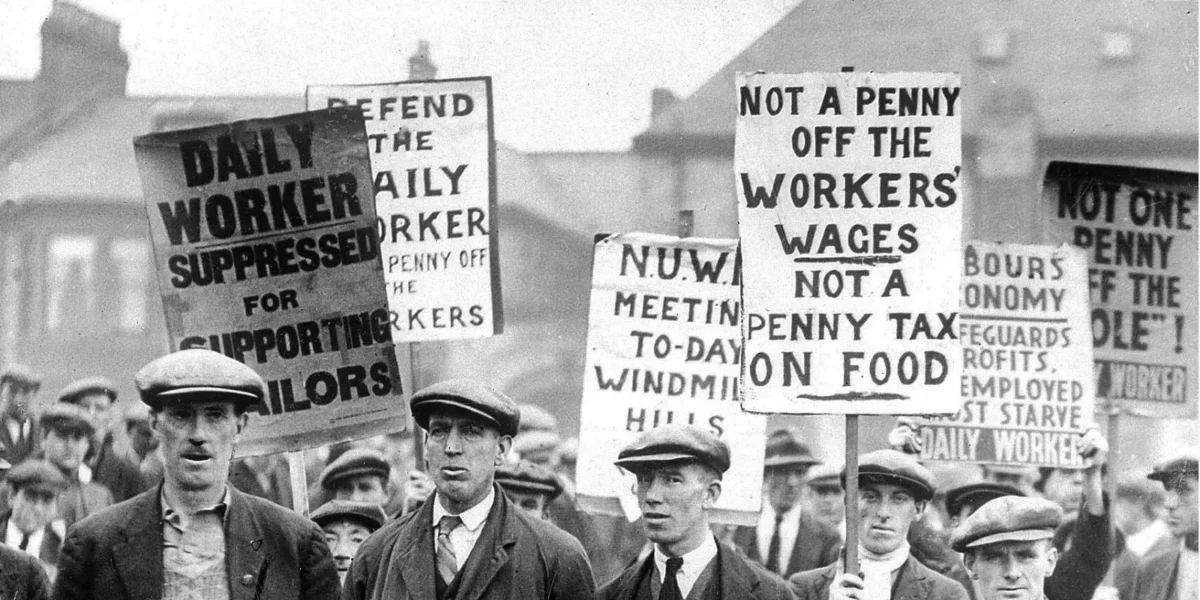
Chapter One
Across the River Thames, opposite fashionable and prosperous Chelsea, is the working class district of Battersea. Power stations, paint and candle factories, railway engine sheds, plumbing and gas works lined the riverside from Vauxhall to Wandsworth bridge.
Separated only by the width of a road were densely-populated streets of working class houses, where women battled daily against the grime belched from those riverside factories.
Battersea has been famed, not only for its Dogs’ Home, but more importantly for its militant working-class politics. Many generations of trade union endeavour and socialist propaganda left their mark.
In the twenties, to the consternation of the liberal-minded Labour leadership of Henderson and MacDonald, Battersea North elected as their member of parliament the Indian Saklatvala. Not only was he an Indian but a Communist and was sponsored by the united Battersea labour movement.
The link that Saklatvala established with his worker constituents was not that of the proverbial surgery ‘can I help you?”, ‘have you any problems?’ At that time the entire working class had a problem: that of survival against employers’ lockouts, widespread unemployment and the downward slide of the sliding scale of wages agreements.
Saklatvala spoke at factory gate meetings and introduced the monthly report back from Westminster. There were great meetings. Long before the doors of the town hall opened queues formed just like they used to at Stamford Bridge.
The platform was always crowded. Sak, as he was affectionately known, was flanked by the entire executive of the Trades and Labour Council and numerous representatives of Indian and colonial organisations. He was short in stature, broad shouldered with flashing eyes and a magnificent orator.
Those monthly report back meetings on the doings in parliament stirred hundreds into activity. The Battersea labour movement pulsated with life and was united. Marxist classes held by the old Plebs League flourished. Trade union branches were crowded.
One such branch of the General and Municipal Workers used to meet on Saturday nights and there the Workers Weekly was sold by the quire.
It was therefore not surprising that in August 1924 the inaugural conference of the National Minority Movement should be convened in Battersea Town Hall.
What high hopes the founding of an organised opposition in the trade union movement held. The unions, to the exasperation of the rank and file workers, were riddled with sectionalism. That inner disunity within the trade union movement was regarded as the cause of successive defeats in the post war years.
Wherever workers delegates met, in the trades councils, union conferences, clubs and pubs, talk centred on the chronic weakness of the industrial movement. It was with this political setting that Tom Mann presided over the first national gathering of rank and file trade unionists, employed and unemployed, miners and metal workers, women from London’s rag trade, railwaymen regardless of sectional and craft unions.
What inspiration he gave that gathering. It was time to stop the rot, to end the retreat. Time that sectional and craft barriers were broken down, time that industrial unionism came into its own. Yet the more effective trade union organisation that he desired, was not just to obtain another penny in the wage packet, but to fashion a more efficient weapon in the hands of the workers in their battle to change society.
As he emphasised, stepping to the front of the platform, pushing up his shirt cuffs, ‘kicking capitalism off the face of this planet’, he demonstrated the kick like a footballer taking a penalty.
Big Jim Larkin was there. What a giant of a man, demanding to know what the movement was going to do about ‘poor little Ireland’. From the South Wales coalfield Arthur Horner, then checkweighman at Mardy, outlined the grim conditions of the miners since the betrayal of Black Friday. Horner brought the message that the Miners’ Minority Movement was stirring the valleys, and the prophetic warning that cheap reparation coal extracted from defeated Germany would result in fresh attacks on the miners by the coal owners in this country.
In the town hall vestibule was a man with a friendly face, a big hat and wide girth. It was George Hicks, a rising star among the left trade union leaders. He was no stranger to the Battersea movement. In fact the Bricklayers branch in Battersea had been for years his base. Yet to push open the door leading from the vestibule to the conference and identify himself with the Minority Movement was something he never did.
Both he and A.A. Purcell, who were destined to dominate the industrial scene in the years 1924-26, had since the engineering lockout in 1922 advocated a more effective centralisation of the Trade Union Congress General Council.
But to become committed to an organised trade union leadership was not their cup of tea. They chose to remain on the sidelines, to fraternise at embassy receptions, to sign a few ghosted articles for left papers and, when the hour of decision struck, to capitulate to the right wing of the trade union movement.
The growth of the Minority Movement, from its inception to the eve of the General Strike, owed a lot to the positive propaganda aimed at strengthening the workers’ movement. Laced together with a series of political and economic demands went the agitation for all embracing factory committees, the regional expansion of trades council organisation and the campaign for 100 per cent trade union membership.
Even the most lethargic union official was at his wits end to oppose the militants’ call for a ‘show card’ day in the factories and depots. The mood was there, incipient maybe, to build industrial class power.
Labour’s first government, born and buried by the grace of the Liberal Party, provided a salutary lesson in parliamentary politics. The threat by that government to use troops and invoke the Emergency Powers Act against striking workers, did more to shake confidence than did all the much-publicised photographs of His Majesty’s Labour ministers in top hats, knee breeches and dangling swords.
Unemployed and employed workers, desperate for work and a revival of trade joined in the swelling protest when the Anglo-Russian trade talks were threatened with breakdown. For a moment it seemed that a significant section of the trade union movement were aligned against the Labour cabinet’s possible disowning of their electoral pledges.
Chapter Two
At the Hull Trade Union Congress in 1924, Tomsky, as fraternal delegate from the Russian unions, received an enthusiastic welcome. It was a demonstration of the deep feelings running through the movement for unity.
Tomsky, a self-declared “worker diplomat”, had been involved in the tortuous negotiations with the Labour government and the financiers. It was during those negotiations that he established relations with the TUC General Council.
The then President of the TUC was A.A. Purcell, who less than three years previously had been interested in launching in Moscow the ‘Red International of Trade Unions’. At Hull a seed was sown that 18 months later was to produce the Anglo-Russian Trade Union Committee.
The dynamic for consummating that alliance between the two trade union centres was the Communist Party and the Minority Movement. An impressive Minority Movement conference was held on the theme of International Trade Union Unity.
It marked both the culmination of a campaign to bring pressure on the General Council and a perceptible shift to the right in communist politics.
Left leaders were built up. Their timidity to challenge the disruptive policies of the right wing in the Labour parties and localities passed unnoticed. In the fateful preparatory period leading up to the General Strike, the Communist Party put into cold storage its revolutionary criticism of left reformism.
The ruling class were not passive at the turn of events. Faced with intractable problems in the basic industries, particularly mining, and a rising industrial militancy, they prepared their offensive against the workers.
Parliamentary combination between the Conservative and Liberal parties made short shrift of the Labour government. Aided by the Liberals, Stanley Baldwin, at the helm of the Conservative Party, forged his way to parliamentary power.
In a fiercely fought class election, the Labour Party was defeated, but in spite of all the disappointments and faded hopes, it rallied another million labour voters. From the moment of kissing the King’s hand as Prime Minister, Stanley Baldwin, for all his sermons on class peace, was the embodiment of class war in the interest of the employers. Under his leadership, the strategy was perfected to bring the trade unions to their knees and the wages of all the workers down.
The pattern of the employers’ offensive soon became clear. They planned a wage attack on the unions sectionally. The railwaymen’s All Grades programme was contemptuously rejected.
Seamen were presented with a wage reduction. The engineers, who had been negotiating for an interminable time for a £1 a week increase, were threatened with a national lockout if the unofficial strike at Hoe’s engineering works was not terminated.
Coalowners, whose windfall profits that followed from the French occupation of the Ruhr had dried up, faced the miners with the demands for a 10 to 25 per cent reduction in wages and the return to local wage bargaining. So draconian was the attack on the miners’ already low standards that the united trade union movement rallied to their defence.
The solidarity then displayed was sufficient to compel the Baldwin cabinet to reverse its own declared policy within 24 hours. They bought time, time in which to prepare a crushing defeat on the trade union movement. A subsidy was given to the coal owners for nine months while a Commission of Enquiry without miners’ representation acted as a screen for their preparations.
How elated was the movement in those days. For a brief moment it appeared as if all the differences within the movement had evaporated on that glorious Red Friday. In a few short weeks such illusions were shattered. Ramsey MacDonald, at an ILP summer school expressed in his peculiar woolly way, the opinion that it was unethical that constitutional government should bow to the threat of force. The right-wing leadership looked askance at the growing industrial strength and its leftward trend. Within months, the parliamentary Labour leadership, stricken with what George Lansbury termed ‘Front benchism’ went on the offensive against the left wing.
At the Labour Party conference held in Liverpool in October 1925, a whole series of exclusions were carried, directed at the Communist influence in the party. Scarcely had the delegates arrived home and reported to their organisations on the Liverpool conference decisions when the government instituted a series of raids on the homes and offices of the leaders of the Communist Party and Minority Movement. Twelve leaders were indicted under the Incitement to Mutiny Act, 1797.
The imprisonment of the revolutionary leadership was a conscious part of the government’s preparations for the maturing crisis.
Once more the unity of the movement was manifest. Thousands packed the Albert Hall from floor to ceiling and with Lansbury’s inspiration, chanted the alleged seditious call to the soldiers “not to fire on their comrades who are workers”.
With the surge of popular protest, the left leaders found their voices. Clapham Common was a sea of faces on the occasion of the march on Wandsworth prison where the communist leaders were imprisoned. Wandsworth, unlike Brixton prison, seemed impenetrable. A year before demonstrators outside Brixton prison were able over the wall to shout encouragement to the Poplar councillors and to be inspired by Lansbury with his throaty voice singing the Red Flag through his cell window.
Yet before and behind the high walls of Wandsworth prison the atmosphere was electric. Thousands, singing, chanting, jubilant and confident was a sign that once again the workers were on the march.
Chapter Three
The retreat of the government in July 1925 in the face of the threat by the unions to stand four square with the miners enraged the extreme right, particularly the coal owners. They were hell-bent on the lockout that was to operate on 31 July.
To restore profitability to the mining industry, the coal owners had but one answer – wage cuts. They appeared, not only to the miners, but also to wide sections of popular opinion, as hard-faced men. The prevailing sentiment that appeared to be on the side of the miners was not lost on Baldwin.
But more urgent reasons than the tide of opinion dictated the decision of the government to postpone the conflict. They were not prepared for an industrial upheaval.
Scarcely three months before, they had made a desperate bid to re-establish the premier position of the pound sterling. Faced with the economic and financial supremacy of America, the British government sought to restore its financial leadership by up-valuing the pound.
To be able, as Churchill remarked, ‘to look the dollar in the face’, the pound in relation to the dollar was raised from 4.40 to 4.86. This meant dearer exports, at a time when there were already more than 1/½ million workers on the live register as unemployed. Coal at that time was a vital export; whole mining districts such as South Wales, Northumberland and Devon depended on the export trade.
The consequence for the working class was grim. Dearer exports meant, unless the workers could successfully resist, a further depression of their already low standards of living. That was the stark reality.
Two days after Red Friday, Joynson-Hicks, the Home Secretary, a diehard Tory, declared he was ‘going to say straight out what the Prime Minister was alleged to have said in conference – namely, it might be that, in order to compete with the world, either the conditions of labour, hours or wages would have to be altered in this country’.
Winston Churchill, Chancellor of the Exchequer, was equally outspoken. Speaking of Red Friday, he said: ‘We therefore decided to postpone the crisis in the hope of averting it, or if not averting it, of coping effectually with it when the time comes.’
Churchill’s words ‘coping effectually’ to that generation had a sinister ring. He was no stranger to the use of troops in strike struggles. The carnage from his military adventure at Gallipoli was still fresh in memory.
In the early twenties, the years of interventionist wars against Russia, Churchill was in the words of a contemporary, “the most formidable and irrepressible protagonist of an anti-Bolshevik war”.
Those two speeches from Baldwin’s Cabinet colleagues were precise enough. The government had stepped back from conflict only in order to prepare itself for a future battle.
As a testimony to past militancy of organised labour, the government of Lloyd George had been concerned with contingency planning in the event of a general strike. How would central government cope, and how would the political and military system stand up to a possible break of communication with the centre?
Top personnel in the civil service together with a small nucleus of government officials had for some years been occupied in developing a skeleton plan. Now Baldwin sought to re-activate such emergency organisation and he chose Joynson-Hicks to head a government committee.
The plan that evolved and was first published on the declaration of National Emergency on the eve of the General Strike, was that the country was to be divided into ten divisions, each division headed by a government civil commissioner. Their primary function was to secure the co-ordination of all of the forces of the state within their divisions.
Each commissioner had a committee with responsibility for coal, food, railways, roads, canals and post together with a group of military and police liaison officers. The only omission appeared to be liaison with the judiciary. Yet as the struggle eventually unfolded there was little evidence of their being out of step.
To prepare effectively, the government in November alerted the local authorities. The difficulty of unfolding their plans over such a wide field had its drawbacks. At grassroots level, the Labour Party had widespread representation. But even here there was no flare up, no exposure of what the government was up to. The Labour Party nationally must have been aware of that secret circular issued to the local authorities.
That there were no widespread revelations and the government was able to press forward their preparations can only be explained by the policy conducted by the Labour Party at the time. They were not interested in sustaining the fighting spirit and utilising every opportunity to awaken the workers to the impending struggle.
Any talk of preparations for a General Strike was regarded by the Labour leadership as provocation. As George Lansbury wrote at the time: “Most of the front benchers have a fatal touchiness for the dignity of the House, and cannot stop thinking of the time when they will be in office again”. That was the measure of how the parliamentary leadership of the Labour Party expressed the class interests of the workers.
There was nothing mealy-mouthed about the Tories and the extreme right. They became the pacemakers in the preparations to smash the strike.
In September, the initial steps were taken to launch the volunteer Organisation for the Maintenance of Supplies, an avowedly strike-breaking force with the object of protecting the public services and working the railways, trams and road transport.
Joynson-Hicks, the Home Secretary, gave it official support. Private enterprise readily gave to the OMS lavish facilities for the training. The OMS became the national rallying centre for an entire army of blacklegs. As the government confidently advanced its preparations, ministers’ speeches increasingly talked of the mining crisis in the context of a national emergency, a threat to the state, an attack on the constitution.
Every effort was made to detach support from the miners. With ruthless energy they organised their forces to achieve the defeat of the miners and the unions.
Chapter Four
Prepare to fight was the message of the second conference of the National Minority Movement held immediately following Red Friday. There was no room to doubt that the government, coal-owners and grim economic outlook coalesced to force the workers into a defensive position.
The Minority Movement, within a year of its rise, had won some significant successes within the trade unions. From the bottom up, efforts had been made to influence the agenda of the forthcoming Scarborough Trade Union Congress (1925). As a direct consequence of an organised drive within the unions the revolutionary opposition could claim authorship of no less than six resolutions to be debated at Scarborough.
A national left wing was crystallising; it was, however, by no means homogeneous. There were two distinct strands in that trade union opposition. There was a hard core from the grass roots and district leaderships that were keenly aware of the debilitating effect that unemployment and depressed conditions had on trade union organisation. They did not only advocate fighting back, but sought to fashion an offensive strategy.
Wage claims from the railwaymen, engineers and transport workers should tie in with the miners and build a new industrial alliance to secure their demands by a greater economic power. This was the left wing strand that responded to the initiatives of the Minority Movement and made possible its dynamic growth in the years 1924-26.
The other strand was the left trade union leaders like Hicks, Swales, and Purcell whose influence in the General Council of the TUC coincided with the departure of the more right wing leaders for pelf and place in the first Labour government. The lefts’ stock-in-trade was the power of industrial unionism; unions centrally directed would be able to shake the power of Capital.
Basically they were products of the pre-war industrial movement with its syndicalist tinges, the sharper edges of which had become blunted as they arrived in the leadership of important unions. From the Hull TUC they rose to particular prominence for their advocacy of international Trade Union unity.
The Scarborough Congress (1925) was a high water mark for the left-wing forces in the trade unions. Meeting as it did, separated by barely seven months from the General Strike, in an excess of left rhetoric, it evaded the central issue on its agenda – that of preparation for the coming conflict.
Never before had a British Trade Union Congress expressed itself so militantly on international politics. Resolutions were passed condemning Imperialism in India, Egypt, China, the Dawes plan in Germany and endorsing the General Council’s report on the setting up of the Anglo-Russian trade union committee. It appeared as if all the insularity of the British movement had been swept away by the North Sea breezes blowing on the Scarborough sea front.
Such a view, however, would be most superficial. On the vital question – what do we do here on the home front – those same delegates who had applauded revolutionary speeches on the colonies, retreated to their parochial and craft positions. How else can we explain that the issue of extending more power to the General Council of Congress was referred back for further consideration.
Elated by Red Friday the broad labour movement was awakened to the coming struggle. From the open spaces throughout the country, moors, commons, downs and mountainside, mass meetings became the weekend fare. A.J. Cook, from the time of his election as secretary of the Miners Federation, set the pace. From hundreds of platforms he spelt out the reality to vast crowds.
If the coal owners’ demands were enforced the miners in five districts (Scotland, Lancashire, North Staffs, Cumberland and the Forest of Dean) would actually get less money wages than before the war (1914). The post war gains, meagre as they were, would be lost. Such a dire defeat would set the labour movement back a generation. He was not alone; all that was best in the movement took to the platforms, each in their own way, to warn the workers of the threatening danger.
In that period the labour press grew in dimension. Lansbury launched his Labour Weekly with the aim of building ginger groups within the movement to get back on the track of changing society. The Sunday Worker appeared under the editorship of Willie Paul. It sought to give expression to and organise the left current that was growing within the Labour Party and the unions.
The Communist Party’s Workers Weekly used to advertise, “Its sixty thousand readers are the cream of the working class movement”. By the time of the General Strike its circulation had climbed to 100,000. As a sign of the growing consciousness and confidence amongst communists, for the first time the organisation on a factory and depot basis actually took off. An impressive number of factory papers made their appearance, an experience that was to prove invaluable in the days ahead.
The coal industry, vital to the economy of the country, was in a critical condition. Incredibly backward in its organisation, starved of investment, hammered by falling exports and technical change, with oil replacing bunker coal, and burdened by a rapacious system of feudal royalty payments; such was the condition of the industry that even Baldwin’s Commission was unable to conceal.
Not that his commission of enquiry grappled seriously with the problems of the industry. Its terms of reference had other objectives. The conclusions that it reached was the need to re-organise the industry in order to re-establish its profitability; as an interim measure the wages of the miners were to be reduced.
All through the long days of the depression, cynical and weary politicians had traded on the lethargy and apathy of the workers. In the Spring of 1926, they were faced by an angry and militant working class. The long hoped for revival had arrived.
The great propaganda campaign to swing the whole movement solidly behind the miners was gaining ground.
In March, 1926, Lansbury’s paper reported that 1,5 million workers had declared their union’s support for the proposed Workers Industrial Alliance. The engineers had voted for it two to one – a Constitution was in the making. The organised left wing in the trade union movement, the National Minority Movement, called a special conference of action on March 21st in Latchmere Baths, Battersea.
The response indicated the depth of feeling flowing through the movement: delegates from 547 organisations representing 957,000 assembled; no less than 52 Trades Councils sent delegates. One measure of its impact was that Hicks, Turner and Findlay, three members of the TUC General Council, sent messages to the conference, although each letter confined itself to expressions of protest at the arrest of the imprisoned leaders.
As the conference opened under the presidency of Tom Mann, the official welcome was given by Jack Clancy, chairman of the Battersea Trades and Labour Council. He brought the conference alive by relaying the news that for their refusal to operate the Liverpool Labour Party Conference decision on the expulsion of the communists, Battersea and Bethnal Green had been disaffiliated. Regardless of the gravity of the situation facing the workers at that moment the right wing chose to split the movement.
Tom Mann, in a memorable analytical speech examined the issues facing the class, Baldwin’s assertion that the wages of all workers must come down. The purpose of the Coal Commission was to divide the movement. On all sides could be seen the growing preparations of the employers and government to impose their solutions to the crisis. Extreme right wing strike breaking organisations were mushrooming. The British Fascist organisations appeared at workers’ meetings. No workman could be indifferent.
“Therefore”, he went on to declare “prepare at once. Let us perfect our relations with each other; let us have our industrial machinery ready for action. The real central body through which we must function is the General Council of the Trades Union Congress. All unions should be loyal thereto and co-operate therewith.” That was the clearest possible expression of communist and minority movement opinion in the days preceding the General Strike.
It would be false to present either Mann or the Conference of Action leadership as passively directing all their efforts to official channels. The great positive programme for the immediate days ahead, a programme that served the class in the nine days of May, was its call for
1. Each Trades Council to constitute itself a Council of Action that embraced all the workers organisations in the locality.
2. Establishing under the auspices of the Trades Council a Workers’ Defence Force against Fascism.
3. To organise the workers on the job into factory and pit committees.
4. To demand the right of soldiers and naval ratings to refuse strike service.
With those ideas the discussions in the following months took on a new dimension.
Now was the time to prepare the organisation for the inevitable battle ahead.
In that period, hardly a Trades Council existed that was not compelled to consider the implications of becoming a Council of Action. The cleavage with the right wing in the movement, who had been content to go along with a general agitation for the justice of the miners’ claim, now asserted itself. It was on the issue of preparation that the left found the greatest response. Only weeks now separated the workers from the actual struggle. In those weeks the revolutionary left, the Communist and Minority Movement, struggled alone against the right wing in the movement.
Chapter Five
The first of May 1926 dawned with the miners already locked-out. It was the greatest May Day in living memory. In every town and city, from hundreds of meetings and demonstrations the workers asserted their solidarity with the cause of the miners. In Birmingham, the conservative base of the Chamberlains, more people were on the streets than had been seen at a recent royal visit; thousands marched.
London’s May Day was the crowning achievement. From the twenty-nine metropolitan boroughs, from mid-morning to late afternoon, the streets were alive with demonstrators. Trade union banners that had not been aired for years floated in the breeze; across all the Thames bridges marchers stepped out for Hyde Park. Those contingents whose line of march was to pass Mémorial Hall, where the conference of trade union executives was in session, were told by the excited delegates that the General Strike had been called for midnight of May 3. To the rank and file trade unionists, it seemed that at last the fruitless negotiations were over and now the movement was being made ready for action.
In Hyde Park, from a dozen platforms, a militant mood swept that vast crowd of people. This was the real measure of the workers’ feelings. Deep down, whatever his occupation, each felt that a defeat this time for the miners would be but a prelude to an all-round attack on the whole of the working class.
The conference of the trade union executives, which for three days had been in session, appeared to be entirely uncritical of the general council’s negotiating team. At that time, no-one knew, least of all the rank and file, that Arthur Pugh, the TUC president, only a few days before had been alone with Baldwin at Chequers. Even the absence of a miners’ representative on the negotiating committee, and the last-minute inclusion of MacDonald and Henderson went unchallenged. Like the masses, the lay union representatives at that conference, with their virgin illusions, thought that the General Council, by its decision to call for a General Strike, was by that act identifying with the hopes and aspirations of the whole movement.
The leading core of General Council negotiators had other plans. No sooner was power passed to them than they sought to utilise the remaining days, not to perfect the organisation for the strike itself, but to find a formula to prevent it happening.
Anxious to secure a compromise, begging for a settlement, they finally approached Baldwin with a formula, calculated to break the deadlock, behind the backs of the miners’ leaders. In essence, they agreed to urge on the miners a cut in wages subject to the mine-owners and government accepting the proposals of the Samuel Commission. The Government, however, with all its preparations in an advanced stage, its proclamation of the State of Emergency off the printing presses, the disposition of the armed forces mobilised for despatch to the main industrial centres, the OMS and special constabulary at the ready – broke off all negotiations with the TUC.
The working people knew nothing of the policy that the General Council had pursued since the closing session of the conference of executives. With empty hands, in spite of its grovelling, the General Council was left with no pretext whatsoever for calling off the strike. All that was then known throughout the movement was the General Council’s strike call. And it was to that call that the workers responded with undreamed-of enthusiasm – a response so overwhelming that both the government and the union leadership were staggered by its magnitude.
With the communications system of the country paralysed by the unanimity of the strike, Baldwin addressed a message to the nation in which he declared: ‘Constitutional government is being attacked…..’and urged the people to co-operate with the government ‘to safeguard the privileges and liberties of people of this island’. At the same time that his message was coming over the wireless, at every police station notices were being posted of the effect of the Emergency Powers Act on the liberty of the subject. The police were by that Act given the right to arrest without warrant, enter any place, by force if necessary, and seize or detain anything they liked. Further, being in possession of any document containing any report or statement the publication of which would be a contravention of the regulation made the individual liable to a penalty. In the following nine days the workers witnessed and experienced the full force of the state machine mobilised in defence of the privileges of the mine-owners. In the communications system that then existed, primitive compared to modern times, the monopoly was held by the government. By the full use of the BBC news bulletins and their handout, The British Gazette, everything possible was being done to undermine the high morale of the working class. Churchill surpassed himself in the art of lying propaganda.
The ostentatious display of the armed forces, armed columns providing escort for OMS food convoys, the movement into the Mersey, Thames and Tyne of warships and submarines were all provocative steps taken to intimidate and break the solidarity of the workers. From the pulpits, no less a figure than Cardinal Bourne proclaimed the General Strike a sin against the Almighty. Legal luminaries spoke of those unions and members responding to the strike call as acting illegally. Judges and magistrates were all harnessed in the service of the draconian Emergency Powers Act. With great fervour, the police and special constabulary sought out the workers’ counter communication weapon, the strike bulletins, that were produced with great elan. The remaining weapon that the government possessed to defeat the strike was the obsequious union leadership. In spite of their formal break with the TUC negotiators, all through the strike, in the salons of the wealthy, backstage negotiation was continuous.
At the last minute, the generals of the trade union leadership fashioned a semblance of strike strategy. Their aim was to call the unions in successive groups into the strike struggle. Ostensibly this was to be a morale booster, ever fresher forces joining the strike. Its overall effect nationally was to produce confusion. In the provinces, unions and workers didn’t know whether they should be out or in – an arse or elbow situation.
Such was the spirit that thousands who should have stayed in, according to TUC strategy, came out. In the localities, at grass roots level, the organisation of the strike rose to great heights. Given a modest role to play in the last minute instructions of the TUC the trades councils were ‘charged with the responsibility of organising the trade unionists in dispute in the most effective manner for the preservation of peace and order’. It was the trades councils and councils of action that from the very first day grew in stature, improvising and initiating a communication system, giving coherence and direction to the movement in their particular localities. Possibly for the first time, a local leadership faced the organisation of a strike, not in one factory, but over a wide geographical area. It was on the issue of permits for goods to be transported by permission of the TUC that, in the most advanced areas, the workers had a taste of power.
As the Councils of Action grew, spreading in the more militant districts to a regional basis, even the government’s district commissioners began to reckon with their power. The North East, notwithstanding the government’s disclaimer, was an example of the incipient and growing power of the local workers’ organisation. To answer the lies of the daily broadcast, most Councils of Action developed strike bulletins of their own. Branch and council secretaries became editors and worker journalists; the duplicator, flat bed or rotary, became the tool jealously guarded from the police search. These ever growing initiatives were observed at the time by the speaker’s teams sent on tour from Eccleston Square, the TUC headquarters. This intelligence flowing into the TUC, was a source of worry to the General Council leadership. The gap between the high morale and enthusiasm of the workers in the localities and the palsy of the leadership at the centre raised threatening problems. Could the movement get into the wrong hands? That thought crept into leaders’ speeches. The British Worker, the TUC’s paper, emphasised daily that there was no threat to the constitution – ‘the strikers are orderly’. As the strike entered its second week, the General Council issued a message to all trade unionists: ‘Nothing could be more wonderful than the magnificent response of millions of workers to the call of their leaders. From every town and city in the country reports are pouring into the General Council headquarters stating that all ranks are solid, that the working men and women are resolute in their determination to resist the unjust attack upon the mining community……. The General Council’s message at the opening of the second week is “Stand firm. Be loyal to instructions and trust your leaders”.’ Could there ever be a leadership so craven, backed by such a resolute following, which at the same time its ‘Stand Firm’ message was circulating, was locked in negotiations seeking terms of surrender.
With such a leadership, and the absence of any democratic control being exercised by the conference of union executives, it was inevitable that the strike would be brought to an ignominious end. All through the nine days, there existed through all layers of the movement an appalling ignorance of the policy that was being pursued at the top. From the first day of publication of The British Worker the General Council appointed its own censors to vet all material published in its name. The pretentious rise to influence of the left leaders caused them to hold their tongues. Not a word was uttered by them of the impending surrender. History had caught up with their favourite nostrum, the folded armed General Strike. They were shattered by living reality. Yet even on the field of their own philosophy, there is no evidence that the left leaders, the possessors of centralised power, struggled for an aggressive strike strategy. On the final day, before their humiliating journey to see Baldwin, the full resources of the workers had not been committed to struggle. The economic power of the electricians, the gas workers, the workers in post and telegraph, despite their aspirations to be involved, were not called out.
The six TUC leaders that finally made their way to the miners’ headquarters, in the fruitless effort to persuade them to join in the surrender, included A.A. Purcell, the much publicised leader of the left. What happened to the document issued by the General Council at the conference of executives on May 1st? In a sense that document laid down the terms of reference for the conduct of the struggle. Paragraph five specifically stated: ‘The General Council further direct that the Executives of the unions concerned shall definitely declare that in the event of any action being taken and trade union agreements being placed in jeopardy, it will be definitely agreed that there will be no general resumption of work until those agreements are fully recognised’ (my emphasis). In their haste to surrender, not only did the General Council repudiate its past decisions to stand by the miners, but furthermore that agreement which was made with the constituent unions was rejected.
The time had arrived for the General Council, with their army still in the field brimming with confidence, to be ushered into Baldwin’s study to ignominiously surrender. What an end; as the first garbled account of the strike being over reached striking workers, their first thoughts turned to the need to organise a victory parade. No one thought in terms of defeat; the cleavage between masses and leaders was never so wide. Slowly, imperceptibly, the real meaning of the wireless bulletin penetrated the consciousness of the incredulous workers. The strike had been unconditionally surrendered. ‘It can’t be’, workers thought. They turned to the union branches for confirmation and an explanation. At that moment, with crowds packing the streets, it seemed with synchronised timing that confused workers were savagely attacked by the special constabulary.
The writer of these lines vividly remembers the scenes at Battersea Town Hall on the afternoon of that day. Anxious for official news, the chairman of the Battersea Council of Action, Jack Clancy was sent to Eccleston Square to get confirmation. Almost overcome with emotion he related to that vast audience the news that the strike had been called off but the miners were still out. He could say no more. The loudest boo that I have yet heard went up from that crowd and was echoed all along Lavender Hill. The mood was angry in the extreme. Was this an isolated experience relating only to a small pocket in the British working class? Published memoirs, Trades Council histories, the provincial press reports reveal the contrary.
The next twenty-four hours were to bear witness to the indomitable will of the workers that alone saved the face of British trade unionism. This represented to the employers their hour of triumph. With the unions defeated, there was no barrier, according to their reckoning, to stop them imposing the most humiliating conditions governing the return to work. The workers undismayed, fought back. On the railways, in transport, at the docks the struggle was renewed. A bitter and angry working class, now aware of the qualities of their leadership, fought on against the harsh terms of employment then being offered. This fight back was no isolated skirmish; within hours it again was assuming national proportions. It was now the hour for Baldwin to come to the aid of the demoralised union leadership. He did so by an appeal to the employers, in a typically hypocritical speech, to put behind them all malice and vindictiveness and help get the country back to work. Those sugary words covered the massive victimisation drive launched against military workers.
No one can deny the dedicated service that the members of the Communist Party and Minority Movement gave to the strike struggle, hampered as they were by the early arrest of their leaders and the police action in crippling their press. In the Councils of Action, because of their early stand for preparation they had earned some authority.
Commanding such support, why was the party unable to prepare the class for the act of capitulation by the reformist leadership? R.P. Dutt, writing after the strike, rightly comments: ‘The capitulation of May 12 came as a thunderclap without warning to the majority of workers all over the country.’ In a later passage he explains why the class were not prepared for such treachery. ‘The intrigues of the right-wing leaders were neither countered nor exposed by the left leaders, but in the interests of ‘unity’ the facts were concealed and the workers left without warning.’
Such an answer assumes that both left and right trade union leaders had different policies during the strike. The facts are different. Long before the strike, at Scarborough, Liverpool and in the conference of trade union executives, the vacillation of the left leaders was known – how in the critical moment they were adept at stepping on one side and giving way to the right wing. From time to time the indecision of the left leadership was commented on, but the basic policy of the party remained to build them up as allies in the fight against the right wing. Even during the strike, in the Workers Bulletins care was taken over the critical words directed at the Left leaders. For two years it had been the policy of the party to put its criticism of left reformism into cold storage. With its support of the left leaders, the party was unable itself to develop an alternative leadership or to correctly warn the workers of the impending capitulation.
You can get a copy of The General Strike by Harry Wicks for £4.00 + P&P (£1 for UK 2nd class) by ordering from here.
The pamphlet has been edited and republished under the Revolutionary History imprint for the strike’s centenary, with the addition of a glossary providing background information for the contemporary reader.
https://is-history.site/the-general-strike-by-harry-wicks/
In 1976 there was a meeting I attended at a pub called the Pindar of Wakefield on the Grays Inn Road,London. The pub had a plaque commemorating the time Lenin and the Bolsheviks used to meet there. (It’s no longer a pub and the plaque has been removed). The meeting in 1976 was held to debate Tony Cliff’s expulsion of Higgins, Wicks and 200 others who had mistakenly believed Cliff’s commitment to building a National Rank and File Movement, which the IS conference had decided on. Wicks was defiant, arguing that Cliff was repeating the Stalinist methods of the CPGB which had got him expelled back in the day. Wicks was right.
The Pindar of Wakefield building is still there in Grays Inn Road. But its now named The Water Rats and is more of a music venue.