

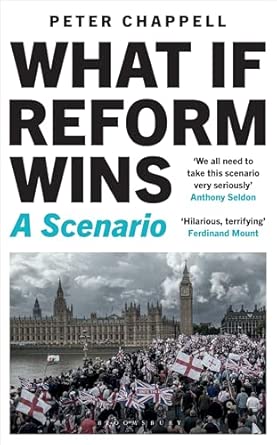
This book, written by a Times journalist, is a work of fictional ‘future history’ based on the light-minded idea that British liberalism, British institutions, and a little bit of help from the European Community will easily see off a Reform government within a couple of years. This period can then be junked down the memory hole with no real harm done. This represents both the resignation of parts of the Tory leadership and a whole lot of the Tory membership, that Reform UK is taking over the mantle of leadership of the Right. It is also utterly complacent about the damage that a Reform UK government can do to the British and international working class.
The international dimension of a Reform victory is mainly excluded from this book, but in a real future would resound like a thunder clap in international politics. The danger of a far right victory in France or Germany (or both) on the horizon, linked up with Trump /Vance in the United States and Meloni in Italy would bring the far right offensive and the working-class response to a crescendo.
Leadership of the fight against Reform is more and more in the hands of the left and ecosocialist forces outside the Labour Party – no matter whether that party is led by Andy Burnham or Wes Streeting. And the real discussion should be not what to do about a Farage government in power, but what united fronts and election alliances are needed to prevent a Reform UK government coming to power in the first place.
For the moment, the nightmare of a Reform government, unfortunately, seems to advance inexorably. Look at the demonstrations of the far right in Southampton. Look at the Reform UK website – grubby semi-fascism presented in the slickest and most professional website of any British political organisation.
Are left-wing nightmares realistic?
Wouldn’t the solid core of some British liberal values overcome a Farage government? Wouldn’t the resilience of parliamentary institutions act as a brake on a far-right government? This book thinks so, and from that viewpoint is utterly complacent, reflecting the self-satisfied and lazy thinking of the British middle class.
This is a work of fiction, but one informed by support for the status quo. In this book’s narrative, at the 2029 election Reform UK wins an absolute majority of MPs, but only a handful more seats than the other parties combined. Its absolute majority comes unstuck because of the limited ideological unity of its 370 MPs.
The two things that undermine the Reform government are the proposal to deport 1.5 million immigrants during the first five years, and its budget, which pivots around a central, devastating proposal – savage cuts in spending alongside a revision of the income tax threshold, raising the point at which tax starts from its current £12,000 to £17,000 a year. The first proposal collapses in chaos; the second is defeated in Parliament because MPs do not agree with all the cuts proposed.
The government’s first and most important action – the passing of a Great Reform Bill, which unleashes deportation raids, sends the Navy into the Channel to repel small boats, and withdraws Britain from European human rights legislation – causes chaos at the ports and airports, chaos on the streets, and chaos as the European Union retaliates with tariffs.
The second issue which undermines the government is the budget reform package, which hits many Reform supporters in its attempt to gain support among poorly paid workers. Some Reform MPs vote against the government, and Farage is doomed.
This narrative is based on the view that the polarisation to the left and right, which has devastated the Tories and threatens Labour, is a short-term problem which, in the last analysis, will come unstuck as the normal Conservative-Labour-Liberal order reasserts itself. Things will be all right in the end; no need to panic. No wonder the book gets a big commendation from Alastair Campbell, one of the architects of New Labour.
Why this book is unrealistic
The book is unrealistic because it: a) underestimates the scope of the Reform UK plan for government; b) underestimates the political capabilities of Farage and his team; and c) ignores Reform’s ability to mobilise extra-parliamentary protest in support of its government.
The political banner of a Reform UK government and its Tommy Robinson-supporting allies is: a) anti-immigrant racism; and b) the “anti-woke” ideological offensive, aimed at:
- shutting down anti-racist and other equality structures in all public services;
- purging “woke” academics and courses in the universities;
- shutting down programmes and channels of public service broadcasting;
- withdrawing the licence of Channel 4 unless it shuts down its liberal Channel 4 News;
- gutting the NHS through privatisation and moves towards a health insurance structure like that in the United States;
- reasserting Christianity against multi-faith and no-faith recognition;
- easserting the centrality of the heteronormative family;
- and banning all teaching that includes recognition of gender and ethnic minorities.
There is one point where the anti-woke crusade will shine a searchlight – anti-trans prejudice and caricatures.
The assault on civil liberties will, of course, include attempts to circumvent the right of assembly and demonstration.
This is a huge agenda, and one in which the right-wing press and broadcast media would be used to try to drown opposition.
If Reform Wins ignores the anti-woke crusade, and barely refers to Tommy Robinson and the mass far-right movement he has built. If the extreme right is denied significant agency, then the left, the workers’ movement, and progressive social movements are also ignored. But that is unrealistic. One response from the left (and liberals) could be to bury their heads in the sand and hope it will all go away. But it won’t.
Which brings us back to 2026. What happens after the next election depends on what we do now. Whether Andy Burnham wins the Makerfield by-election (and thereby almost certainly the Labour leadership too) is important, but not the most important thing. Burnham’s programme, urging more government “control” of public services, is weak and timid and will not lead Labour in a fundamentally different direction.
Build an Ecosocialist Alternative
The most important task now is building an ecosocialist alternative which can utilise the new multi-party system to create a left programme and left ecosocialist intervention in the struggles, on the streets, and in elections. For the moment, such an alternative must be focused on the Green Party under its Zak Polanski leadership group.
The political right, the ruling class and the security apparatus will do anything possible to undermine and slander Polanski. More attacks are coming.
The most crucial political battle that the left has to wage is the fight for multiculturalism. The academics and journalists of the extreme right make multiculturalism their key target. Eric Kauffman, formerly head of the politics department at Birkbeck University and author of Whiteshift, says that we should champion “integration”, not multiculturalism. He has in mind immigrant groups acting like white British people.
The call for integration was the plank of liberal opponents of racism in the US and UK in the 1950s and 1960s. It meant: abandon your identity and adopt the one we have prepared for you – quiet and submissive people, forever trying to be like the white people next door.
Integration didn’t work because any amount of trying to be like white people didn’t stop the gross racism that permeated Britain and other advanced capitalist countries. Multiculturalism, in theory and practice, grew with the response of ethnic minorities and progressive movements to the racism of employers, the police and landlords.
Multiculturalism was first used in relation to different ethnic groups, but now it is also a call for recognition of the autonomous rights and practices of different national and LGBTQ+ groups as well.
A far right myth of 1950s Britain
I saw on TV news a report of the May 15 Tommy Robinson mobilisation. A middle-aged and obviously working-class woman said: “I want us to be Britain again.” The same thing was said on the Southampton racist mobilisations.
“Britain again” means the return to a mythical Britain of the 1950s – warm beer, white people, homosexuality illegal, compulsory heterosexuality, British troops sent to places like Aden, Kenya, Cyprus and Egypt to put down the natives; lesbians and many straight women locked in loveless marriages, women working for “pin money”. Boring three-channel television was on offer for much of the period, with very few viewers finding anything wrong with The Black and White Minstrel Show.
If Reform wins in reality, it will unleash a huge battle, mainly conducted outside Parliament. But outside Parliament does not mean underestimating the role of elections, which remain an integral part of the battle of ideas.
Whatever the result in Makerfield, and in the light of the failure of the Your Party initiative, the Left needs an open discussion about how to defeat Reform and, as part of that process, how to build the broadest unity of all those forces committed to a more egalitarian and democratic society. Such a discussion would have to start with the recognition, however bitter, that Your Party has been wrecked by its bureaucratic clique leadership, and that, for the foreseeable future, as far as mass politics is concerned, the banner of radical change has passed to the Greens.
This assessment is absolutely right to target ‘complacency’ around RefUK/Restore Britain/UKIP etc. as one of today’s biggest dangers – not just amongst the liberal establishment, but also within the left. In the debates circulating around the Makerfield by-election as to whether or not the Greens should stand a candidate there, there have been some crass comments, such as: “It doesn’t matter if RefUK win there”; “Burnham is worse than Farage”; and, most dangerous of all, “It won’t matter if Farage becomes PM, because he’ll show up the weakness of RefUK policies”! Only the absence of the term ‘social fascist’ stops such individuals from repeating the criminal stupidity of the KPD in the early 1930s. In less than 2 years since getting re-elected, Trump has done tremendous damage – a RefUK govt. would be almost as destructive. That’s why we have to make sure that RefUK/Restore Britain don’t win anywhere – local govt., by-elections, but especially any general election. Only the other day, RefUK won 2 local council by-elections in Barrow (Cumbria). Every single win gets them more publicity, more ‘donations’, and further boosts the morale of those sucked in by their slick propaganda. The left really needs to wake up – NOW!
Phil is right that the Chapel book is complacent and right that the street movement deserves more analytical weight than a Times journalist is likely to give it. But the threat model conflates two problems that need to stay separate. I’m half way through the book myself, so far it’s a fun what if, like the what if Napoleon won the Battle of Waterloo type thing.
Reform UK is, for now, a rougher version of the Tories. Farage is an economic libertarian in the Thatcherite mould, with an immigration obsession, not a fascist with a programme. The parliamentary fragmentation Phil gestures at is probably more accurate than the review’s “inexorably advancing nightmare” framing suggests.
A Reform government would be brutal in ways the British working class has experienced before. It would also most likely collapse after a short period. The party is going to really struggle to attract candidates of note, Labour have struggled this time around with candidates not expected to win suddenly winning. Expect more dodgy plumbers than a room of Krugers.
Tommy Robinson is a related but distinct problem. His mobilisations spike around incidents and recede. The Islamophobia-first focus has a ceiling. He does not benefit Reform electorally and Farage knows it. That does not mean the street atmosphere his mobilisations produce is harmless, but it is not the same as a unified far-right bloc bearing down on Parliament.The Belfast violence carries its own historic weight. Something like it on the English mainland remains possible, but Robinson is not the vehicle and neither is Reform.
The threat is real. The analysis needs to be precise about which threat, or we end up defending against the wrong one.