


Jo Freeman’s 1970 essay ‘The Tyranny of Structurelessness’ argued that informal, non-hierarchical groups do not eliminate power structures: they make them invisible and unaccountable. The British left has reproduced this failure repeatedly, from the women’s liberation movement of the 1970s through Beyond the Fragments, through Your Party’s bureaucratic collapse, to the Connections network today. As the Green Party absorbs a growing portion of the dispersed post-Corbyn layer, the question of whether it can develop accountable democratic structures — or whether its rapid expansion under Zack Polanski is producing a new version of the same informal elite — is one of the most important organisational questions on the left. Freeman’s essay, fifty-five years old and still unread by most of the people it describes, is where to start.
Sometime in the summer of 2025, 800,000 people gave Your Party their email address. The number was real. The desire behind it was real. What Your Party did not have was any mechanism by which those 800,000 people could hold its leadership accountable for what was done in their name.
A year on, most of that layer has moved. Some to the Connections network, some to the Socialist Federation, a great many into a Green Party that has more than tripled its membership in nine months. The vehicle changed. The question did not, because it was never a question about vehicles. It has a name, given to it in 1970 by a woman writing about a movement that believed it had abolished power. Jo Freeman called it the tyranny of structurelessness. The British left has spent fifty-five years proving her right and most of it still has not read her.
Freeman’s argument is not complicated, which is part of why it keeps being ignored: simple truths are easy to nod at and hard to act on. There is no such thing as a structureless group. Any collection of people that stays together for any length of time develops a structure. The only question is whether that structure is explicit or hidden, accountable or unaccountable. Informal structures are not more democratic than formal ones. They are less democratic, because their rules are known only to those already inside them, their power cannot be challenged by any legitimate procedure, and their authority flows from personal relationships rather than from the consent of the group. Structurelessness, Freeman wrote, ‘becomes a way of masking power’. And it is ‘usually most strongly advocated by those who are the most powerful, whether they are conscious of their power or not’.
Hold that last clause. It is the whole essay. The people who most love the open, informal, structureless formation are usually the people the informal structure already serves.

The recurrence is the evidence
If this were a mistake, it would happen once. It happens every time, which is how you know the problem is structural rather than contingent.
In 1979 Sheila Rowbotham, Lynne Segal, and Hilary Wainwright published Beyond the Fragments, first as a pamphlet out of the Tyneside Socialist Centre and Islington Community Press, then as a book from Merlin. It sold out. A national conference in Leeds pulled hundreds. Every organisation on the revolutionary left felt obliged to answer it. The argument, at bottom, was Freeman’s applied to the whole left: the fragments were doing the work of a party, Wainwright wrote, the ‘left-wing trades councils, socialist resource centres, socialist women’s groups, theatre groups, left bookshops, militant shop stewards’ committees’, all of them carrying out ‘the functions of a socialist party but without the co-ordination and long-term perspectives of a party’. The work was being done. The power was not being held to account.
The book was right about the disease. It was right that democratic centralism as most of the far left practised it meant centralism with the democracy left theoretical, and right that the informal male hierarchies of the revolutionary left reproduced in miniature the oppressions they claimed to fight. Penelope Duggan pressed the hardest version of the objection: that the left’s very way of doing politics is ‘simply masculine’, built for one half of the population and closed to the other. She grounded it in the sexual division of labour, which she read as a constant of the workforce. It does not halt at the organisation’s door. The same formal role carries different content depending on who fills it, political work in a man’s hands, clerical labour in a woman’s, and the informal structure does the reassigning while the title on the door stays fixed.
Beatrix Campbell sharpened it in a direction that matters more now than it did then. Trotskyist organisations, she argued, ran on ‘a kind of slide rule’, a particular vocabulary whose terms functioned as passwords: ‘the naming carries a kind of control, and then you don’t have to think about them’. Master the language and you get to run things. Fail to, and you are ‘grappling with concepts rather than with reality’, and the grappling itself marks you as peripheral. Anyone who has watched a bright new member fall silent in a meeting the moment the acronyms start knows Campbell was describing something that did not die with the IMG.
The confirmations came from the people trying to rebut it. Rowbotham, in the IMG’s own journal that autumn, named the star system from inside it and by naming it demonstrated it: ‘The person who can speak or write like me putting these things together may be momentarily “leading”’, she wrote, before adding that in another sense she should ‘be seen as a particularly backward person’. The star who identifies the star system is still the star. The SWP’s Lindsey German meant to refute the book and instead described her own organisation’s informal leadership with some precision: participatory democracy, she warned, throws up its own leaders, ‘women who have some time to spare’, ‘a certain level of education and articulacy’, ‘journalists, writers and so on’. She was correct. She had simply drawn the SWP’s own internal map by accident.
The wrong turn, and why it still matters
Beyond the Fragments diagnosed the disease and then prescribed a version of it. The appeal to prefigurative politics, the idea that the movement’s forms must already model the socialist relations it is building, was elegant. It was also a way of dodging the question of structure by talking instead about the quality of the relationships inside the unstructured space.
Freeman had answered this ten years early. When a group has no specific task, she wrote, ‘the people in it turn their energies to controlling others in the group’, not from malice ‘but out of a lack of anything better to do with their talents’. The consciousness-raising circle, the horizontalist network, the participatory assembly: each works for the task it was built for, which is generating shared understanding among a small group of similar people. It does not scale to a national campaign. And it cannot hold power to account, because it contains no mechanism for doing so.
The fragments learned this the hard way. Their most prominent activists, Wainwright among them, ended up inside the Greater London Council under Livingstone, using state money to fund the autonomous organising the book had championed. The prefigurative politics of the fragments needed institutional cash to breathe. Thatcher abolished the GLC in 1986 and the fragments dissolved. The most consistent horizontalists on the British left arrived, by the logic of their own commitments, inside the reformist state, and then the state cut the branch they were sitting on. The date is not the point. Any formation today that takes warm relationships for accountable structure is walking the same road, and it ends where the fragments ended.
The same test, now
Which brings the argument to the present, where it is being taken live.
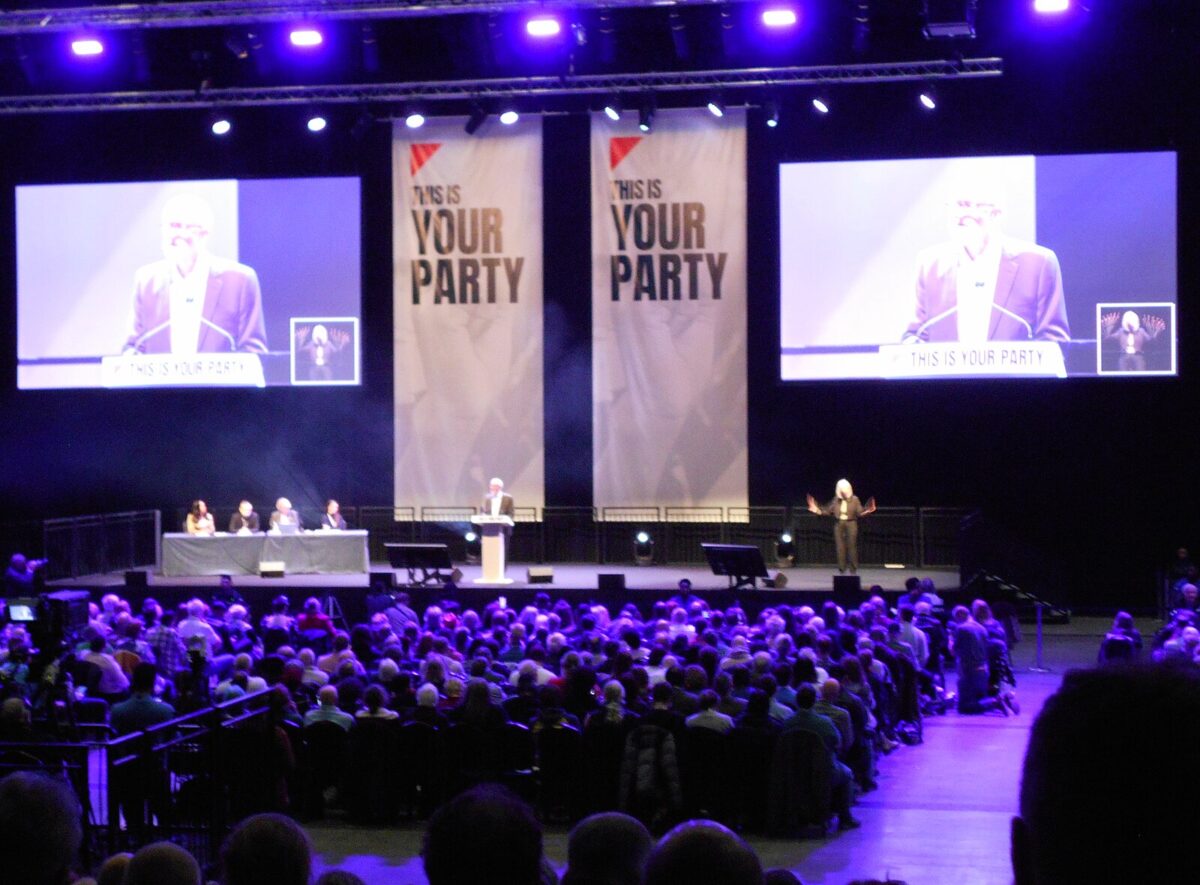
Your Party had a Central Executive, a leadership, and in Corbyn a figure whose public profile ran far ahead of any formal accountability to the members. What it did not have was a branch structure with democratic rights over national decisions. Hundreds of proto-branches built real local presence and absorbed real energy; the membership list sat centrally, and the branches had no claim on it. Freeman named this in 1970 as the star system: the movement ‘has thrown up many women who have caught the public eye’, who ‘represent no particular group’, but who, in the absence of any accountable spokesperson, get treated by the press as the movement’s voice. Swap the noun and you have Your Party’s first year exactly. The proto-branches never chose Corbyn as their spokesman. They had no procedure by which to choose anyone, because none had been built. And when the branches pushed, the leadership’s answer was not to open the structure but to freeze it: ban dual membership, expel the organisers, pull what authority existed further into the centre. Freeman saw that coming too. Challenge an informal elite and it reaches for formal rules, not to submit itself to democratic contest but to institutionalise the arrangement it already enjoys.
The Connections network is the honest case, and I want to be careful with it rather than tidy. It began last autumn as an online discussion group faciliated by the Transform network, and by its own account it did not set out to be an opposition; the conduct of the Many-dominated Your Party executive made it into one. On 6 June it held the first of a promised series of conventions, at SADACCA, the African Caribbean community centre in Sheffield, under the plain banner ‘Where next for the Left?’. No more than a hundred and fifty came through across the day. I was there for the closing session, when perhaps eighty were left in the room, and when the final resolution was put most of them kept their hands down. Read that as failure and you misread it. That many people, spread across that many political directions, cannot manufacture a shared line in a single day, and the thin vote registered exactly that, a real political condition rather than a facilitation problem that better chairing would have solved. Where Freeman starts to bite is at the next stage, the one nobody has reached, when a network that has been carrying the functions of a party without its coordination begins to take decisions that actually bind people, and it is not clear the people convening it have settled how those decisions will be made, or by whom, which is perhaps the most honest thing that can be said about it just now.
The triangle here is old. At the autumn 1978 Marxist Symposium, Celia Pugh put the IMG women’s commission line, a revolutionary party with an autonomous women’s organisation as sister formation; Campbell argued for a party transformed by the autonomous movements; Joan Smith of Women’s Voice argued for a third form independent of both. Revolutionary organisation, facilitated autonomous space, programmatic debate structure answerable to neither. That triangle maps without much strain onto the Socialist Federation, now building toward its September founding congress, the Connections network, and the SEDA today. The 1979 debate settled it that all three forms are necessary and none alone is sufficient. It did not settle which does what, and neither have we.
What the Greens are about to decide
The highest-stakes case is the one growing fastest. Since Zack Polanski took the Green Party leadership in September 2025 its membership has run from around 70,000 to past 220,000, and on 26 February 2026 it broke through at Westminster: Hannah Spencer took the Gorton and Denton by-election off Labour, with Reform second and Labour beaten into third. A large share of the post-Corbyn dispersal, the same layer that handed Your Party its 800,000 addresses, along with much of the pro-Palestine vote Labour had forfeited, has reoriented towards them.
This deserves analysis rather than reflex, and the analysis is Freeman’s. Rapid growth is not democratic accountability. The party grew because Polanski is a compelling media figure with a clear left message, and that is the star system operating at scale. Polanski clearly has a democratic mandate to speak for England’s Greens, but his authority comes from his authentic charisma, and skill as a speaker and media performer.. A party of 70,000 with a settled culture and known informal networks is a different animal from a party past 220,000 that has taken in three new members for every old one in nine months, strangers who arrive with their own expectations of what the surge is for. The informal channels through which the party actually makes its decisions, which candidates get backed and which internal critics get quietly eased towards the door, were shaped under the old conditions and have not been redrawn for the new scale.
The German comparison is not a prophecy, it is a mechanism. Die Linke’s accommodation to the Greens, and the Greens’ administration of cuts in one German city after another, did not happen because the members wanted austerity. It happened because the informal networks steering the party in office answered to nobody who could compel a different course when the fiscal squeeze came. The Greens here do not yet run councils at scale, Mid Suffolk aside, and their stated position is anti-austerity. The warning is prospective. A party past 220,000, gaining ground electorally, led by a figure whose authority rests substantially on media profile rather than on any internal democratic mandate, is walking towards the pressure that has broken every previous left formation to reach municipal power. Its policies will collide with British capital; without revolutionary politics to win that collision, the record says it capitulates when organised capital pushes back. Whether it has built the structures to survive that pressure is a question its new members are entitled to ask now, loudly, before the answer is decided for them.
Freeman’s actual proposal, put to work
Freeman was never against organisation. She was against the mystification of its absence, and her closing section on democratic structuring reads better in 2026 than most of what has been written since. It is usually cited as a list. It is more useful as a set of questions to put to whatever formation you are currently standing in.
Who holds this authority, and by what procedure were they given it? To whom are they answerable, and through what mechanism could that authority be withdrawn? How widely is authority spread, and how often does it rotate, or has it settled on the same handful of capable, available, articulate people it always settles on? Can an ordinary member find out what was decided, by whom, and why, without knowing someone on the inside? Does everyone have equal access to the group’s resources, its money, its data, its platforms, its list of 800,000 names? Put those questions to Your Party and the answers are damning. Connections, asked the same, would say honestly that it has not met them yet and knows it. The Green Party past 220,000 answers with silence, or a membership card. Which is not an answer.
These are not radical demands. They are the minimum conditions for an organisation to be the thing it says it is. The women’s liberation movement did not meet them. Neither did Your Party. The Greens, at their present scale, are not meeting them yet either, and the reason the left keeps failing this test is not mysterious. Informal power is comfortable for those who hold it. The star system is comfortable for the stars. The friendship networks that run things are comfortable for the friends.
Last year, at the People’s History Museum in Manchester, all three authors of Beyond the Fragments, Rowbotham, Segal and Wainwright, now in their seventies and eighties, gave the keynote at a conference marking the book’s anniversary. The questions they had raised in 1979 were still on the table. The left that gathered to ask them had spent four and a half decades producing variants of the same answer, a new network, a new formation, a new vehicle, each with the same invisible structure and the same unaccountable conveners. And somewhere in a room in that building, or one very like it, the people who will build the next formation were taking notes, and some of them were already, without noticing, the friends who would run it.
From Duncan’s substack Red Mole
Sources. Jo Freeman’s ‘The Tyranny of Structurelessness’ (1970) is on marxists.org. Penelope Duggan’s ‘simply masculine’ criticism and her observation on the sexual division of labour are from ‘The Feminist Challenge to Traditional Political Organizing’, IIRE Working Paper No. 33, based on a report to the IIRE Women’s School in 1991 and published in International Viewpoint in 1997. The IMG’s 1979 exchange on Beyond the Fragments, with contributions from Rowbotham, Campbell and Joan Smith, appeared in International vol. 5 no. 1; Lindsey German’s SWP response is on marxists.org.
Ooops! I drafted this article before the May local elections when Mid Suffolk was the only Green majority council. Since May, Green control has expanded to Hastings, Lewisham, Norwich and Waltham Forest. Some other places have hung councils or no overall control, but with Greens inside the administration.
Also, I missed that the Forest of Dean has had Greens in the administration since 2021, and so have Hastings, Lancaster, Lewes and Stroud since 2023/2024.
Spot on article on the ‘horizontal’ mess the left is in and its lack of democratic participation/accountability leading to disillusion and the killing of hope for many. However it ought to be pointed out that the autonomous Women’s Liberation Movement, Black Liberation and Gay Liberation for all their structural faults arose in many respects because the left either ignored the question of oppression or marginalised it in favour of economistic struggles at the point of production. That has to be put together with a profound mistrust of democratic centralism as masking exclusionary ‘male white’ power and authoritarian rule by the few. It probably wasn’t until just after the mid 1970s that oppression was taken seriously by the left having previously deserted the basic Marxist principle that the struggles against economic exploitation and social oppression are indivisible. Hence the highly structured left parties (and trade unions) despite their democratic credentials left no room in which the ‘new’ social movements could participate and breathe. The three authors of ‘Beyond the Fragments’ still believe this to be true. Is it or have the left and TUs progressed since the 1970s? Here are a few notes I made on Sheila Rowbotham’s contribution:
Is The Future Female?
The question raised by Lynne Segal in her book of the same title (Virago 1987) in many ways had already been approached in Beyond The Fragments (1979/2013 Merlin Press) though Segal developed it further. Later the arguments for a new and radical departure from uncritically accepted politics on the revolutionary and reformist left were developed by the authors through a ‘gendered’ lense rather than a pure and simple class analysis. In many respects this approach informed The Care Manifesto, The Politics of Interdependence by the Care Collective (Verso 2020) designed to bring about the complete transformation of ‘our economy’ and society along feminist lines. To simplify things it might be worthwhile to discuss the common ground between the three authors of BTF, Lynne Segal, Hilary Wainwright and Sheila Rowbotham, as three of the main feminists on the left and then discuss possible areas of agreement and disagreement depending on the issues raised and how the ideas of the three authors heavily influenced The Care Manifesto. .
To begin with all three authors share a profound distrust of what they a describe as Leninist forms of organising on the revolutionary left. They see democratic centralism, with the emphasis more on centralism than democracy, as masking authoritarian rule and stifling individual creativity. The parties of the revolutionary left are seen as forbidding, male-dominated territory that works against full democratic participation favouring an elite leadership and discouraging membership especially for women.
All three contrast this ‘vertical’ top-down way of organising with with what they perceive as a more democratic, egalitarian ‘horizontal’ approach. The main organising principles around this way of operating allow for a leaderless consensus to emerge through the political input of decentralised amalgams of different movements that allows for the maximisation of democratic participation and decision making.
Sheila Rowbotham cites the rapid growth of the Women’s Liberation Movement as an example of this way of organising leading to a ‘tremendous impetus to rethink society, the economy, culture and politics.’ The rapid growth of WLM groups in towns and cities launched campaigns on many issues affecting women that neither the rigid ‘economism’ of the ‘Bolshevik’ revolutionary left nor the tepid engagement of the reformist left touched upon. Campaigns were launched for nurseries and collective child care, equal rights at work, free contraception and abortion on demand, family allowances and the establishment of Womens’ Centres against male violence and rape. Rowbotham states that ‘All this had been done through decentralised movement, consisting of small groups without formal leadership structures.’ Consciouness raising groups were also established to explore issues and emotions that prevented women achieving full growth as human beings and to help women to come out loud and proud to express ideas and to take action.
Womens’ Liberation Movement
Overview: Re-establishing libertarian socialist tradition against the rigidities of ‘Leninism’? Feminism = making many aspects of Marxism anew? Impetus to rethink society, the economy, culture and politics.
Structures
Vertical (Leninist/democratic centralist, stifling individual creativity) vs horizontal (leaderless, decentralised ‘movement’, participatory democracy). Refer to the ‘Tyranny of Structurelessness’ for arguments against ‘horizontalism’ but also qualify objections with…..
Question: Does democratic centralism always mask authoritarian rule? With the emphasis more on centralism than democracy?
Organisational autonomy to work with others but also created stuff that the left ignored such as:
Equal rights at work, reproductive rights (free contraception and abortion on demand), family allowances, nurseries, regional and local womens’ centres against rape and male violence, conferences, publishing groups, theatre groups, folk and rock bands, film collectives, trade union caucuses, food Co-ops and so on.
Against sexism and misogyny in all its forms – Miss World Competition, working men’s clubs, discrimination at work, Imprisonment of women in the powerless, domestic sphere where womens’ labour invisible or seen as worthless.
Quote from placard: “If you want to avoid slavery don’t get married.”
Subjective elements – women disadvantaged as oppressed and second class citizens therefore working collectively overcame lack of confidence as individuals. Consciousness raising groups helped women to discover themselves and ‘come out’ fighting.
Prefigurative forms of organising: “Utopia in the bad old world of capitalism.” Yet, an approach that meant the manner in which we organise would affect the way the new society is shaped. Compare Alan Todd’s position on becoming vegans if we are serious about an Ecosocialist future.
Rejection or marginalisation by the left of struggles against oppression.
The struggle against the twin evils of capitalism, exploitation and oppression, are indivisible. Not so with much of the left from about the late 1960s to the mid 1970s.
Some on the left viewed the Women’ Movement as a middle class distraction that militated against the class struggle. They adopted an economistic approach which saw the the struggle of workers economic power with real revolutionary potential to be at the point of production (workplace).
What a mess – well, not quite.
Sheila Robotham did acknowledge that the WM was subjected to the Tyranny of Structurelessness. Not just in terms of a dominating and unaccountable leadership (unofficial hierarchies) but because of the lack of guiding rules meetings would often degenerate into into silences and paralysis through the lack of procedures to decide policies.
Even so sharing ideas and mutual help could be exhilarating and it enabled thousands of women to grow in confidence.
SR saw the WM challenging every aspect of men’s hold over culture, ideas and power as reflected in the language. Language helped to shape culture eg ‘chairman,’ ‘mankind,’ ‘brotherhood’, ‘Yours fraternally’. Women completely excluded.
SR still believes that Leninism inclines to authoritarian forms of organising. She still believes Marxism is a valuable source but not as a fixed dogma. She wants us to consider a pot pourri of traditions in terms of their insights and deficiencies including Lenin, Trotsky, anarchism, feminism, gay liberation and movemens against colonialism and racism.
All of this potentially as a reworking of democracy and society through a gender lense.
6. SR on the word ‘socialism’. “I have identified so profoundly with the word ‘socialsm’ that it is the word I still carry with me; I am aware however that many younger radicals do not. One of my current uncertainties is whether hanging on to the word itself is of value for the future or whether new terms will emerge to fit a new context.”