

(featured image above -The Survivor, Kahlo)
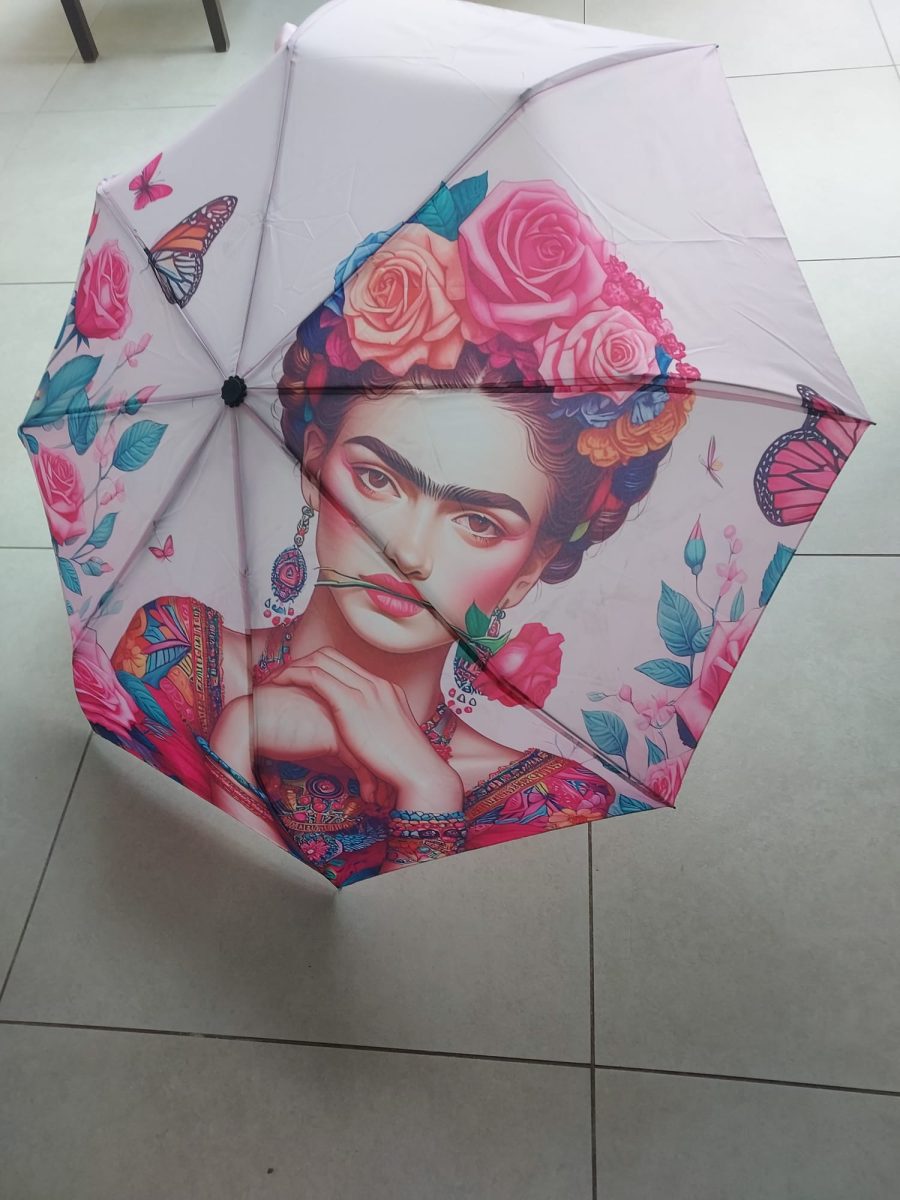
A week ago we were walking in Naples on a very hot afternoon and we saw a migrant worker selling a Frida Kahlo umbrella. A few days ago in Salerno we came across a café in the historic centre that was also Frida themed. There are over 100,000 Frida themed commodities available to buy on line. This show is all about (maybe too much about?) the incredible artistic and commercial impact of Frida Kalho, the great Mexican artist. As the Tate curator said at the press launch she is undoubtedly the modern female artist that has had the biggest global recognition. 50,000 tickets were sold even before the show opened.
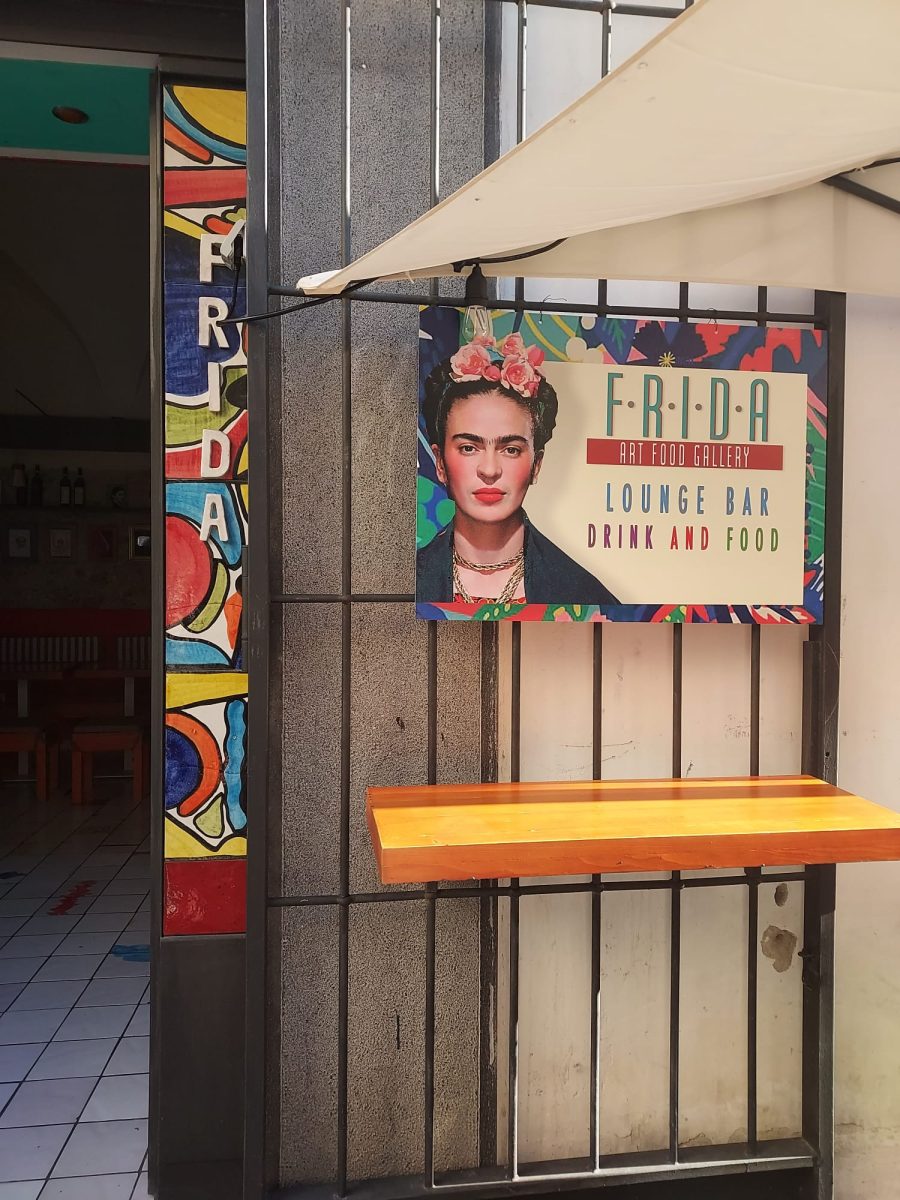
You can understand the appeal. Her extraordinary symbolic pictures – fifty self portraits – and her remarkable life story speak strongly to so many audiences.
Women and feminists relate to her struggle to become an artist independent of her famous muralist husband, Diego Rivera. After her divorce she vowed to make a living from her own work even though she later remarried him. Diego cheated on her more than once including with her own sister. She had her own sexual relationships – including with Leon Trotsky whom she and Diego had courageously welcomed into exile. Her pictures and her life story produce a strong emotional reaction for many people, particularly women. Conservative premier Teresa May had some Frida branded bracelets.
Her fluid sexuality also appeals to gays, lesbians, trans and the queer community. She often posed in masculine clothes. One of the ‘tribute’ pictures reproduces Frida’s double self portrait as two gay men in dresses with hearts drawn on their naked chests.
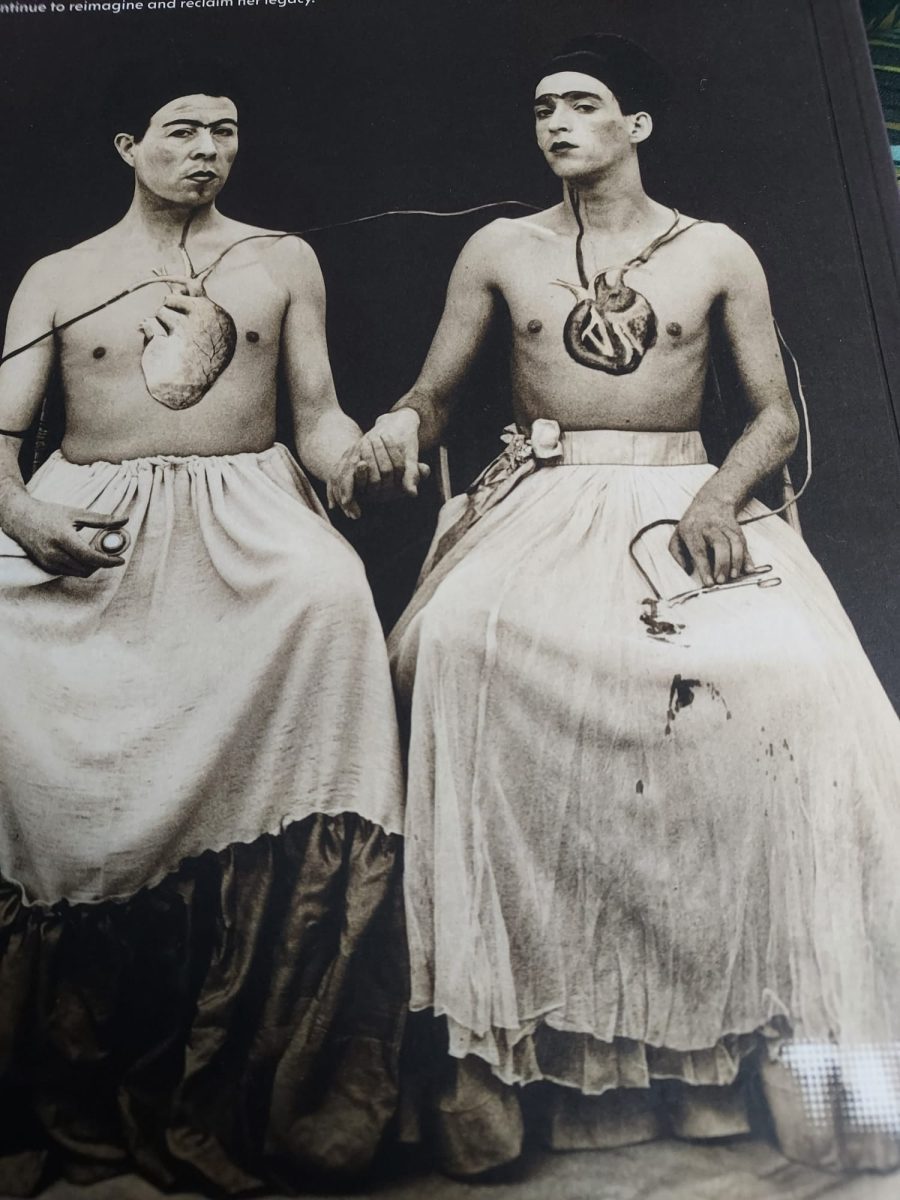
Francisco Casas, Los Dos Fridas
Frida challenged the failure of official and bourgeois Mexican society to recognize indigenous Mexican culture. She often dressed in traditional indigenous garb. The generally progressive and bohemian artistic community often would look to the culture of the European colonialists. We see a whole room in the exhibition highlighting the effect of Frida’s work on the movement for Chicano migrant rights in the USA.
A communist and anti-imperialist
Kalho was a communist who actively opposed capitalism and the hegemony of US imperialism over Mexico. Unsurprisingly people on the left are particular fans. We get little information in the exhibition about her politics. Her positions spanned openness to the small minority of Trotsky’s Left Opposition to her later accommodation to the orthodox Stalinist Communist party.
This political engagement overdetermines all the other emancipatory roles she adopted. The exhibition tends to fragment this commitment into different silos. So she is described by the curators as a fighter against inequality, someone who celebrates Mexican culture, a pioneer for a freer sexual identity and a unique explorer of her own disablement. This tick box approach means the Bank of America has no problem in partly bankrolling the show and even celebrating uncritically the global commodification of her image. A representative from the Bank spoke at the press preview and the handouts include promotional plugs for the Bank and its unparalleled network of ATMs! Frida would surely be turning in her grave.
Her great picture, At the Borderline between Mexico and the United States, done when visiting the USA summed up her attitude to institutions like this bank which contributed to Trump’s inaugural celebrations, does not encourage trade unions and participates in the financial strangulation of Cuba.
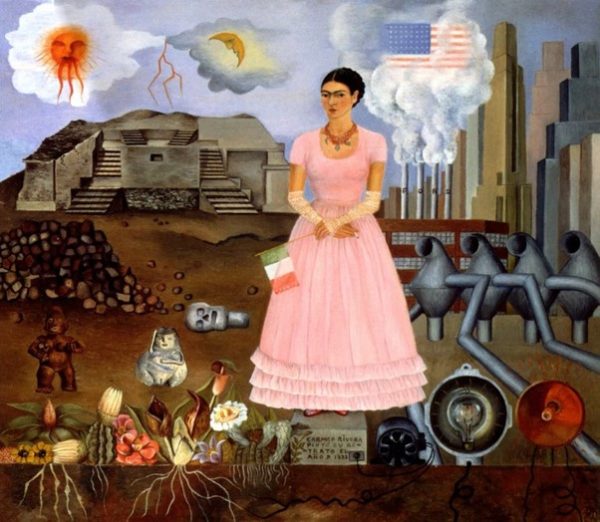
You can read a detailed analysis of this picture in a previous article on this site.
Certainly like the English artist, Tracey Emin, Frieda painted the lifelong pain and disability that affected her from the time of a tragic road accident when she was a young woman. Again this relatively rare artistic treatment of a life long illness speaks to many people suffering from the same situation.
Frida and ‘celeb’ culture
Maybe she is one of the few artists who has become part of what is known as ‘celeb’ culture. You can relate to her and buy the ‘merc’ without really finding out too much about her or her art. I did not realize that there are lots of people who like to dress up as Frida lookalikes! This has not happened much with other artists. Even Tracey Emin did up a lookalike picture.
A Barbie doll was produced but had to be re-issued because it ‘whitened’ her image with light skin, took out the converged eyebrows and left out her traditional Mexican dress. The exhibition tries to deal with this by having a room showing all these commodities but there is not enough commentary or analysis of this phenomenon. Surely some critical texts could have been included.
On the other hand the show does present around 200 works that are inspired by Frida. Some of these are interesting and work in their own right but many are not particularly memorable. It is bit like tribute bands that cover the hits of Abba or the Rolling Stones, it can be a fun night out but it is not the real thing. One work I thought stood on its own feet was this :
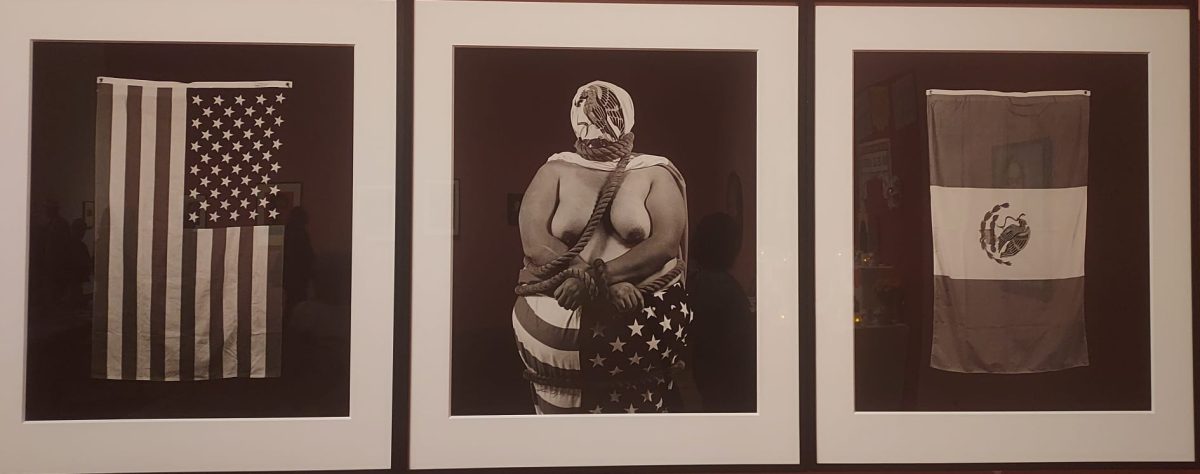
This photo triptych, Three Eagles Flying by Laura Aguilar in 1990 is direcfly inspired by Kahlo particularly the picture we have included above (Self portrait along the borderline between Mexico and the United States). Aguilar, like Kahlo, places herself at the crossroads between the two countries.
‘Chicano, lesbian, large-bodied and dyslexic, Aguilar grappled with her non-normative identities throughout her life, turning to photography as a means to give voice to her immediate community of Latina, queer and brown women’
(Catalogue p 40)
She pictures herself constrained by the ropes of the dominant ideology with her head covered with the Mexican flag and the bottom part of her body with the US flag. This picture stood out from much of the rest of the art inspired by Kahlo.
An intense self portrait
There are around thirty of so works by Kahlo but only a very few are her major pictures. One of the best is a picture she made in 1940 when she had temporarily split from Rivera.
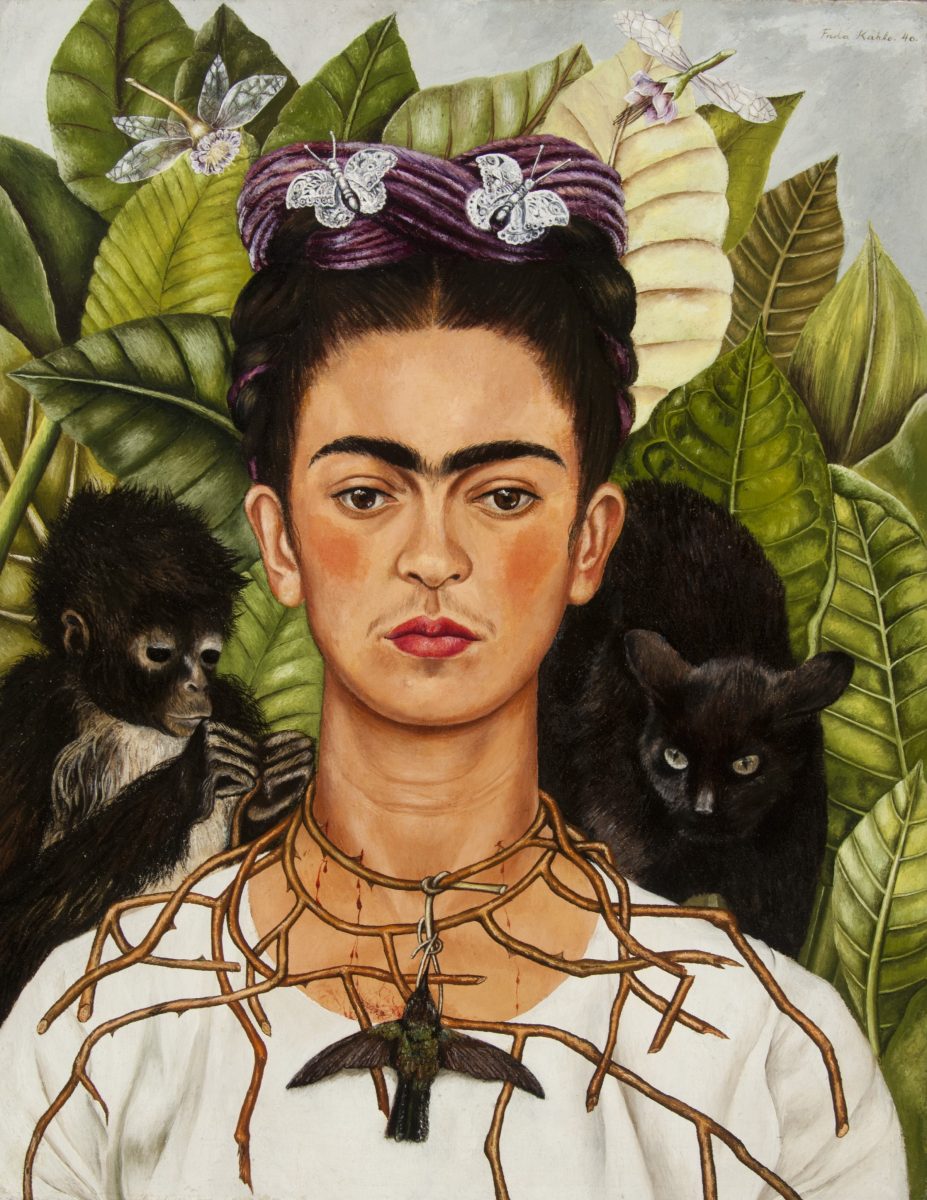
She looks directly at the viewer in a way that replicates the representation of Christ or saints in religious art. The thorns around the neck further reference this. The humming bird refers to a folk tradition in Mexico that symbolizes your desire to win back a lover. The monkey was a present from Diego and represents him but the cat (Frida) is strong and ready to strike back. Like the Surrealists, with whom she had a relationship but never joined, there is a lot of symbolism. . The composition is studied too as your eye links the shape of the humming bird, her ‘mustache’ and her eyebrows. The picture expresses her emotional suffering brilliantly.
There is a very short silent video of Rivera and Kahlo in the show that is fascinating. Diego is standing above her and she is seated. He caresses her cheek and Frida responds and yet does not respond. There is an ambiguity about it that maybe is influenced by what we know about their tempestuous relationship but the tension remains.
Worth a visit
This show is worth visiting but I think it neither shows us much we did not already know about Kahlo nor really explains and analyses the way our society makes her into an icon. Many of the reviews in the mainstream media make the same points (Guardian, New Stateman)The commodification is treated too uncritically in my opinion. We were told by one curator that since Frida wanted to be financially independent of men she would have embraced all this. You can only make that logical leap if you evacuate her actual political identity.
The catalogue is very good and includes lots of things that are not in the exhibition as well as a number of stimulating articles.
Of course there is no need to be snobbish about all the tat. Anything that might make people find out about Kahlo is positive . It is just that you do not need to spend so many resources filling an exhibition at one of our major museums with tribute art of varying quality.
We bought the umbrella.