

Sometime in the early 1970s I remember Brian Slocock standing up during some student occupation and saying that we need to develop our own media outside the control and editing of the capitalists. Brian was right and this film makes the same point very forcibly. Making sure we get the images and films of our protests and of any repressive actions by the state is vital for building the movement. Documenting what we do provides a record of our actions and evidence that we can use politically, or legally in some cases.
The film tells the story of Misan Harriman, photographer and activist. He is the son of a Nigerian Chieftain who became a very rich businessman. On coming to Britain he was sent to a private school and later had a good job in recruitment in the City of London. We follow his personal journey as he rejects that life and takes up photography and becomes more and more active in movements against racism, colonialism and inequality. People can come to the movement for a better world from all sorts of backgrounds.
His passion for his art is evident in nearly every scene as you always see him with his Leica camera taking pictures of personalities and of anonymous demonstrators on protests in three continents. The image of his inquisitive eyes set behind huge black glasses sticks in your mind long after the film. It is a face that inspires trust and empathy. You notice that he generally asks people on demonstrations whether they mind having their photo taken – not something that always happens.
Standing on the shoulders of other great photographers
One aspect of the film is his respect for the great photographers of the liberation movements in the USA and South Africa. He is self-taught but acknowledges their influence on his work. We see many of their classic pictures. We learn about Peter Magubane who took photos of the Sharpeville massacre, the Soweto uprising and become Nelson Mandela’s official photographer. The Apartheid state persecuted him relentlessly and he spent 600 days in solitary confinement. Harriman meets his white assistant who has survived Magubane and maintains his archive.
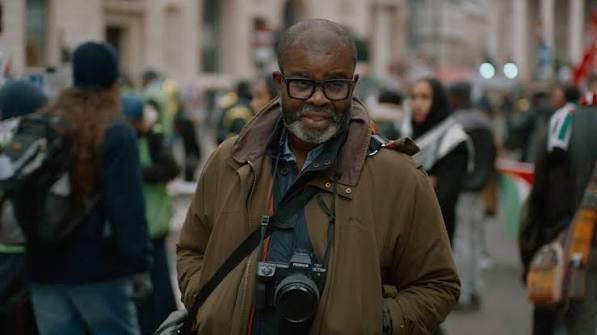
image Rio Cinema
His breakthrough as an activist photographer came when one of his pictures of a demonstrator in a Black Lives Matter protest was retweeted by the son of Martin Luther King. We follow Harriman as he meets King in Atlanta. In each of these meetings we assist at the photo shoot he organises at the end of the meeting.
In one scene Harriman goes to the Oscars ceremony where his short film The After about a man who lost his family in a stabbing spree, was nominated for an Oscar. You seen the tension there between the celebrity world and the movement. He does not deny his sense of achievement in making it to the Oscars and how attractive the glamour is. Yet he still spends time connecting with the pro-Palestine protests there and he shows images of the large number of homeless people in Los Angeles. He did not win the Oscar.
The pro-Palestine solidarity movement is extensively covered in the film. I am sure many people will be looking to see if they see themselves or people they know. You catch the absolute mass impact of the movement. His images focus on the thousands of homemade placards with slogans or comments people have produced themselves. Up close you see how Labour’s complicity with Israel and the genocide has lost a generation of activists.
Resistance is global
Harriman travels to Minneapolis to observe how George Floyd’s memory is honoured. A George Floyd square has been set up and has been maintained every since his murder by the police. A local representative from the NACCP (National Association for the Advancement of Colored People) is interviewed and her photo taken.
Harriman does not cherry pick the protest movements from around the world that he supports – we see images of the Iranian government’s repression of the Women, Life, Freedom protests. He recognises that there has been an increase in people rising up across the globe. Not just for equality but in defence of our planet –there are pictures of Extinction Rebellion actions.
Indeed his support for the Albanian people’s opposition to Jared Kushner’s attempt to buy an area of outstanding natural beauty created a media storm when he mentioned the links between Kushner and the Israeli government and ‘Jewish millionaires’. The tweet was deleted when he realized the use of the religious term, Jewish, played into antisemitic prejudices. However as a result the Zionist lobby campaigned to get his position as the Chair of the trustees of the South Bank Centre reviewed. A defence campaign including a 100,000 strong petition supported by many personalities such as Mark Ruffalo and Gary Lineker responded to the smears. Later he left his post but not as a direct result of this matter.
Trolled by racists
In the film he shares the appallig racist insults he receives on social media. What is inspiring is his continuing resolve to use his art to record the voices of resistance throughout the world. He could easily do a lot more of the lucrative work he has done in the past. Harriman was the first black photographer to do the cover of the British Vogue with pictures of Marcus Rashford and Adwoa Aboah.
What a great title for this film. His images show how the police or army are actually shooting the people. At the same time by ‘shooting’ the people in struggle they help to sustain the struggle.
People are often moved more by images than text. The right picture can also bring down the rich and powerful if it reveals who they really are – just think of Andrew Windsor in that car or Mandelson in his underpants. The picture of the brave doctors or journalists in Gaza can inspire us to fight on. The Left needs to develop its media as an instrument of the struggle. This film shows some of the ways we can do this.