

Source: AntiCapitalist Musings
This is the second time in as many weeks that I have found myself writing about an attempt to discipline a cultural institution.
The first concerned Helen Cammock’s film on Churchill and the Bengal famine at the National Portrait Gallery. The second concerns the Quentin Blake Centre and an exhibition that includes work by Tom of Finland. On the surface they have little in common. One is about imperial history. The other is about queer art.
Look more closely and the resemblance becomes difficult to ignore.
Neither campaign is really about a single artwork or exhibition. Both begin from the assumption that a public cultural institution has fallen under the influence of the wrong ideas and must therefore be challenged, corrected or brought back into line.
The National Portrait Gallery is accused of rewriting British history. The Quentin Blake Centre is accused of abandoning its duty to safeguard children. The language changes. The object changes. The underlying argument does not.
What matters is not simply that a particular exhibition exists, but that a publicly funded institution chose to host it. The institution becomes the real target because it is treated as the place where cultural legitimacy is produced.
Stuart Hall argued that politics is fought not only through elections and legislation but through the institutions that shape common sense. Schools, broadcasters, universities, museums and galleries all help determine what appears normal, respectable and true. It is hardly surprising that they become sites of political struggle.
Read in that light, the Telegraph’s article is more than a report of a controversy. It is an attempt to organise one.
The newspaper calls it “gay pornography”. The gallery does not.
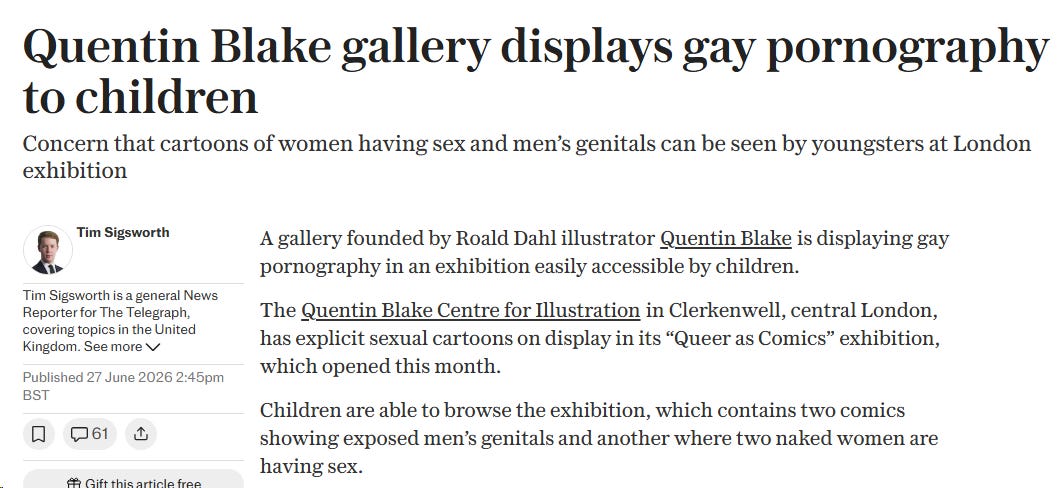
That distinction matters because it establishes the terms of the argument before the reader has encountered either the exhibition or the institution itself. The exhibition is framed first, and only then described.
Lucy Marsh of the Family Education Trust appears as the voice of ordinary parental concern. The article does not tell readers that the Family Education Trust was, until recently, the Responsible Society, a conservative Christian lobbying organisation with a long history of opposing sex education, LGBT inclusion in schools and abortion access.
Within hours of publication the organisation was circulating the article through its own channels, adding a question omitted from the Telegraph’s account: “Why is it that the word ‘queer’ seems to mean that normal safeguarding rules need not apply?” The post was quickly amplified by Max Steiner, Chair of Christian Democracy UK.
Family Education Trust@FamEdTrust

The article did not end with publication. It immediately became part of an existing political campaign.
Hall argued that ideology rarely succeeds by inventing anxieties. It succeeds by reorganising them.
Parents do worry about children. Public institutions should think carefully about how they present adult material. Safeguarding carries genuine moral authority. None of those concerns is fabricated. The political work lies in connecting them to something else.
That is what happens when the phrase “non-contact child abuse” enters the discussion.
It is not a recognised safeguarding category. It borrows the authority of safeguarding while shifting the argument onto different terrain altogether. The Family Education Trust’s own intervention identifies no specific safeguarding failure, no child put at risk and no curatorial breach. It identifies the presence of queer culture within a public institution.
Tom of Finland, Touko Laaksonen, appears in the article almost as though he were some marginal provocateur. His work is held by the Tate, the Museum of Modern Art in New York and the Victoria and Albert Museum. To argue that a book of his drawings on a gallery shelf constitutes child abuse requires a definition of pornography that reaches far beyond this exhibition. The Telegraph never quite makes that argument. It merely invites the reader towards it.
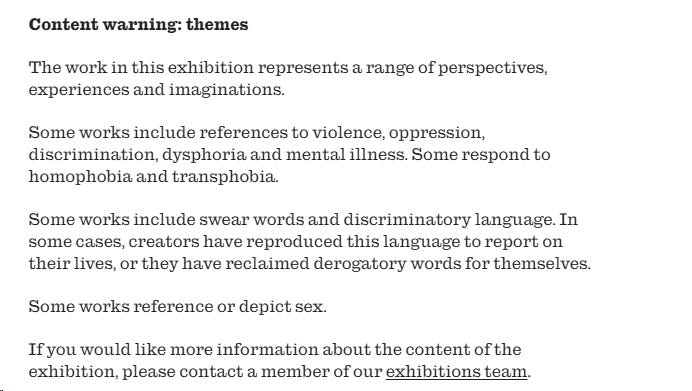
Buried beneath the campaign is a genuine curatorial question. Quentin Blake’s reputation rests primarily on his work for children, and the centre built around his archive invites families to treat it as a children’s space. That creates a real tension when an exhibition includes explicitly adult material. The gallery used content warnings and required under-14s to be accompanied by an adult, standard practice across the museum sector. Whether that is enough in an institution so strongly identified with childhood is a legitimate matter for discussion. It is simply not the same question as whether queer art should be excluded from the institution altogether.
It is simply not the question the article is most interested in answering.
The real proposition is broader.
Queer cultural expression is presented as inherently suspect wherever children might encounter it, and institutions that choose to display it become suspect by association. Once that proposition is accepted, the details of this exhibition matter rather less than the precedent it establishes.
Seen this way, the Quentin Blake Centre is not an isolated controversy. It belongs to a wider politics that seeks to define which histories may be told, which identities may be represented and which institutions deserve public trust.
That is why it echoes the campaign against the National Portrait Gallery.
Churchill and Tom of Finland are not really the story.
The story is the struggle over the institutions that shape Britain’s cultural common sense.