


Eric Tucker left school at 14. He became apprenticed as a sign writer but gave that up to work in a series of unskilled jobs until ill health stopped him working. He lived at home with his mother for nearly eighty years, he never married nor had children. We only know of one brief infatuation with a woman. He was a professional boxer for a few years. Although he spent a lot of time in pubs – often the roughest ones – and had hundreds of acquaintances and occasional friendships, he did not really have close lifelong friends. He was the main carer for his mother for many years. His constant companion was his art. From the outside he was always with people but he guarded his total independence and did not let people get too close.
Eric took up oil and water colour painting but kept his family away from his work most of the time. He painted all his pictures in the small front room and guarded them jealously from the outside world. Only once did he submit a painting to a local open show. He had no formal training as he missed out on the slight opening up of the world of culture to working class people in the late 1950s and 1960s. As he neared the end of his life he intimated to his family that he would like an exhibition. Sadly he died before that was possible. The local Warrington art gallery did not respond. Undeterred his brother and nephew resolved to mount an exhibition in the house he had lived in all his life. To their astonishment they discovered around 500 paintings.
The exhibition was a big success as local people and some people from the art world queued to see it. Eric got his exhibition at the Warrington art gallery a year or two later. Since then his work has been shown at several private art galleries and prints of his work do sell. You can see a fair bit of his work and get further background at the Eric Tucker website where we have taken the images in this article.
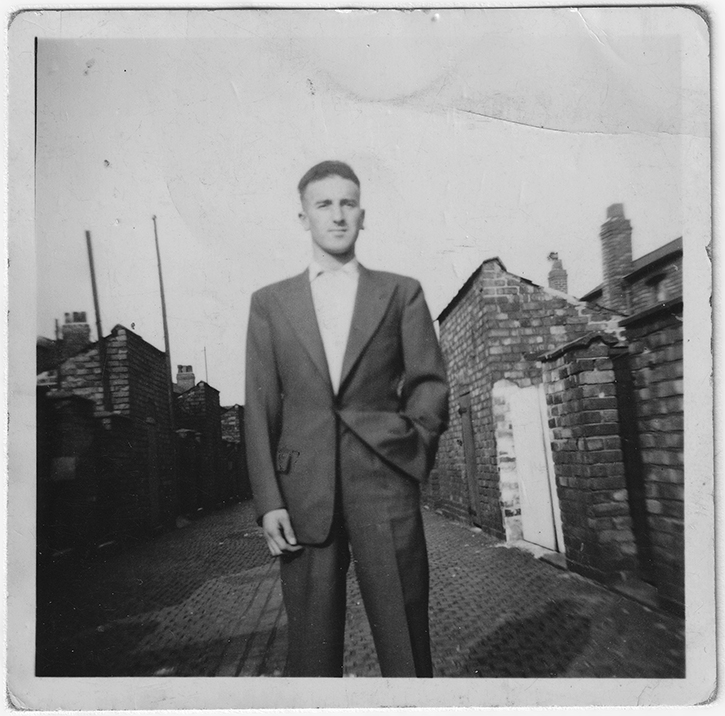
His nephew rescues Eric’s work
His nephew Joe Tucker wrote a book, The Secret Painter, about his uncle in 2025 which was made into a BBC 4 Book of the week in 2025. You can listen to it here. I discovered Eric’s story after a relative (thanks Val) recently gave me a copy to read. It is a terrific read. Joe, who has written TV shows like Black Ops, grew up with his uncle and shares his intimate memories about this unconventional and cantankerous man. For the young Joe all those traits that sometimes antagonized his family and the local community – his shabbiness, drinking and abrupt manner – drew him closer.
The book tousles with the big question of why such a creative painter never really tried to promote or share his work. Why did he never leave his mother and the family home? Why did he persist in doing unskilled work when he could have learnt a trade like a sign writer? Why did he appear never to have any intimate relationships? Losing his birth father when young and his treatment in the army were elements that led him to keep himself independent and to enjoy what he called the real ‘rough’ world of working class life in the pubs, bookies and fairgrounds. He distrusted the middle class and even, to a degree, those working class people who wanted to better themselves and move away from his world.
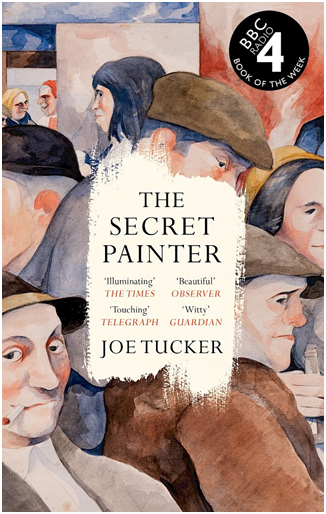
There is quite a bit of detective work in the book where Joe Tucker seeks out some of the people who knew him better. He even manages to contact the woman who Eric became enamored with on a holiday to Paris. She recounts that ‘she was not romantic for him’ although the writer does not entirely take her account as the absolute truth. I suppose what makes the book a great read is that there are probably people in all our families that we do not really know as well as we might
How the class system crushes talent
What the book does well is to show how Eric’s story exposes two things about the class system. On the one hand it shows that artistic talent and creativity abounds among the working class. Eric taught himself, went regularly to art galleries in Manchester and he read books on art. Eric is not unique there are many Erics who have extraordinary gifts. On the other hand the system does not facilitate the emergence of everyone’s talents. Joe Tucker makes a good point when he says the TV world he works in is probably not any more open to working class talent than it was 30 years ago. As socialists we believe we can build a fairer more beautiful world because a revolution would release a multitude of talents. The capitalists talk of entrepreneurial expertise and the need for elites, we know the human capital to change the world exists out there already.
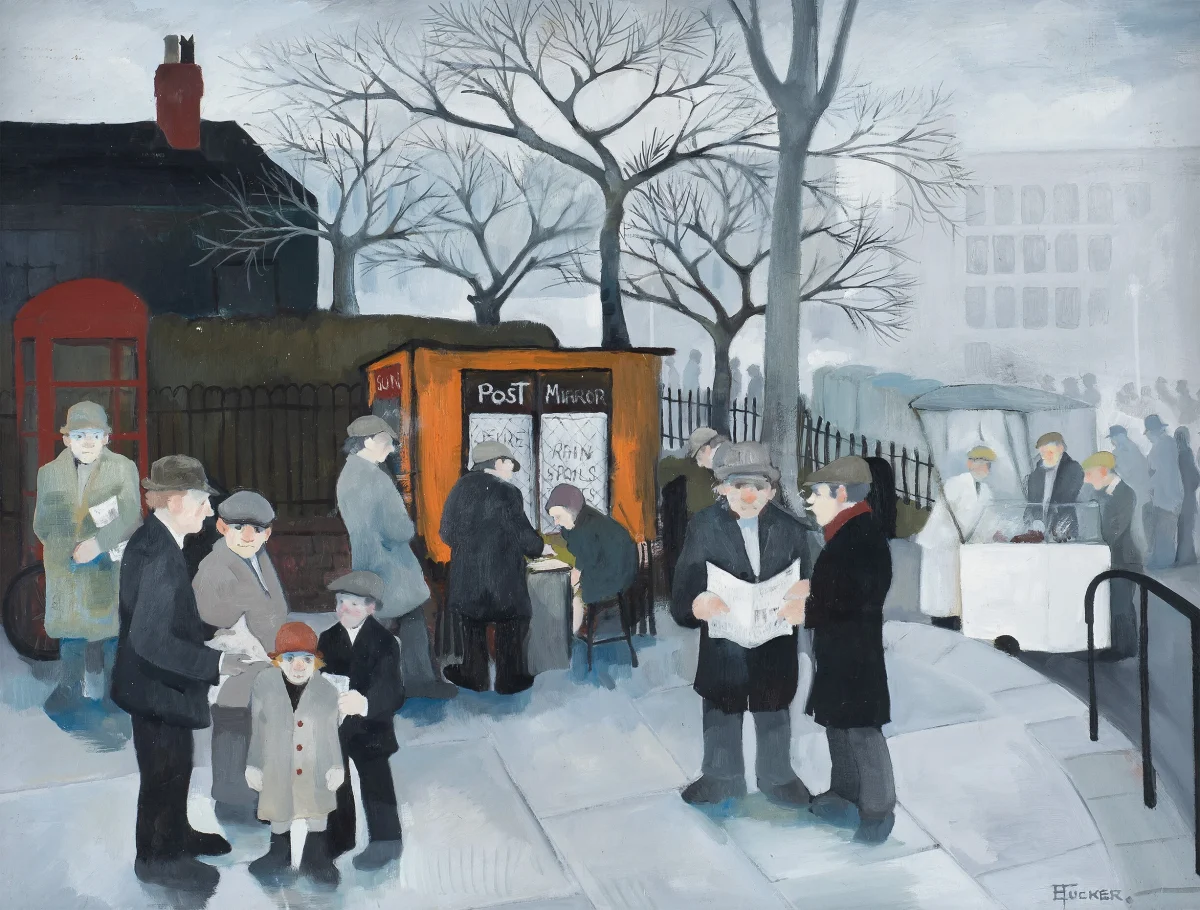
Let us look at his art. Eric paints us a world that is mostly lost. His method was to sketch on any odd bit of paper below the table so people would not know he was working. He takes us inside the smoky warmth and beery smells of your spit and sawdust pubs. We are in the middle of people watching kids play cricket in the streets of terraced houses. The live entertainment of football stadiums, pub bands, boxing bouts, bookmakers, circuses and fairgrounds made up a working class communal leisure experience that is so distant from the increasingly individualized and commodified spectacle we endure today .
Tucker was no Lowry
Many people have compared him to L S Lowry the famous painter of ‘matchstick’ people who chronicled the world of the working class. Lowry was a rent collector and was not really a member of the working class in the way Eric was. I think this is reflected in the art too. Lowry’s work atomises the working class and these figures are mostly part of the landscape. There is no real detail of their faces or of their personality. Tucker on the other hand brings you right up close. You feel you are in the pub, you smell humanity. If you look closely you can see the incredible variety in the people Tucker paints. His composition is much more complex than it looks at first glance, it allows him to give real depth, even a sort of 3 D effect. His painting is much more colourful and vibrant that a lot of Lowry’s.
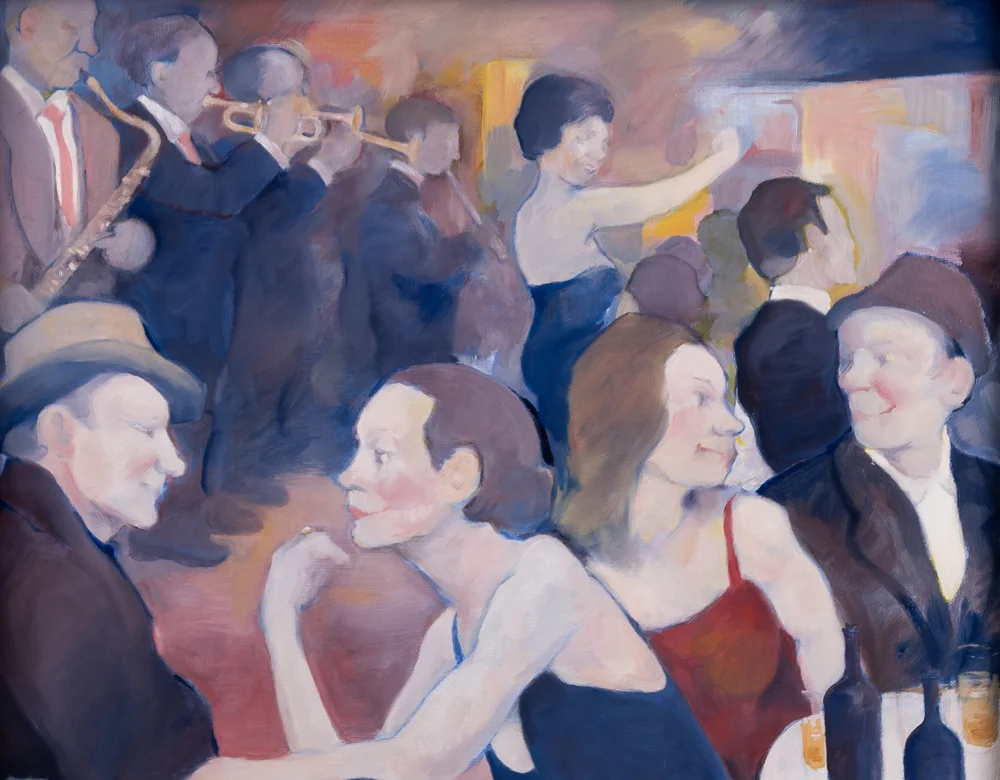
The picture below is just such cinema. Your eye goes to the jazz band at the top left of the picture. The yellows and amber hues convey the warmth and heat of the venue. Then you look at the central focus of the female singerin he centre of the picture. But wait, right in the foreground you have two couples with their eyes entwined in each others. Have you seen a better image of people in love? The way he develops the compositional lines in this picture is sheer genius. A joyous celebration of having a good time, people in love. You just do not get much of this in a lot of Lowry. You could compare Tucker’s art to Degas or particularly Edward Burra. The latter also painted in the demi monde of clubs in France and elsewhere. You find the same empathy with ordinary people. If you look at some of northern gothic renaissance or baroque Caravaggio paintings you get a similar rich feast of humanity close up.
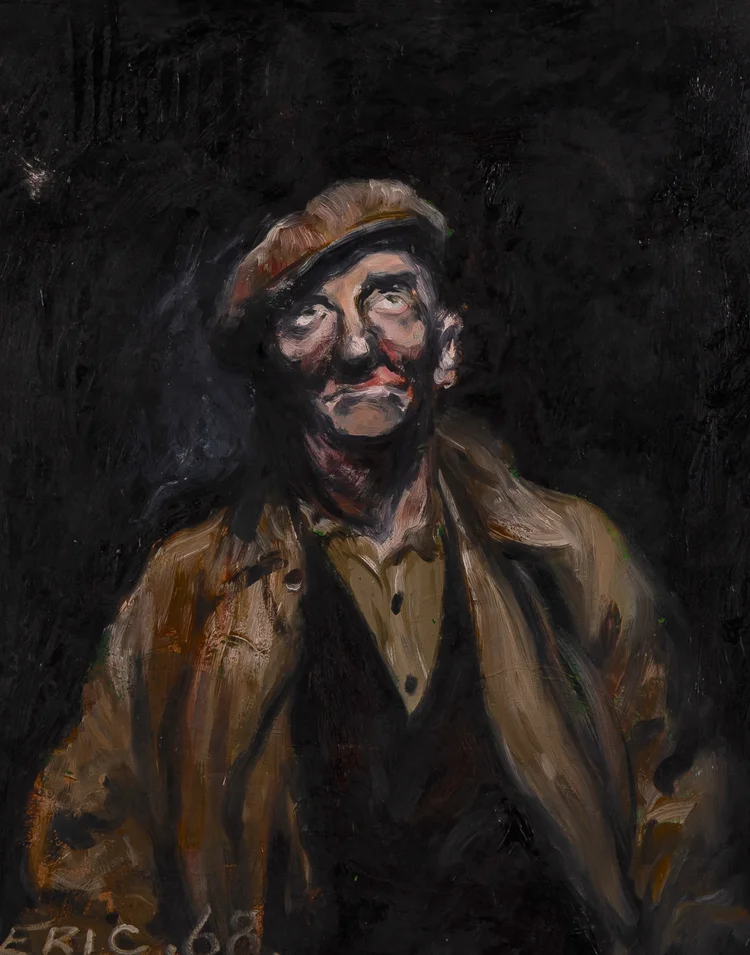
Tucker would assiduously collect images from magazines. Occasionally he would work up a pointing from them. He found a great photo of a miner and produced this:
A different horizon
It captures the reality of a miner’s life without any sentimentality. The sheer filth of your daily work is shown on his skin and clothes. He stands upright and strong and his gaze is upwards, to the light and the relief of the surface. Most miners never romanticised the daily grind and risks involved. The technical command of all these dark shades reflects the painter’s skills.
Certainly the world he painted no longer exists even if a sense of community at work and play still survives. Thatcher’s destruction of these communities that Blair refused to reverse has meant working class identity as a class has been severely weakened not just politically but also objectively and culturally. When Burnham uses the slogan the ‘politics of place’ he may not have the solution but he certainly is pointing to a real issue. In places like Warrington where Tucker lived young people tend to leave and the failure of Labourism to offer real change has meant the advance of the far right Reform and Restore. Eric Tucker’s life and work expresses a different potential.
All pictures are from the Eric Tucker website.