


[An extract from Jaime Pastor’s article written on 4 October for Viento Sur that provides some of the political background to the present crisis].
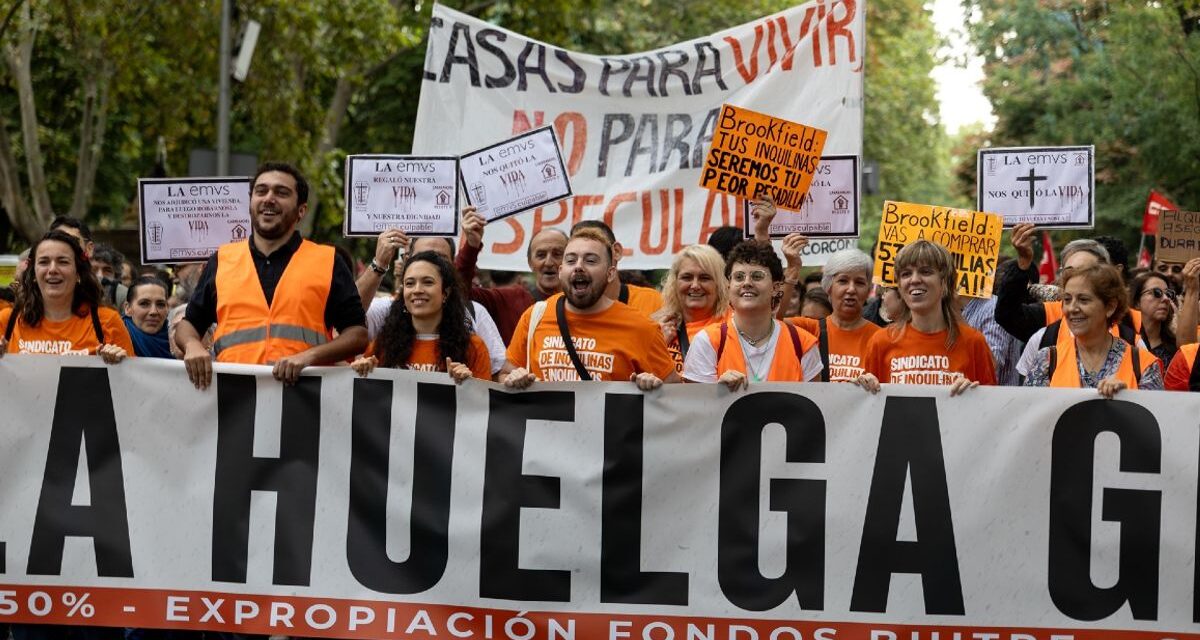
The history of the class struggle is full of moments and events that mark a turning point and act as catalysts for mass protests and uprisings that expand the realm of the possible. This time, the political and social landscape in the Spanish State has changed radically in the space of a week. the demonstrations and, above all, the sit-in in Sol Square, which began on 26 September in the wake of the outrageous eviction of 87-year-old Maricarmen, have turned into a social upheaval. It marks, as the Tenants’ Union rightly asserts, the beginning of “a new political cycle coming from below”.
On this occasion, the movement for decent housing has taken centre stage, becoming a focal point and meeting place for the various struggles unfolding on different fronts – such as education, feminism and environmentalism. As well as in the labour sphere, in the anti-racist and anti-fascist struggles, and in those confronting the many different forms of precariousness in our lives.
Clear evidence of all this is the convergence of activists from a wide range of social and political groups and generations at the protest camps. They have become genuine meeting places, as well as at the demonstrations that are spreading to many different locations. This social and political upheaval is even having an international resonance.
A new 15M Indignados movement?
There is much talk of the 15M movement of 2011 as a precedent, and undoubtedly the most obvious symbolic link is their shared origins at the Puerta del Sol in Madrid. But we must remember that in 2011 the international context and the trigger (the Great Recession of 2008 and the austerity measures imposed by the troika and Zapatero), as well as the characteristics that defined that generation, were very different from those of today. Although there is a thread of continuity in the struggle for decent housing, which was already one of its main aspirations back then.
At this historic moment, following the failure of social liberalism and left-wing populism, and against the backdrop of a worsening eco-social and climate crisis we see rise of a reactionary and ultra-liberal authoritarianism. It is the dominant international trend that must be combated and finds its ultimate expression in the genocide in Gaza. In the face of this, we are witnessing encouraging signs with the emergence, at long last, of new forms of resistance and new social and political actors. Their discourse and demands challenge, to a greater or lesser extent, not only a political regime or the far right, but also a form of capitalism that preys on all living things. This is reflected in the many outbursts of protest led by Generation Z in different parts of the world, as well as in the new processes of re-politicisation that go beyond a mere struggle for the political regeneration of the system.
Upsurge on housing now a political crisis
It is precisely this path that is now being embarked upon here and now in this new political cycle ushered in by the housing movement.
One need only stroll along Calle Maricarmen, Avenida 26 de Septiembre, or the Komuna de Sol, or read the slogans on banners—such as ‘Make Israel Palestine Again’—that dominate the Madrid encampment. As well as witness the example of self-organisation centred on a new way of living together within these encampments, in all their diversity, to see this symbolic convergence of radical and even revolutionary ideas.
The defeat of the two ‘minimum standards’ decrees tabled by the social liberal PSOE led coalition government in Parliament on Friday 30th have been yet another drop that has further overflowed the cup of indignation and anger sweeping through the movement. It has also confirmed that the much-heralded surprise of Junts (Catalan nationalist formation) voting against them – despite the concessions the government made to their demands in its (false) defence of small property owners – was no such thing. Junts understood very well that the struggle over housing is a class conflict and could not afford to abstain, as this might alienate the rentier capital that supports it.
[The following is Jaime’s most recent article published in Viento Sur yesterday on 10 October]
Today, the rentier class has dealt the final blow to our comrade Maricarmen Alicia del Río
This statement from one of the spokespersons for the Tenants’ Union – the organisation that stood by Maricarmen in her fight against eviction right up to her final day – expresses in the strongest possible terms the shock her death on 7 October has caused amongst a broad and diverse majority of society; even beyond the borders of Spain. The cruelty and relentless, rumour-fuelled hostility shown towards her by both the vulture funds and the reactionary political, judicial and media bloc have been completely unmasked, leaving them with no excuse whatsoever. The anger and outrage that have been evident in the protests against her eviction since 23 September have now reached unprecedented levels and provide even more reasons, if that were possible, for the continuation of a movement that grows stronger by the day. This is already being demonstrated in the camps and in the new acts of solidarity across the country with the woman who has become a symbol of the movement. In all of these, as was written from the Sol Camp:
“Maricarmen has been and will remain a symbol and an example for all of us, for the protest for decent housing and for continuing to organise in defence of our rights. She has been the spark that has ignited this unstoppable fire of struggle”.
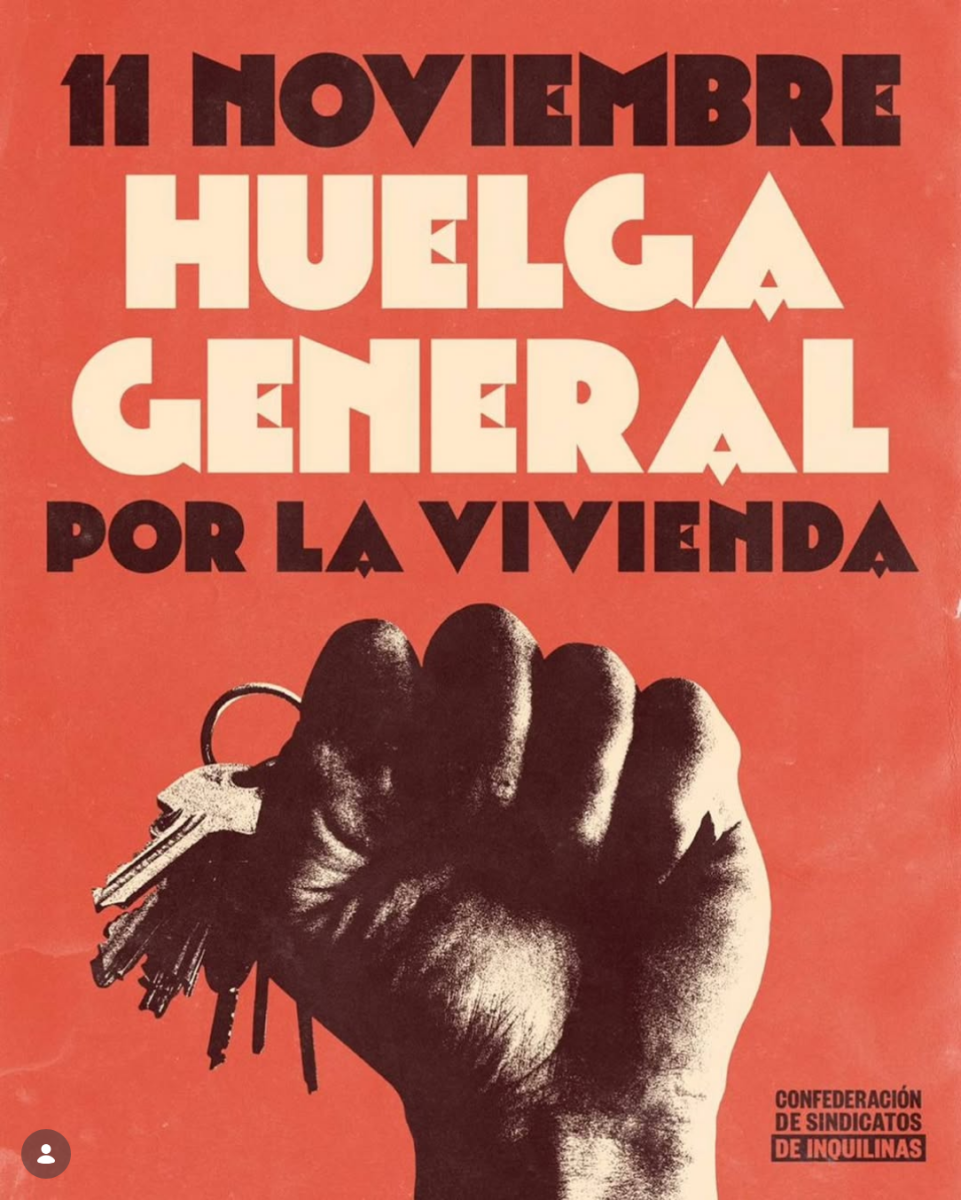
This harsh and sad news came following Pedro Sánchez’s decision to call a general election on 29 November, convinced that the social upheaval over housing could offer him the best possible opportunity to remobilise the left-wing electorate and counter the forecast—shared by virtually all the polls—of an absolute majority victory for the right wing PP-Vox coalition. It also coincides with the support of virtually all national and regional trade unions for the Tenants’ Union’s initiative to call a general strike, already agreed for 11 November.
Sanchez seizing his chance?
Sánchez’s final decision to bring forward the elections was already practically inevitable following Junts’ rejection of the first housing decree and with no hope whatsoever that the presentation of the national budget would secure a parliamentary majority. Sánchez must also have taken into account that he was unlikely to face a more favourable situation in the coming months, given that inflation continues to rise (currently 4.9 per cent) and that the legal harassment involving him (the Zapatero, Leire Díez and family cases) shows no sign of abating. That is why he chose to announce the snap election in a speech in which he once again employed anti-elite rhetoric and boasted of some of his moderate social measures, or of the favourable figures on economic growth. However the fact is that these continue to stand in stark contrast to the worsening material living conditions – and, above all, wages, housing and prices, not to mention healthcare and education – of the majority of the working class.
Furthermore, Sánchez has chosen to re-approve, with some amendments, the two decrees 1 that were repealed in Congress, in the Council of Ministers, with the aim of ensuring that at least the first is approved by the Standing Committee of parliament within a month. He thus aims to demonstrate that he continues to acknowledge the pressure from the housing movement, seeking to present himself as an ally of the movement in the face of the PP, Vox, Junts and UPN (Union of the Navarrese People).
Comeback won’t be like 2023
However, it will not be as easy for him to stage a comeback as it was in July 2023; any such comeback would now have to be much more significant, as the advance of the right-wing parties – primarily Vox – appears to be virtually irreversible. Added to this is the fact that disaffection with the PSOE-Sumar coalition government has increased substantially amongst many working-class people as a result of many of the policies it has implemented or failed to deliver – relating to housing, but also to the repeal of the ‘Gag Law’ (restricting protest) – during the eight-year parliamentary term.
The response from the right wing PP and far right Vox to the snap election was not long in coming, despite their initial bewilderment, as – until Maricarmen’s eviction – it was the crisis in Ceuta that offered them the best backdrop for their racist campaign and their electoral prospects 2. Feijóo, PP leader, has nevertheless expressed his satisfaction, as he now sees himself, ‘at last’, as the future Prime Minister. Even so, he does not seem entirely convinced, as he has once again resorted to raising the alleged ‘risk’ of electoral fraud, following in the footsteps of Ayuso and Vox as loyal vassals of Trumpism. That said, the PP leader is hardly ever heard speaking of policy proposals, beyond wanting to repeal everything progressive that Sanchez’s government may have done, He obsesses with proclamations against sick leaveand using slogans such as “PSOE or democracy” or “Spain against the PSOE”.
Reactionary threat if right wins
But, once again, it is former Prime Minister Aznar who has spoken most clearly, attributing a momentous significance to the 29 November elections. He goes so far as to claim that these are the most important since the Transition (from Franco’s fascism) because the future of the 1978 regime, with the monarchy at its head, is at stake…
As for Vox, its proclaimed pillars of ‘national priority, deregulation and remigration’ leave no doubt as to what its aims are should it come to power: to impose a racist, anti-working class, sexist, climate-change-denying and ultra-liberal policy. This is now confirmed on a key issue: the pension counter-reform, which has already been announced by that sinister figure, MP Figaredo – the very man who called for a ‘hunting down’ ofa migrants in Ceuta. So, what lies in store for us if these parties come to power against a backdrop of the rise of the reactionary International – as we are currently witnessing in Germany and Brazil – is a veritable counter-reform on the political, social and cultural fronts.
Furthermore, the call for elections has come amidst a dispute amongst the forces to the left of the PSOE at a national level that have governed alongside that party.
Disputes among PSOE’s coalition partners on the left
The dispute centres on who will lead the Sumar coalition – now renamed the Frente Amplio – and whether or not an agreement with Podemos is possible. As the polls predict, the potential electorate for this bloc has shrunk considerably over the past eight years and is likely to be even smaller if they stand separately. PSOE support or abstention would increase. Elsewhere, there are the pro-sovereignty left-wing parties at regional level (such as EHBildu, BNG, ERC, Compromís, Chunta Aragonesista and Adelante Andalucía), with a genuine regional base, which will stand under their own party names. It remains to be seen what programme and what rhetoric they will adopt, in order to assess whether they reflect a desire for political reorientation following the greater or lesser degree of subordination they have maintained in relation to the PSOE up to now. Special cases are those of Adelante Andalucía, which advocates an anti-capitalist form of Andalusian nationalism, and the CUP, whose national leadership has decided not to stand, although this decision must be ratified in an internal referendum.
Furthermore, what is also becoming apparent in these mobilisations is the emergence of a new generation of social and political activists who, together with significant sections of earlier generations, are expressing a new process of radicalisation that urgently calls for a radical Left independent of the still-hegemonic socio-liberalism 3.
Preparing and organising the General Strike
In any case, the preparation for the General Strike on 11 November requires the greatest possible unity of action in setting up neighbourhood committees, workplace and student committees throughout the country, as has already been proposed by the Tenants’ Union and other trade union, feminist, environmentalist and social organisations in general. It must be, as was successfully proposed for the feminist General Strike on 8 March 2018, “a strike by workers, care workers, consumers and students”. Although its reach in factories was limited at that time, as the mainstream trade unions only called for partial two-hour walkouts.
There are therefore sufficient grounds to be confident that the agreement reached regarding this call will pave the way for a virtually total strike – an unprecedented event on the eve of an election campaign. This process is also taking place against the backdrop of a likely European ‘hot autumn’, the likes of which we have not seen for some time, as we are already witnessing in France and Belgium.
Obviously, there are different currents and strategies within this bloc and, therefore, we must strive to prevent any exploitation for electoral gain. We must ensure that this call for action is underpinned by shared objectives which, building on the demands for decent housing, fair wages and reasonable prices, go further and takes on a rent-seeking, speculative and predatory form of capitalism.
This mobilisation must not remain indifferent to the threat posed by an electoral victory for the right, which we must confront with all our collective strength. But we must also do so by upholding the movement’s autonomy, as well as its determination to continue the struggle whichever government is in power, at any level, both before and after 29 November. This is all the more important given that the main powers over housing lie with the autonomous communities and local councils, the majority of which are governed by the PP, in many cases in coalition with Vox.
We are entering a decisive few weeks. The growing belligerence on the part of the reactionary bloc, employers’ organisations and the lobbies of rent-seeking interests (all the more so given their proven capacity for blackmail, as demonstrated in the case of Junts) will not waver in their use of every possible means of dirty warfare to prevent the General Strike from becoming a success capable of altering the current balance of power.
Footnotes
1. On some of the limitations and contradictions of these decrees and the need to “ban the purchase of property not intended for habitation”, see: “Housing: an unsustainable situation”, Gloria Marín and María Gómez, viento sur, 3 October 2026, . For a historical perspective on the Spanish property market, the 1997–2007 bubble and its consequences up to the present day: “Urban planning with bubbles, the boom in deals and the decline of planning”, José Manuel Naredo, viento sur, 7 October 26. Also, “Goosebumps: The exodus of vulture funds, deregulation and housing”, Fátima Martín, Viento Sur, 10 October 26. ↩︎
2. An election poll, carried out between 7 and 8 October and published in El País on 9 October – that is, after Maricarmen’s eviction and the calling of a snap election – gives 50.8 per cent of the vote to the bloc comprising the PP (31.9 per cent) and Vox (18.9 per cent), whilst the PSOE obtained 28.1 per cent, Sumar 5.3 per cent and Podemos 2.3 per cent. This would give the PP and Vox a combined total of almost 200 seats, whilst the progressive coalition would fall short of 130. To the latter figure must be added any seats that may be won by non-state left-wing political forces, but even so, the gap remains far wider than it was before the start of the 2023 election campaign. ↩︎
3. Even before the ‘Maricarmen effect’, there were already polls pointing to this trend: “Left-wing voters are moving further to the left in a Spain that is turning to the right”, Público, 19/09/26.
Subheadings added by ACR editors, Translation by ACR↩︎